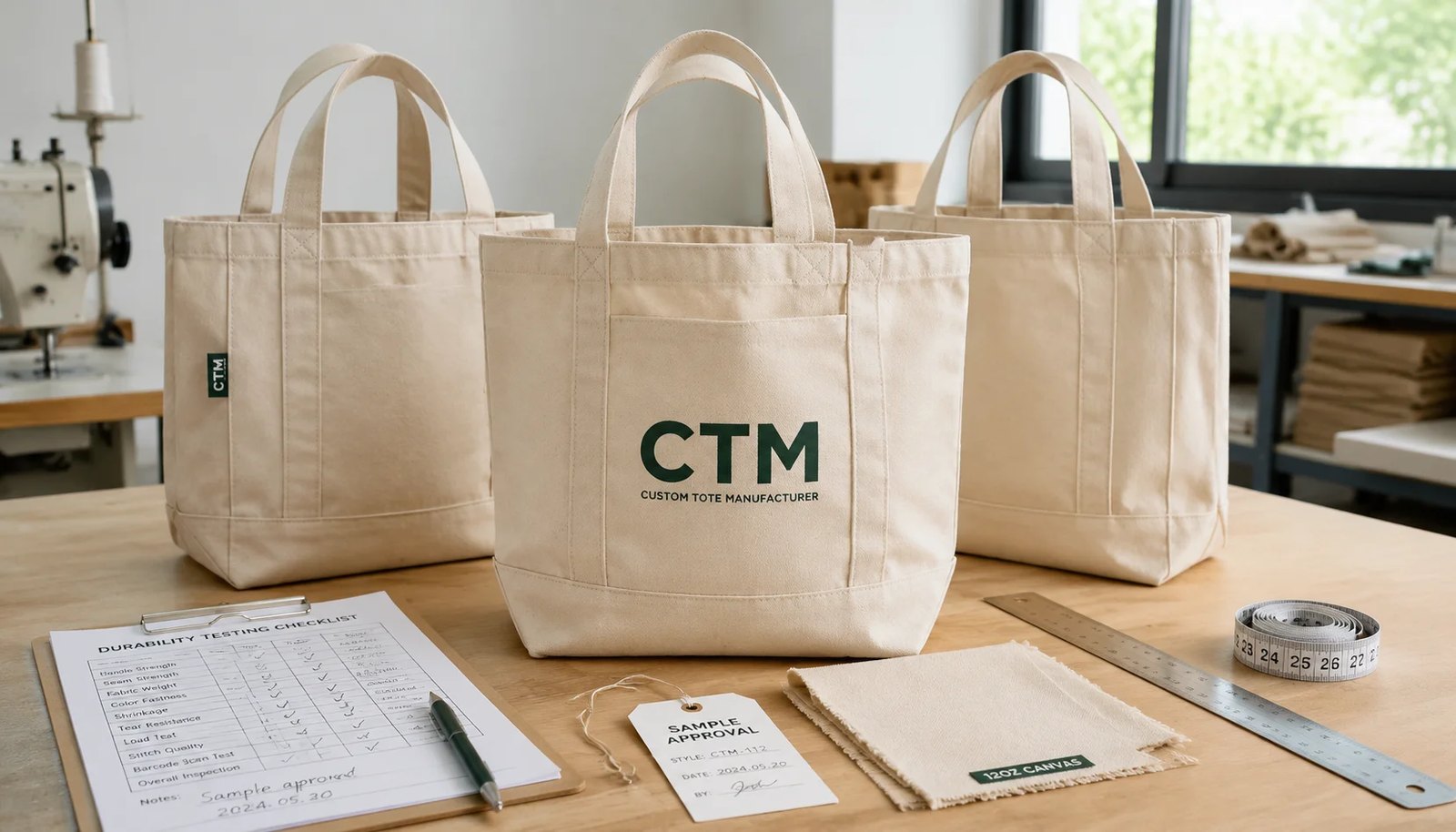
Start with the grocery load, not the tote label
Natural grocers buy reusable totes for a different job than a trade show buyer. A grocery tote is lifted repeatedly while carrying jars, produce, cartons, frozen items, bottles, and uneven shapes that press into corners. The bag is handled at checkout, carried to a cart, moved into a car, unloaded at home, folded, stored, and reused. The durability question is not whether a sample can look attractive on a table. The question is whether the same construction can survive repeat handling without handle failure, seam opening, print damage, or obvious shape distortion.
This is why the RFQ should describe the use case before it describes the artwork. A supplier can quote a canvas bag that is technically reusable but still too light for regular grocery duty. Another supplier may quote a heavier canvas but use a weak handle attachment that fails earlier than the body fabric. Procurement teams get better comparisons when they define expected load, bag shape, handle construction, testing method, and packing requirements in the first quote request.
For wholesale canvas grocery totes for natural grocers, durability is also tied to brand perception. A natural grocer customer may pay for the bag or reuse it as part of a sustainability habit. If handles stretch, seams pucker, or the print cracks quickly, the issue becomes a retail-quality problem, not only a promotional-product problem.
- Define whether the tote is a paid reusable bag, free promotion, loyalty item, or store operations bag
- Assume mixed grocery loads create more stress than evenly distributed flat merchandise
- Treat handle attachment and top hem strength as primary durability controls
- Ask suppliers to quote against a written use case instead of a generic canvas tote description
Compare 8 oz, 10 oz, and 12 oz canvas with a finished-weight basis
Canvas weight is useful only when all suppliers quote it on the same basis. Some quote ounces per square yard before finishing. Others quote finished GSM after washing, dyeing, calendaring, or other processes. A quote that says 10 oz can represent a different finished hand feel and strength than another 10 oz quote if the basis is not stated. For procurement, the safer approach is to specify both oz and GSM and require the supplier to confirm finished weight tolerance.
For grocery use, 8 oz canvas is best treated as light duty unless testing proves otherwise. It can work for promotions, farmers market handouts, or light produce purchases, but it has less margin when customers carry bottles, jars, and pantry staples. A 10 oz canvas, roughly 280 to 305 GSM finished depending on construction, is a common starting point for reusable grocery totes because it balances strength, folding, printability, and cost. A 12 oz canvas, roughly 320 to 360 GSM finished, gives more substance for larger gusseted bags or paid retail programs, but the higher weight increases fabric cost, carton weight, and sometimes sewing difficulty.
Heavier fabric should not be used as a substitute for proper construction. A 12 oz tote with narrow handles and weak reinforcement can fail faster than a 10 oz tote with strong handle insertion, consistent seam allowance, and proper box-X stitching. Buyers should request side-by-side quote lines for 10 oz and 12 oz versions using the same dimensions, handle design, print area, and packing method. That makes the price difference meaningful.
- 8 oz: acceptable for light-duty or promotional use when load expectations are modest
- 10 oz: practical baseline for many reusable grocery programs
- 12 oz: stronger candidate for larger bags, paid retail totes, or higher expected basket weight
- Require finished GSM tolerance and state whether testing is by roll, panel, or completed bag
Build the bag body around real grocery shapes
Flat totes are easy to quote and cheap to pack, but they are rarely the best shape for grocery baskets. Grocery items are bulky and uneven. A bag with side and bottom gussets distributes the load more predictably and makes packing easier at checkout. Boxed corners help the bag stand open and reduce the outward pull that a flat bag places on the top seam when overfilled.
Gusset depth should be chosen with the intended assortment in mind. A shallow gusset may be enough for produce and boxed goods, while a deeper bottom helps with jars, cartons, and prepared foods. Wider is not always better. Oversized bags invite overloading, which increases handle stress and can create complaints even if the bag passed a moderate load test. The specification should define finished width, height, side gusset, bottom gusset, and tolerance in centimeters so suppliers are not free to adjust proportions to save fabric.
The top hem and seam allowance deserve line-item attention. A neat top edge is not only cosmetic; it stabilizes the opening and supports the handle attachment area. Inconsistent hem width, narrow seam allowance, skipped stitches, or corner twisting can turn a reasonable fabric into a weak finished tote.
- Use side and bottom gussets for grocery programs expected to carry mixed loads
- Avoid oversizing unless the load test and handle design are upgraded accordingly
- Specify top hem depth, seam allowance, and boxed-corner construction
- Measure gusset depth on finished goods, not only on the flat pattern
Specify handles as an engineered stress point
Most grocery tote failures start where the handle meets the bag body. The center fabric panel may look strong, while the handle stitches carry repeated shock loads every time the shopper lifts the bag. Procurement teams should define the handle material, width, drop length, insertion method, reinforcement pattern, and stitch quality before asking for final pricing.
Self-fabric handles match the canvas body and support a clean natural look. They can perform well when they are wide enough, properly folded, and inserted into a strong seam or top hem with box-X or bartack reinforcement. Cotton webbing handles can offer more consistent thickness and a firmer grip, especially for heavier grocery programs, but webbing should be checked for edge feel, shrinkage, color match, and attachment strength. Narrow handles may reduce cost but concentrate pressure on the hand and on the stitch line.
Handle drop length should match the retail use. A 25 to 30 cm drop often works for shoulder or hand carry, but the right number depends on bag height, shopper clothing, and whether the store expects customers to carry heavier loads by hand. Very long handles can make the bag swing more when overloaded, increasing stress at the attachment points.
- Set handle width, total length, finished drop, and attachment method in the RFQ
- Require box-X, bartack, or an equivalent approved reinforcement at stress points
- Check self-fabric handles and webbing handles side by side when durability matters
- Reject vague terms such as reinforced handles unless the stitch method is shown
Use measurable durability tests with pass and fail limits
A useful durability testing checklist needs numbers. A one-time photo of a tote hanging from a hook with weight inside does not prove repeat-use performance. At minimum, buyers should require a static load test and a cyclic lift test on preproduction samples and selected production samples. These tests do not replace a retailer-specific standard or third-party lab requirement, but they create a clear supplier baseline.
A practical starting protocol for a standard grocery tote is a 15 kg static load held for 2 hours on 5 finished bags. The load should be distributed in a way that does not cut the fabric, such as smooth weights or grocery-like packed items. Pass criteria can include no broken handle stitches, no fabric tearing, no seam opening greater than 2 mm, no handle elongation greater than 10 mm from the pre-test measurement, and no severe body distortion that prevents normal use.
For cyclic testing, a reasonable internal screen is 10 kg lifted and lowered 500 cycles on 5 finished bags. The lift should use the actual handles, with the bag raised fully off the test surface and lowered without dragging. Pass criteria should again include no broken threads, no handle detachment, no seam opening greater than 2 mm, no tearing at the top hem or gusset corners, and no handle stretch above the agreed limit. Larger bags, paid premium totes, or programs with heavier expected loads may need a higher load or third-party testing. Lighter promotional programs may use a lower requirement, but the exception should be intentional and documented.
- Static example: 15 kg, 2 hours, 5 finished bags, no seam opening above 2 mm
- Cyclic example: 10 kg, 500 lift cycles, 5 finished bags, no broken handle stitches
- Record handle drop before and after testing; limit elongation, such as 10 mm maximum
- Repeat testing on PPS and first-lot production samples from different cartons
Choose print methods by artwork, volume, and wear risk
Natural grocer artwork often uses simple marks, dark green or earthy colors, and moderate print areas on natural canvas. Water-based screen printing is commonly a good match because it can keep the hand feel softer than heavy ink deposits and is efficient for simple one to three color logos at volume. That does not mean every water-based print will perform the same. Ink system, mesh, curing, fabric absorbency, and print area all affect rub resistance and cracking.
Large solid prints need extra review. A dense block of ink can stiffen the fabric, show abrasion sooner, or crack along fold lines if the ink deposit or cure is poorly controlled. Digital print can help when artwork is complex or order quantity is low, but color repeatability and unit cost should be confirmed. Heat transfer can deliver sharp detail, yet the edge feel and folding performance may not match the desired natural canvas look. For minimalist programs, a woven side label or sewn logo tab can provide durable branding while leaving the carry surface uncoated.
Print approval should happen on the actual canvas or a bulk-like substitute approved in writing. Color should be checked after curing and cooling, not only wet or immediately after printing. For high-visibility retail programs, add dry rub testing and a basic fold-flex review to the approval process.
- Screen print: efficient for simple logos and moderate to high quantity
- Digital print: useful for complex artwork or smaller runs, with closer color-cost review
- Transfer: sharp detail but requires fold, edge, and hand-feel approval
- Woven label: durable low-coverage branding option for understated natural grocer designs
Control MOQ logic before the quote comparison
Canvas tote pricing can look simple until the buyer asks how MOQ is applied. A supplier may set MOQ by total order quantity, fabric color, handle color, print artwork, print screen, store logo, or SKU. For a natural grocer with regional stores or several departments, the cheapest path is often to standardize the body and vary only the artwork or label. That lets the factory purchase one fabric lot, cut one size, and reduce changeovers.
Ask suppliers to separate the main cost drivers. A useful quote should show the bag body, fabric weight, handle type, print method, print colors, packing method, and any setup charges. It should also show price breaks for 10 oz versus 12 oz canvas and for one logo versus multiple logos on the same bag body. Without this detail, a buyer may choose a low unit price that later becomes expensive when each store logo triggers a separate setup or MOQ.
Exceptions should be explicit. If a small regional logo run is needed, the buyer may accept a higher unit cost or different print method. If the chain wants one premium bag for all stores, the buyer may choose a heavier fabric and fewer SKUs. The point is to make the tradeoff visible before the PO is issued.
- Confirm MOQ by total order, color, size, artwork, print screen, and destination
- Standardize size and construction when multiple logos are required
- Request price breaks for 10 oz and 12 oz using the same artwork and packing
- Separate setup charges from unit price so small runs are not misread
Make sampling prove production readiness
A proto sample can show shape and artwork placement, but it may not prove durability. For a procurement approval, the preproduction sample should use bulk-like canvas, final handle material, approved reinforcement, final print method, and intended packing fold. If a supplier uses substitute fabric to save time, the buyer should treat the sample as visual only and require a corrected PPS before bulk production.
The sample review should be measured, not only photographed. Weigh the finished bag, measure width, height, gussets, handle width, and handle drop. Inspect the top hem, handle stitching, seam allowance, corner boxing, and loose thread control. Run the agreed static and cyclic tests or at least the internal version before approving bulk cutting. Record the results on a sample approval sheet and keep one sealed golden sample for final inspection.
Store operations or distribution teams should see the sample before the order is locked when the program is large. They may catch issues that design and procurement miss: bags packed too tightly for fast distribution, handles that do not work with winter coats, cartons too heavy for warehouse rules, or totes that do not stand open at checkout.
- Require PPS in bulk-like materials and final construction
- Measure every critical dimension instead of relying on supplier photos
- Keep a sealed golden sample with the signed specification sheet
- Do not approve bulk production until print strike-off and durability checks are complete
Write QC, packing, and lead-time gates into the PO
Quality control works best when the supplier knows the rejection points before sewing starts. The PO or attached spec sheet should state fabric tolerance, finished-size tolerance, handle construction, print placement, testing requirements, inspection method, packing rules, and carton marks. This reduces the chance that a factory treats comments in email as optional preferences rather than acceptance criteria.
Packing matters for both cost and retail presentation. Over-compressed cartons can crease prints, twist handles, or create hard fold marks. Underfilled cartons waste freight cube. A clear packing plan should state units per inner bundle, units per carton, maximum gross weight, carton dimensions, barcode requirements, shipping marks, and whether moisture control is required. Natural and undyed canvas should be protected from dirty storage, odor, mildew, and water exposure before loading.
Lead time should be managed in gates: artwork approval, print strike-off, PPS, bulk fabric booking, cutting, printing, sewing, in-line QC, final inspection, packing, and shipment release. Sewing time is rarely the only schedule risk. Late barcode details, revised artwork, unclear carton marks, and skipped PPS testing often create longer delays than the production line itself.
- Attach the final spec sheet to the PO and require supplier confirmation
- Set carton gross weight and carton marks according to warehouse rules
- Use in-line QC for sewing and final QC for dimensions, print, packing, and load tests
- Separate approval dates from production dates so schedule risk is visible
Compare landed value, not just the lowest FOB
The lowest FOB quote may be valid for a light promotional tote, but it is often the wrong benchmark for a reusable grocery program. A cheaper bag may use lighter fabric, narrower handles, fewer reinforcement steps, weaker printing, or compressed packing. Those savings can disappear if the retailer receives complaints, rejects cartons, or stops reordering because the tote feels disposable.
A stronger commercial comparison includes unit price, fabric weight, construction method, test evidence, defect controls, carton cube, carton weight, sampling cost, setup fees, and order flexibility. A 12 oz bag may not be necessary if a 10 oz bag with better handle reinforcement passes testing. A webbing handle may justify its cost if self-fabric handles fail the cyclic lift test. A woven label may be more practical than a large print if the brand wants a long-lasting natural look.
The best supplier quote is the one with the fewest unresolved assumptions. Before awarding, ask which requirements are included in the price, which are optional upgrades, and which need testing confirmation. Procurement buyers should be able to compare each supplier line by line against the same durability checklist, not against broad sales language.
- Score suppliers on specification match, test evidence, QC controls, and packing discipline
- Treat heavy duty, reinforced, and premium as claims that need construction details
- Use landed cost and operational fit, not only FOB, for final award decisions
- Document any exception, such as lighter fabric or lower test load, before issuing the PO
Specification comparison for buyers
| Spec decision | Option to compare | Best fit | Buyer risk to control |
|---|---|---|---|
| 8 oz canvas, about 225 to 255 GSM finished | Lower-cost light canvas | Promotional giveaways, farmers market events, small produce purchases, or short-term campaigns where heavy reuse is not the main promise | Do not approve for regular grocery loads unless handle testing passes; require supplier to state whether weight is greige, finished, or average lot weight |
| 10 oz canvas, about 280 to 305 GSM finished | Standard reusable grocery weight | Natural grocers needing a practical balance of durability, foldability, printability, carton cube, and unit cost | Set finished GSM tolerance in writing, such as target 295 GSM with agreed tolerance; confirm bulk fabric is not substituted after sample approval |
| 12 oz canvas, about 320 to 360 GSM finished | Heavier daily-use grocery tote | Premium store programs, larger gusseted bags, higher expected basket weight, or paid retail reusable bags | Higher fabric cost and carton weight can be justified, but only if handle reinforcement and seam allowance improve with the fabric weight |
| Flat tote body | No gusset or minimal bottom depth | Light retail merchandise, documents, samples, or lower-cost promo use | Poor fit for jars, cartons, and produce; load pulls outward at the top seam and customers may overstuff the opening |
| Side and bottom gusset with boxed corners | Structured grocery body | Mixed grocery loads, checkout bagging, and bags expected to stand more easily while being filled | Gusset depth must be measured on finished goods; poor boxed-corner sewing creates twist, uneven base shape, and stress points |
| Self-fabric handles inserted into body seam | Clean cotton look with strong attachment potential | Natural-brand programs that want the handle to match the bag body and support repeated grocery carrying | Specify handle width, seam insertion, box-X or bartack reinforcement, and stitch density; self-fabric alone is not automatically strong |
| Cotton webbing handles | More consistent handle thickness and grip | Heavier grocery programs, shoulder-carry designs, or orders needing a stronger handle with less sewing variability | Color and shrinkage can differ from body canvas; confirm webbing composition, width, edge feel, and attachment method |
| Water-based screen print | Simple 1 to 3 color logo or message | Most natural grocer branding where soft hand feel, clean artwork, and moderate to high volume matter | Large solid areas need rub, cure, and cracking checks; avoid treating water-based ink as a universal durability guarantee |
| Digital print or transfer | Detailed artwork, gradients, lower MOQ, or short runs | Seasonal art, local store campaigns, or complex images where screen setup is inefficient | Unit cost, color repeatability, edge feel, and fold abrasion vary by supplier process; approve printed PPS before bulk cutting |
Buyer checklist before sampling
- Define the intended use: giveaway tote, paid reusable grocery bag, loyalty member bag, or staff/store operations bag.
- Specify finished fabric weight in both oz and GSM, and state whether the tolerance is tested on finished fabric, finished bag panels, or roll samples.
- Set finished bag dimensions in centimeters: width, height, side gusset, bottom gusset, top hem depth, and acceptable measurement tolerance.
- Choose the handle type before quoting: self-fabric, cotton webbing, recycled cotton webbing, or another approved material.
- Define handle width, total handle length, finished drop length, seam insertion depth, reinforcement stitch type, and stitch density expectation.
- State a minimum durability requirement with exact pass criteria, not only a phrase such as heavy duty or strong handles.
- Request a static load test, for example 15 kg held for 2 hours on 5 finished bags with no seam opening, no broken handle stitches, and no handle elongation above 10 mm.
- Request a cyclic lift test, for example 10 kg lifted and lowered 500 cycles on 5 finished bags with no broken threads, no fabric tearing, and no seam opening above 2 mm.
- Clarify whether the durability test uses evenly distributed weights, rigid blocks, bottles, or a grocery-like mixed load that may stress corners differently.
- Lock print method, print size, ink type, color standard, placement tolerance, and whether rub or fold testing is required after curing.
Factory quote questions to send
- What finished fabric weight do you guarantee in bulk, in GSM and oz, and what tolerance applies to each production lot?
- Is the fabric plain weave canvas, cotton duck, recycled cotton blend, organic cotton canvas, or another construction?
- Are you quoting finished fabric weight after dyeing, washing, and calendaring, or greige fabric weight before finishing?
- What bag dimensions are included in the quote, and what finished-size tolerance do you accept for width, height, and gusset depth?
- How are the handles attached: patched to the panel, inserted into the top hem, inserted into the side seam, or extended as part of the body construction?
- Does the price include box-X stitching, bartack reinforcement, double rows, or another specific reinforcement at every handle stress point?
- What load testing have you run on similar grocery totes, and can you state the load weight, hold time, cycle count, sample size, and pass condition?
- Can you run a 15 kg static load test for 2 hours and a 10 kg cyclic lift test for 500 cycles on PPS and first-lot samples?
- What print method is included, how many colors are included, what maximum print area is priced, and what ink or transfer system is used?
- How do you verify print curing, rub resistance, adhesion, and cracking risk before packing?
Quality-control points to confirm
- Finished fabric weight should match the approved specification within the written tolerance, with random checks from multiple rolls or finished panels.
- Finished dimensions should be measured after sewing and pressing, including width, height, side gusset, bottom gusset, top hem depth, and handle drop.
- Handle reinforcement should match the approved sample exactly, including stitch pattern, stitch density, thread type, insertion depth, and backstitch or bartack location.
- Static load testing should be documented on PPS and production samples, with load weight, hold duration, sample size, and pass/fail observations recorded.
- Cyclic lift testing should be run on samples from more than one carton when possible, not only on a hand-selected sample from the sewing line.
- Pass criteria should include no broken handle stitches, no fabric tearing, no seam opening above the agreed limit, no handle elongation above the agreed limit, and no severe bag-body distortion.
- Print inspection should include placement, registration, color match, ink coverage, curing, dry rub, wet rub if relevant, and fold or flex review for large printed areas.
- Top edge fold, hem width, seam allowance, corner boxing, and side seam alignment should be checked because small sewing shortcuts can reduce load performance.
- Loose threads should be trimmed at stress points; untrimmed threads near handle reinforcement can hide skipped stitches or poor backtacking.
- Carton inspection should verify unit count, inner bundle count, gross weight, carton strength, carton marks, barcode labels, and packing list accuracy.