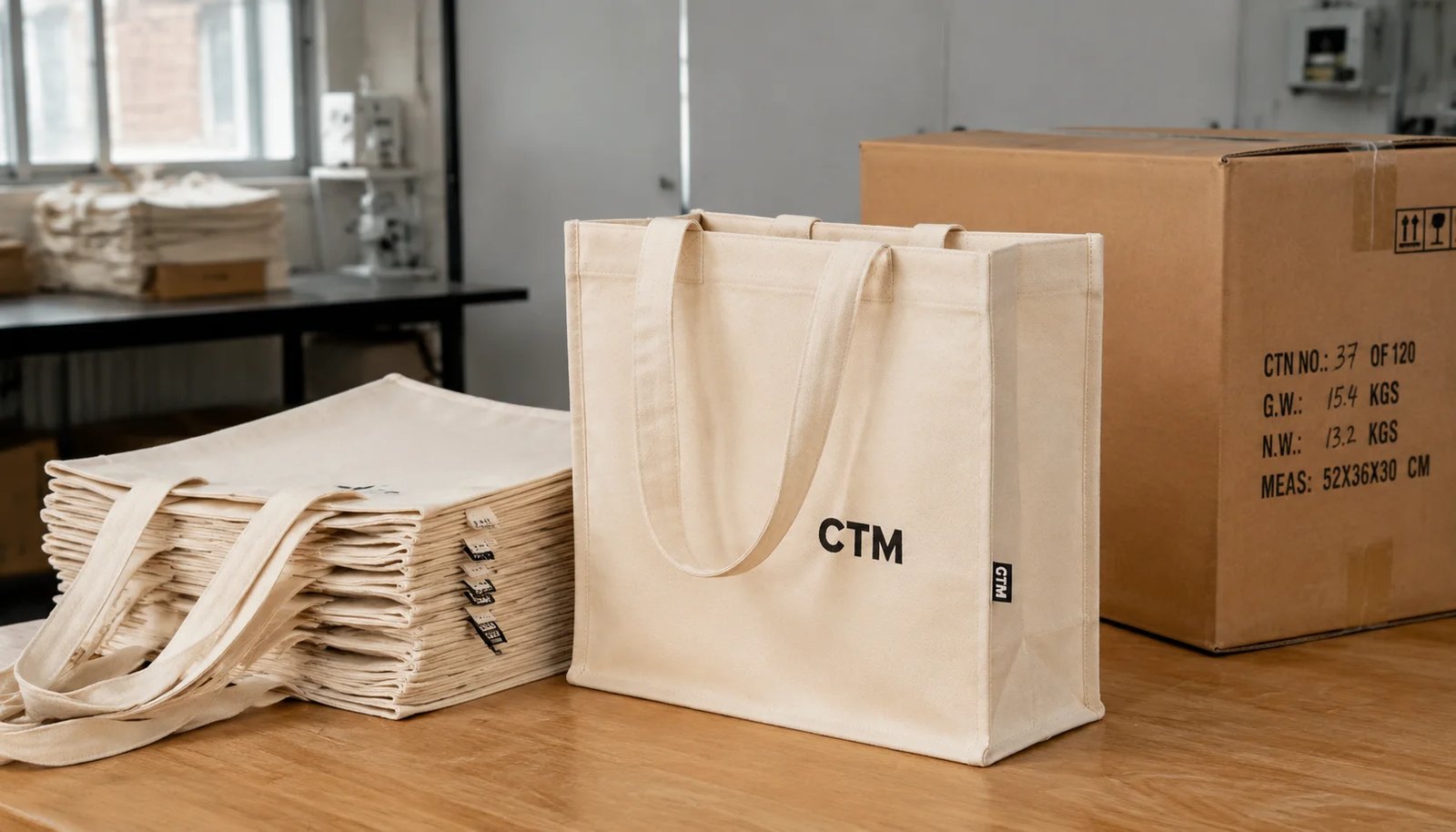
Why carton planning matters more than most tote RFQs admit
For natural grocer programs, the tote itself is usually straightforward: natural canvas, simple branding, reusable construction, and a bag size that can carry produce, jars, dry goods, and a few boxed items. The expensive mistakes usually happen later, when the order moves from approved sample to export packing. If the carton plan is vague, suppliers may optimize for sewing speed or carton count rather than warehouse handling, freight cube, and store-level usability.
A bag quote that looks competitive on unit price can become less attractive after actual packed dimensions are known. A slightly heavier but better-folding canvas can ship more efficiently than a floppy light fabric with oversized gussets. Likewise, a two-side heavy print may need lower carton compression or longer drying time, adding both cost and schedule risk. Carton planning is not a warehouse afterthought; it should be part of the tote specification from the first RFQ round.
- Freight is charged by weight or cube, whichever is higher; canvas grocery totes often become cube-driven before they become weight-driven.
- Carton handling matters at three points: factory loading, importer DC receiving, and retail store backroom storage.
- Unclear pack counts create downstream labor cost for recounting, relabeling, and store distribution.
- For natural cotton bags, moisture exposure and print offset risk are real packing issues, not theoretical ones.
Start with the selling use, because bag geometry drives the carton
The right carton plan starts with the actual retail use. A grocery checkout tote meant for everyday basket replacement needs different geometry from a promo tote handed out at a seasonal event. Natural grocers usually want a practical size with enough gusset for produce, bottles, and pantry staples, but not so much depth that the empty bag becomes bulky in transit. If the bag is too wide and too deep, carton cube increases quickly and shelf refill teams end up handling awkward bundles.
A common working size for this channel is around 35-38 cm wide, 35-40 cm high, with a 10-15 cm bottom or side-and-bottom gusset. That range usually balances carrying capacity and shipping efficiency. Larger dimensions may look more generous in photography but can raise freight per unit materially. Buyers should lock the use case first, then approve dimensions, then request a packing estimate based on actual folded orientation rather than a generic carton guess.
- Checkout-focused tote: prioritize structure, stable gusset, and durable handle reinforcement.
- Produce-and-pantry tote: medium body with practical gusset often packs best.
- Gift-with-purchase tote: lighter weight and flatter gusset may reduce freight if load performance is less critical.
- Bottle-heavy use: request stronger handle stitching and consider slightly narrower body to reduce sag.
Choose canvas weight by load performance and freight cube, not by habit
For custom canvas grocery totes, 10 oz to 12 oz canvas, roughly 280-340 GSM, is usually the practical range for natural grocer retail. Below that, the bag may feel too promotional and collapse under heavier mixed groceries. Much above that, the tote becomes sturdy but bulkier to fold, and shipping efficiency can worsen unless the design is small. Buyers sometimes default to the heaviest fabric they can afford, assuming it always signals quality. In reality, overbuilt fabric can add cost without improving the actual shopper experience.
The important point in RFQs is to define the fabric in GSM and construction terms rather than relying only on ounce language. Different factories convert ounce claims loosely, and finishing can shift the feel. If one quote comes in lower, compare the estimated bag weight and packed carton dimensions before assuming it is a true saving. A 260 GSM bag quoted as 10 oz may produce a softer hand but not the same field durability or stacking behavior as a real 300 GSM canvas.
- Typical practical spec: 300 GSM natural cotton canvas for reusable grocery use.
- Unbleached natural canvas may have slight shade variation; state your acceptable appearance standard.
- Heavier fabric can reduce body collapse but increases folded thickness in carton.
- Request bulk fabric swatch approval if repeat orders must match prior store programs.
Print method affects drying, folding, and packed condition
Most natural grocer tote programs use simple 1-2 color screen printing on natural canvas. That is usually the most stable and cost-effective method for medium and large runs. It handles store logos, short sustainability messaging, and event branding well. From a packing perspective, moderate one-side print coverage tends to be easier to dry, stack, and ship than heavy full-panel graphics. This matters because poorly cured ink can transfer onto adjacent folded bags during bundling and ocean transit.
If your artwork uses large dark fills, two-side print, or edge-near seams, carton planning should become more conservative. Factories may need longer curing and staging time before final packing. Compression inside tightly loaded cartons can also mark the print surface. Buyers do not need to avoid strong graphics, but they should treat print coverage as a packing variable and not only a design issue. A good quote should separate print setup assumptions, coverage area, and whether anti-offset paper or extra drying time is needed.
- Screen print suits most tote programs with simple branding and moderate coverage.
- Heat transfer may work for detailed art but can stiffen panels and change folding behavior.
- Large ink areas increase risk of blocking, offset, and visible fold marks.
- Request a rub test standard and photo of packed printed sample if the artwork is dark or saturated.
MOQ logic should match SKU split and carton discipline
MOQ for canvas grocery totes is rarely just one number. The useful MOQ is the one tied to fabric color, print design, and packing split. For example, a natural grocer chain may want one base bag across four regional slogans. The total volume may be healthy, but if each design is packed separately with unique carton marks and labels, the supplier's real production logic changes. Buyers should avoid approving a quote that shows a low headline MOQ but leaves setup and split-pack economics vague.
Carton planning connects directly to MOQ because mixed SKUs can increase handling cost and reduce packing speed. If each region needs fixed store allocations, ask whether mixed carton packing is possible or whether single-SKU cartons are required for export. Single-SKU cartons simplify inbound control but can increase outbound redistribution work. There is no universal best answer; the right method depends on your DC workflow. The point is to tie MOQ and packing structure together before PO issue.
- Clarify MOQ per artwork, per size, and per fabric color.
- Separate sampling MOQ from bulk MOQ when testing new sizes or print layouts.
- Mixed carton programs may save importer labor later but raise factory packing cost now.
- A low MOQ on paper can hide print screen charges, repacking charges, or carton mark surcharges.
How to set a carton specification that works in the real world
A usable carton specification needs more than 'export carton' on the PO. Buyers should define expected pieces per inner bundle, pieces per master carton, acceptable gross weight, and whether the bags must be folded in a fixed orientation. For grocery totes in 300 GSM class, 50 or 100 pieces per master carton are common starting points, depending on dimensions, gusset, and print coverage. The goal is to balance freight efficiency with safe handling. A carton that maximizes unit count but arrives over-compressed or too heavy for warehouse teams is not a good carton.
Ask the supplier to quote estimated outer carton dimensions and gross weight based on actual folded samples, not spreadsheet theory. If your distribution center breaks packs into store allocations, inner bundles of 25 or 50 may be preferable to loose-count cartons. If bags are sold in stores as folded stock near checkout, consistency of folding and face-out presentation may matter just as much as freight cube. This is why the carton spec belongs in the product approval process.
- Useful gross weight target: often below 16-18 kg for manual handling, subject to buyer warehouse rules.
- Inner bundles of 25 improve counting and store allocation for many retail programs.
- Overstuffed cartons may lower nominal freight cube but raise damage claims and receiving friction.
- Require shipping marks that match PO, style code, and carton count sequence.
Sample approval should include packed samples, not only the bag itself
Many buyers approve a beautiful pre-production tote sample and move on, only to discover later that the packed master carton dimensions differ from the quote estimate. The safest approach is staged sample approval: first confirm the bag dimensions and construction, then confirm print placement and color, and finally confirm a packed sample or at least a packing trial with measured carton dimensions. Carton planning based on the approved bag alone is still incomplete because fold method, handle tucking, and bundle compression affect the final cube.
For natural grocer programs with larger volume, a packed sample is commercially justified. Even one trial carton can reveal whether handles bulge, gussets rebound, or print surfaces stick after compression. It also gives your forwarder or logistics team realistic cube data before booking. This is especially useful when comparing suppliers whose unit prices are close. The supplier with the slightly higher tote price may still win on landed cost if the packed carton is more efficient and more robust.
- Approve at least one blank size sample before print if dimensions are new.
- Approve a printed pre-production sample using final fabric and final handle construction.
- Request one trial-packed master carton with measured outer dimensions and gross weight.
- Review carton photos from all sides, including inner bundles and sealing method.
QC thresholds that prevent freight, print, and receiving disputes
Quality control for canvas grocery totes should go beyond visible sewing defects. For carton planning, the highest-value QC points are the ones that stop freight and receiving disputes before they happen: dimension tolerance, bag weight consistency, handle reinforcement, print cure, bundle count, and carton shape after loading. If a supplier only discusses visual final inspection, that is a warning sign that the packed-goods phase is under-controlled. Importers pay the cost when cartons split, counts drift, or print blocks inside the bundle.
Set acceptance criteria that your QC partner or in-house team can actually inspect. For example, require carton dimensions to stay within a practical tolerance from approved packed sample, and require gross weight not to exceed your handling threshold. On the tote itself, make sure seam allowance, stitch security, and handle attachment are verified under load. A natural grocer tote often carries jars, canned goods, and produce, so real-use stress matters more than a showroom appearance review.
- Measurement tolerance should cover width, height, gusset, and handle drop.
- Print should pass a dry rub review before bundling; offset inside folded stacks should be unacceptable.
- Cartons should remain square and intact after loading, with no burst corners or severe sidewall bowing.
- Bundle count errors should be treated as shipment nonconformity because they affect inbound reconciliation.
Lead time risk usually sits in printing and packing, not just sewing
Procurement teams often focus lead time questions on fabric booking and sewing capacity, but for printed canvas totes the last stage can be the unstable one. If printing is delayed, curing is slow in humid conditions, or packed carton dimensions need rework, the shipment can slide even when cut-and-sew looked on schedule. This matters for natural grocer launches tied to seasonal campaigns, Earth Day promotions, membership events, or store opening calendars.
A better timeline breaks the order into milestones: material approval, cutting start, sewing completion, print completion, packing trial, final packing, and ex-factory readiness. This gives buyers earlier warning if the bottleneck moves from production to finishing. It also helps when comparing quotes that look similar but use different assumptions. One supplier may quote a shorter lead time by excluding packed-sample approval or by assuming immediate artwork release. Those hidden assumptions should be visible in the quotation review.
- Sample lead time and bulk lead time should be listed separately.
- Printed bags may need staging time before bundling to avoid offset risk.
- Carton mark approval can delay packing if PO details change late.
- Ask for batch-ready dates if partial shipment is a possible fallback.
Use a landed-cost view when comparing supplier quotes
When two tote quotes are close, landed cost comparison should decide the order, not unit price alone. Start with ex-factory bag cost, then add print setup, packaging extras, carton upgrades, inland transport, and estimated ocean freight based on real carton cube. If one supplier can pack 100 pieces cleanly into a carton within your weight limit while another needs a bulkier packout, the apparent savings may disappear after freight and warehouse handling are included.
This is where quote transparency matters. A disciplined supplier should break out bag cost, print cost, trim cost, and packing assumptions. If carton dimensions are omitted, buyers are comparing incomplete offers. For natural grocer buyers, there is also a retail execution angle: better cartons can reduce receiving damage, recounting labor, and backroom clutter. Those operational costs may not appear on the purchase order, but they are still part of the program economics.
- Compare quotes on delivered packed unit economics, not just sewn bag cost.
- Use estimated freight per piece based on carton cube and route assumptions.
- Include the cost of split SKUs, labels, and repacking if your DC requires them.
- Factor in handling efficiency at importer warehouse and store level.
Specification comparison for buyers
| Spec decision | Recommended option | When it fits | Buyer risk to check |
|---|---|---|---|
| Fabric weight | 10 oz to 12 oz canvas, about 280-340 GSM | Best for grocery loads, repeated reuse, and better carton efficiency than very heavy canvas | Some suppliers quote lighter fabric but call it the same ounce weight; require GSM tolerance and finished bag weight range |
| Bag size | Medium grocery format around 35-38 cm W x 35-40 cm H with 10-15 cm gusset | Good for produce, jars, boxed items, and store checkout use without oversize carton waste | Large gussets increase cube fast; oversized bags often create poor carton fill and higher freight per unit |
| Handle construction | 2.5-3.8 cm webbing or self-fabric handles with X-box stitching | Suitable for heavier basket loads and fewer field failures at store level | Quotes may omit reinforcement stitch count; request handle attachment detail and pull-test method |
| Print method | 1-2 color screen print for most natural grocer programs | Works for simple logos, ingredient messaging, and lower setup cost across mid-volume runs | Large dark ink coverage can offset onto adjacent bags if packed too quickly; require curing standard and dry time before packing |
| Inner packing | Flat packed in PE bag bundles of 25 or 50 | Balances warehouse counting efficiency with manageable store handling | Bundles of 100 may compress print and distort gussets; confirm whether polybag thickness and desiccant are included |
| Master carton count | 50 or 100 pieces per export carton depending on bag thickness and print coverage | Controls carton weight while keeping freight efficient for importer DC receiving | Do not accept count-only planning; require carton gross weight, dimensions, and drop resistance |
| Carton board grade | 5-ply export carton for standard sea freight; stronger grade for long LCL route or humid season | Reduces split cartons and bag contamination during port handling | Thin board may still pass sample photos; request burst strength or board spec plus loaded carton photo |
| MOQ structure | MOQ by fabric color and print layout, not only by total order quantity | Useful when natural grocer program needs multiple stores, campaigns, or regional artwork | A low total MOQ quote may hide surcharges on split SKUs, carton marks, or repeated print setups |
| Shipping mode planning | Sea freight for bulk replenishment, air only for approved sample or launch rescue | Best landed cost for routine retail programs | If launch timing is tight, ask for ex-factory date by batch and carton-ready date, not only final shipment date |
Buyer checklist before sampling
- Define selling use before size approval: checkout tote, produce-and-pantry tote, wine-and-jar tote, or promo giveaway. Carton planning changes with gusset and fabric weight.
- State target fabric clearly in GSM and weave type, not only ounces. Example: 300 GSM natural cotton canvas, plain weave, unbleached.
- Include finished bag dimensions with tolerance for width, height, and bottom or side gusset. Carton cube cannot be estimated accurately from artwork only.
- Specify handle length, width, and reinforcement method. Long shoulder handles and short hand-carry handles stack differently in export cartons.
- Match print method to retail use. Large one-side screen print usually packs easier than heavy two-side coverage with dark inks.
- Set bundle quantity inside each master carton, such as 25 pieces per inner bundle and 100 pieces per master carton, if your DC counts by bundle.
- Require carton gross weight limit acceptable for your warehouse team, such as under 16-18 kg, rather than letting the factory maximize count without handling logic.
- State if hangtags, barcode labels, or retail-ready belly bands are needed. Small trims can change bag compression, packing speed, and carton count.
- Ask for estimated packed carton dimensions before sample approval, then again after pre-production sample, because actual folding method changes final cube.
- Include moisture protection requirements for ocean freight, especially for natural cotton and kraft hangtags in humid routes.
Factory quote questions to send
- What is the exact fabric specification in GSM, yarn count if available, and finished weight tolerance per bag size?
- What bag dimensions and gusset style are included in the quote, and what is the stated size tolerance after sewing and finishing?
- What print method is quoted, how many colors, what print area, and what curing method is used before packing?
- How many pieces per inner bundle and per export carton are included, and what are the estimated carton dimensions and gross weight?
- What carton board grade is used for export, and does the quotation include moisture barrier measures such as liner bag or desiccant when requested?
- Is MOQ based on total order quantity, per fabric color, per print design, or per size?
- What sample stages are available: digital artwork proof, blank size sample, printed pre-production sample, and packed carton sample?
- What lead time is needed for lab dip or fabric approval if natural cotton shade consistency matters across repeat orders?
- What are the additional charges for split shipments, mixed carton packs, barcode stickers, hangtags, or custom shipping marks?
- Can you provide a loading estimate showing units per carton, cartons per pallet if palletized, and estimated container quantity per 20GP or 40HQ?
Quality-control points to confirm
- Fabric GSM should be verified from bulk material, not sample swatch only, because packed cube and bag feel both change when GSM drifts lower or higher.
- Finished bag measurements should be checked on a realistic sample size set, especially gusset depth after turning and pressing.
- Handle attachment must show clean X-box or equivalent reinforcement with no skipped stitches, loose thread buildup, or seam grin under load.
- Print must be dry, cured, and rub-resistant before packing; dark ink transfer onto folded natural canvas is a common complaint.
- Fold method must be consistent so master cartons stay within stated dimensions and stores receive uniform pack appearance.
- Inner bundle count must match shipping mark and packing list exactly; miscounts are common when factories switch from 50-pack to 100-pack logic mid-run.
- Cartons must remain square after loading, with no overstuffing that causes burst corners or deformed bags.
- Carton marks should include PO, style, color, quantity, carton number, gross weight, and country of origin if required by the buyer.
- Random drop and compression checks on loaded cartons are useful for heavier 12 oz canvas totes headed to long ocean routes.
- Odor, mildew, and dust control should be reviewed before sealing cartons, especially for unbleached cotton stored during humid weather.