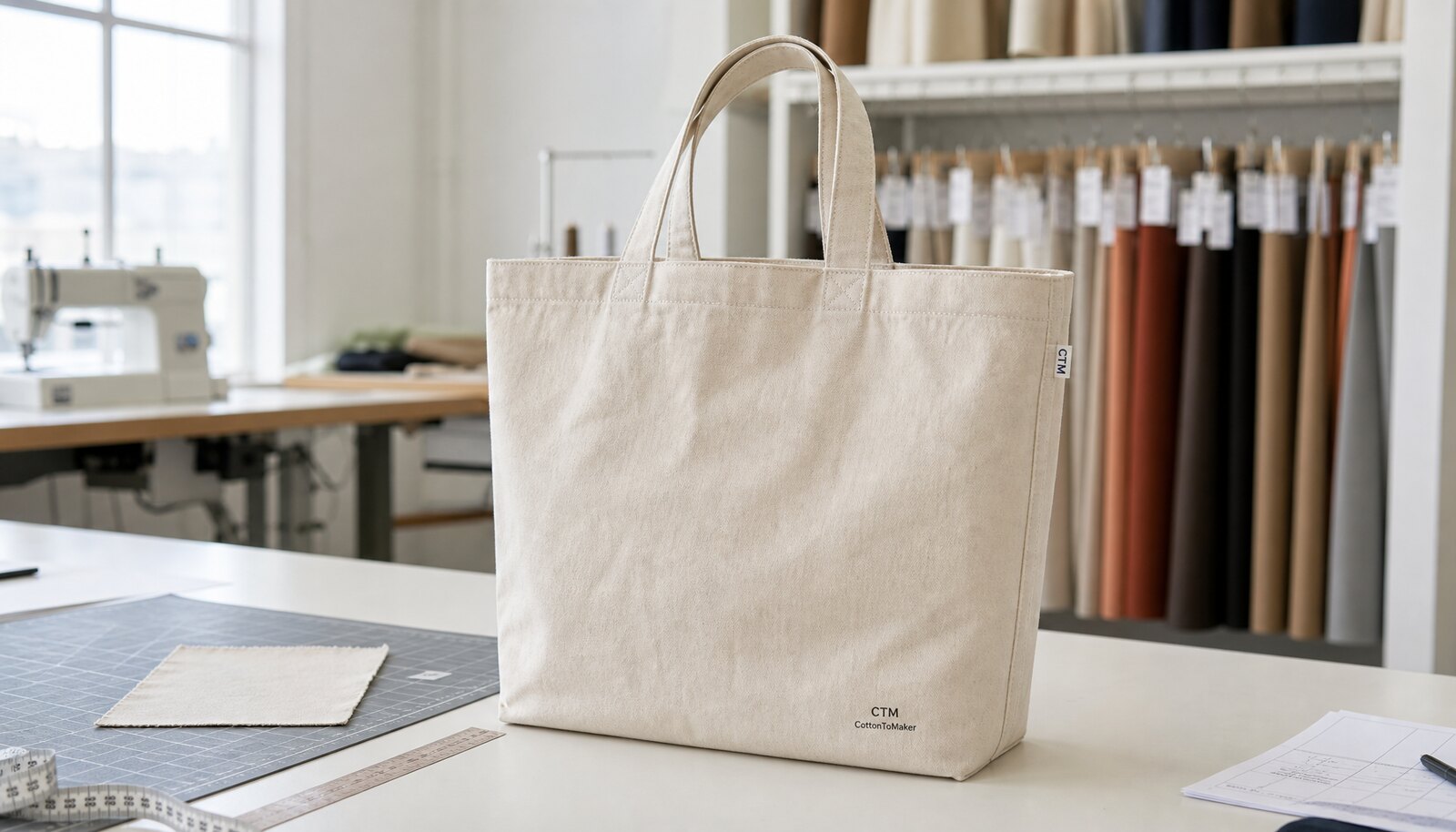
1) Why apparel brands source exhibition totes as a private-label program, not a simple promo item
Canvas exhibition tote bags look simple, but apparel brands use them in ways that make sourcing more demanding than a standard giveaway order. The same tote may need to support a launch event, a retail counter sale, an e-commerce insert, and an exhibition handout. That means the buyer has to balance three goals at once: brand presentation, carrying performance, and commercial cost.
A private-label tote also has to sit naturally beside the brand’s apparel, tags, and packaging. If the canvas is too light, the bag feels temporary and can collapse in use. If the print method is too glossy or fragile, the tote may look acceptable on a sample table but fail after a few folds. If packing is not planned early, the bag can arrive creased, scuffed, or miscounted even when the sewing itself is acceptable.
The right sourcing plan starts by defining the bag’s job. Is it meant to be sold, given away with purchase, used as a VIP event gift, or packed with folded apparel? That answer determines the acceptable fabric weight, the level of finishing, and how strict the quality controls need to be. It also changes what a factory should quote: a cheap promotional tote can tolerate simpler construction, while a retail-facing tote should be spec’d and inspected like a branded product.
For procurement teams, the main risk is not paying a little more for a better tote. The real risk is comparing two offers that are not actually the same product. One supplier may quote a promotional bag with light canvas and bulk packing, while another quotes a retail-ready piece with heavier fabric, tighter print control, and carton labeling. A good sourcing plan forces both suppliers to work from the same construction, the same fabric basis, and the same decoration method before the first sample is cut.
- Define the end use before requesting prices.
- Treat the tote as a branded product with a real spec, not only as packaging.
- Compare like for like before judging price.
2) Build the product brief around use case, size, and load rather than around logo placement
A strong RFQ starts with practical product decisions. The factory needs to know the tote’s finished size, gusset depth, handle drop, target load, and whether the bag must stand upright or simply carry folded garments. Those details drive fabric choice, stitch density, reinforcement, and carton weight. Without them, the supplier will fill in the blanks with its own default construction, which may not match your brand or budget.
For most apparel-brand exhibition programs, a medium-size tote with enough depth for a folded garment stack is more useful than a flat promotional bag. Buyers often forget to specify handle drop, but this matters in real use. A short drop is awkward over the shoulder. A long drop can make the bag hang too low and weaken the visual profile. If the tote will include a boxed insert, hangtag, or folded apparel, the interior width and gusset need to support that shape without distortion.
Make the brief concrete. Instead of writing “premium canvas tote,” write the intended finished dimensions, acceptable tolerance range, handle material, closure style if any, and whether the bag must pass a carry test or hold a defined weight for event use. For procurement teams, this approach reduces quote noise and makes sample comparison much more meaningful.
It also helps to define which details are fixed and which are negotiable. For example, you may allow either natural or bleached canvas but require a specific weight band and the same print area. Or you may allow two handle options but only one fold method. This keeps sourcing flexible without letting suppliers change the commercial intent of the product.
In practice, a buyer should also decide whether the tote is part of the merchandise plan or only a support item. If it is bundled with apparel, it may need to survive warehouse handling, not only an event handout. If it will be sold, it should be judged as a customer-facing accessory. That distinction affects acceptable finish level, inspection scope, and the level of documentation you should ask for from the supplier.
- Write the brief with usable dimensions, not marketing adjectives.
- State expected use, such as event handout, retail add-on, or apparel carrier.
- Separate must-have specs from acceptable alternates so quotes stay comparable.
3) Fabric and construction spec ranges: what to ask for, and how to read GSM vs oz
The most common mistake in tote sourcing is mixing fabric terminology without clarity. Canvas is usually discussed in both ounces per square yard and GSM, but those numbers are not interchangeable by intuition alone. As a rough buying reference, 8 oz canvas is often around 270 GSM, 10 oz around 340 GSM, 12 oz around 400 GSM, and 14 oz around 475 GSM. Actual values vary by weave, finishing, and supplier measurement method, so treat these as working ranges rather than exact conversions.
For exhibition totes, many buyers start around 10 oz to 14 oz canvas. Lighter weights can be fine for low-cost handouts, but they may feel too soft if the tote is expected to carry apparel. Heavier canvas gives more structure and a more substantial hand feel, but it also adds sewing difficulty, cost, and carton weight. The right point depends on how the tote will be used and whether the brand wants a cleaner drape or more body.
Construction details matter as much as fabric weight. Ask the factory to identify the fabric composition, yarn count if available, weave density, finish, and whether shrinkage or washing behavior has been tested. A washed canvas may feel more premium but can change the size slightly after finishing. A dyed fabric may look richer but requires tighter shade control. If the tote will carry repeated weight, request reinforcement at the handle attachment points and a seam structure that suits the load.
Common construction options to compare include self-fabric handles, webbing handles, boxed corners, gusseted bottoms, top-edge binding, inside seam finishing, and reinforcement patches. A self-fabric handle can look more cohesive with a premium brand, while webbing can improve strength and consistency. A gusset helps the bag hold apparel more naturally. A boxed corner or bottom panel can improve shape, but it adds labor and can raise MOQ if the factory treats it as a more complex line item.
The practical buyer question is simple: what construction gets you the least compromise for the intended use? If the tote is a launch giveaway, a clean plain body with screen print may be enough. If it is intended to carry a folded shirt or knitwear, the gusset and handle reinforcement deserve more attention than decorative trim. In other words, spend on the structure that the customer will feel every time they pick up the bag.
- Use GSM and oz together so suppliers cannot hide behind one measurement system.
- Ask for the exact fabric basis, not just “canvas” or “cotton canvas.”
- Request construction options with separate pricing if you are comparing premium versus promo versions.
4) Decoration method decision tree: choose by artwork complexity, durability, and MOQ
Decoration is where many tote orders drift away from the intended commercial outcome. The best method depends on the artwork, the target life of the tote, and the order volume. For a simple logo or short slogan, screen printing is still the most practical default because it gives strong color opacity and is repeatable across bulk runs. If the artwork is complex, full color, or highly detailed, another method may make more commercial sense even if the unit price is a bit higher.
A simple decision tree helps. If the design has one to three solid colors, needs durability, and the order is not extremely small, screen print is usually the first option to quote. If the design is highly detailed or you need a fast short-run test, a transfer process or digital method may be more suitable. If the tote is premium and you want a quieter brand mark, embroidery or a woven label may work better, although embroidery on canvas must be checked for puckering and added weight.
The key is to match method to use. A cheap transfer can look acceptable in a photo and still crack or lift after repeated folding. A screen print that is too thick can feel heavy or misaligned on soft canvas. A woven label can elevate the product, but it adds a separate component, a sewing step, and a potential placement issue. For apparel brands, the decoration method should be chosen after you decide whether the tote is meant to read as a promotional item, a retail accessory, or a bundled premium piece.
Ask the factory to show not only a digital proof but a strike-off or pre-production print on the actual canvas body. This is especially important for dark ink on natural canvas, small typography, and any design that sits near a seam or fold line. If the supplier hesitates to test the actual fabric, slow down and verify capability before bulk approval.
One useful negotiation point is to quote two decoration paths when the design allows it. For example, compare a one-color screen print against a woven label plus small print. The first may be lower cost and easier to repeat; the second may create a more premium retail look. Buyers often save more by choosing the right method than by pushing the same method into a cheaper lane.
- Screen print: best for simple logos, repeatability, and better cost control at scale.
- Transfer print: useful for short runs or complex artwork, but needs durability checks.
- Embroidery or woven label: useful for premium positioning, but check puckering, placement, and added labor.
- Always test the chosen method on the actual production fabric, not just on a similar blank.
5) Supplier shortlist strategy: how to verify factory capability with evidence, not promises
A useful shortlist should be built from evidence, not only from price and responsive sales emails. For canvas tote sourcing, the buyer should verify whether the supplier actually makes sewn bags, whether the line can handle your chosen construction, and whether the factory understands branded packing and quality control. A strong-looking quote is not enough if the supplier cannot show recent tote production, actual line photos, or material records.
Start with three to five suppliers and separate them into likely factory-direct, trading, or hybrid routes. Then ask for proof that is hard to fake: factory exterior and line photos, sewing machine area images, sample room photos, cutting and printing area photos, and examples of recent canvas or cotton tote work. If they claim a compliance program, ask for the current test reports or declarations that support that claim. If they say they can do custom labels, ask for an actual label sample or clear photo of a previous job.
Pay attention to capability fit. A supplier that makes basic promotional totes may still be the wrong choice if your tote needs a boxed bottom, reinforced handles, or retail-ready folding. A bag workshop with stronger sewing discipline may be a better match even if the quoted price is a little higher. Procurement buyers should also ask who signs off on deviations: if the sales team says yes to a spec change but the factory line cannot execute it consistently, the order will suffer later.
Useful evidence to request includes the fabric spec sheet or mill declaration, sewing line photos, close-ups of seam and bar-tack quality, print samples on the actual canvas, label placement photos, packing photos, and any third-party inspection or test report relevant to the materials. If the supplier cannot provide these, treat the quote as an early estimate rather than a dependable production offer.
A stronger verification step is to ask one or two supplier-specific questions about their own process. For example: where do they source handles, who checks incoming fabric shade, how do they control label alignment, and what happens if a production lot fails first-piece approval? The answers often reveal more than a polished factory deck. A real manufacturer usually answers with process detail, while a broker tends to answer only with reassurance.
- Ask for production photos, not only showroom images.
- Verify whether the seller is the actual maker or a coordinator.
- Match supplier capability to the bag structure, not just to the lowest unit price.
6) Quote comparison that actually helps buyers negotiate: cost logic, not just unit price
This is where many sourcing plans get too thin. A fair quote comparison for canvas exhibition tote bags needs more than one price number. You need to know what fabric was priced, what print method was included, what packing was assumed, and what documentation support comes with the offer. A low unit price is meaningless if the supplier quietly used a lighter canvas, excluded labels, or priced only a simple bulk pack that your warehouse cannot receive directly.
The table below is built for procurement comparison. It reflects the commercial logic buyers actually use: total cost, MOQ, lead time, documentation burden, and the risk of hidden rework. If two quotes look close, the table helps identify why one route may still be better for your program.
When you review a quote, insist on apples-to-apples detail. Ask the supplier to state whether the price includes fabric, sewing, printing, woven label, polybag, insert card, carton marks, and shipping terms such as EXW or FOB. If one offer looks significantly cheaper, check whether the factory has assumed a lower GSM, fewer print colors, simpler seams, or looser packing density. Those differences often explain the gap better than negotiation does.
Use negotiation where it matters. Ask for price breaks tied to material efficiency, carton utilization, or repeat order assumptions rather than only pushing for a lower headline price. For example, if the tote size can be adjusted by a small amount without affecting function, that may improve fabric yield and reduce waste. If the color is a standard natural canvas instead of a custom-dyed body, the supplier may avoid a separate dyeing step. Buyers get more durable savings when they negotiate based on process, not only on margin.
Also compare the hidden costs on the buyer side. A cheaper supplier that needs extra rework, more warehouse sorting, or manual repacking can cost more overall than a higher-priced supplier with cleaner carton logic. Procurement teams should evaluate the cost of inspection time, receiving labor, and any delay risk to the marketing or retail calendar. A tote order is not just a factory number; it is a program cost.
- Compare total program cost, not only bag ex-factory price.
- Separate the price of the body, decoration, label, and packing when possible.
- Use the same spec version for every supplier so the comparison is real.
7) Buying comparison table: route, cost logic, MOQ, lead time, compliance, and decision threshold
Use this table to decide which sourcing route fits your program. Lead times are directional and depend on fabric availability, sample approval speed, seasonality, and whether the supplier already has the required material in stock. Compliance notes are also directional: a supplier may say they can handle compliance, but the buyer still needs the actual documents or test reports.
Decision thresholds matter as much as price. A low-cost route can be acceptable for a simple event tote, but a retail-facing program usually needs tighter documentation, better packing, and more stable repeat production. If you plan to reorder, choose a route that can reproduce the same fabric and print result later without forcing a full requalification.
Use the table as a commercial filter. If you see a low unit price but a vague answer on trim sourcing, carton detail, or sample control, the risk is not small. It is usually a sign that the supplier is pricing the visible product and leaving the hidden work for later. That is where orders become messy.
- Directionally estimate total landed cost by adding packing, inspection, and freight efficiency to the unit price.
- Treat lead time as a function of approvals, not only of sewing capacity.
- Use compliance-heavy routes when the tote enters retail or customer-facing fulfillment.
8) Sample ladder: blank sample, print strike-off, pre-production sample, and approval gate
A disciplined sample process saves time later because it separates construction problems from branding problems. For a private-label tote, the sample ladder should be explicit. First, review a blank sample or a construction sample to verify the body shape, stitching, handle comfort, and fabric feel. Second, review a print strike-off or decoration sample on the real fabric to confirm artwork position, color, and edge quality. Third, approve a pre-production sample that uses the actual production fabric, final labels, and intended packing method.
A sample is only useful when it answers the right questions. The blank sample should tell you whether the bag holds its shape, whether seams are straight, and whether the handles feel proportionate to the bag body. The print sample should tell you whether the logo remains legible near seams or fold lines, and whether the ink or transfer looks intentional rather than patchy. The pre-production sample should prove that all approved decisions can coexist in one unit without creating a new problem.
Build an approval gate into the sourcing plan. Do not let the factory start bulk cutting until the final sample is signed and the key variables are frozen: fabric, size, print position, label placement, fold method, and carton count. If the buyer changes artwork after sample approval, the order should return to the approval gate rather than continuing on assumptions. That single rule prevents many avoidable disputes.
For bigger programs, ask for first-off photos or a first production piece before the line runs full speed. This is the moment to catch errors in handle orientation, label placement, print alignment, or fabric shade. It is much cheaper to stop a batch at that stage than to sort defects after packing.
Procurement teams often rush the sample phase because tote bags feel simple. That is exactly why problems slip through. The sample stage is where you confirm whether the supplier understands the bag as a product, not just as a sewn item. If the supplier cuts corners here, they are likely to cut corners in bulk too.
- Use a 3-step ladder: blank sample, print sample, pre-production sample.
- Approve actual production materials, not mock materials.
- Freeze the spec before bulk cutting starts.
9) Supplier verification beyond the sample: factory capacity, trim sourcing, and document checks
Sample quality is not the same as production capability. To verify a supplier properly, buyers need to check whether the factory can actually sustain the order with the same materials, trims, and quality controls. That means looking beyond a pretty sample and asking how the factory sources handles, labels, threads, printing inks, and cartons. If a supplier cannot explain where the trim comes from, there is a real chance the bulk order will shift to a substitute part after approval.
Audit the factory’s practical capacity. Ask how many sewing lines are available for tote production, whether the factory runs canvas bags year-round or only seasonally, and whether printing is done in-house or outsourced. Ask what happens if your order overlaps with a high season. A factory that depends on outside printing or late-stage trim purchases can still deliver well, but only if the buyer knows where the bottleneck is before placing the order.
Check documents with the same skepticism you would use for a new apparel supplier. If the factory claims a specific cotton canvas weight, ask for the specification or mill reference that supports it. If they say the labels are custom made, ask for label approval artwork and a photo of an existing label run. If they say they can meet a retail program, ask for carton markings, traceability notes, or inspection reports that show the process in use. For any test claim, ask for the actual document, the date, and the product code it applies to.
References matter too, but they should be relevant references. If the supplier says they have shipped totes before, ask whether those were promotional handouts or retail-facing products. The difference changes the level of control you need. A supplier that can handle simple event bags may not be the right partner for a brand that needs clean folding, tight print registration, and repeatable packing standards.
The buyer should also ask who owns the specification on the factory side. When a change request comes in, is it handled by sales, sampling, production, or QC? A good supplier can name the decision owner. A weak one gives answers that move around depending on who is on the call. That inconsistency is often the earliest warning sign of later disputes.
- Verify actual sewing and printing capacity, not only a showroom or sales desk.
- Check trim sourcing for handles, labels, thread, and packaging before bulk approval.
- Ask for documents that match the exact product, not general claims.
10) Packing, freight, and post-shipment follow-up: close the loop after the goods leave the factory
Canvas totes are soft goods, which makes packing choices especially important. If the bag is folded too tightly, the print can crease. If it is packed too loosely, cartons become inefficient and freight cost rises. The buyer should specify fold direction, bundle size, carton count, and whether the tote needs individual polybags, interleaving, or tissue protection. These details are not cosmetic; they affect damage rate, receiving speed, and how the goods look when they reach stores or event teams.
Carton design should be part of the sourcing decision, not a last-minute admin task. Ask the supplier to state carton dimensions, gross weight, and quantity per carton so you can estimate shipping efficiency and warehouse handling. If the program has multiple SKUs, ask how the supplier will separate and mark them. Poor carton marking can be as disruptive as a print defect because it slows receiving and increases sorting errors.
For apparel brands, the most practical packing question is often: how much handling can the tote take before it looks used? If the bag will be handed out at a show, a simpler bulk pack may be fine. If it is going into a store or e-commerce box, the bag may need a cleaner fold, a smoother print face, and stronger protection against scuffing. That decision should be made before the packing quote is accepted, not after the first cartons arrive.
After shipment, close the sourcing loop with a short feedback review. Record what happened with print quality, carton condition, count accuracy, warehouse receiving, and customer feedback if the tote went to retail or event use. Then save any changes needed for the next order: tighter fold method, revised label placement, stronger handle reinforcement, or a more efficient carton count. This is how a tote program becomes repeatable instead of starting from zero each time.
A strong private-label sourcing plan is not just about placing the first order. It is about making sure the factory can reproduce the same quality on reorder, with the same fabric, the same print feel, and the same packing outcome. The best buyers treat the post-shipment review as part of supplier qualification, because the next purchase depends on whether the first one was truly controlled.
- Specify folding and carton rules early to reduce crease and scuff risk.
- Use carton dimensions and gross weight to evaluate freight efficiency.
- Keep a post-shipment log so reorders can be tightened instead of rediscovered.
Specification comparison for buyers
| Supplier option | What to verify | Commercial advantage | Buyer risk to control |
|---|---|---|---|
| Direct sewing factory | fabric swatch, approved sample, seam close-ups, logo test photos, packing pilot, and final inspection evidence | Better sample-to-bulk control and faster production feedback | May be weaker on export paperwork or branded packing unless checked early |
| Trading company | Factory name, production photos, trim-source proof, and who owns QC decisions | Can coordinate small mixed orders and extra services | Markup can hide real factory capability and slow defect decisions |
| Specialized bag workshop | bag size, gusset, handle drop, seam allowance, stitch density, reinforcement patch, and loading expectation | More practical for detailed construction, trims, and repeat programs | Capacity may be limited during peak seasons |
| Low-price general supplier | 8-12 oz cotton canvas, 120-220 gsm cotton, recycled cotton, or blended fabric selected by use case and target price | Useful for simple promotional runs with loose specs | Material downgrades, weak packing, and vague inspection scope can erase savings |
| Retail-ready supplier | fold method, inner bundle, carton count, carton mark, moisture protection, SKU separation, and warehouse receiving needs | Can handle labels, SKU separation, carton marks, and receiving rules | Higher unit cost must be compared against reduced warehouse work |
| Compliance-focused supplier | Fabric records, labeling review, test plan, and production traceability | Safer for retail programs and repeat brand orders | Documentation claims need evidence, not only sales language |
| Local sample room plus bulk factory | Signed sample, bulk factory handoff, first-piece photos, and deviation owner | Good for complex branding before large production | Sample room quality may not match bulk line unless handoff is controlled |
Buyer checklist before sampling
- Define the tote’s use case first: giveaway, retail add-on, VIP gift, event handout, or apparel carrier.
- Lock the finished size, gusset depth, handle drop, and expected load before asking for prices.
- Specify fabric composition, fabric weight in GSM and oz, finish, and acceptable variation range.
- State the decoration method, artwork size, color count, placement, and any fine-line or small-text risks.
- Ask for a blank sample, printed sample, and pre-production sample in sequence for any non-trivial order.
- Request evidence of factory capability: sewing line photos, cutting and printing area photos, recent tote examples, and material or test documents.
- Confirm packing details early: fold method, polybag or bulk pack, carton count, carton marks, and barcode needs.
- Set QC acceptance criteria in writing: dimension tolerances, seam quality, print quality, defect thresholds, and sampling level.
- Tie approval to a version-controlled spec sheet so the supplier cannot cut from an older revision.
- Plan a post-shipment review so defect trends, packing issues, and reorder changes are captured before the next PO.
Factory quote questions to send
- What exact fabric are you quoting, including composition, GSM, and whether the weight is before or after washing or finishing?
- Can you confirm the full bag construction: body panels, gusset type, seam allowance, handle length, handle drop, and reinforcement method?
- What is included in the unit price line by line: fabric, cutting, sewing, printing, labels, inserts, polybag, carton, and pallet if needed?
- What MOQ applies per design, per color, per print method, and per packing format?
- Which sample stages do you support, and will the pre-production sample use the same fabric, print ink, and labels as bulk?
- What tolerances do you normally hold for dimensions, print position, color variation, and stitch defects?
- Can you provide production photos, trim or fabric records, and recent inspection or test documents for the quoted construction?
- How many pieces per export carton, what is the carton size and gross weight, and will the packing protect printed areas from creasing?
- What is the lead time after sample approval, and which items can extend it: dyeing, screens, labels, or packing changes?
- If we change artwork size, label type, or handle construction after quote, which cost items or MOQ assumptions change immediately?
Quality-control points to confirm
- Fabric weight should match the approved spec range, with no obvious thin patches, uneven weave, or shade banding across body panels. Accept normal lot variation, not visible inconsistency.
- Handle stitching should be reinforced at stress points with consistent bar-tacks or secure cross stitching. Check both handle ends and attachment points for skipped stitches or loose anchoring.
- Seams should be straight, trimmed, and secure. Set a visible tolerance target such as no open seams and no seam puckering that affects shape or load bearing.
- Bag dimensions should stay within agreed tolerances after sewing and finishing. Check body width, body height, gusset depth, and handle drop on first-off pieces and AQL samples.
- Print position should sit within the approved area with clean edges, correct color tone, and no major misregistration. Reject obvious bleed, cracking, flaking, or ghosting on fold points.
- Artwork should remain legible at normal viewing distance, including small text and thin lines. Require a printed strike-off if the logo contains fine detail.
- Labels, hangtags, and side seam branding must match the approved artwork and placement. Check orientation, stitch alignment, and whether any label edges curl or fray.
- Packing should protect the print face and keep the bag fold consistent. Check for scuffing, moisture risk, carton damage, and count accuracy before shipment release.
- For first runs, inspect pre-production pieces and first production output before the line continues. Hold bulk if the first-off sample differs from the signed sample.
- Use a measurable inspection method such as AQL on finished goods, plus extra checks on print area, handle reinforcement, and carton marking consistency.