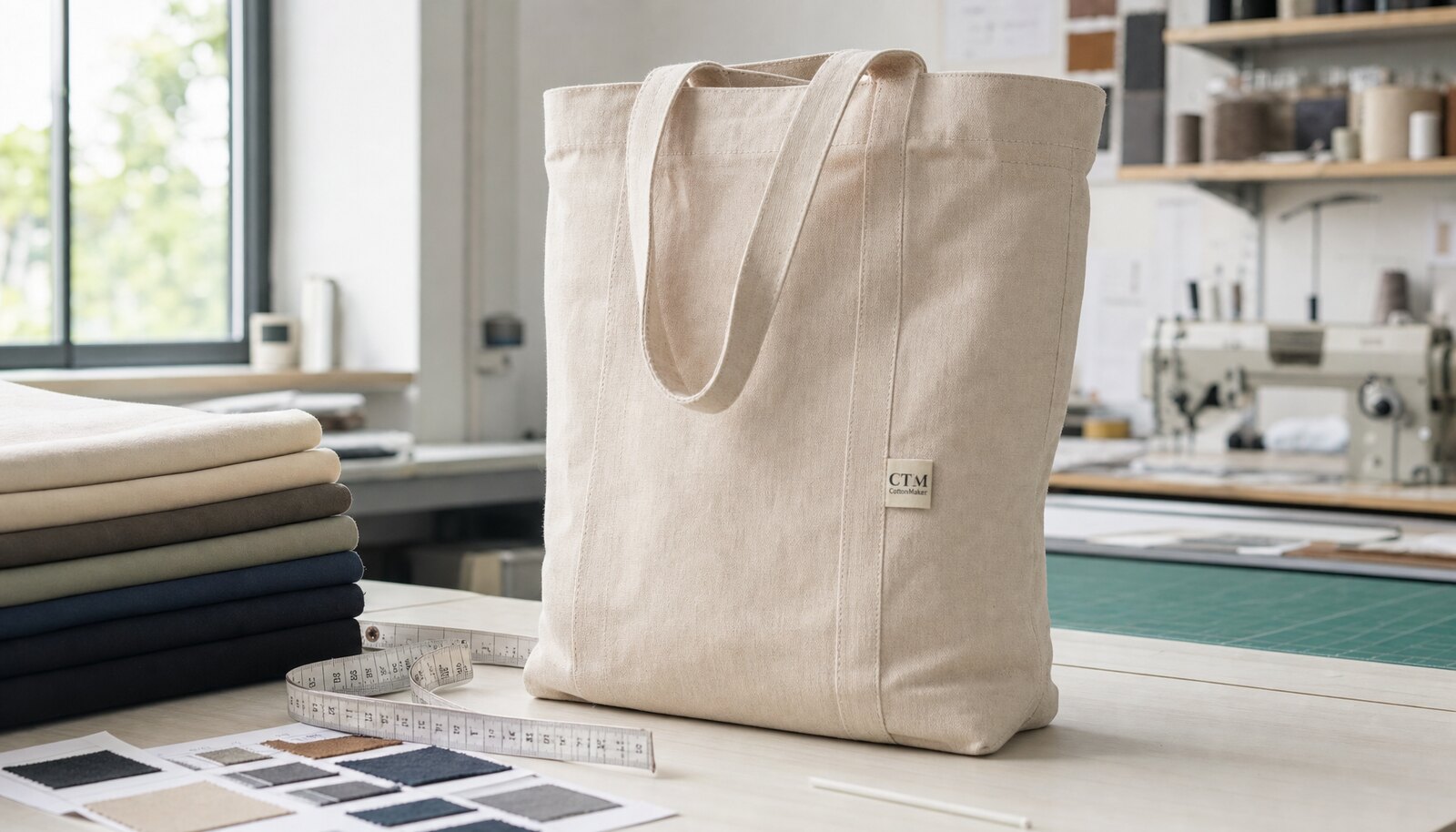
Why canvas exhibition tote bag specs matter for apparel brands
For apparel brands, a canvas exhibition tote bag is rarely just a tote. It may be a show giveaway, a retail add-on, an e-commerce insert carrier, a seasonal launch bag, or part of a bundled apparel kit that has to arrive looking clean and consistent. That is why the packaging specification matters as much as the bag itself. Two suppliers can quote the same style and still produce very different landed costs because one includes folding, polybagging, carton marks, and moisture protection while the other quotes only the sewn bag. If the buyer does not define what “finished” means, the factory will fill in the gaps with its own standard.
Procurement teams usually feel the pain in three places: quote comparison, sample approval, and warehouse receiving. A vague RFQ can hide a better price behind missing pack-out costs. A sample can look right on the table but fail once folded for carton packing. And a warehouse can reject a shipment because the cartons are too heavy, the barcodes are unreadable, or the bags arrive with stubborn fold lines from over-compression. For apparel launches, the tote is often part of the brand presentation, so the spec needs to cover both product performance and pack presentation.
- Define the tote as a product, a packaging component, or both.
- Separate bag cost from packing cost in the RFQ so quotes stay comparable.
- Write the end-use clearly: event handout, retail item, shipping insert, or apparel kit component.
Start with structure before artwork: size, canvas weight, and carry performance
The first commercial decision is not the logo; it is the bag body. Fabric weight changes the quote, the hand feel, the print result, and how the tote behaves once it is loaded. For many apparel buyers, a 10 oz canvas can work for lightweight promotional use, but it can feel soft or flimsy when the bag is meant to carry folded tees, hoodies, or mailed apparel bundles. A 12 oz canvas is often the practical middle ground because it balances cost, durability, and print quality. A 14 oz canvas usually makes sense when the tote needs a premium touch, heavier load performance, or a more structured appearance on shelf or at events. The right choice depends on use case, not just a general “best weight” rule.
Size and structure are just as important. A tote that carries apparel needs to fold cleanly, stack efficiently, and keep its shape after printing and packing. Common starting points are around 380 x 420 x 100 mm or 400 x 350 x 120 mm, but those are only references. The right dimensions depend on what the tote has to hold, whether the bag includes a gusset, and how the brand wants it to sit in cartons or on a retail fixture. A double-fold top hem is usually more durable than a raw edge or a single fold, and the handle attachment area should be reinforced enough to survive repeated lifting without seam distortion. Cotton webbing handles cost more than self-fabric handles, but they can be more consistent in production and more comfortable in use.
- 10 oz: lighter promotional use, lower cost, softer structure.
- 12 oz: common commercial balance for apparel launches and retail use.
- 14 oz: better for premium feel, better opacity, and heavier carry loads.
- Write finished size, not just cut size, and state the tolerance in millimeters.
- If the tote is a packaging component, prioritize foldability and carton efficiency over bag stiffness.
Choose the print method based on quantity, artwork, and durability expectations
Screen print remains the safest option for many apparel-brand tote programs with one or two spot colors. It is durable, repeatable, and usually the most cost-effective route when the artwork is simple. But the buyer should not assume that a digital proof is enough. Ink behavior changes on different canvas weights and surface finishes, so the right approval step is a strike-off on the actual fabric. That sample tells you more than a screen mock-up because it shows how color, coverage, and edge sharpness behave on the real substrate.
Complex artwork changes the cost and risk profile. Digital print or heat transfer can handle gradients, fine details, and small logos, but the buyer should treat them as a durability decision, not just a design decision. If the bag will be handled in stores, at events, or in warehouse distribution, the logo has to survive folding, abrasion, and repeated contact with other items. For that reason, it helps to define not just the method, but also the acceptable wear standard. If the artwork must stay crisp after a practical rub test, that should be stated in the RFQ. Placement also matters. “Centered” is not a production spec; the buyer should define the logo’s distance from the top hem, side seam, and gusset in millimeters.
- Screen print: best for spot colors, cost control, and repeatability.
- Digital or transfer print: better for gradients or complex artwork, but verify rub and crack resistance.
- Embroidery, woven labels, or patches: useful for premium presentation, but they add labor and setup.
- Always request a strike-off on the actual canvas before bulk approval.
- Write placement in millimeters, not general wording.
Define packing, folding, and carton rules before the quote is finalized
Packaging is where tote quotes stop being comparable. One supplier may quote the sewn bag only, while another includes individual folding, tissue, polybags, barcode stickers, carton printing, and master carton packing. That is not a small difference; it changes both unit cost and warehouse experience. For apparel brands, the tote may enter a distribution center, sit in storage, and then be handed to stores or customers long after production. If the pack format is not defined, the bag can arrive technically correct but commercially inconvenient. Loose folding may be acceptable for a bulk shipping program, while retail-ready packs usually need a cleaner presentation.
Carton design should be written for both handling and shipping efficiency. A practical master carton often holds 25 to 50 tote bags, depending on the size, folding method, and whether the bags are individually wrapped. Gross weight should usually stay below about 20 kg to keep cartons manageable for warehouse handling, but that target can shift with the destination, transport mode, and local manual handling rules. Ask the supplier for a carton proposal with dimensions, quantity per carton, gross weight, and packing order. If the route is humid or involves sea freight, moisture protection should be part of the packing plan. A tote packed too tightly can arrive with deep fold lines, distorted print, or a flattened, tired look, so the packing method should be approved with the same seriousness as the bag itself.
- State the folded dimension so carton sizing can be built correctly.
- Specify whether the tote is loose-folded, tissue-wrapped, polybagged, or inserted with cards/barcodes.
- Ask for carton count, gross weight, and carton marks in the RFQ.
- For export or humid routes, include moisture protection in the spec.
- If pallets are used, ask how the cartons will be stacked and whether corner protection is needed.
How to compare MOQ and price breaks without getting trapped by hidden setup costs
MOQ is not a single number; it changes with the spec and with who is doing the work. A standard natural canvas tote with one-color print and simple packing can usually start at a lower MOQ than custom dyed fabric, contrast handles, zipper closures, or retail-ready insert cards. If a supplier gives the same MOQ for every version, they are probably either hiding setup costs inside the unit price or quoting against a simpler specification than you think. That is why procurement teams should ask for tiered pricing at multiple volumes rather than one target quantity.
A useful comparison matrix is 500, 1,000, 3,000, and 5,000 pieces, all quoted to the same spec. Then separate one-time charges from recurring charges. One-time items might include screens, artwork prep, fabric dyeing, woven labels, carton printing, and first-piece approval time. Recurring costs are the bag body, handles, sewing labor, print labor, and pack-out labor. This separation matters because the lowest unit price at 5,000 pieces may not be the best commercial option if the supplier has hidden setup fees or if the reorder price changes sharply. Buyers should also confirm what happens on repeat orders: are screens stored, do dye lots repeat, and does the factory preserve approved references? Those details affect both price and consistency on reorder.
- Ask for pricing at several volumes, not just one.
- Separate setup fees from recurring unit cost.
- Check whether price changes by print color, handle type, or packing format.
- Ask how repeat orders are handled and whether prior approvals are retained.
Choose the right supplier route for the risk you actually have
Different supplier routes solve different procurement problems. A direct tote factory usually gives the best base price and the best control over sewing, fabric, and print when the specification is stable and the order is meaningful. An integrated converter is useful when the program needs bag making plus labeling, bagging, carton marking, and kit packing in one place. A trading company can help when the brand is sourcing multiple products at once or needs help screening factories, but the buyer should be careful about production-site transparency. Local decorators can be fast for urgent domestic work, but they are often not the actual bag manufacturer, which means fabric consistency and long-run repeatability need extra review.
The route decision should be based on where the buyer expects friction. If the priority is stable shade, repeatable stitching, and clear reorder continuity, the buyer should ask for factory records, in-line photos, and inspection evidence from the actual production site. If the launch is small and speed matters more than unit cost, a nearshore or domestic option may be better even if the piece price is higher. If the bag is part of a larger apparel kit, a fulfillment partner may be the right final-mile option, but product QC still needs to happen before pack-out. The best route is not the one with the simplest sales pitch; it is the one that reduces the number of unknowns between quote and shipment.
- Direct factory: strongest when the spec is stable and the quantity is repeatable.
- Integrated converter: strongest when packing and labeling matter.
- Trading company: strongest when the buyer needs sourcing support, but transparency must be enforced.
- Local or nearshore supplier: strongest when speed and lower freight complexity outweigh higher unit cost.
- Fulfillment partner: useful for pack-out, not a substitute for bag-quality control.
How to verify supplier documentation before you award the order
A good supplier file is more than a business card and a product photo. Start with the legal basics: factory name, registered address, business license, and the actual site where the tote will be made. Then ask for production photos that show the cutting, sewing, printing, packing, and warehousing areas, not just the showroom. If the seller is a trader or agent, ask them to identify the actual production site and confirm which steps are in-house versus outsourced. This matters because a buyer can only manage quality well if the chain of responsibility is visible.
The next layer is quality documentation. Ask for a recent audit summary if one exists, plus evidence of corrective actions if issues were found. Ask how the supplier defines AQL and what sample size they use for carton checks. Ask whether they have an in-house QC team, and if so, whether that team is independent from production. A supplier can say “we have QC,” but that tells you very little unless you know who signs the report, what defect list they use, and whether they can hold shipment if a batch fails. For apparel buyers, comparing supplier documents is often more useful than comparing brochure language. A factory that can show current records, named personnel, and real photos is easier to manage than one that only offers general assurances.
- Request the production site name and address, not just the sales office location.
- Ask for recent in-line or final inspection photos tied to your spec.
- Request a business license, audit summary, or compliance pack if available.
- Confirm whether sewing, print, and packing are in-house or subcontracted.
- Ask who has authority to stop shipment if QC fails.
Build the sample approval workflow before bulk production starts
Sampling is where the commercial spec becomes real. For canvas exhibition tote bags, a strong workflow usually has three steps. First is the strike-off or material confirmation stage, where the buyer checks fabric shade, weave, and print behavior. Second is the pre-production sample, which should match the final artwork, handle construction, size, and packing method. Third is the golden sample, which becomes the working reference for bulk production and repeat orders. If the brand skips one of those stages, there is a good chance that every department will later use a slightly different version of “approved.” That creates avoidable disputes.
Approval should be measured, not informal. For example, bag width and height might be allowed within plus or minus 5 mm, handle drop within plus or minus 10 mm, and print placement within plus or minus 5 mm. The buyer should also define the acceptance standard for shade variation, stitch quality, and folded appearance. If the tote will carry apparel, test it using the actual packed weight, not a generic block. The bag should be lifted repeatedly to check handle comfort and seam security. When the sample is approved, the sign-off should list the version number, date, artwork revision, fabric reference, pack method, and who approved it. That record is what the factory should build against later.
For larger programs, it helps to keep two approved references: one sealed golden sample and one working sample for production-floor reference. The sealed one protects the official standard; the working one prevents handling damage to the master reference. If a rework is needed, the buyer can compare the batch against a known version instead of trying to reconstruct the approval from email threads.
- Use strike-off, pre-production sample, and golden sample as separate gates.
- Write size, placement, and handle tolerances in numbers.
- Approve the tote using the actual packed apparel weight if it will be used that way.
- Keep a sealed reference sample and a working sample.
- Record version number, date, and approver in the sign-off.
QC details that matter in real production, not just in a checklist
Most tote bag problems are small and expensive rather than dramatic. The canvas may drift slightly in shade between cutting lots, stitches can wander near gussets, and print can land a few millimeters off-center. On a generic giveaway, some of those issues might pass. On an apparel-brand launch, they look inconsistent and unprofessional. That is why QC should be built around defect severity, measurement method, and inspection cadence. A good plan separates critical defects, major defects, and minor defects so the factory knows what triggers rework, what triggers sorting, and what is merely cosmetic.
Operationally, buyers should ask for at least two control points: one after cut-and-sew and one before packing. At cut-and-sew, check measurement, seam security, handle attachment, and print position. Before packing, check count, fold quality, carton content, carton labels, and moisture protection. If the supplier uses AQL, ask which level applies to overall appearance and to dimensions, and require the report to show sample size and defect count. If a problem is found, ask for photo evidence with scale references or measurement marks so the issue can be reproduced later. “Bad print” is too vague; “print 8 mm low and 3 mm right on 6 of 50 inspected pieces” is something a factory can act on.
For rework approval, define the workflow in advance. Who sends the defect photos, who approves the fix, and whether repaired goods must be rechecked before packing. If the tote ships with apparel or inserts, ask the supplier to verify the final pack-out sequence so the right items are inside the right bags and cartons. A lot of preventable claims come from correct product but wrong packing order, which is why product QC and pack-out QC should be treated as separate controls.
- Ask for defect categories: critical, major, minor.
- Require AQL reporting with sample size and defect count.
- Check dimensions at least after sewing and again before packing.
- Use photo evidence with a ruler, template, or measurement scale for any dispute.
- Separate product QC from pack-out QC if apparel or inserts are included.
Carton, pallet, and warehouse standards for tote bag programs
Carton specification is not paperwork; it is a warehouse usability issue. If cartons are too heavy, too large, or inconsistently labeled, the receiving team pays for it later. A practical master carton should balance cube efficiency with safe handling, and in many tote programs that means keeping gross weight near or below 20 kg, though the exact target depends on destination and transport rules. Ask the factory to propose carton dimensions based on the folded size of the tote, not the other way around. If the bags are unusually soft or premium, the carton may need extra support to avoid crushed corners or flattened presentations.
Pallet rules should also be written if the shipment will be palletized. The buyer should know how many cartons fit per layer, the expected pallet height, whether stretch wrap is used, and whether corner boards or top sheets are needed. If the warehouse uses barcode scanning, state the barcode type, placement, and scan direction. For apparel brands, carton marks should normally include style code, color, quantity, carton number, origin, and any store or DC reference required by the receiving team. If the cartons are likely to sit in humid conditions, consider desiccant, inner polybag thickness, or a carton grade that better resists softening. The goal is not to over-engineer the pack; it is to avoid receiving rejects that have nothing to do with the bag itself.
A simple but useful control is a carton audit photo set before shipment: one open carton showing the fold, one closed carton showing the label, one pallet view if palletized, and one count sheet. Those photos do not replace inspection, but they make warehouse disputes much easier to settle.
- Define carton count, dimensions, and gross weight together.
- State whether pallets are required and what pallet height is acceptable.
- Write barcode placement and style in the RFQ if warehouse scanning matters.
- Use moisture control for humid routes or sea freight.
- Ask for carton photos before shipment, not just after arrival.
Specification comparison for buyers
| Spec decision | Recommended route | When it fits | Ownership and QC to verify | Typical cost structure / buyer risk |
|---|---|---|---|---|
| Direct canvas tote factory | Best base price and strongest control over fabric, stitching, and print when the spec is stable | 1,000+ pcs, repeat orders, one or two print colors, standard packing | Confirm whether the factory owns cutting/sewing, who signs off on golden sample, and whether in-line QC is their own team or outsourced | Usually lower unit price, but setup, carton, and inspection may be separate; risk is missing add-ons unless the RFQ is explicit |
| Integrated bag + packing converter | One-stop for sewing, print, labeling, polybagging, carton marking, and kit packing | Retail-ready totes, launch kits, or programs where the bag ships with apparel or inserts | Verify which operations are in-house versus subcontracted, and who controls final pack-out counts | Higher unit price than a plain factory, but less handoff risk; cost includes packing labor and materials |
| Trading company managing named factories | Useful when you need multi-SKU coordination or supplier screening support | Launches with changing specs, mixed product baskets, or buyers who need faster market coverage | Require named production sites, sample traceability, and proof that the factory quoted the same revision | Usually adds margin or service fee; buyer risk is factory substitution, quote opacity, and slower root-cause resolution |
| Local decorator or domestic printer | Fast turnaround and easier artwork revision cycles | Short runs, event deadlines, urgent reorders, or programs needing domestic delivery speed | Check whether they sew in-house or source blanks, and ask for wash, rub, and seam evidence if they are decorating only | Higher piece cost but lower freight complexity; risk is variable fabric consistency if they are not the actual bag maker |
| Nearshore small-batch workshop | Lower freight exposure and simpler communication on limited runs | Market tests, regional editions, early sell-through experiments, or small capsule launches | Verify cutting capacity, dye consistency, and whether they can keep shade continuity across repeat lots | Often flexible but less scalable; risk is limited fabric choice and slower reorders if materials are sourced ad hoc |
| OEM factory with in-house QC team | Better for strict acceptance criteria and repeatable reorders | Brand programs that need documented checks, stable shade, and fewer handoffs | Confirm QC ownership, AQL level, defect photo format, and who can authorize rework before shipment | May cost slightly more than bare-bones suppliers, but usually lowers rework and dispute costs |
| Fulfillment partner with kitting capability | Good when the tote ships with apparel, inserts, or subscription packs | DTC launches and warehouse-kitted orders that need pack-out services | Separate product QC from pack-out QC; confirm whether the fulfillment partner inspects sewing or only counts pieces | Cost includes storage, kitting, and handling; risk is assuming packing QC equals product QC |
| Third-party sourcing agent plus audited factory | Useful when buyers want benchmark pricing and compliance screening | New supplier onboarding, larger launches, or procurement teams needing risk control | Ask for audit date, scope, corrective actions, and proof that the production site is current and not just “available” | Adds service cost and coordination time; risk is paying for access without enough manufacturing transparency |
Buyer checklist before sampling
- Finished size, gusset depth, handle drop, and all tolerances are written in millimeters.
- Canvas weight is stated in GSM or oz, with yarn count or weave detail if the buyer cares about hand feel or opacity.
- Fabric color is defined by Pantone, lab dip, or approved swatch, and the approval method is stated.
- Print method, number of colors, placement dimensions, and artwork file format are defined.
- Inner pack format is clear: loose fold, tissue wrap, polybag, barcode sticker, desiccant, or insert card.
- Carton count, carton dimensions, gross weight limit, and carton marks are specified.
- The RFQ asks for separate pricing on fabric, sewing, print, packing, labels, cartons, and inspection.
- MOQ and price breaks are requested at several quantities, not just one target volume.
- Sample stages are named: strike-off, pre-production sample, and golden sample.
- QC thresholds cover seams, stitch density, print position, shade variation, measurement tolerance, and packing defects.
Factory quote questions to send
- What exact canvas weight, weave, and finish are you quoting, and can you show a fabric swatch or spec sheet tied to the same production lot or a recent lot?
- Is the price based on one approved print color and one print location, and what is the cost for each additional color, side, or extra setup?
- What is the minimum order quantity for this exact spec, including the handle type, size, and packing format?
- Which costs are one-time setup charges, such as screens, artwork prep, labels, carton printing, or first-time sampling?
- What is the standard size tolerance for the bag body, gusset, and handle drop after sewing and printing?
- Will you pack each bag loose, folded in tissue, or in a polybag, and what is the cost difference for each option?
- What carton size and carton count per master case do you recommend for export, and what gross weight will each carton carry?
- What samples will you supply before bulk, and which one will become the golden sample for final acceptance?
- What inspection standard do you use, what AQL level do you apply, and can you separate major, minor, and critical defects in writing?
- What is the production lead time after sample approval, and what specific items can extend it, such as fabric booking, artwork revisions, or packing changes?
Quality-control points to confirm
- Fabric weight matches the approved spec, and the shade is within the agreed tolerance band when checked against the approved swatch under consistent daylight or a light box.
- Cut size, finished size, and handle drop stay within the tolerance written in the RFQ, measured from the same reference points on every approval and inspection.
- Seams are straight, bar-tacks are secure, and handle attachment points do not pucker, distort, or show skipped stitches under tension.
- Print is in the correct position, uses the approved color, and shows no bleeding, cracking, smudging, pinholes, or misregistration beyond the agreed allowance.
- Thread ends are trimmed cleanly, with no loose thread longer than the agreed limit, and no oil marks, dirt, or textile contamination on visible surfaces.
- Bag opening, gusset shape, and top hem stay flat after pressing and folding, without twist, skew, or curl that would affect retail presentation.
- Inner packing matches the agreed method, with no contamination, moisture marks, crushed corners, or mixed SKU counts.
- Carton count is correct, carton labels are legible, and carton dimensions match the shipping plan and pallet build.
- Sample approval sign-off is recorded before bulk starts, and any change is documented in writing with version control and buyer sign-off.
- If the tote will carry apparel, the loaded bag passes a practical lift and seam-stress check with the actual packed weight and a repeated lift cycle.