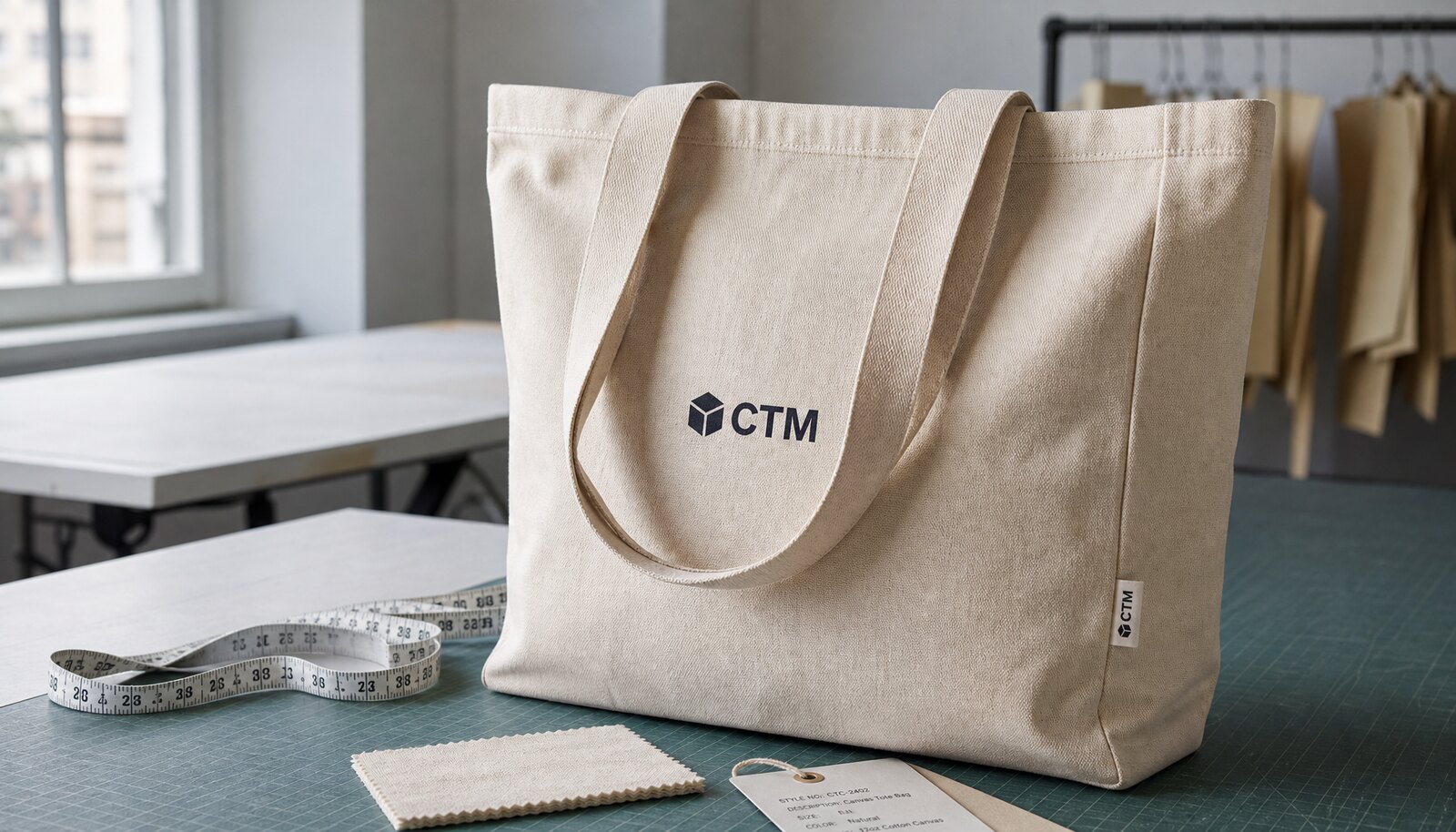
Why Winery Exhibition Totes Need a Different Spec
Wineries buy canvas exhibition tote bags for a different job than a grocery tote or a fashion accessory. The bag has to hold tasting notes, order forms, brochures, bottle sleeves, and sometimes a small sample kit while still looking clean on a trade-show table. That means the sourcing decision starts with function and brand presentation, not artwork alone. A good logo cannot compensate for a bag that folds in half, loses shape in transit, or fails at the handle after a few events.
For procurement teams, the real objective is repeatable brand use with low rework risk. The tote should look credible at the stand, survive handling by staff and visitors, and still be acceptable for a retail shelf or cellar-door giveaway. If the program will be reordered across seasons, the spec needs to stay stable from batch to batch. Many tote projects fail because the first sample is approved loosely, then the second production run shifts in shade, handle length, or print position because the buyer never froze the spec in writing.
- Use case first: tasting events, trade shows, distributor visits, and premium giveaways each need a different build level.
- A wine tote that carries only paper can be lighter than a kit that includes bottle inserts or product samples.
- Brand visibility matters, but not at the expense of seam strength, bag shape, or packing consistency.
Start With End Use, Not Artwork
Before you compare quotes, define what the bag must actually carry. A tote used for brochures and flyers can be built differently from one that needs to support a bottle sleeve, a corkscrew insert, or heavier tasting collateral. That difference affects fabric weight, gusset depth, handle length, and reinforcement. If the team only briefs the supplier on logo size, the factory will quote the easiest interpretation rather than the one that serves the winery's real use case.
The best buyer brief starts with the event scenario. Is the tote for a tasting room handout, an expo welcome pack, a distributor meeting, or a retail merch item? Once that is clear, the rest of the spec becomes easier to control. A 38 x 42 x 10 cm tote is a common starting point for winery exhibitions because it carries literature vertically and leaves room for inserts. If the bag must be worn over a shoulder during a long event day, handle drop becomes just as important as handle length.
- Write the intended load into the brief, not just the visual concept.
- Specify finished size, gusset depth, and handle drop as production dimensions, not artwork dimensions.
- If the tote may carry a bottle or heavier set, widen the gusset or add a base insert instead of relying on thicker fabric alone.
Material Choices That Change Cost and Performance
For most winery exhibition programs, 12 oz or about 400 gsm cotton canvas is the practical baseline. It gives enough body for paper inserts and event kits without making the bag excessively stiff or expensive to freight. If the tote only carries thin literature, 10 oz can work, but it often looks underbuilt for a premium winery brand. If the bag must support heavier sample packs or repeated use, move up to 14 oz or 16 oz and confirm that the sewing line can still keep the bag neat and flat.
Do not let the fabric discussion stop at ounces or gsm. Ask about weave density, finish, and whether the canvas is raw, washed, dyed, or bleached. Those details affect color consistency, print sharpness, shrink behavior, and the hand feel of the finished tote. A washed canvas can look more premium but may cost more and require tighter shade control. A dyed body can align better with a wine brand palette, but custom dyeing usually raises MOQ and lengthens lead time. These are not cosmetic choices only; they change production economics.
- Use 12 oz or 400 gsm as the default comparison point for most winery event bags.
- Ask the supplier to state the fabric finish and not just the nominal weight.
- Treat custom-dyed canvas as a separate cost and schedule item, not a free upgrade.
Construction Details Buyers Should Freeze Early
Small construction choices have a bigger effect on durability than buyers often expect. Long self-fabric handles are common because they keep the visual language simple and reduce sourcing complexity. What matters more is how those handles are attached. A cross-box stitch or bar-tack at the handle base distributes stress better than a basic single seam. If the tote will be reused across multiple events, that reinforcement is not optional. It is the difference between a bag that feels premium and one that feels disposable.
The same principle applies to the top edge and bottom seam. A neat top hem prevents the bag from collapsing at the mouth, and a reinforced bottom seam helps the tote keep its shape under load. If the bag is open-top, the opening should still sit flat enough for literature to be placed quickly at an event table. If a zipper is added, or if a board insert is used, the factory should show how that feature affects carton packing, stitch count, and MOQ. Extra structure is useful only when the buyer knows why it is there.
- Specify the handle attachment method, not only the handle length.
- Ask for bar-tack, cross-box, or equivalent reinforcement details in the quote.
- If the bag needs to stand upright, request a base insert or reinforced gusset rather than assuming fabric thickness will solve it.
Decoration That Survives Events And Reorders
For canvas exhibition tote bags for wineries, one- to two-color screen print is usually the safest decoration method. It gives sharp edges, predictable repeatability, and lower risk on coarse canvas than more complex print systems. It also keeps the quote easier to compare across suppliers. If the logo includes a fine crest, tiny text, or thin lines that do not reproduce well on textured canvas, a woven label or stitched side label may be the better brand treatment. Buyers should judge decoration by legibility and durability, not only by what looks impressive in a mockup.
Keep the layout restrained. A large front logo, a small side mark, and perhaps an interior stamp usually feel more premium than a crowded print system. Avoid placing critical artwork across seams, folds, or heavy stitch zones because those areas move during packing and opening. For natural, ecru, navy, or black canvas, simple artwork often looks more expensive than a busy design. If the winery wants a retail-ready finish, ask for print registration targets and a sample of the actual ink tone on the exact canvas body before bulk production starts.
- Use screen print for repeat runs and simple brand marks with one or two spot colors.
- Use woven or stitched labels when the identity needs fine detail or a premium finish cue.
- Keep key artwork away from seams, folds, and the top hem line.
Supplier Routes And Cost Drivers
Compare suppliers by production control, not by the lowest unit price. A direct factory with in-house sewing and printing is usually the best fit when the winery will reorder the same tote across seasons. It gives the buyer one accountable source for fabric reservation, print setup, sewing, and packing. A trading company can still work, especially if it manages multiple product types, but the buyer should know exactly where the bag is cut, printed, and packed. If those answers are vague, the quote may look clean while the production chain stays opaque.
The cheapest ex-factory price can become the most expensive landed result when setup, sample fees, packing, and freight are ignored. Ask each supplier to separate base bag cost from print setup, label cost, carton cost, and retail packaging. That makes supplier-side differences visible. For example, one factory may have a low sewing price but a high setup charge because it outsources printing. Another may have a slightly higher unit price but lower freight because it packs more efficiently. Procurement teams should compare landed cost, not just sticker price.
- Direct factory works best for stable artwork, repeat orders, and tight spec control.
- Trading company works best when you need mixed categories but adds another layer of accountability.
- Stock supplier works best for speed, not for custom consistency or long-term brand control.
- Always ask where the fabric is sourced, where the printing happens, and where final packing is done.
MOQ, Sampling, And Revision Control
MOQ should be tied to material and decoration, not only the bag shape. A supplier may accept a low quantity for blank canvas totes, but custom printing, dyed fabric, woven labels, or special packing usually push the practical minimum higher. That is normal. The buyer risk is not a higher MOQ by itself. The risk is when the supplier hides the real minimum by shifting the spec after order confirmation or by bundling setup costs into a vague quote. Ask for MOQ by size, artwork color count, and packing format so the commercial logic is visible before you commit.
Sampling should protect the order from small but expensive mistakes. Do not approve from a JPEG alone. Require a pre-production sample that shows the actual canvas, the actual ink, the actual thread color, and the actual handle length. Keep a signed gold sample on file. If the factory revises the sample after proof approval, treat that as a new revision and record the change. This discipline matters because canvas may look simple, but the wrong handle drop, logo placement, or packing fold can make the tote feel off-brand even when the bag itself is technically usable.
- Expect a higher MOQ when the order includes custom color canvas, multiple print colors, or extra labels.
- Keep one sealed gold sample for the exact bag that was approved.
- Record every revision to handle length, logo placement, and packing before bulk production starts.
- Ask whether sample fees are credited back on bulk order, and under what conditions.
Quality Control Standards Buyers Can Actually Use
Canvas tote quality problems usually show up in details that are easy to miss during sample approval. Common failures include handle asymmetry, crooked prints, seam puckering, broken stitches at the top corners, and size drift that makes carton packing inefficient. Buyers should not rely on a vague statement like good quality or standard export quality. Put measurable acceptance criteria into the order so the factory knows what will pass and what will be rejected. That is especially important for winery programs where the bag is a brand carrier, not a disposable giveaway.
A practical QC plan should combine visual inspection with simple tests. Use AQL 2.5 for major defects and 4.0 for minor defects as a baseline, unless the brand wants tighter control. Set finished size tolerance at about +/- 0.5 cm on key dimensions, and ask for print registration within about 3 mm for simple single-color artwork. For load-bearing confidence, request a static hang test at the agreed load for 60 seconds with no seam opening or handle tear. For print durability, ask for a dry and wet rub test using a standard textile method such as AATCC 8 or an equivalent factory procedure. If the ink system is sensitive, add a tape adhesion check on a printed sample panel. None of these measures is complicated, but together they give procurement leverage when you need to reject weak lots.
- Inspect the load-bearing seams, top edge, handle base, and print alignment first.
- Use AQL plus simple functional tests instead of relying on visual judgment alone.
- Measure against the approved sample, but back it with written tolerances and test methods.
Packing, Cartons, And Freight
Packing should match the end use. If the totes are for distributors, event teams, or warehouse rework, bulk packing by size and artwork is usually the most efficient route. If the bags must arrive retail-ready or gift-ready, then individual polybags may be worth the extra cost. The problem is that many quotes leave packing vague, so one supplier prices bulk packs while another prices retail-ready units. Those are not equivalent offers. The lowest price may only look better because the packing work was stripped out of the quote.
Carton planning is not a minor admin issue. Canvas bags compress differently depending on fabric weight, handle length, and whether they are folded with the print face in or out. Ask for inner pack count, master carton count, carton dimensions, and gross weight. If the cartons are too optimistic, freight cost becomes inaccurate and warehouse handling becomes messy. If the winery team will insert literature or relabel the bags later, bulk pack without over-packing is usually the better choice. The objective is to keep the logo uncreased, the cartons efficient, and the receiving team able to count stock quickly.
- Choose bulk pack for distributor handling and lower freight density loss.
- Choose retail pack only when the bag must be shelf-ready or gift-ready on arrival.
- Confirm that the logo is not hidden in the fold line or crushed by carton stacking.
- Ask for carton labels that match the PO item code and artwork version.
Schedule, Reorders, And Program Control
Winery purchasing is calendar-driven. Trade shows, harvest events, holiday gifting, and distributor meetings do not move because a tote bag is late. The main schedule risk is rarely sewing time alone. It is usually artwork approval, fabric reservation, print queue position, and packing changes that appear after the order is already moving. Build the timeline backward from the ship date and leave room for one revision cycle on the sample. If the order includes a custom canvas color or a new label, the schedule becomes less forgiving immediately.
In many factories, sampling takes about 7 to 14 days and bulk production about 25 to 45 days after approval, but those are planning ranges, not promises. Queue time and material availability can shift the real schedule. If the event date is fixed, freeze the bag spec early, close artwork fast, and avoid late changes to packing. For reorders, keep the gold sample, the final spec sheet, and the approved carton plan in one place so the next PO does not start from scratch. That is the simplest way to protect consistency across seasonal programs.
- Plan for sample approval before booking the shipping window.
- Lock artwork, fabric, and packing rules before the factory enters mass production.
- Keep one buffer week in the schedule when the order is tied to an event date.
- Store the approved spec so reorders do not depend on memory or old email threads.
Specification comparison for buyers
| Spec decision | Recommended option | When it fits | Buyer risk to check |
|---|---|---|---|
| Sourcing route | Direct factory with in-house cutting, sewing, and printing | Best for recurring winery programs, seasonal reorders, and artwork that must stay consistent | Hidden outsourcing can change print quality, lead time, and accountability if the supplier cannot name the actual production line |
| Fabric weight | 12 oz or about 400 gsm cotton canvas | Good balance for brochures, tasting notes, and light gift kits without making freight or storage inefficient | Too light can feel flimsy; too heavy can raise carton weight, add stiffness, and increase total landed cost |
| Print method | One- to two-color screen print on the main panel | Best for strong winery branding, clean edges, and repeatable production on coarse canvas | Small text, gradients, or too many colors can blur, crack, or force expensive setup changes |
| Handle construction | Long self-fabric handles with cross-box or bar-tack reinforcement | Fits event bags that may carry literature, a bottle sleeve, or a heavier welcome pack | Single-row stitching or weak handle base reinforcement can fail after repeated lifting |
| Bag size | About 38 x 42 x 10 cm or 16 x 14 x 4 in | Works for exhibition handouts, winery inserts, and premium giveaway use | If the gusset is too shallow, catalogs and inserts will sit awkwardly and pack poorly |
| Closure and structure | Open top for standard giveaways, optional zipper or base insert for premium kits | Useful when the tote doubles as a presentation pack or retail item | Extra components add labor, more quality points, and longer production time |
| Packing method | Bulk packed by size and artwork, with polybags only when retail-ready | Best for distributor programs, event teams, and warehouse relabeling | Individual polybags add labor, volume, and carton cost without improving the bag itself |
| Sampling route | Pre-production sample plus signed gold sample | Needed for first-time suppliers and every new artwork or construction change | Photo approval alone can hide shade drift, handle symmetry issues, and size variation |
Buyer checklist before sampling
- Lock the finished size, gusset depth, and handle drop in both cm and inches.
- Specify the fabric weight in gsm or oz, plus whether the canvas is raw, washed, dyed, or bleached.
- State the print method, number of colors, and exact artwork placement on the bag.
- Define the reinforcement at the handle base, top edge, and bottom seam.
- Confirm whether the bag needs a woven label, side label, interior stamp, or none.
- Choose the packing format, carton count, and whether individual polybags are required.
- Set the sample rule: pre-production sample, gold sample, and written approval signoff.
- Request quote lines for bag body, print setup, sample fee, packing, and carton charge.
- Ask for the MOQ by artwork, color, and size, not only one blended order minimum.
- Record the required lead time, ship term, and destination port or warehouse before sending the PO.
Factory quote questions to send
- What is the exact fabric weight, weave density, and finish you will use for this bag?
- Is the printing done in-house, or is any decoration outsourced to a third party?
- What is the MOQ by size, artwork color count, and packing format?
- Can you quote the bag separately from print setup, sample fee, and carton cost?
- What tolerance do you accept for finished size, handle length, and print registration?
- Can you provide a pre-production sample and keep a sealed gold sample on file?
- What are the standard inner pack and master carton dimensions, and how many bags per carton?
- What is the production lead time after sample approval and deposit?
- Which terms are included in the quote: ex-factory, FOB, or delivered pricing?
- What inspection documents, test reports, or packing photos can you supply before shipment?
Quality-control points to confirm
- Finished dimensions match the approved spec within the agreed tolerance band, typically +/- 0.5 cm on key measurements.
- Fabric weight is consistent across the lot, with no thin spots, weak weave, or visible slubs outside the approved material standard.
- Handle stitching is even, with secure reinforcement at the stress points and no loose or skipped stitches at the seam ends.
- Print position is centered and aligned, with no blur, double hit, color shift, or bleeding into the canvas weave.
- Thread ends are trimmed, seam lines are clean, and there are no broken stitches, oil marks, needle damage, or odor issues.
- Use AQL 2.5 for major defects and 4.0 for minor defects as a baseline incoming inspection plan, unless the brand requires tighter control.
- For load-bearing approval, use a static hang test of the agreed weight for 60 seconds with no seam opening or handle tear.
- For print durability, request a dry and wet rub test such as AATCC 8 or equivalent, and a tape adhesion check if the ink system needs it.
- The bag should pass a practical carry test with the actual event load, not only a visual inspection.
- Carton count, inner pack count, label information, and carton marks must match the approved packing list exactly.