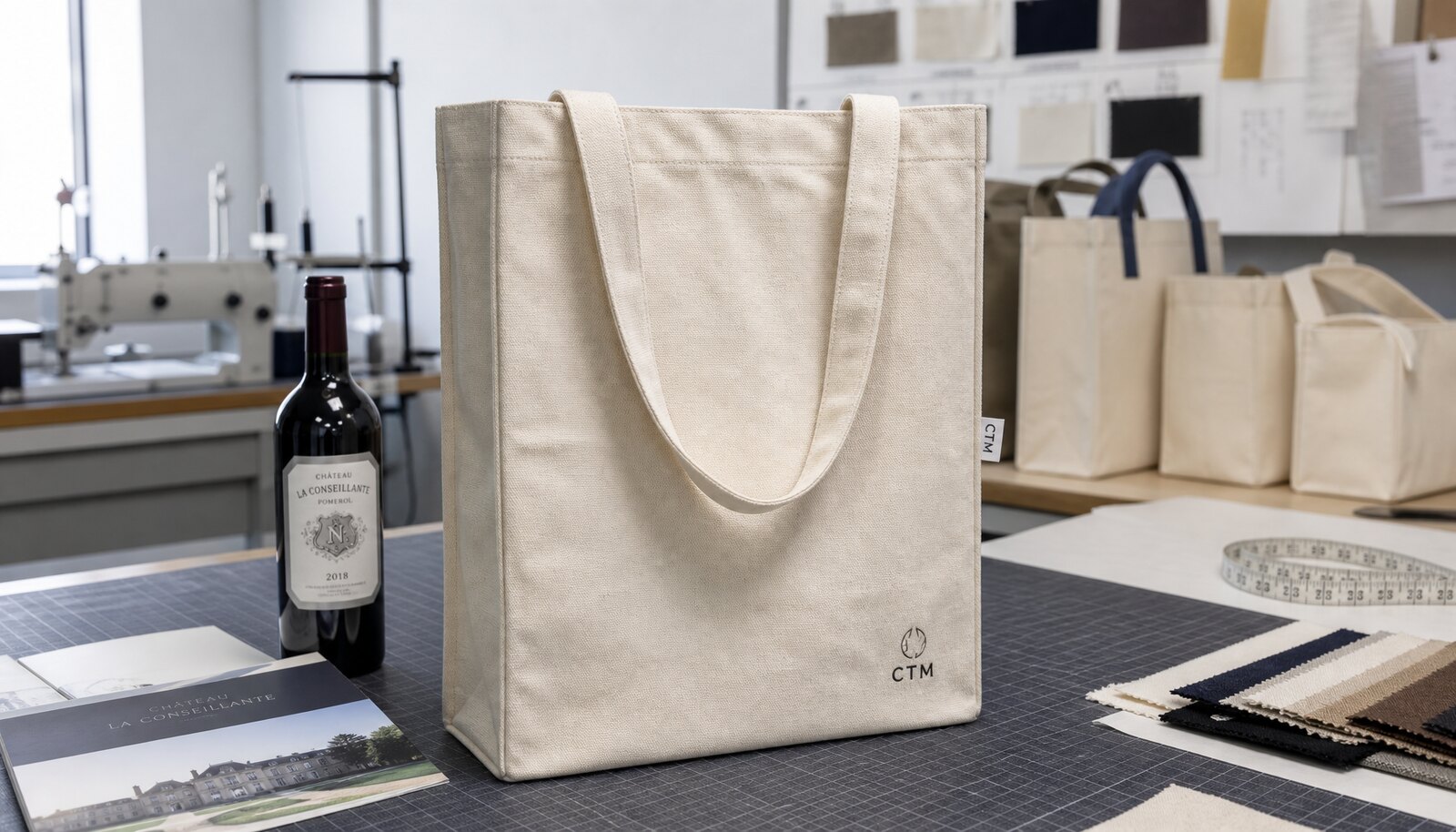
Start With The Packaging Job, Not The Tote Name
For wineries, a canvas exhibition tote bag is not just a giveaway. It is a packaging carrier, a merchandising object, and sometimes a brand proof point all at once. It may hold a single 750 ml bottle, brochures, tasting notes, inserts, a club signup card, or a small gift. That means the tote must be judged like packaging, not like a generic shopper bag. The wrong bag can look attractive on a table and still fail the first time a bottle shifts in the base or a handle twists under load.
The most useful first decision is the use case. A tote that carries one bottle to a trade fair needs different dimensions and reinforcement than a bag that only holds brochures. A tasting-room retail tote can justify a better print, a heavier canvas, and a more structured base because the customer may keep using it. An exhibition handout bag can be lighter if the contents are soft and low risk. Write the spec around what the bag actually carries, how often it will be reused, and what the winery wants the bag to signal on the shelf or at the event.
That distinction matters in sourcing too. Suppliers often quote the same-looking bag with different assumptions about fabric, sewing, and packing. If the RFQ only says “canvas tote,” the supplier will fill in the blanks with their own standard. A procurement buyer should instead define the load, dimensions, finish level, and whether the bag must protect glass, support a premium brand image, or reinforce a sustainability narrative. When that is clear, price comparisons become meaningful rather than cosmetic.
- Define the load: one bottle, two bottles, brochure pack, or mixed collateral.
- State the channel: exhibition handout, tasting-room retail, club fulfillment, or gift-with-purchase.
- Specify whether the bag must stand upright on a counter or only carry flat collateral.
- Decide early if a bottom board, bottle divider, or gusset shape is required.
- Note any reuse expectation: one event, repeat carry, or resale-grade use.
Fabric Weight Should Match Bottle Load And Reuse Expectations
Canvas weight is one of the biggest drivers of feel, strength, and quote variance. For a light handout bag, 8 oz canvas can work if the contents are soft and the tote will not be reused often. Once a glass bottle enters the picture, most buyers should start at 10 oz or 12 oz. In common conversion terms, 10 oz is about 340 gsm and 12 oz is about 407 gsm. Heavier canvas usually gives better stitch holding, better shape retention, and a more premium hand feel when the bag is placed on a table or shelf.
Standard cotton canvas is the easiest route when the buyer wants predictable print results and lower commercial risk. Recycled cotton can support the sustainability story, but it often brings more slub, more shade variation, and less uniform surface texture. That is not automatically a problem; it is a design decision. Organic cotton is even more claim-heavy, which can help with positioning, but it usually narrows the supplier pool and can increase both price and lead time. The bag should be chosen for the real use case first and the sustainability message second.
For wineries, the commercially useful question is whether the fabric can safely carry the bottle without stretching, sagging, or making the tote look tired after only a few uses. Heavier is not always better either. Very heavy canvas can make the tote stiff, raise freight cost, and reduce foldability for exhibition distribution. The best weight is the one that balances strength, print surface quality, packing efficiency, and the perceived value of the final tote.
When comparing quotes, ask the supplier to state the fabric weight, weave density if available, shrinkage range, and whether the base fabric is bleached, natural, dyed, or recycled-content material. If the supplier cannot separate those details, the quote may be too vague to compare honestly.
- Use 10 oz canvas for brochure-plus-light-item handouts and low-load kits.
- Use 12 oz canvas when the tote must carry one bottle and still feel reusable after the event.
- Consider 14 oz only when the tote is a premium retail item or needs a firmer structure.
- Ask for fabric lot photos and a specification sheet, not just the marketing name of the material.
- Check whether the fabric can shrink or skew after steaming, washing, or long storage.
Print Method Affects Branding, Durability, And Reorder Economics
Decoration is not just a branding choice; it is a lifecycle choice. On canvas exhibition tote bags for wineries, one-color screen print is still the most dependable option for simple logos and strong unit economics. It handles folded storage well, it is easy to inspect visually, and it usually gives the cleanest result on natural or bleached canvas. If the artwork is simple, this route often has the lowest risk of rework and the easiest sample approval process.
Water-based or low-odor ink systems can fit a sustainability-led program better than heavy plastic-like inks, but buyers should not assume those terms automatically mean better performance. The key is whether the ink survives folding, handling, and repeat use without cracking or sticking. Embroidery can look premium, but on lighter canvas it may pull the fabric or distort the panel if the stitch density is too high. Heat transfer can work for short runs or complex art, yet it needs a fold, rub, and edge-lift check before bulk approval. Digital print may help with detail, but it can be harder to control across lots if the fabric is not consistent.
For many winery programs, the best commercial solution is a simple front print combined with a sewn woven label or side label for traceability and merchandising consistency. That combination keeps the brand visible while avoiding over-designed decoration that can raise cost and reduce durability. The point is not to use the most creative method. It is to choose the decoration that will still look right after travel, event handling, and warehouse storage.
When the art is approved, lock it down. Buyers should specify print size, placement from seam or top edge, Pantone target if relevant, number of colors, and whether the print must be visible when the tote is folded. A clean drawing is worth more than a loose verbal instruction because it prevents the supplier from making a judgment call at production time.
- Keep the main logo simple if unit economics and durability matter.
- Specify exact logo size, placement, and color reference before quoting.
- Ask for a folded sample, not only an open-flat proof.
- Require a rub test and a visual check after folding if the bag will be stored or shipped flat.
- Use a woven or sew-on label when you want a subtle traceability cue without adding much print complexity.
Sourcing Route Changes What You Really Pay For
A sustainable packaging comparison is only useful if the sourcing route is compared honestly. The same tote can be offered by a factory, a trading company, or a local decorator, but the quote may include very different services. Factory direct usually gives the best visibility into fabric, stitching, and packing. That matters when a tote has to carry a wine bottle and support a sustainability story. Trading companies can help when the buyer is short on internal sourcing capacity or needs several packaging items coordinated together. Local decorators can be practical for urgent domestic orders or event-only runs, but the buyer may have fewer material choices and less control over the sewing standard.
The tradeoff is not simply price versus service. It is control versus convenience. A factory can often hold tighter control over material origin, reinforcement, and carton packing. A trading company may be able to bundle smaller needs and move faster across languages and regions, but the buyer should be careful about who actually owns quality control. A local decorator may be able to hit a tight event deadline, but if the bag body is sourced elsewhere, the buyer still needs proof of what was actually used. Otherwise the quote is not directly comparable.
A procurement buyer should compare the same bag body, same decoration method, same carton count, and same incoterm across every source. If one quote is EXW and another is FOB, the numbers do not mean the same thing. If one supplier includes labels and inner packing while another excludes them, the unit price is misleading. The cleanest comparison is a line-by-line quote that shows exactly what is included and what is not. Only then does the route choice become a real commercial decision rather than a gut feel.
- Compare the same dimensions, same fabric weight, same print area, and same packing method across all suppliers.
- Separate body cost, decoration cost, packing cost, sample cost, and freight basis.
- Do not compare a factory-direct quote with a local retail decorator quote unless the service scope is identical.
- Ask the supplier who owns final QC and what evidence they can show from a similar run.
- Request a named port, named warehouse, or named delivery basis for every quote.
Use A Buyer Comparison Framework To Sort Factory, Trading, And Local Options
Buyers often receive three offers that look like they refer to the same tote, but each one sits in a different commercial model. One supplier may quote a plain natural canvas bag with one-color print. Another may include recycled cotton and a woven side label. A third may look cheaper because it excludes setup, freight, or packaging details. To make the comparison useful, score the supplier route on the things that actually matter in a winery program: production control, sustainability proof, response speed, reorder stability, and landed cost.
The table below is a practical comparison lens rather than a marketing ranking. Factory direct is usually the strongest route for repeat orders and custom sizes because it gives the buyer the most leverage over the spec. Trading companies can be helpful when the buyer needs several items coordinated or wants a smoother communication layer. Local decorators can be the fastest option for urgent event work, especially when the bag body is standard and the buyer only needs a simple print. None of those routes is automatically best. The right answer depends on whether the program is a one-time event, a seasonal retail offer, or a recurring winery packaging line.
For sustainability-led buying, route choice also affects proof quality. A factory is more likely to provide source documents for fabric and packaging materials, while a reseller may only pass along summaries. That does not make the reseller unusable, but it does mean the buyer should ask harder questions about traceability and documentation. In a buyer review, a clean paper trail often matters as much as the tote itself.
- Score suppliers on control, proof, speed, price stability, and reorder ease.
- Treat a very low quote as a scope review until the inclusions are verified.
- Ask each supplier to identify what they manufacture themselves and what they outsource.
- Use the same bag specification document for every route so you are comparing like with like.
- Require sustainability documents to be attached to the actual quoted material, not to a generic catalog item.
Sustainability Claims Need Documentary Proof, Not General Statements
Wineries are often asked to support packaging choices with more than a green-looking product photo. For that reason, sustainability claims should be backed by documents that procurement can actually file and audit. If the tote is recycled cotton, ask for recycled-content verification that names the material source, the percentage claimed, and the document type used to support it. If the tote is organic cotton, ask for the applicable certification number and scope, not only a verbal promise. If the packaging is meant to be more recyclable or lower waste, request the packaging-material declaration, so the receiving team knows whether polybags, tissue, belly bands, and cartons align with the claim.
The useful standard is not perfection; it is traceability. Buyers should know whether the factory can provide fiber content declarations, certification references, and carton material details. If the supplier mentions a well-known program such as GRS, GOTS, FSC, or another certification, ask for the scope certificate and whether the exact factory, material, and order fall within that scope. If the claim is about recycled content, ask whether the verification applies to the yarn, the fabric, or the full tote. Those are not interchangeable. A buyer can support a better sustainability story only when the paperwork matches the physical goods.
The same discipline should apply to packaging. If the winery wants minimal plastic, the supplier should be able to state what replaces the polybag, how the product is protected during shipping, and whether the carton paper has any relevant documentation. If the tote uses a recycled label or kraft insert, ask for material specification, adhesive details where relevant, and whether the item creates any recycling conflicts. In B2B procurement, sustainability is strongest when the documents are specific enough to survive legal, marketing, and warehouse review.
If the supplier cannot provide the documents, that is not necessarily a dealbreaker. It does mean the claim should be downgraded from verified to informational, and the buyer should be careful about how the product is described externally.
- Request fiber content declarations and recycled-content verification for the exact quoted material.
- Ask for certification scope, certificate number, and factory name when organic or certified materials are used.
- Get a packaging-material declaration for cartons, inserts, labels, and any polybags or wraps.
- Clarify whether the sustainability claim applies to the fabric only or to the full finished tote.
- File the supporting documents before marketing copies or catalog claims are finalized.
MOQ, Lead Time, And Reorder Stability Should Be Reviewed Together
MOQ should never be treated as a standalone number. In canvas tote production, the minimum usually depends on fabric width, fabric color, print setup, label type, and how efficiently the factory can cut and pack the order. A simple natural canvas tote with one-color print may have a much lower MOQ than a custom dyed, lined, or label-heavy version. Once recycled cotton, special webbing, or extra reinforcement is added, the minimum often rises because the factory has to buy or schedule materials in larger batches.
For winery buyers, the more useful question is how the order structure affects repeatability. If the tote will be reordered for every tasting season or trade event, then consistency matters more than squeezing the first run by a small amount. A buyer may get a better commercial outcome by choosing one universal bag body and changing only the label or print version, instead of creating several fully custom styles that are hard to reproduce. A repeatable spec also makes inventory management easier, especially when the tote is used across regions or channels.
Lead time should be broken into sample approval, raw material availability, sewing, printing, packing, and transit. A quote that only says “30 days” is not enough. Recycled or organic fabrics can add time if the mill or greige stock is not on hand. Custom labels, special handfeel requirements, or a change in packing method can also extend the schedule. Buyers who work backward from the event date rather than from the purchase order date usually avoid the most expensive last-minute decisions.
The strongest buyer practice is to freeze the artwork and sign off the sample before the production slot is locked. If changes happen later, they should be treated as controlled revisions with an updated lead time and cost impact. That approach prevents confusion and keeps the supplier accountable for what was actually approved.
- Request price breaks at three or more quantities so you can see the true MOQ effect.
- Ask whether MOQ changes by fabric color, print color, label type, or packing style.
- Keep the first order to one style unless there is a real channel reason to split it.
- Separate sample time from bulk production time in every schedule.
- Set a change-control rule so late artwork edits do not reset the whole timeline.
Sample Approval Should Test The Tote With Real Wine Use Cases
A sample for a winery tote should be judged with the real bottle, real collateral, and real handling scenario. Many tote samples look acceptable when empty and fail once a bottle is inserted. The handle feels too short, the base sags, or the bag narrows in a way that makes the bottle awkward to remove. A proper approval round should include the exact bottle diameter and weight, any brochure pack or insert, and any divider or bottom board the finished product is expected to use.
The sample also needs to prove the decoration method. Buyers should inspect logo clarity, edge definition, ink coverage, seam direction, and whether the bag folds neatly without scuffing the print. If the tote is supposed to support a premium or sustainable brand image, the sample should also show that the finishing choices do not create unnecessary waste or a visually cheap look. The approval note should be specific: what passed, what failed, and what is acceptable as a controlled variance. That is far more useful than a generic “approved.”
For bottle carriers, one of the most useful tests is a simple carry and set-down test. Put the real bottle in the bag, carry it by the intended handle, set it down on a flat surface, and check whether the base stays balanced. Then fold the bag as it will be packed or warehoused and inspect whether the print cracks, the stitching puckers, or the corners hold their shape. This kind of sample approval is fast, but it captures the failure modes that matter most in winery use.
If the bag is meant for a bottle and collateral set, test both the load and the fit. The print may look excellent, but if the tote cannot handle the actual contents comfortably, the spec is wrong. Sample approval is the cheapest point to find that out.
- Test the bag with the exact bottle format intended for market.
- Measure handle drop and confirm both hand carry and shoulder carry if required.
- Check print rub, stitch pull, and fold memory before bulk approval.
- Record any acceptable deviation in writing so the factory is not guessing later.
- Approve the sample only after the actual contents fit without forcing the seams or base.
Packing, Labeling, And Warehousing Details Affect The Real Cost
Packing is a commercial decision, not a side detail. If the tote is heading directly to an exhibition floor, the buyer usually wants clean presentation and low scuff risk. For export, 25 or 50 pieces per carton is common, but the right carton count depends on shape retention, carton size, and how the bags will be received at the destination. If the order supports a sustainability program, some buyers prefer no polybags. That can work, but the warehouse and receiving team should agree first, because loose-packed canvas can collect dust or pick up handling marks during transit.
The best packing specification is the one that preserves the bag shape, keeps the count accurate, and fits the warehouse process. Ask the supplier for carton dimensions, gross weight, and whether the cartons are designed for sea freight or only for short domestic transport. If the shipment is going to a trade-show contractor, the carton marks should include style, color, quantity, destination, and event reference. If the shipment will be palletized, the pallet pattern and stacking height should be confirmed before freight is booked.
Labeling also matters when the tote is part of a larger winery program. Woven side labels, sew-in care labels, and carton labels should all match the approved spec. If there is a recycled-content or organic claim, that claim should appear in the right place and in the right wording. The label should not overstate anything the supplier cannot support. A buyer that checks packing and labeling at sample stage avoids receiving disputes later, especially when the bags are distributed across multiple channels or event partners.
- Specify whether you want polybags, tissue wrap, belly bands, or no plastic at all.
- Confirm carton count and whether handles will be folded in one direction to reduce deformation.
- Ask for carton dimensions before booking freight so pallet and container loading can be planned.
- Request packed-carton photos before departure if the shipment is time-sensitive.
- Make sure label wording matches the documents that support any sustainability claim.
Compare Landed Cost By Line Item And By Usable Tote
A tote that looks inexpensive on paper can become costly after the full quote is loaded. Real landed cost includes sample charges, print setup, labels, packaging, cartons, inland freight, export freight, duty assumptions, and any rework allowance. On winery programs, buyers should also think about the cost of failure. If a seam opens at an event or a print looks weak after handling, replacement cost can erase the savings from the cheapest quote. A slightly better spec can be cheaper over the life of the program if it reduces defects and avoids last-minute reorders.
The most useful comparison is a line-item quote normalized to one incoterm. If one supplier quotes EXW and another quotes FOB, the prices are not directly comparable. Ask for the bag body, decoration, packing, cartons, and freight basis as separate lines. Then compare the total delivered cost, not just the unit cost. For internal procurement approval, it can help to calculate the cost per usable tote, where defect allowance and replacement probability are included in the estimate. That is especially relevant for trade fairs, tasting-room retail, and club fulfillment where presentation quality matters.
A simple cost model can help the team avoid false savings. Start with the base bag price, add decoration, add packing, add cartons, add freight, and then add a small contingency for inspection rejects or replacements if your program is sensitive to appearance. If a supplier cannot support the spec cleanly, the lowest quote may be the least useful one. In B2B packaging, the right question is not “Who is cheapest?” It is “Which quote gives the right tote at the lowest risk-adjusted delivered cost?”
When comparing suppliers, ask them to explain any unusually low line item. Sometimes the quote is competitive because it uses stock fabric or standard packing. Sometimes it is low because the supplier omitted something important. A buyer should be able to identify that difference before the order is released.
- Request line-item pricing for body, print, label, packing, carton, and freight basis.
- Normalize all quotes to the same incoterm before comparison.
- Include defect allowance and replacement risk in the landed-cost view.
- Ask for price breaks at multiple quantities to see how the curve moves.
- Treat unusually low quotes as scope checks until inclusions are verified.
Specification comparison for buyers
| Decision area | Best-fit option | Buyer tradeoff | Procurement note | QC or proof to request |
|---|---|---|---|---|
| Fabric route | 10 oz to 12 oz cotton canvas; recycled cotton if claim support is needed | Heavier fabric costs more but carries bottles better and feels more premium | Match weight to bottle load, not just to price target | Fabric spec sheet, fiber composition, shade tolerance, shrinkage range, and lot photos |
| Supplier route | Direct cut-and-sew factory with in-house print and packing | Best control and usually cleaner reorders; higher coordination effort at the start | Best for repeat winery programs and custom dimensions | Factory profile, production photos, line capability list, and recent inspection record |
| Supplier route | Trading company or sourcing agent | Easier communication and bundle management, but less visibility into material origin | Useful when the buyer needs multi-product coordination or limited internal sourcing time | Factory disclosure, material traceability, and confirmation of who actually owns QC |
| Supplier route | Local decorator or print house | Fast for urgent domestic runs, but fewer fabric options and less control over bag construction | Works for short lead times and smaller campaigns | Sample of actual bag body, print proof, and confirmation of construction source |
| Decoration route | One-color screen print plus woven or sew-on label | Lower decoration cost and durable brand presentation | Best for simple winery logos and exhibition handout bags | Print strike-off, Pantone reference, wash/rub test, and placement measurement |
| Decoration route | Embroidery or mixed decoration | Premium look, but higher cost and more risk on lighter canvas | Only use when the brand wants a stitched feel and accepts higher setup cost | Stitch density, needle pull check, and test on the exact canvas weight |
| Decoration route | Heat transfer or digital print | Good for small runs or art with fine detail, but durability must be checked | Avoid if the tote will be folded, handled, or reused many times | Crack test after folding, abrasion check, and edge-lift review |
| Handle construction | Cotton webbing or self-fabric handles with bar tack or X-box reinforcement | Better for bottle loads; slightly higher sewing time | Critical for wine carriers because handle failure ruins the user experience | Handle drop, stitch count, bartack length, and pull-test evidence |
| Closure and insert | Open top with optional bottom board or bottle divider | Simple and cost-efficient, but open tops protect less during transit | Use inserts only when the bottle format or brand kit really needs them | Fit test with actual bottle diameter, board thickness, and carton-size impact |
Buyer checklist before sampling
- Define the end use first: one bottle, two bottles, brochure pack, tasting-room retail, or club fulfillment.
- Lock the fabric weight in oz and gsm, plus whether the bag must be standard cotton, recycled cotton, or organic cotton.
- Specify bag dimensions, gusset depth, handle length, handle drop, and whether a bottom board or divider is required.
- Set the decoration method, print size, logo placement, and Pantone target before requesting final pricing.
- Ask for a real pre-production sample made from the exact production fabric and tested with the actual bottle format.
- Require line-item pricing for body, print, labels, packing, cartons, and freight basis so hidden costs are visible.
- Confirm overrun/underrun policy, lead time after sample approval, and who signs off on change control.
- Request sustainability documents up front: fiber proof, recycled-content verification, packaging material declaration, and any relevant certification numbers.
- Verify carton count, carton dimensions, and receiving labels so the warehouse can handle the shipment without repacking.
- Document acceptance tolerances for size, stitching, print placement, and fabric shade before production starts.
Factory quote questions to send
- What fabric weight, fiber content, and shrinkage range are you quoting, and can you attach the spec sheet?
- Is your price EXW, FOB, or CIF, and which port or warehouse should we use for comparison?
- What is the MOQ per color, per print method, and per label option?
- Are screen fees, plate fees, artwork setup, sample charges, and carton charges separate from the unit price?
- What are the exact bag dimensions, handle length, handle drop, and gusset size in the quote?
- How many pieces per carton, what are the carton dimensions, and what is the gross weight per carton?
- What is the production lead time after sample approval, not including sea or air transit?
- What is your acceptable overrun or underrun range, and how do you treat under-shipments?
- Can you share photos from a similar canvas tote run, including in-line QC or final inspection records?
- What material and packaging documentation can you provide to support recycled, organic, or recyclable claims?
Quality-control points to confirm
- Check fabric weight against the approved spec and confirm the lot does not drift beyond the agreed tolerance.
- Measure body width, height, and gusset on random pieces and set tolerances tight enough for retail packing and bottle fit.
- Inspect handle reinforcement, bartacks, seam density, and stitch-back at the stress points where the bottle load sits.
- Confirm print placement, color match, and edge sharpness on the first pieces, middle of run, and final pieces.
- Test the bag with the actual bottle format plus brochures or inserts to confirm fit, balance, and base stability.
- Rub-test the print after folding and handling to see whether the ink cracks, smears, or sticks together.
- Open cartons at random and verify count, folding direction, label placement, and scuff control.
- Reject pieces with odors, loose threads, oil marks, broken stitches, or visible contamination.
- Check carton compression and corner strength if the shipment will move by sea or stack in a warehouse.
- Capture photo evidence at sample approval, first article, midline, and final packing before release.