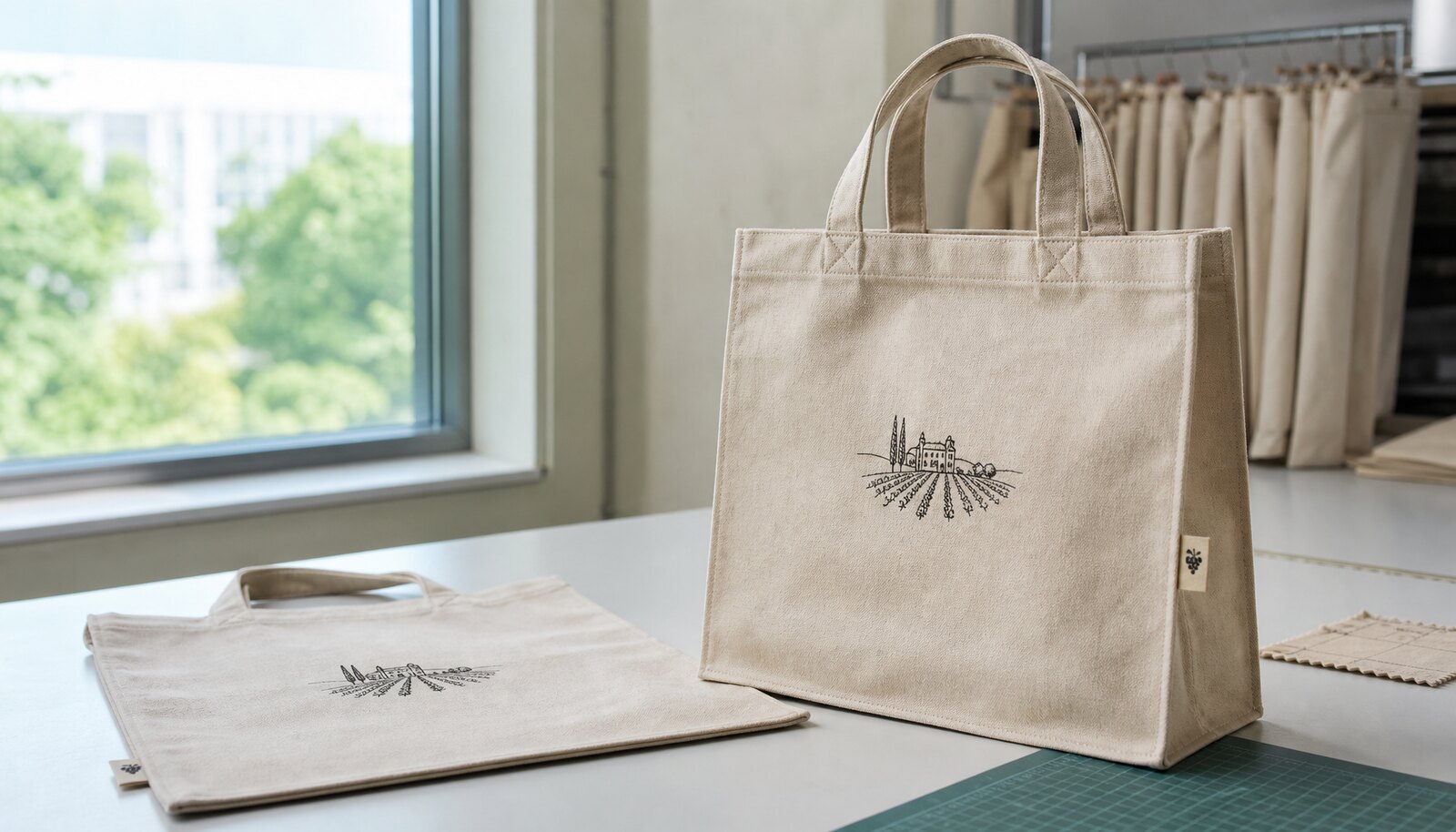
Why Winery Tote Specs Need More Discipline Than a Generic Giveaway Bag
A canvas exhibition tote for a winery has a narrower job than a general promotional bag. It needs to carry a bottle, tasting notes, and retail add-ons without collapsing, while still looking good enough to sit at a tasting counter or travel home with a customer. That means the buyer should start with load behavior, presentation, and receiving channel, not with artwork alone. If the bag is only for brochures or a trade-show handout, the spec can be lighter. If the winery expects customers to leave with wine purchases, the construction, handle length, and bottom support need more attention.
This is where many RFQs fail. A request that says only "canvas tote with logo" forces the supplier to guess the use case and fill in the gaps from their own defaults. The result is usually a quote that looks competitive until the buyer discovers the handles are too short, the print is too small, or the carton pack does not fit the warehouse plan. For winery programs, a better brief separates event use, retail use, club gifting, and bottle carry, because each one changes the bag spec and the acceptable price range.
The buyer also needs to think about brand behavior after the event. A tote is not a one-time leave-behind. It is a visible object that may get reused in public, placed on a tasting counter, or sold in a retail environment. That makes construction consistency and visual finish important procurement variables, not just style preferences. A bag that looks fine in a sample photo can still fail the brand if it wrinkles badly, tips over when set down, or shows cheap stitching around the handles.
The practical rule is simple: if the tote will represent the winery after handoff, the buying spec must be tighter than the casual gift-bag standard. That does not mean overengineering every order. It means matching the bag to the real job and rejecting vague sourcing language that hides the tradeoffs.
- Define the use case before asking for a price.
- Separate event carry, bottle carry, retail resale, and gifting into different programs if needed.
- Treat the tote as a branded utility item, not just a print surface.
Start With the Load, Then Set the Bag Dimensions
For wineries, the most useful starting point is the intended load. A bag built for brochures only does not need the same fabric body or handle reinforcement as a bag expected to hold one or two wine bottles plus packaging inserts. Once the load is clear, the bag dimensions become easier to set. The buyer can then decide whether the tote needs a wide opening for quick packing, a deeper gusset for bottle stability, or a taller body for retail visibility.
A practical way to write the spec is to define the contents first, then the dimensions. For example: one bottle plus a brochure pack, or two bottles plus a tasting sheet, or retail purchase plus gift card. That gives the supplier a real target for gusset depth, base width, and handle drop. It also helps the procurement team avoid the common mistake of approving a bag that looks fine on paper but is awkward in hand because the opening is too narrow or the handle length does not match the way customers actually carry the bag.
The body size should also reflect the environment. Trade-show carry favors a shoulder drop and a bag that folds flat when empty. Tasting-room retail often favors a slightly shorter handle and a cleaner silhouette for shelf display. If the tote is going to sit on a retail wall or beside the register, the front panel area and logo placement matter as much as capacity. Buyers should check whether the bag must stand upright for point-of-sale use or only remain functional in transit.
One useful procurement move is to ask the supplier to quote against a measured sample load rather than a generic dimension. If the bag must fit a 750 ml bottle with insert, say that directly. If the bag must carry two bottles without the handles cutting into the top seam, say that as well. Clear load language reduces dispute later and keeps the final bag from being underbuilt.
- Write the spec around the intended contents, not around a vague size guess.
- Confirm whether the bag must stand upright or only carry flat items.
- Check handle drop against the expected carry style: hand carry, shoulder carry, or mixed use.
Fabric Weight and Construction: Where Most Quality Differences Show Up
For standard winery exhibition use, 12 oz canvas is usually the most practical base. It gives enough structure for a branded tote without driving cost or freight too high. Move up to 14 oz or 16 oz when the bag needs a more premium hand feel, when it will regularly hold bottle weight, or when the winery wants the tote to feel closer to retail merchandise than a free event handout. Heavier fabric also helps the print sit flatter, which is useful when the logo includes filled areas or needs strong contrast on natural canvas.
Do not compare quotes only by the stated ounce weight. Ask how the supplier measures it, whether the canvas is unbleached, bleached, or dyed, and whether the bag includes reinforcement at the handle joins and bottom stress points. A well-made 12 oz tote with bartacked handles and a gusset can outperform a loose 14 oz bag with weak seams. Buyers should also ask about stitch count, seam allowance, and whether the bag uses single-needle, double-needle, or bartack reinforcement at the highest load points.
The right way to judge construction is to tie it to the use case. If the tote is for brochures and tasting-room retail add-ons, a medium-weight body with clean finishing may be enough. If the tote is for bottle carry, check the bottom panel width, whether the side seams are locked cleanly, and whether the handle joins are supported by extra stitching or reinforcement patches. If the bag will be reused often, the buyer should care about seam neatness and thread control because loose threads and crooked seams signal weak process control even before the bag fails.
A supplier should be able to explain the fabric source, stitching sequence, and what prevents the handles from tearing out under load. If that explanation is vague, the bag spec is probably vague too. For procurement, that is a warning sign. The goal is not to buy the heaviest canvas on paper. The goal is to buy the lightest construction that still survives the actual carry requirement with acceptable appearance and repeatability.
- 12 oz: practical baseline for most event and tasting-room programs.
- 14 oz: stronger visual body and better fit for bottle carry or resale.
- 16 oz: premium feel, but heavier freight and higher unit cost.
- Reinforcement at handles and base matters as much as nominal fabric weight.
Decoration Choices: Pick the Method That Matches the Brand Job
Most winery logos work well with one-color or two-color screen print. It is the most economical method for bulk orders, it reads clearly on natural canvas, and it allows the buyer to keep the order simple. If the logo includes fine lines, serif text, or a detailed crest, the supplier should show how the print will behave on the actual fabric rather than on a smooth digital mockup. On canvas, mesh count, ink deposit, and curing quality matter. A print that looks sharp on screen can still wash out or fill in if the fabric surface is too rough or the ink is too thin.
Embroidery and woven labels serve a different commercial purpose. They make sense when the tote is part of a premium retail line, club-member gift, or visitor purchase that needs to feel more like merchandise than a giveaway. The tradeoff is cost, rigidity, and sometimes slower production. Embroidery can stiffen the front panel and change the drape, which is not always desirable on a soft tote. Woven labels are useful when the buyer wants subtle branding or a secondary brand mark, but they should be checked for stitch edge quality, corner curl, and attachment method.
Heat transfer can work for short runs or samples, especially when the artwork is more complex than the main run justifies. The risk is feel and wear. On canvas, a transfer may sit more obviously on the surface than buyers expect. That is acceptable for some event programs, but it should be tested if the tote is meant for repeated use or retail resale. For logos that are small or text-heavy, buyers should ask the supplier to show actual legibility at the final size, not a scaled-up artwork proof.
A practical brand rule helps here: if the tote is supposed to promote the winery, screen print usually wins on value and clarity. If the tote is supposed to be bought as product, ask whether the decoration method supports the shelf price. That keeps decoration choices aligned with commercial intent instead of defaulting to the most familiar option.
- Screen print is the default for simple winery logos and repeat orders.
- Embroidery adds perceived value but can stiffen the panel.
- Woven labels work well for restrained branding or premium presentation.
- Approve the decoration on the actual fabric, not only on a digital render.
Sourcing Routes, Regions, and Commercial Terms That Affect the Real Price
The right supplier route depends on how tightly the buyer needs to control the spec. A direct factory is usually the best fit when the winery wants repeatable quality, clear sample control, and a clean path to reorders. The factory can confirm fabric weight, seam method, print process, and packing in one conversation. That matters for a product like a canvas exhibition tote because the bag is both functional and brand-facing.
A trading company can be useful when the buyer is consolidating multiple products into one shipment or when the internal team wants a broader procurement partner. The downside is that the quote may bundle too many details together. It becomes harder to see whether the price difference comes from fabric, printing, packing, or an unseen margin layer. Regional decorators can be helpful for urgent domestic replenishment, but the buyer still needs the same inspection discipline because local production is not automatically better; it is only easier to manage when the timing is tight.
Region matters because it changes lead time, freight, and the commercial term you should ask for. A factory in Asia may quote EXW or FOB, which requires the buyer to understand origin handling and ocean or air freight. A domestic shop may quote delivered pricing or standard freight included. None of those terms is inherently better. The important point is that the buyer compares apples to apples. If one quote includes destination delivery and another does not, the unit price is not directly comparable.
The buyer should also ask who owns each risk point. EXW pushes more work to the buyer. FOB simplifies the export side if the forwarder is already in place. DDP can be useful for some importers, but it hides cost structure and may complicate compliance if the supplier is not experienced. For procurement, the best choice is usually the term that matches the buyer's logistics capability, not the one that merely looks lowest on a quote sheet.
- Direct factory: best for repeat quality and transparent spec control.
- Trading company: useful for mixed-line sourcing, but less transparent on cost structure.
- Domestic decorator: useful when speed matters more than lowest unit cost.
- Ask which commercial term is quoted: EXW, FOB, or DDP.
- Choose the route that can produce a physical sample matching bulk production.
Quote Like a Buyer, Not a Catalog Shopper
A useful quote separates the item into visible cost pieces. Bag body, handles, stitching, print, label, sample fee, setup cost, packing, and carton marks should all be clear. If the supplier gives one all-in number without stating the fabric weight or decoration method, the quote is not ready for internal approval. It may still be useful as a rough screen, but it is not reliable enough for landed-cost comparison.
For winery tote programs, the most common hidden costs are setup fees for artwork, extra print colors, woven label tooling, individual polybagging, and carton labels or inserts. These are not minor details. They change the effective unit price and can also affect freight because packing method changes carton count and volume. Buyers should ask for the quote on a single spec version first, then ask how the price changes if the winery adds a second logo version, a different handle length, or retail-ready packing.
A good RFQ package is short but complete: a spec sheet, artwork file, packing instruction, target order quantity, and a note on the end use. The supplier does not need a long story. It needs the right technical inputs so the quote reflects the same product the buyer intends to receive. If the buyer expects the supplier to infer load, pack style, and quality level from a product name alone, the resulting quote will almost always miss something important.
To compare suppliers cleanly, ask each one to quote the same base version and to list all optional charges separately. Then compare not only the unit price but also the total landed cost at the same delivery term. That keeps the procurement team from choosing a cheap-looking quote that becomes expensive after packing, freight, and rework are added.
- Request a line-item quote, not just a unit price.
- Ask which costs are one-time setup fees and which are per-bag costs.
- Quote one spec version first, then price any variants separately.
- Use the same spec sheet across all suppliers so the quotes are comparable.
Sample Approval and QC: Where Buyers Should Be Strict
A digital mockup can approve artwork placement, but it cannot approve the bag. For a winery tote, the pre-production sample needs to use the same canvas, same thread, same decoration method, and the same trim that will be used in bulk production. The buyer should measure the sample, inspect the seam lines, and test the handle pull with a realistic load. A bag that looks acceptable while empty can fail once a bottle shifts inside it. That is especially relevant for exhibition orders, where the bag is often carried all day and handled by customers who will notice poor construction quickly.
The sample review should be documented. Mark the approved print position, handle drop, top hem, gusset depth, and any logo placement relative to seams or edges. If the brand wants a specific visual alignment, write it down instead of relying on a verbal note. Keep one signed sample as the gold standard. If the factory later ships bags that differ from that sample, the buyer needs a clear reference for rejection or rework.
Inspection should be structured enough to catch real factory failures, not just cosmetic preferences. Common defects worth rejecting include wrong logo version, broken seams, missing bartacks, off-center print, obvious stains, and carton short-ships. Slight thread ends can be trimmed, but structural defects should not be tolerated on a branded tote program. If the tote is intended for retail resale, the buyer should also check front-panel presentation, label legibility, and whether the bag stands cleanly on a shelf or counter.
A practical QC plan for canvas exhibition tote bags for wineries is straightforward: verify dimensions, visual finish, load performance, and packing accuracy. If the factory cannot explain how it will check those four items before shipment, the buyer should not assume the factory will do it well. QC is cheaper when the criteria are specific before production starts.
- Approve the physical sample, not just the artwork file.
- Measure the sample and record the approved tolerances in writing.
- Test with a realistic load before releasing mass production.
- Keep one signed sample tied to the PO and spec revision.
Build a Test Plan That Matches the Bag's Actual Use
The strongest QC programs for soft goods are simple and measurable. For these totes, the buyer should define a load test, a visual checklist, and an acceptance limit for each critical issue. A practical load test is to fill the bag with the intended contents or an equivalent weight and hold it for a short period, then inspect for seam distortion, handle elongation, or print damage. If the bag is for one bottle plus insert, the supplier should test that exact configuration. If it is for two bottles, the test should reflect that heavier load, not a generic weight guess.
Buyers should also separate critical defects from minor ones. A wrong logo, a torn handle, an open seam, or a missing label is a reject. A small loose thread may be a trim issue if it does not affect strength or appearance. That distinction matters because it keeps inspection consistent and avoids arguments after the shipment arrives. It also helps the buyer negotiate the right corrective action, whether that means rework, replacement, or a partial credit.
The acceptance criteria should be specific enough that two different inspectors would reach the same result. Define the maximum allowed size deviation, the logo placement window, the shade band for natural or dyed canvas, and the packaging count tolerance. If the tote is retail-facing, add a visual check for press marks, wrinkles, and label alignment. If it is a trade-show giveaway, the print and structure matter more than presentation, but the bag still needs to function cleanly.
For wineries, the most useful quality control detail is often the simplest one: ask the supplier to prove the bag survives the expected carry scenario before the bulk run begins. That one request prevents a lot of unnecessary back-and-forth later.
- Use the intended bottle or load as the test basis whenever possible.
- Write pass/fail criteria for seams, handles, print, and carton counts.
- Treat wrong artwork, open seams, and handle failures as critical defects.
- Keep QC focused on what the bag must actually do, not just how it looks.
Packing, Cartons, and Freight: The Landed Cost Is in the Details
Packing should follow the route to market. If the bags are going to a winery warehouse or distributor DC, bulk packing is usually the most efficient approach. If the totes go directly to a tasting room, retail shelf, or club-member gifting program, individual polybags, barcode labels, or insert cards may be needed. That improves presentation, but it adds labor and volume. On soft goods, a small packing change can move the carton count enough to affect freight cost and warehouse receiving time.
Buyers should ask for carton dimensions, gross weight, and pack quantity before approving the order. Those three numbers determine how the shipment behaves in transit and how it lands in the warehouse. A quote can look cheap until the cartons are oversized or underfilled, which raises CBM and handling cost. If the product is going to be palletized, ask whether the carton size is suitable for standard pallet stacking and whether the boxes can withstand double-stacking without crushing the tote shape.
The receiving team should also know exactly what to expect on the carton label. If the bags are going to a warehouse with scan-based intake, ask for the SKU, color, size, quantity, and PO number to appear in the same location on every carton. That reduces receiving errors and makes the goods easier to identify on the dock. If the bags will be shipped directly to retail, packing inserts and presentation order may matter more than outer carton optimization.
For landed cost, compare cost per received, saleable bag, not just ex-factory price. Include sample charges, packing, freight, and any destination handling. A slightly higher ex-factory quote can still be the better commercial decision if it packs tighter, ships cleaner, and reduces repacking after arrival.
- Bulk pack for warehouse efficiency.
- Individual retail pack for shelf presentation and barcode control.
- Ask for carton dimensions early so freight can be estimated correctly.
- Compare cost per usable bag delivered, not just price at the factory gate.
Lead Time, Reorders, and the Point at Which a Tote Becomes a Program
For a standard canvas tote with one-color print and stock materials, a lead time of roughly 25 to 35 days after sample approval is a reasonable planning assumption. That timing depends on the supplier having the fabric, trim, and capacity already available. If the project requires custom-dyed canvas, special labels, multiple print versions, or a more complex packing format, the schedule will extend. Buyers should treat the first factory estimate as a starting point, not as a firm commitment until the sample is approved and the purchase order is frozen.
The most common schedule slip points are not mysterious. They are late artwork approval, sample revision, packaging changes, and re-quoting after scope creep. The fastest way to protect the timeline is to freeze the dimensions, artwork, and packing method before the production order is released. If the winery team is still deciding between shoulder-length and hand-carry handles, the order is not ready. It is cheaper to delay release by a few days than to absorb a rework after the line starts.
For repeat programs, reorders are easier when the supplier holds the spec on file and the buyer keeps revision control disciplined. A tote bag is simple enough that teams sometimes underestimate the need for version control. That usually creates the first avoidable problem when the bag is reordered for a different event, colorway, or vintage campaign. The buyer should keep the approved sample, final artwork file, carton spec, and inspection notes linked to one revision number so a reorder does not drift from the original approval.
At some point, the tote stops being a one-off purchase and becomes a managed program. That is the right time to ask whether the bag should be split into an event version and a retail version. If the use cases are different enough, separate SKUs usually save money and reduce quality compromises.
- Plan 25 to 35 days after sample approval for standard stock-material orders.
- Add time for custom dyeing, labels, or multi-version artwork.
- Freeze the spec before production release.
- Keep each reorder tied to a revision number and retained approved sample.
Specification comparison for buyers
| Spec decision | Best-fit option | Why buyers choose it | Tradeoff or risk to check |
|---|---|---|---|
| Fabric weight | 12 oz canvas for event and tasting-room handouts; 14 oz to 16 oz for bottle carry or retail resale | Balances cost, print clarity, and enough body for repeated use | Ask for actual fabric weight in GSM or oz plus weave density; do not buy on nominal weight alone |
| Load requirement | Single-bottle carry with insert or sleeve; two-bottle carry only with reinforced base and handles | A clear load target prevents underbuilt bags and avoids returns from weak seams | Require a simple load test: bag should hold the intended contents for 5 minutes without seam failure, handle tear, or visible distortion |
| Bag structure | Gusseted tote with bottom panel and reinforced handle joins | Keeps shape, improves bottle stability, and looks more premium on display | Flat bags are cheaper but twist under load and offer less usable volume |
| Decoration method | 1-color or 2-color screen print for most winery logos; woven label or embroidery for premium retail programs | Screen print is economical and clear; labels and embroidery add perceived value | Fine lines, small text, and crest details can fill in or distort; approve on actual fabric |
| Handle design | Shoulder-length handles for exhibition use; shorter hand-carry handles for checkout and tasting-room retail | Improves comfort based on how the bag is actually carried | Handle drop that is too long drags on the floor; too short is awkward with outerwear |
| Closure | Open top for standard giveaway and retail use; zipper only when security or travel use is part of the brief | Open-top bags are simpler, cheaper, and faster to produce | Zippers add cost, extra stitching, and QC risk; only use them if they solve a real need |
| Color strategy | Natural canvas or stock-dyed fabric for most orders; custom dye only when brand presentation requires it | Natural canvas usually gives the best price, fastest lead time, and strongest print contrast | Custom colors can raise MOQ, add dye-lot variation, and lengthen schedule |
| Supplier route | Direct factory for repeat or volume programs; regional decorator for urgent domestic replenishment; trading company only when consolidating multiple SKUs | Direct sourcing usually gives better control over construction and sample matching | Intermediaries can obscure the true spec and make landed-cost comparisons less reliable |
| Packing method | Bulk pack for distribution; individual polybag and barcode label for retail or club-gift programs | Packing should match the receiving channel and end use | Retail packing increases labor, carton volume, and freight cost; confirm carton optimization before approval |
Buyer checklist before sampling
- Define the use case first: tasting-room gift, trade show handout, retail resale, club gift, or bottle-carry program.
- Write the spec before you request pricing: finished size, fabric weight, handle length, gusset depth, logo method, and packing format.
- State the intended load in the RFQ, such as one bottle plus insert or two bottles plus brochure set.
- Send vector artwork and confirm logo colors with Pantone references or clearly approved visual samples.
- Ask the supplier to state whether the quote is based on stock canvas or custom-dyed canvas.
- Request a pre-production sample using the same fabric, thread, print method, and trims planned for bulk production.
- Ask for a simple bottle-load or equivalent weight test on the sample before mass production starts.
- Request carton dimensions, gross weight, and pack quantity so freight and warehouse handling can be calculated early.
- Make the quote separate fabric, stitching, print, labels, packing, sample cost, and tooling or setup fees.
- Confirm inspection rules in writing, including size tolerance, print placement tolerance, shade variation, and defect limits.
Factory quote questions to send
- What fabric weight do you recommend for the intended load, and what is the measured finished weight of the bag?
- Is the quote based on screen print, embroidery, woven label, heat transfer, or another decoration method?
- How many colors are included in the quoted print price, and what is the setup fee for each additional version?
- What is the MOQ by style, fabric color, logo version, and packing format?
- Can you provide a pre-production sample made from the same fabric, thread, and print process as bulk production?
- What are the finished dimensions, handle length, gusset depth, seam construction method, and reinforcement points?
- What simple load test do you use, and what weight or bottle configuration does the sample need to pass?
- What are the carton dimensions, gross weight per carton, and pack quantity per carton?
- What costs are excluded from the quote, such as artwork fixing, print plates, labels, inserts, or outer cartons?
- What QC tolerances do you use for size, print placement, stitching, and shade variation?
Quality-control points to confirm
- Finished dimensions should match the agreed spec within a defined tolerance, commonly +/-0.5 cm for body measurements and +/-1 cm for handle drop unless the buyer approves a different standard.
- The tote should pass a basic functional load test using the intended contents or an agreed test weight equal to that load for at least 5 minutes without seam failure, handle tear, or serious body distortion.
- Handle joins should be reinforced with bar tacks or equivalent stitching and should not show skipped stitches, loose loops, or uneven attachment length.
- The top hem and side seams should be straight and secure, with no open stitches, seam slippage, twisting, or puckering that affects function or presentation.
- Logo placement should match the approved sample and remain centered or positioned within the agreed tolerance window, commonly around +/-0.5 cm for standard placement.
- Print should be dense and even, with no patchiness, pinholes, washout, bleeding, ghosting, or obvious misregistration between colors.
- For natural or dyed canvas, all panels in the same bag should fall within the supplier's approved shade band; obvious panel mismatch should be rejected.
- Fabric should match the agreed ounce or GSM spec and should not be replaced with a lighter substitute without written approval.
- No visible oil marks, stains, needle damage, broken threads, snags, loose lint, or contamination should appear on front panels or handles.
- Carton count should match the purchase order exactly, and carton markings should match the shipping instruction sheet and receiving label requirements.