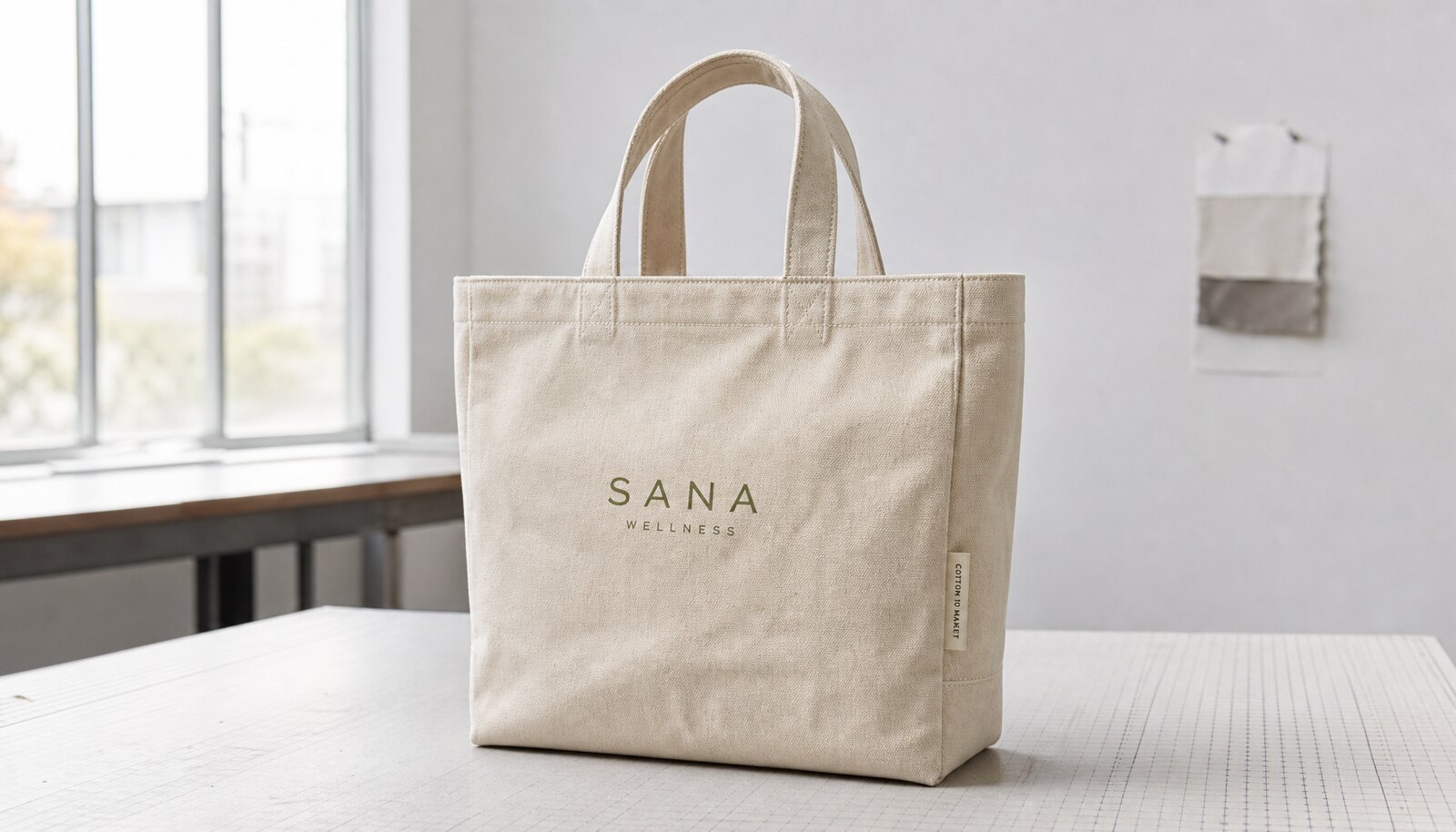
Why wellness brands need a different tote spec
A canvas exhibition tote bag for a wellness brand is not just carry packaging. It is part of the shelf story, the booth story, and the perception of the product inside it. When a tote sits next to skincare, supplements, or lifestyle goods, buyers and consumers read its structure, print quality, and finish as a signal of how carefully the brand manages the rest of the range. A weak tote can make the whole launch feel cheaper than it should.
That is why procurement has to look beyond the unit price. A bag that collapses on the shelf, shows uneven print on natural canvas, or arrives wrinkled and dirty can create avoidable brand damage before the first unit sells. For a retail launch, the tote needs to survive handling, carry real weight, and still look intentional after packing, transport, and store display.
- Treat the tote as a branded product component, not a generic giveaway.
- Judge the bag by empty shape, loaded performance, and shelf presentation.
- Assume the tote will be touched, stacked, and handled more than a one-time event bag.
Define the use case before you ask for prices
The best source spec depends on where the bag will be used. Exhibition handouts usually prioritize speed, low cost, and a clean logo. Retail add-ons need more structure because they sit beside sold goods and have to look finished on the shelf. Gift-with-purchase bags often need a balance of both, since the customer judges them as part of the bundle value. A standalone retail tote is the strictest case because shoppers compare it directly to other accessories in the store.
Before you request quotes, decide what the bag has to carry and how it will be sold. Bottles, jars, and boxed kits need a wider opening, stronger bottom construction, and often a baseboard. Flat inserts or brochures can use a lighter build. If the brand team has not agreed on the primary use case, the supplier will make assumptions that may not match the channel, and the quote will be impossible to compare.
- For flat inserts and light handouts, a lighter open-top tote may be enough.
- For bottles, jars, or mixed kits, prioritize gusset depth and bottom support.
- For retail shelf display, ask whether the bag must stand upright when empty.
- Do not let the supplier choose the use case for you; that decision changes the whole spec.
Fabric, weave, and structure choices drive the real spec
For most retail launch programs, the practical canvas range is 12oz to 14oz. A 12oz bag is usually the baseline when the goal is a clean natural look, acceptable structure, and sensible freight. A 14oz build gives more body, better shelf presence, and a more premium feel when the bag is sold or bundled with higher-value products. Below that range, the tote can feel too soft for retail. Above it, the bag may become heavier and more expensive without adding enough visual value.
Weight alone is not the full story. Weave density, yarn quality, bleaching, dyeing, and whether the bag is washed after sewing all affect the final result. A tighter weave can print cleaner than a looser heavier cloth, and a washed bag can shrink or soften in ways that change size and logo position. Structure choices also matter: gussets add volume, baseboards help the bag stand, lining improves interior finish, and reinforced handle attachments improve lifespan. Each of those adds labor, inspection points, and carton bulk.
- 10oz to 11oz works for low-cost event handouts, but it may feel too soft for retail display.
- 12oz to 13oz is the common default when the tote must look clean and travel well.
- 14oz and above suits premium bundles, bottle sets, or shelf-ready bags that need more body.
- A baseboard often improves perceived quality more than simply increasing fabric weight.
Decoration and brand presentation need to match the art and the price point
The decoration method should follow the artwork, not the factory preference. Screen print is usually the most efficient choice for one to three solid colors, especially on natural canvas where opacity matters. It gives a cleaner brand mark, better repeatability, and stronger durability for most wellness launch use cases. Transfer print and digital print help when the artwork has fine lines, gradients, or small text, but they should be approved carefully because the print can sit on top of the fabric rather than blending into it.
Embroidery can work for small premium marks, but it is rarely the best fit for large retail graphics because it adds cost, can distort fine detail, and changes the hand feel of the bag. Whatever method you choose, specify the actual print area, the center line, the color target, and the tolerance for placement. Approving from a PDF alone is a common mistake. The print must be checked on the actual panel size, because even a small shift looks worse on a tote than on a paper proof.
- Use screen print for bold logos and the best cost-to-durability balance.
- Use transfer or digital only when the art is too detailed for clean screen work.
- Use embroidery sparingly and only when the logo size and retail price justify it.
- Request a strike-off on the real fabric before you approve bulk printing.
Supplier routes should be compared by control, not just by price
A direct factory usually gives the best control over fabric, construction, print, and packing. That matters when the tote is part of a retail launch and must match a brand standard across multiple markets or store groups. A trading company can be useful when you are consolidating several products into one shipment or need a smoother communication layer, but the buyer should still ask for the real producer, the factory location, and the actual production flow. A local decorator is often the fastest route for a small pilot, but they may only work with stock blanks and have limited influence over the bag body itself.
The right route depends on which risk you are managing. If you are worried about consistency and long-term repeat orders, the direct factory route usually wins. If your launch is a test and speed matters more than perfect spec control, a stock blank plus decoration route may be enough. The danger is comparing those offers as if they were the same product. They are not. The quote should make clear who is sewing, who is printing, who is packing, and who is responsible if the sample and bulk product diverge.
- Direct factory is usually best for repeatable retail SKUs and custom construction.
- Trading companies help with coordination, but the buyer must verify the actual factory.
- Local decorators are useful for short-run testing, but they often limit fabric choice.
- Compare routes only after the same size, same print, and same packing rules are fixed.
Pricing bands and carton economics can change the margin fast
For planning purposes, a plain 12oz unlined tote with one-color print sits in a very different cost band from a lined zipper bag with a baseboard and custom labels. The premium version can easily add 30 to 70 percent to ex-works cost before freight, depending on materials, labor, and setup charges. That spread matters more on a retail launch than on a giveaway program because the bag may be sold as a visible part of the assortment or bundled into a kit with a fixed gross margin target.
Carton economics can be just as important as the factory quote. A zipper, lining, or baseboard can lower the number of units per carton, which increases freight per bag even when the factory price looks acceptable. A carton that drops from 50 units to 30 units can erase much of the apparent saving from a cheaper base spec. To compare suppliers properly, ask for the unit price, setup fees, carton dimensions, gross weight, and loading assumptions. Then model landed cost, not just ex-works cost, against the margin you need at retail.
- The main cost drivers are fabric weight, print colors, lining, zipper, baseboard, and packing format.
- A higher unit price is not always the worse deal if it preserves carton density.
- When the bag is bundled with products, calculate margin on the full set, not the tote alone.
- Ask suppliers to quote the same packing format so freight comparisons stay meaningful.
Sampling and approval should lock the spec before bulk production
The safest approval chain is fabric swatch, print strike-off, pre-production sample, then golden sample. Each step should lock a different part of the build. The swatch confirms fabric tone and hand feel. The strike-off confirms print size, opacity, and placement. The pre-production sample confirms construction, handle drop, size, and any accessory details. The golden sample becomes the reference that both sides keep during mass production and receiving. If the supplier tries to skip one of those steps, the risk usually shows up later in shrinkage, color mismatch, or a bag that looks right in photos but wrong in the carton.
For a retail launch, inspect the sample the way the buyer will inspect bulk. Check the bag empty and filled with realistic weight. Put the intended bottle, carton, or brochure inside it and see whether the top opening still looks neat and whether the base still sits flat. Measure at least 3 samples, not just one, because a single perfect sample can hide a bad production pattern. Any change after sample approval should be documented with a revision note, not handled casually in email threads.
- Never approve only from digital images; require a physical sample.
- Measure width, height, gusset, handle drop, and print position on the sample.
- Keep a retained golden sample at the buyer site and the factory site.
- Re-approve if the fabric lot, print method, or packing format changes.
QC standards need concrete thresholds, not general promises
For branded retail bags, the inspection plan should define major and minor defects before production starts. A practical default is AQL 2.5 for major defects and AQL 4.0 for minor defects at general inspection level II, unless the retailer or brand manual requires a stricter rule. But the numbers alone are not enough. The defect list must say what counts as a major failure, what counts as a cosmetic issue, and what has to be reworked before shipment. Without that, a supplier can claim the order is checked while still shipping bags that would be rejected at the retail DC.
The most useful thresholds are concrete. Set visible size tolerance at plus or minus 1 cm, handle drop at plus or minus 0.5 cm, logo placement at plus or minus 5 mm, and print registration at no more than 2 mm for one-color graphics. Use a 5 kg static hang test for 60 seconds on handles, then check for seam opening, bartack lift, or strap creep. Inspect the first 2 cartons off the line, then sample every 10th carton on launch-critical orders. That approach catches drift early instead of discovering the defect after packing is complete.
- Reject open seams, skipped stitches on visible panels, or thread tails longer than 10 mm.
- Reject handle failures, bartack lift, or seam creep after a 5 kg hang test.
- Reject front-panel stains larger than 3 mm, oil marks, needle damage, or strong odor.
- Reject print cracking, peeling, or heavy edge lift after a 20-bend flex check.
- Reject carton mixes unless mixed packing was written into the PO and carton marks.
Packing and cartonization determine whether the bag arrives retail-ready
A tote can be correctly sewn and still fail the launch because of packing. Flat bulk packing is fine for giveaways or warehouse inserts, but retail programs often need a cleaner presentation. Depending on the channel, that can mean an individual polybag, a barcode label, tissue, a hangtag, or a lightly inserted stiffener. The right format depends on how the bag will be received and displayed, not on habit. If the store or DC wants quick intake, the label and carton mark matter as much as the bag itself.
Carton planning should be treated as part of the spec. Ask for carton dimensions, gross weight, units per carton, and pallet pattern before you award the order. If a baseboard or zipper reduces folding efficiency, carton fill will fall and freight will rise. If the bag is traveling by sea, include moisture protection if the route or season requires it. If it is going directly to a retail distribution center, make sure the carton marks, SKU code, and pack count match the receiving system exactly.
- Choose packing based on the sales channel: event, DTC, retail shelf, or distribution center.
- Confirm whether each bag needs a barcode, hangtag, care label, or retail sticker.
- Ask for packed dimensions, not just product dimensions, before freight booking.
- Make sure mixed SKUs are approved in writing before they are packed together.
Commercial terms and timing should be written before the PO goes out
A good tote specification still fails if the commercial terms are vague. The supplier should quote lead time by stage: fabric booking, sampling, bulk sewing, in-line inspection, final packing, and shipment window. That is the only way to protect a retail launch calendar. A single total lead time is too vague to manage risk because the longest delay is often hidden in one step, such as fabric availability or packing approval. If the date matters, ask the supplier to explain the critical path and the assumptions behind it.
The purchase order should also define what happens if the bulk bag diverges from the approved sample. For brand-sensitive work, write down the approved color target, print placement, packing format, and defect remedy before production begins. Clarify who owns artwork files, who approves any revision, what incoterm applies, and what rework or replacement terms apply if the order misses the agreed spec. When a tote is part of a retail launch, the cost of a mistake is not just replacement units. It can be missed shelf time, reshipment, and a weak first impression at the store.
- Separate sample timing, bulk timing, packing timing, and shipment timing.
- Write down who approves the final color and who signs off on any post-approval change.
- Define rework or replacement responsibility if the bulk lot misses the approved sample.
- Keep a launch buffer so a packing delay does not force a rushed shipment.
Specification comparison for buyers
| Option | Best fit | Commercial tradeoff | Quote checks |
|---|---|---|---|
| 12oz unlined open-top, direct factory | Event-to-retail launch programs that need a clean look without overbuilding the bag | Lower ex-works cost and lighter freight, but softer structure and less shelf presence | Confirm finished weight after washing, seam finish, print opacity, and whether the bag still holds shape when filled |
| 14oz gusseted bag with baseboard, direct factory | Shelf-ready retail launches, bottle sets, or bundles that must stand upright | Higher unit cost and larger carton volume, but stronger perceived value and better pack-out behavior | Check carton density, baseboard thickness, stand-up stability, and handle reinforcement details |
| Lined zipper version, specialist bag factory | Premium wellness kits, resale programs, or higher-ticket retail assortments | More sewing steps, zipper alignment risk, and slower lead time, but a more finished interior and better product security | Ask for zipper gauge, puller spec, top-edge symmetry, and the extra inspection points added by the lining |
| Stock blank plus local decorator | Short-run pilots, fast market tests, or same-week event needs | Fastest route, but limited fabric control and less consistency across repeat runs | Verify blank source, shrinkage behavior after decoration, and whether the blank bag matches the retail standard |
| Trading company or consolidator | Multi-item launches where totes must ship with inserts, labels, or other brand collateral | Easier coordination, but lower transparency on the actual factory and process controls | Request the producer name, inspection access, markup structure, and whether packing is done in-house or outsourced |
| One-color screen print versus multi-color decoration | Simple wellness logos and icon-led branding versus detailed art or small text | One-color screen print is usually the best cost-to-durability ratio; complex decoration raises setup and defect risk | Confirm the actual artwork size, Pantone target if needed, registration tolerance, and whether the print will crack or fade after flexing |
Buyer checklist before sampling
- Define the end use first: exhibition handout, retail add-on, gift-with-purchase, or standalone retail SKU.
- Lock finished dimensions, gusset depth, handle drop, and whether the bag must stand upright when empty.
- Specify fabric weight in oz or GSM, plus whether the canvas is natural, bleached, dyed, washed, or unwashed.
- State the decoration method, artwork size, number of colors, and any Pantone requirement or tolerance.
- Decide whether you need lining, zipper, inner pocket, snap, baseboard, or reinforced handle stitching.
- Set packing rules: flat or semi-folded, individual polybag or bulk pack, barcode position, and hangtag use.
- Ask for a fabric swatch, print strike-off, pre-production sample, and retained golden sample before bulk release.
- Compare quote inclusions line by line: body fabric, sewing, print, labels, packing, carton marks, and inland terms.
- Request lead time by step: material booking, sample, bulk production, inspection, packing, and shipment window.
- Confirm who owns the artwork files, who signs off final color, and how any post-approval change will be handled.
Factory quote questions to send
- What exact fabric weight, weave density, and finishing method are you pricing, and is the weight measured before or after washing?
- Are you quoting as a direct factory, trading company, or local decorator, and where does the actual production happen?
- Please separate the cost of the bag body, handles, print, lining, zipper, baseboard, labels, and packing.
- What screen, plate, or setup fees apply, and do they change if the artwork or print position is revised?
- What is the MOQ by color, by artwork, and by accessory combination such as zipper, lining, or pocket?
- What finished size tolerance, handle drop tolerance, and print placement tolerance do you commit to in bulk production?
- What is the expected carton size, gross weight, and unit count per carton for the quoted build?
- Which inspection standard do you use, and what defects are treated as major versus minor?
- Can you produce a pre-production sample using bulk fabric and a print strike-off before we approve mass production?
- What are the lead times for fabric booking, sampling, bulk sewing, packing, and shipment, and what items can extend the schedule?
Quality-control points to confirm
- Finished dimensions should stay within plus or minus 1 cm for height and width, and plus or minus 0.5 cm for handle drop on retail launch bags.
- Logo placement should stay within plus or minus 5 mm of the approved center line, with no visible skew that distracts from the front panel.
- No open seams, skipped stitches on visible panels, or thread tails longer than 10 mm should be accepted on retail-grade bags.
- Handle attachment should pass a 5 kg static hang test for 60 seconds without seam opening, bartack lift, or strap creep.
- For screen print, accept no misregistration above 2 mm on single-color logos and no pinholes larger than 1 mm in solid fill areas.
- For transfer or digital print, perform a 20-bend flex check and reject any visible cracking, peeling, or heavy edge lift.
- Fabric shade should match the approved bulk swatch; front-panel stains larger than 3 mm, oil marks, or needle damage should be rejected.
- No strong odor, exposed metal fragments, crushed corners, or dirty carton interiors should pass final inspection.
- Use AQL 2.5 for major defects and AQL 4.0 for minor defects at general inspection level II unless your retailer requires a tighter manual.
- Inspect the first 2 cartons off the line, then sample every 10th carton for launch-critical orders, and keep one golden sample at both supplier and buyer sites.