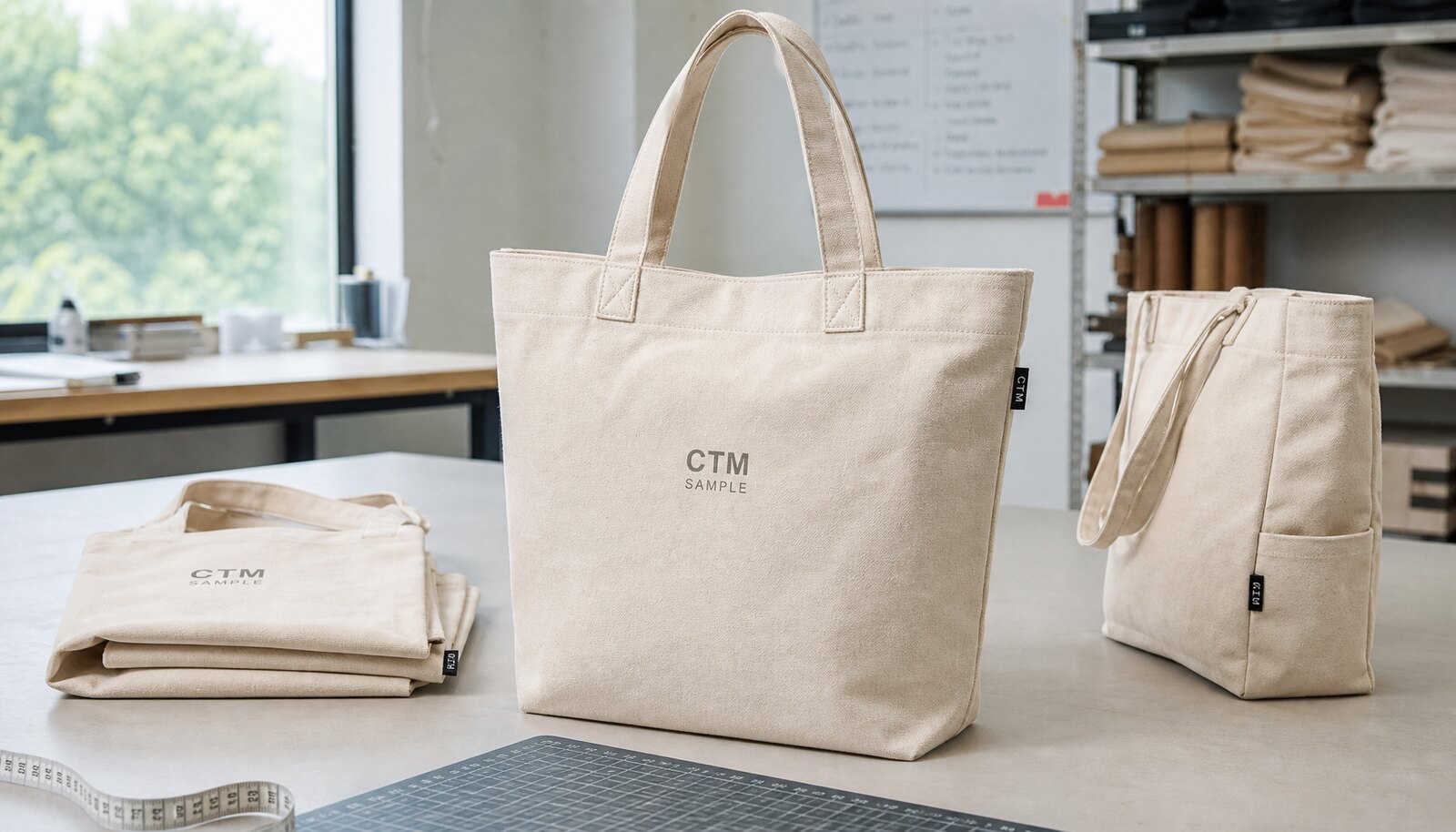
What makes this tote quote easy to misread
A canvas tote for a subscription box is not a generic promotional giveaway. It has to fit a specific packed system, survive warehouse handling, and present cleanly when the customer opens the box. That is why the first quote often looks simpler than it really is. One supplier may be pricing a light stock body with a basic logo print, while another is pricing heavier cloth, stronger stitching, carton labeling, and more labor at packing. Those are not the same product, even if the line item says "canvas tote."
The mistake buyers make most often is to ask for a price before the spec is frozen. If the supplier chooses the fabric weight, seam construction, print method, and packing style for you, you do not have a procurement quote. You have a rough estimate that may drift as soon as the sample stage starts. For subscription box programs, the cost of drift is not just a higher unit price. It can show up as late art changes, missed ship dates, warehouse rework, or a tote that no longer fits the insert plan.
- Quote the same finished spec to every supplier.
- Compare landed cost, not only unit price.
- Treat packing labor and carton requirements as part of the product, not as afterthoughts.
Start with the box program, then size the tote
For canvas tote bags used in subscription boxes, size should come from the packed contents. Start with the finished box dimensions, then add clearance for the tote body, the seam allowance, and the fold thickness. If the tote is meant to hold a folded catalog, a rigid sample item, or multiple inserts, test the fit with an actual packed unit before you freeze the drawing. A tote that looks large on paper can still feel tight once the side seams, handles, and fold line are built in.
Fabric weight changes both the appearance and the quote. Lighter canvas can work for simple inserts or low-load campaigns, but it wrinkles more easily and can look flat once packed. Heavier canvas adds body, improves print stability, and gives a more premium hand feel, but it also adds sewing time, freight cost, and sometimes longer machine handling. If raw material origin matters to your brand, ask where the fabric is sourced, whether the cloth is greige or finished, and whether the supplier can document the mill, dyeing process, or recycled content claim if one is being made.
- Use actual packed samples or dummy kits to verify fit.
- Put both oz and GSM in the RFQ so the factory cannot swap in a lighter cloth.
- State whether the canvas must be natural, bleached, dyed, pre-washed, or recycled.
Compare sourcing routes before you compare prices
The same tote can be quoted through very different sourcing routes, and the cheapest first quote is not always the lowest-risk or lowest-landed-cost choice. A stock body with custom print is usually the fastest way to launch a subscription program, because the bag shape and fabric already exist. A fully custom factory build gives you more control over dimensions, trim, and finish, but it carries more setup cost and usually a longer approval cycle. Trading companies can simplify communication and bundle multiple requirements, yet they often add margin that is not visible unless you force the quote into line-item detail.
The comparison table below is useful only if you keep the assumptions identical. That means the same Incoterm, the same sample requirement, the same inspection standard, and the same packaging expectation. If one supplier quotes FOB and another quotes DDP, or if one quote includes carton labels and another does not, you are not comparing two prices on equal terms. You are comparing two different delivery promises.
- Keep Incoterms consistent across quotes.
- Ask every supplier to price the same sample sequence.
- Do not mix stock-body pricing with custom-body pricing in one comparison sheet.
The RFQ fields factories need to price cleanly
A procurement-grade RFQ should read like a product definition, not a marketing brief. The factory needs the finished dimensions, fabric spec, print spec, sewing spec, packing spec, and delivery terms before it can produce a reliable quote. If any of those are unclear, the supplier will fill in the gap with assumptions. Those assumptions usually favor the factory, not the buyer, and they are rarely visible until the sample or production stage.
The most useful RFQ format is the one that forces a yes or no answer on each variable. A factory should be able to quote the tote body separately from the print, the label work, the packing, and the carton requirements. If it cannot, the quote is too bundled to be useful. Buyers who buy this way can see where the money goes and can decide whether to spend more on body quality, save on trims, or cut cost through simpler packing.
- Finished size and tolerance.
- Fabric composition, weight, finish, and origin.
- Handle length, drop, and reinforcement method.
- Print method, color count, and placement window.
- Trims, labels, and accessory items.
- Packing method, carton size, and carton count.
- Delivery term, payment term, and quote validity period.
- Sample types, test standards, and approval milestones.
Price samples and setup separately, or the quote will be misleading
Sample pricing is where many tote quotes become hard to read. There is a difference between an artwork proof, a pre-production sample, and a shipment sample. The proof checks layout and placement. The pre-production sample should show final fabric, print method, label, seam construction, and packing method. The shipment sample, if you request one, is the final reference for what actually leaves the factory. Each of those can take different time, labor, and material. They should not be wrapped into one vague line labeled "sample fee."
Setup costs also matter more than many buyers expect. Screen making, plate preparation, pattern cutting, and first-piece approvals may be one-time charges for a new program. The quote should tell you whether those costs are reusable on reorder, whether the factory will store the screens or files, and whether you will pay setup again if the artwork changes only slightly. If you are launching a subscription box series with seasonal graphics, this point matters as much as the unit price.
- Ask what each sample proves before you approve it.
- Request separate pricing for setup, sample, and mass production.
- Confirm whether screens, plates, and pattern files are retained for reorder.
QC thresholds that are specific enough to use
Quality control on tote bags is too often described in soft language. That works for internal discussion, but it is not strong enough for factory execution. Set clear pass-fail limits before production starts. A useful baseline is to treat wrong fabric, wrong size, open seams, handle failure, or wrong artwork as critical or major defects depending on the impact on use. For the rest of the bag, use an agreed AQL plan and document the defect classes so the factory does not improvise its own standard.
Defect language should be tied to measurable thresholds. A finished bag should match the drawing within the agreed size tolerance, the handle should be stitched cleanly and reinforced, and the print should sit inside the approved placement window. The supplier should also be able to show how it tests seam strength and fabric strength, and which standard it follows if it makes one. If the factory cannot explain its test method, you should not assume it is controlling the process the way your brand needs.
- Use a clear AQL target on the PO, not only a general QC note.
- Define critical, major, and minor defects in writing.
- Require the approved sample to remain the visual standard for production and final inspection.
Packing and cartonization change your landed cost
Packing is a cost line, a quality issue, and a fulfillment issue. If the tote is going straight into a subscription box, the factory may need to fold it in a very specific way so it sits flat beside the inserts. If the tote is shipping to a warehouse first, the packing can be simpler, but then the carton count, carton size, and protection level become more important. A low-cost bag can become a high-cost receiving problem if it is packed in the wrong sequence or arrives in cartons that are too heavy for the warehouse process.
Ask the supplier to quote the packing method explicitly. Bulk pack is efficient, but it may not suit all programs. Individual polybags may be necessary for cleanliness or retail presentation, yet they add material cost and labor. If the bag includes zippers, metal parts, or rough edges, additional protection may be justified to reduce scuffing and abrasion. The right answer is not to overpack everything. It is to pack in a way that protects the product without creating unnecessary handling cost.
- State the fold direction and pack sequence in the RFQ.
- Ask for carton dimensions, gross weight, and quantity per carton.
- Require carton marks, barcode labels, and master carton identification to match your receiving system.
Commercial terms that should be on the quote
A quote is incomplete if it does not show commercial terms clearly. The first point is the Incoterm. EXW, FOB, and DDP are not interchangeable, and they can make one supplier look cheaper than another when the freight and customs responsibilities are actually different. The second point is payment. New suppliers often ask for a deposit and a balance before shipment, but the buyer should control when the balance is released and what milestone proves the order is ready. If a supplier wants payment tied to documents or inspection, that should be explicit in the quote.
The third point is documentation. A buyer may need a commercial invoice, packing list, certificate of origin, test reports, or compliance paperwork depending on the market and the retailer. If those are required, they need to be priced or at least confirmed before the PO. The same applies to warranty on artwork retention, reorder lead time, and quote validity period. If you do not ask for those items before award, they become negotiation problems later, when you have less leverage.
- Quote the same Incoterm across suppliers.
- Ask for deposit amount, balance timing, and any payment milestone conditions.
- Confirm which documents are included, which are optional, and which have extra fees.
- Ask how long the quote is valid and in which currency it is fixed.
Supplier audit points before you award the order
A low quote is not enough if the supplier cannot prove control over the process. For a custom canvas tote program, audit the basics: does the factory actually sew the bag, or does it outsource part of the work; does it control the print line; can it trace incoming fabric back to a lot or mill; and can it show real sample records, not just polished photos. A proper factory review does not need to be complicated, but it should show whether the supplier has the discipline to repeat the same bag after reorder.
You should also ask how the factory handles nonconformities. If a print shifts, a seam breaks, or a fabric lot arrives off-spec, what happens next? Strong suppliers can explain corrective action, rework rules, and who signs off the final release. That matters because tote bags are simple enough to quote quickly and simple enough to hide process weakness. The buyer who checks traceability, quality records, and complaint handling is far less likely to discover a problem only after the shipment has landed.
- Verify business license, factory address, and who owns the sewing and print lines.
- Ask whether any part of the order is subcontracted.
- Request evidence of incoming fabric control and in-line inspection records.
- Check whether the supplier can explain its corrective action process for defects and rejects.
- Review social compliance or audit documentation if your customer requires it.
How to use the quote to negotiate without losing spec control
Once the quotes are in, the goal is not to push every supplier to the lowest number. The goal is to find out which spec choices drive cost and which ones are simply habit. Ask for alternate pricing on the same tote with one change at a time: lighter fabric, simpler print, fewer trims, different packing, or a stock body instead of a custom one. That gives you leverage without forcing the factory to guess how much value each option creates. It also helps you decide where cost reduction is safe and where it would damage the product or the program.
For repeat orders, the best leverage often comes from process stability rather than unit price alone. Keep the approved swatch, golden sample, print file version, carton spec, and inspection notes attached to the PO. Then ask the supplier to confirm what it will reuse on reorder and what will need to be paid again. If the program is recurring, that simple discipline is often worth more than a small discount on the first order because it protects timing, quality, and art consistency across the full subscription cycle.
- Ask for alternates one variable at a time.
- Use the approved sample and spec version as the reorder baseline.
- Negotiate setup retention, not only the first unit price.
Specification comparison for buyers
| Sourcing route | Cost profile | Lead time | Sample risk | Reorder implication |
|---|---|---|---|---|
| Stock body + custom print | Lowest setup cost and usually the fastest first quote, but less control over exact fabric and dimensions | Often the fastest route because fabric and body construction are already established | Lower sample risk if the artwork is simple and the body spec is already proven | Best when you want a repeatable launch format and may reorder the same body many times |
| Direct factory, fully custom body | Higher first-order cost because pattern, trim, and setup are all new, but usually better economics on repeat orders | Typically longer because fabric booking, pattern making, and sample approval all add steps | Higher risk if the drawing is not fully locked before quoting | Best when the program is stable and the same tote will be reordered with little change |
| Trading company or sourcing agent | Usually adds markup or service margin on top of factory pricing, which can make the first quote look cleaner but not cheaper | Can be moderate if the agent already has vetted factories, but depends on their control over the factory schedule | Sample quality can be good, but the buyer may see less transparency on what the factory actually quoted | Useful if you need coordination across trims, compliance, and communication, but less ideal if you want direct cost control |
| Domestic converter or local assembler | Usually higher unit cost than offshore stock-body options, but freight, communication, and change control are easier | Can be the quickest for urgent or small-volume programs | Lower risk on late changes, but fabric availability can still become a bottleneck | Best for rush launches, test programs, or buyers who value speed and visibility over lowest unit price |
| Material | 8-12 oz cotton canvas, 120-220 gsm cotton, recycled cotton, or blended fabric selected by use case and target price | Before price comparison | Different cloth weights, backing, or certification claims make quotes hard to compare | |
| Construction | bag size, gusset, handle drop, seam allowance, stitch density, reinforcement patch, and loading expectation | Before sampling | Weak stress points create returns and failed inspections | |
| Decoration | screen print, heat transfer, embroidery, woven label, or hangtag matched to fabric texture and brand durability needs | Before artwork approval | The wrong method can crack, bleed, pucker, or fail on the chosen fabric | |
| MOQ | Base MOQ plus change drivers | During quote review | Custom colors, trims, and packing can change minimums |
Buyer checklist before sampling
- Define the end use first: subscription box insert, premium gift bag, event kit, or outer carrier. Do not ask for a price until the use case is fixed.
- Lock the finished dimensions from the packed contents, not from a generic tote template. Include seam allowance, fold thickness, and a clearance target.
- Specify fabric composition, canvas weight in both oz and GSM, weave type if known, finish, and whether the cloth is natural, bleached, dyed, pre-washed, or recycled.
- If you need an origin claim or sustainability claim, ask for the supporting certificate or traceability record before award, not after production starts.
- State handle length, handle drop, reinforcement method, gusset depth, seam type, and whether the bag must stand upright when packed.
- Define print method, artwork size, number of colors, placement window, Pantone target if relevant, and the allowed alignment tolerance.
- List every trim and label item in the RFQ: woven label, care label, barcode sticker, hangtag, zipper pull, inner tag, or side tab.
- Choose one Incoterm for all quotes, then keep it consistent across suppliers so freight and customs assumptions do not distort the comparison.
- State the payment terms you want on the RFQ, including deposit, balance timing, and whether the balance is released only after inspection or documents are approved.
- Specify the packing method: flat pack, folded with polybag, bulk carton, or inserted into the subscription box. Include carton quantity and master carton marks.
Factory quote questions to send
- What exact fabric composition, yarn count or weave, finishing, and mill or country origin are included in this price?
- Can you quote the same tote on EXW, FOB, and DDP terms so we can compare landed cost on one basis?
- What is included in the unit price, and what is excluded as separate charges, such as screens, plates, labels, cartons, or testing?
- What is the MOQ for this exact spec, and how does the unit price change if we reduce quantity or switch to stock fabric?
- What sample types do you provide, what does each sample prove, and what is the charge for artwork proof, pre-production sample, and courier shipping?
- Which test standards can you support for fabric strength, seam strength, colorfastness, and any restricted-substance or compliance requirement we need?
- What AQL level and inspection method do you use for final inspection, and will you accept a third-party inspection report?
- What is the acceptable tolerance for finished dimensions, print placement, handle length, and seam symmetry?
- What is the lead time from sample approval to ex-factory shipment, and which steps are on the critical path?
- What payment terms can you accept for a new account, and do you require deposit before material booking or screen making?
Quality-control points to confirm
- Set finished size tolerances in the drawing, not as a loose estimate. A practical starting point is body dimensions within +/- 1 cm and handle length within +/- 0.5 cm, unless your product engineer sets tighter limits.
- Do not use a vague fabric tolerance such as about +/- 5%. Require the supplier to show the actual fabric lot weight and compare it to the approved spec and swatch.
- Require load-test approval on the finished bag. As a baseline, the bag should not show seam opening, handle detachment, or stitch failure under at least 1.5x the expected filled weight or the agreed internal test load.
- Treat any open seam, skipped stitch at a load-bearing point, broken handle bartack, or needle damage that weakens the fabric as a major or critical defect depending on location.
- Set print placement limits before mass production. As a practical starting point, keep small logo placement within +/- 3 mm and larger art within +/- 5 mm of the approved artwork window.
- Reject visible stains, oil marks, ink smudges, holes, cut yarns, or loose threads beyond the trimming limit you have defined in the spec.
- If color matters, inspect under daylight-equivalent lighting against the approved sample, master swatch, or Pantone reference when applicable.
- Use AQL at the PO level. For many consumer programs, AQL 2.5 major and 4.0 minor is a sensible baseline, but buyers with tighter brand standards can set stricter thresholds.
- Ask for fabric and seam test reports if the factory claims compliance with a specific standard, and file those reports with the order record.
- Check carton count, carton labels, barcode placement, and fold direction during final inspection so receiving errors do not become fulfillment delays.