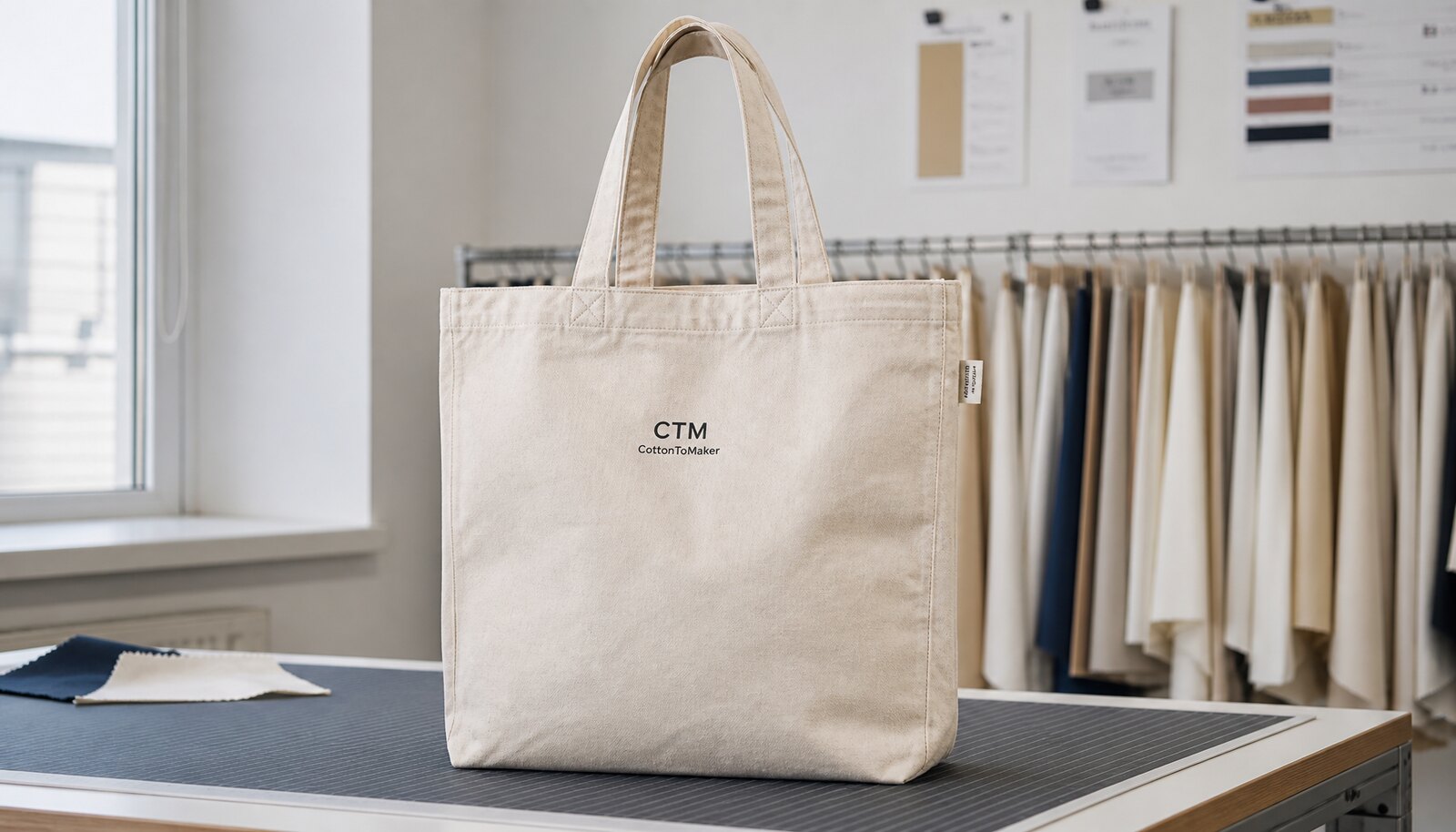
Why school tote reorders fail after the sample looks fine
Most problems with canvas exhibition tote bags for schools start after the first sample is approved. The sample is usually produced with extra attention, by one operator, and from the best available roll of fabric. The reorder is where weak instructions show up. A mill changes fabric lots, a supervisor swaps a handle stitch, or the print shifts a few millimeters because nobody wrote the reference point down. The tote still looks close, but close is not enough when dozens or hundreds of bags are handed out at the same event.
Procurement teams should treat the tote as a working item, not a decoration. For school fairs, orientation packs, donor events, and alumni weekends, the bag has to hold real contents, survive handling, and look consistent across cartons. That means the reorder memo needs to protect three things at once: appearance, load performance, and pack-out consistency. If any one of those drifts, the product creates avoidable receiving work and a weaker presentation on event day.
- Use the approved sample as the control reference, not just a visual guide.
- Write the exact bag size, fabric weight, handle build, and print position into one spec sheet.
- Link the reorder quantity to the event calendar and the actual distribution plan, not to a rough guess.
Write the working spec before you invite quotes
A useful RFQ for canvas exhibition tote bags for schools is short but exact. It should name the finished size, the gusset, the target fabric weight, the handle type, the print method, the print area, the packing format, and the delivery terms. It should also say what is not allowed, such as a lighter fabric substitute, a different handle construction, or a second print location that the buyer did not request. If the spec does not forbid substitutions, suppliers will assume some flexibility and the quotes will not be comparable.
The best way to keep the quote clean is to make the buyer do the comparison work once and then reuse that structure for every reorder. Keep the same line items every time: body size, fabric weight, print method, quantity, packing, carton count, and approval process. That lets you spot real changes quickly. If one quote is cheap because it excludes carton labels, inner packing, or a second proof, the difference will be obvious instead of hidden in email text.
- Use one page for the commercial quote and one page for the technical spec.
- Define the reference edge for print placement and the reference seam for handle location.
- State whether the supplier may substitute fabric, thread, lining, or packing materials without written approval.
Choose fabric weight for load, reuse, and print appearance
For most school-event uses, 10 oz canvas is acceptable when the tote carries flyers, notebooks, and light handouts. Twelve ounce canvas, around 340 gsm, is the safer choice when the bag needs to carry books, catalogues, or heavier welcome kits. The higher weight usually gives a better hand feel, stronger structure, and a cleaner print surface. It can also cost more in fabric, cutting, and freight. The buyer should not default to the heaviest option unless the contents justify it.
Fabric availability matters as much as fabric weight. A factory may quote a preferred gsm, but if that mill lot is not in stock, the next run may use a different roll width or a slightly different weave. That is where variation starts. If your school or district needs repeatability across terms, ask whether the same fabric source can be reserved for the reorder or whether the supplier expects to change mills. If the fabric source changes, require a fresh pre-production sample before bulk release.
- 10 oz is usually fine for light handouts and short event use.
- 12 oz or about 340 gsm is better for books, catalogues, and repeat reuse.
- Ask whether the fabric is in stock, special order, pre-shrunk, or being substituted from another roll width.
Match the decoration method to the artwork and quantity
For a school logo or event mark, 1-color screen print is usually the most stable choice on canvas. It works well on repeat orders, is easy to archive, and keeps the artwork consistent when the same bag is produced again next term. Heat transfer can be practical for short runs or artwork with small details, but it is more sensitive to temperature, operator control, and substrate variation. Embroidery gives a premium look, but it is usually a cost and turnaround tradeoff for large giveaway runs unless the bag is meant to be a higher-value item.
The buyer should ask about print size and placement, not just print method. A supplier can say screen print and still deliver a logo that is too small, too close to the seam, or offset enough that the bag looks inconsistent in a stack. The RFQ should state the artwork version, ink color, measurement from the top edge or side seam, and whether the approved file is vector or raster. If the logo contains thin lines or small text, ask the supplier to confirm what detail level can survive on the canvas weave without filling in or breaking apart.
- Use screen print for bold logos and repeat runs.
- Use heat transfer only when short-run flexibility matters more than long-term repeatability.
- Treat print position as a measured dimension, not a design preference.
Compare suppliers on landed cost, not just ex-works price
A low unit price can be misleading if the supplier has excluded the practical costs that end up on your side of the desk. For canvas exhibition tote bags for schools, the landed cost may include fabric, sewing, screens or plates, packing, inner polybags if used, carton labels, carton reinforcement, domestic delivery to the export point, freight, duty, brokerage, local delivery, and a reserve for inspection or rework. If you compare only the headline ex-works price, you are not comparing the real cost of getting usable bags into your warehouse.
The most useful quote comparison separates base product cost from cost drivers. For example, a supplier may be cheaper on the bag body but more expensive once you add a second print color, a tighter packing format, or a carton spec that meets your receiving rules. Ask for the quote in a way that shows what changes at 500, 1,000, 3,000, and 5,000 pieces. That makes it easier to see whether the price drop is genuine scale efficiency or just a partial quote with omitted work.
- Compare base unit price, print setup, packing, freight assumptions, duty, and local delivery separately.
- Ask whether the quote is ex-works, FOB, CIF, or DDP and what each term includes.
- Request price breaks by quantity so you can see how much of the cost is setup versus material.
Qualify the vendor before you place the reorder
Repeat orders are easier when the supplier has already been qualified. At minimum, ask for the factory name, production address, main contact, legal registration, and a clear statement on whether the supplier will subcontract any part of the order. If your school, district, or buying organization requires social or chemical compliance evidence, request it before PO release rather than after production starts. You do not need a long compliance checklist for every project, but you do need the documents your own procurement rules require.
The right vendor qualification also gives you an escalation path. If a supplier misses the pre-production sample, misses the first inspection, or wants to change material because of stock shortages, you need to know who can make the decision and how fast they can answer. Repeat orders are where weak ownership becomes expensive. A buyer who knows the factory and the real decision maker can stop a bad substitution before it reaches bulk sewing.
- Request factory identity, site address, and subcontracting disclosure.
- Ask for business registration and any required compliance records before deposit.
- Confirm the escalation contact for spec changes, inspection failures, and shipping delays.
Approve the sample with use tests and written tolerances
A good sample approval process checks how the tote works, not just how it looks. Load it with the same kind of items the school will actually hand out, such as brochures, a notebook, a bottle, or a small folder. Lift it by the handle, check whether the top edge distorts, and see whether the print stays legible when the canvas bends. That kind of simple use test tells you more than an empty-bag inspection. It also makes the approval file more defensible if the bulk order later drifts.
Sample approval should include written tolerances. Do not rely on phrases like acceptable or close enough. Record the agreed body dimensions, handle drop, print center point, and shade reference. If the sample is slightly different from the original design but still acceptable, write the deviation into the approval note so the reorder does not return to the earlier version by accident. Keep one signed control sample in the purchasing or receiving file and send a photo set to the factory so both sides are working from the same reference.
- Test the tote with real contents before you approve it.
- Measure print placement from a fixed edge and record the reference in writing.
- Keep one signed control sample and photo reference for the next reorder.
Set packing, carton audit, and warehouse handling rules
Packing affects receiving time, storage space, and event-day distribution speed. Bulk packing is efficient when the totes will be counted into kits later, while individual polybags make sense when the product needs a cleaner presentation or will be sold through a retail-style channel. There is no universal best answer. The right choice is the one that matches how your team will unpack and distribute the goods. If you do not define the format, the factory will pick the cheapest practical option, which may not be the one that works in your warehouse.
Carton discipline matters just as much as the bag itself. Ask for carton labels that include the PO number, style code, color, school or event name, carton sequence, and piece count. If the order is split across campuses or departments, add a carton map so the receiving team can route cartons without opening every box. For larger orders, include a carton audit requirement: verify counts from the first, middle, and last cartons, and reject any shipment where counts or labels do not match the packing list.
- Bulk pack for internal distribution unless presentation quality requires individual polybags.
- Use carton labels that match the receiving plan, not just the factory SKU.
- Require a carton audit before shipment release when the order is split across multiple sites.
Treat lead time and MOQ as variable, not fixed
The idea that tote bags always have a 20 to 35 day lead time or always require a 1,000 to 3,000 piece MOQ is too blunt for procurement work. Those numbers can be a reasonable planning range for a straightforward repeat order after final approval, but they move with region, factory type, seasonality, fabric availability, decoration complexity, and whether the supplier is a direct maker or a trading desk. A simple one-color reorder from stock fabric is very different from a multicolor run that needs new screens, special packing, and a fabric purchase.
The useful question is not what the market average is. It is what pushes the order outside the average. Ask the supplier to identify the earliest risk point in the schedule, such as artwork signoff, blank fabric sourcing, print setup, or packing approval. Then ask for a buffer recommendation in writing. If the event date is fixed, build time for sample transit, inspection, and freight booking into the plan. A reorder that looks fine on paper can still miss the event if the buyer treats the schedule as one uninterrupted block instead of a sequence of approval steps.
- Do not treat 20 to 35 days as a default across all factories or all decorations.
- Ask for MOQ by color and artwork version, not one vague number.
- Build schedule buffer for artwork proofing, sample approval, inspection, and freight booking.
Turn the reorder memo into a repeatable control document
A strong reorder memo is not just a reminder. It is the control document that keeps the next purchase from drifting away from the approved sample. For canvas exhibition tote bags for schools, the memo should capture the approved bag size, fabric weight, print method, decoration area, handle build, packing format, carton labeling, and the supplier contacts who can approve exceptions. If the factory changes anything, the deviation should be visible in the memo before the production line starts.
The same memo should also include an escalation path. If the repeat order fails pre-production sampling, the buyer should know whether to pause, re-approve, or request a corrected sample before mass production. If carton counts are short or labels are wrong, the receiving team should know who signs the discrepancy report and whether the supplier is responsible for rework or replacement. That is how procurement turns a routine reorder into a controlled purchase instead of a repeated guess.
- Freeze the approved sample reference before asking for the next price.
- Keep prior shipment notes and mark every deviation from spec or packaging.
- Define who can approve exceptions, who owns rework, and who signs the discrepancy report.
Specification comparison for buyers
| Decision area | Recommended baseline | Acceptance criteria | Landed-cost and risk checks |
|---|---|---|---|
| Fabric weight | 10 oz for light insert packs; 12 oz / about 340 gsm for books, catalogues, and reuse | Finished bag must match the approved sample feel and structure; agree a fabric tolerance of plus or minus 5 percent on the target weight if your team is using mill documentation | Heavier canvas usually raises fabric cost, sewing time, and freight weight; check whether the quote changes if the mill lot is not in stock or if the factory must buy a different roll width |
| Print method | 1-color screen print for repeat school logos; heat transfer only for short runs or complex artwork | Print size, placement, and ink coverage must be written in the PO; allow no more than plus or minus 0.5 cm from the agreed print center line | Screen setup, extra colors, and second-side prints add cost; ask whether plate or screen charges are one-time or repeated on every order |
| Handle build | Folded self-fabric handles or webbing handles with reinforced X-box stitching | Handle length tolerance plus or minus 0.5 cm and handle drop consistent within one carton; fail any skipped stitches or loose reinforcement | Longer handles increase material use; webbing may cost more but can improve comfort and reduce seam stress during event distribution |
| Bag dimensions and gusset | Medium school-event size around 38 x 42 cm with 8 to 12 cm gusset | Width, height, and gusset tolerance plus or minus 1.0 cm on body dimensions and plus or minus 0.5 cm on gusset; bag should stand and load as approved | Oversized totes raise carton volume and shipping cost; undersized bags create repacking labor and a poor handout experience |
| Supplier route | Direct factory for repeat runs with an approved control sample; trading company only if it adds real coordination value | Supplier must identify the actual maker, production site, and whether any subcontracting is used; no route change without buyer approval | Trading routes can hide factory changes and complicate root-cause analysis; confirm who pays for rework, redraw, or repeat sampling |
| MOQ logic | Treat MOQ as a function of fabric stock, print setup, and production line changeover, not a fixed market number | Buyer should receive a written MOQ by color and artwork version plus price breaks at 500, 1,000, 3,000, and 5,000 pieces | MOQ can be lower with stock fabric or blank bags, but the unit price, print setup, and packing labor may rise; ask what changes at each quantity band |
| Packing format | Bulk pack by carton for internal distribution; individual polybag only when presentation or cleanliness matters | Carton count must be exact, with carton labels showing PO, style, color, event, and quantity; no mixed styles unless approved | Polybags increase carton volume, material cost, and unpacking labor; bulk packs are cheaper but need stronger carton audit controls |
| Quality control regime | AQL-based inspection plus written critical, major, and minor defect definitions | Critical defects must be zero; major defects should use your approved AQL level, and any carton count mismatch is a fail | Inspection fee, photo evidence, carton access, and rework ownership should be defined before production starts |
| Lead time | Simple repeat order after final approval can often sit in the 20 to 35 day range, but only when fabric is in stock and decoration is straightforward | Lead time starts from final artwork and spec approval, not from first inquiry; buyer should require a dated production schedule and shipping plan | Region, factory type, seasonality, fabric availability, decoration complexity, and subcontracting can all extend the schedule; ask for the earliest risk point and the escalation contact |
Buyer checklist before sampling
- The approved control sample, spec sheet, and purchase order all match on size, fabric weight, handle length, print method, and packing format.
- The quote separates base unit price from screen charges, packing cost, carton labels, inner polybags if used, and any freight or duty assumptions.
- The buyer has written tolerance limits for body dimensions, gusset, handle drop, print placement, and acceptable shade variation before deposit release.
- The supplier has shared factory identity, production site address, and any subcontracting disclosure if the order will not stay in one plant.
- Compliance documents are requested in line with school, district, or local procurement rules, including business registration, material declaration, and any social or chemical compliance evidence your organization requires.
- The carton plan defines carton count, label format, pallet or loose-carton handling, gross weight target, and whether the goods will be counted by carton or by piece at receiving.
- The order file includes an escalation path for repeats: who approves deviations, who owns rework, and who signs off on substitute material or packing changes.
- The schedule includes time for artwork proofing, sample transit, inspection, repack if needed, and freight booking so the event date is not exposed to a single delay.
Factory quote questions to send
- What exact fabric weight, weave construction, and roll width will you cut from, and is the material from stock or must it be sourced for this order?
- Which decoration method is included in the price, what is the print size, and what are the extra charges for a second color, larger placement, or a second side?
- Can you quote the same tote at 500, 1,000, 3,000, and 5,000 pieces, and show which cost items change at each tier?
- Who is the actual factory, what is the production site, and will any part of sewing, printing, or packing be subcontracted?
- What documentation can you provide for business registration, factory profile, and any school-required compliance records or test reports?
- What is the exact packing spec, including pieces per carton, carton dimensions, gross weight, inner packing, and carton label format?
- What sample will you supply for approval, how will it be archived, and what happens if the bulk run differs from the signed sample on size, print position, or stitching?
- What is the production start date after final approval, what part of the schedule is most likely to slip, and who is the escalation contact if the ship date is at risk?
Quality-control points to confirm
- Body width and height should stay within plus or minus 1.0 cm of the agreed finished size; fail any bag that clearly looks undersized or oversize next to the control sample.
- Gusset depth should stay within plus or minus 0.5 cm; fail any bag that collapses badly, twists, or cannot sit in the same pack format as the approved sample.
- Handle length and handle drop should stay within plus or minus 0.5 cm; fail any bag with uneven handles, weak stitching, or visible skipped reinforcement points.
- Print placement should stay within plus or minus 0.5 cm from the agreed reference edge; fail any bag with blurred edges, obvious registration shift, or thin ink coverage that makes the logo hard to read.
- Fabric should match the approved sample in color, hand feel, and density; fail visible thin spots, major shade swings inside one shipment, or any roll that is clearly lighter than the signed reference.
- Stitching should be straight and consistent with no skipped seams, broken thread clusters, or loose ends at stress points; fail if the seam opens under normal hand pressure during inspection.
- Carton labels must match the PO, school or event name, style code, color, and carton count; fail any mixed-style carton unless the buyer has approved it in writing.
- Carton counts must be exact at pack-out; use a carton audit that verifies sample counts from the top, middle, and bottom cartons before shipment release.
- If your procurement team uses AQL, write the level into the PO and define critical, major, and minor defects before production; critical defects should have zero tolerance.