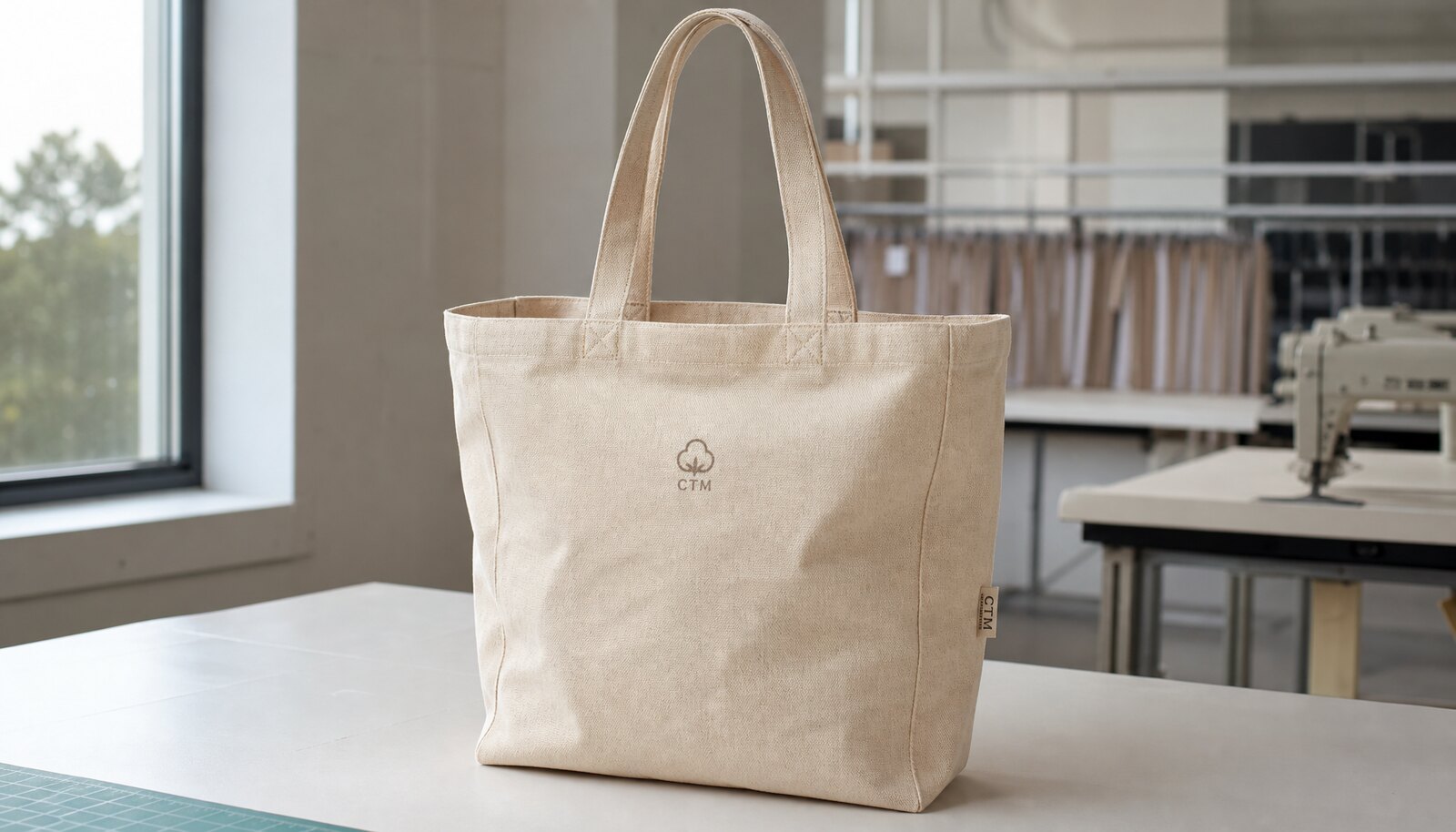
Why school exhibition totes need a tighter spec than they look
A canvas exhibition tote for schools is usually ordered for a fixed event, but it gets used like a daily carry bag: books, brochures, water bottles, giveaways, and sometimes laptop sleeves. That means the bag has to survive more than one use, and buyers should write the spec as if the tote will be judged by students, staff, and parents after the event is over. A vague order for "canvas tote bags" creates too much room for a supplier to substitute a lighter cloth, shorten the handles, or simplify the stitching to hit a quote target.
For private label school programs, the commercial problem is not just the bag itself. It is the total cost of getting an acceptable bag to the right campus or distribution center on time, without rework. If the base construction is wrong, a cheap-looking print or a weak handle can undermine the entire program, even when the price looked competitive on paper.
- Treat the tote as a load-bearing promotional item, not a simple giveaway.
- Write the order around event use: books, folders, catalogues, and reusable campus carry.
- Use the quote to compare construction, not just printed unit price.
Choose the bag structure before you choose the artwork
The most practical school exhibition sizes are usually around 38 x 42 cm, 38 x 43 cm, or 40 x 45 cm with a 10 cm gusset, depending on how much literature the bag must hold. Flat tote formats are fine for brochures and light handouts, but a gusseted bag behaves better when customers put in books, boxed samples, or a hoodie. Handle drop also matters: if the tote is carried over the shoulder, the drop should be long enough to feel comfortable but not so long that the bag drags during a campus walk.
For fabric, 12oz to 14oz natural canvas is the sweet spot for most school programs. It prints well, holds shape, and is heavy enough to feel credible without making the bag stiff and expensive. Move to 16oz only when the bag will carry heavier loads or the buyer wants a more premium retail feel. If the order is a one-time event bag with low unit pressure, 10oz can work, but the risk is lower durability and a flatter hand after printing.
- Common school-use size: 38 x 42 cm or 40 x 45 cm.
- Common gusset: 8 to 12 cm for books and folders.
- Handle length should match carrying style, not just look balanced in the artwork proof.
- Use 12oz to 14oz as the default quote baseline unless the load case is clearly lighter or heavier.
Private label options: keep the branding readable and low-risk
Private label for schools is usually better when it is restrained. A small woven side label, a front print, or a sewn-on brand tab feels more institutional than a large retail-style logo block. If the tote is for school bookstores, alumni shops, or event resale, you may want both a visible front logo and a discrete side label so the bag looks branded without being overly promotional. For donor or multi-party programs, subtle branding also leaves room for co-branding rules.
The method matters. Woven labels and sewn side tabs are usually more durable and more controlled for brand identity, while heat transfer is useful only when the artwork is small volume or has too many colors for screen print. Screen print remains the most dependable choice for most school exhibition tote bags because it keeps setup simple and unit cost stable. Embroidery looks premium, but it is usually only worth it for a retail line or a higher-end institution program because it adds cost and can distort very fine details.
- Best default for school orders: one-color screen print plus woven side label.
- Use embroidery only if the brand wants a premium retail presentation.
- Define label placement tolerance so the supplier cannot move it to an easier sewing position.
- Avoid tiny text in the print unless the logo will be verified at actual size.
How to compare supplier quotes without getting fooled by unit price
Two suppliers can quote the same tote at very different prices because one is quoting a true 14oz canvas bag with reinforced handles and a clean side label, while the other is quoting a lighter body with simpler finishing. That is why the buyer should break the quote into fabric, cut-and-sew, print, label, packing, and carton costs when possible. If a supplier refuses to explain what is included, the price comparison is not reliable enough for procurement approval.
The most useful comparison is a landed-cost view that adds factory price, carton packing, inland handling, and expected freight class impact. A lighter bag may save a few cents at source but cost more in quality risk or customer complaints. A stronger bag may increase the ex-factory price slightly, but it often wins on acceptance rate, especially when schools reuse the tote after the event.
- Compare the quote on same fabric weight, same handle construction, same print area, and same label method.
- Ask whether the price includes one sample round and which part is chargeable.
- Check if carton packing is bulk or individual; the freight difference can be material.
- Use total landed cost, not factory price alone, for the final supplier decision.
Supplier route comparison for school tote sourcing
For canvas exhibition tote bags for schools, the sourcing route changes the risk profile as much as the supplier itself. Direct factories are usually best for repeat programs, private label continuity, and tighter control of print and stitching. Trading companies can be useful when you need mixed-item kits, short procurement windows, or one shipment that includes other education merchandise, but the quote should be scrutinized because the underlying factory spec may be softer than the sample suggests.
If your order is for multiple campuses or recurring seasonal events, it is usually worth standardizing one core spec and one alternate spec. The core spec gives you pricing stability, while the alternate allows you to switch between stock canvas and custom-dyed canvas depending on schedule pressure. This reduces the chance that every event becomes a fresh sourcing project.
- Direct factory: stronger for repeatability, spec control, and better visibility into print and cut-and-sew.
- Trading route: useful for mixed programs, but insist on the actual factory spec behind the quote.
- Stock body route: good for lower MOQ and faster lead time.
- Custom woven route: better for large annual programs when you need exact color, feel, or compliance with a brand standard.
Sample approval should test use, not just appearance
A sample that looks right on a desk can still fail in real school use. The pre-production sample should be loaded with books, folders, and a water bottle so the buyer can see how the handle feels, whether the base sags, and whether the print cracks when folded. The sample should also be folded back into its packed condition to see whether the bag stores cleanly for distribution. If the tote needs to be handed out in classrooms or at a registration desk, the folded profile matters more than many buyers expect.
Do not approve a sample until the label placement, print color, and stitch quality all match the intended bulk order. If the approved sample uses a different cloth shade or different handle length from the quotation, the bulk order may drift. Keep one signed sample on file and attach its dimensions, photos, and approval date to the PO.
- Fill test: confirm the bag can hold the intended school load without seam pull or handle twist.
- Fold test: confirm the tote still fits the intended giveaway pack or carton size.
- Rub test: lightly rub the print surface by hand to detect weak ink curing.
- Label test: confirm the woven label edge is clean and does not pucker the fabric.
Packing details can change your freight and your distribution labor
Packing should be part of the buying decision, not an afterthought. Many school buyers only discover carton inefficiency after the shipment is already booked. Bulk packing at 50 or 100 pieces per carton is usually the best approach for institutional programs because it keeps the cost lower and avoids extra individual packaging waste. Retail or e-commerce programs may need individual polybags, but those should be specified only if they are truly necessary.
Ask for outer carton dimensions, gross weight, and pack count before approving the order. A small change in fold size can materially affect carton fit, pallet density, and freight calculation. If the bags are going into regional school warehouses, carton marking should be clear and durable enough to support split distribution by campus or program code.
- Bulk packing is usually the lowest-cost route for school events.
- Individual polybagging should be reserved for retail resale or protected distribution.
- Carton marking should include SKU, color, quantity, and production lot if you need traceability.
- Keep folded size aligned with carton packing before the artwork is finalized.
MOQ logic: when a small trial run is smart and when it is expensive
MOQ should be read in relation to fabric setup and print complexity. If the bag uses stock canvas, a standard size, and one-color screen print, the supplier can usually support a lower MOQ than a custom-woven or dyed program. Once you add special handle material, multiple print colors, custom labels, or a new fabric shade, the MOQ rises because the factory has to absorb setup time and material risk. Buyers often focus on the lowest acceptable order quantity without noticing that the unit price at that level may not be suitable for a broader rollout.
For schools, a pilot order is useful when the bag is being tested with one campus or one event type. But if the tote is already approved for a district-wide program, too-small MOQs can create inconsistent batch quality or multiple reorder prices. A better approach is to quote one small run for validation and one scaled quote for the full program so procurement can see the price step clearly.
- Stock body plus simple print supports the most flexible MOQ.
- Custom fabric or special labels usually push MOQ upward.
- Separate pilot pricing from annual or repeat run pricing.
- Avoid accepting a low MOQ if the quote hides weak material or setup shortcuts.
Lead time and schedule risk: where school programs usually slip
The main schedule risk is not sewing capacity alone. It is slow artwork approval, unclear sample comments, and fabric availability. For a standard canvas tote with one-color print, a practical lead time is often 25 to 40 days after sample approval and deposit, but that window expands quickly if the order requires special weave, dye, multiple colorways, or peak-season factory slotting. If the program is tied to back-to-school or a conference date, the buyer should work backward from the event and allow time for sample review and one correction cycle.
Procurement teams should treat the first artwork submission like a contract document. Every delay in the proof stage can affect the final shipping window. If the supplier says the bags are in production before the printed sample is signed off, that is a red flag. School orders tend to be time-sensitive, and once the distribution date is fixed, there is very little tolerance for rework.
- Budget time for artwork proofing, sample approval, production, packing, and export booking.
- Do not let production start before the final sample is signed.
- Peak seasons can add queue time even if the sewing process itself is simple.
- If the order is urgent, use a stock canvas body and a simple print plan.
Use a practical quote structure to make supplier replies comparable
The cleanest RFQ for this product should not be a vague one-line request. It should contain size, fabric weight, color, print method, label method, packing, carton target, and delivery term. When the supplier responds, separate the price into blank bag, decoration, packing, and special handling if possible. That structure makes it easier to see whether a higher quote is truly more expensive or just more complete.
A useful quote also includes sample policy, production lead time, and tolerances. Without that information, buyers often compare a polished presentation against a bare price line and end up choosing the wrong partner. For school exhibition tote bags, the best supplier is usually the one that gives the fewest surprises after order placement, not necessarily the cheapest first number.
- Request quote parity on the same bag size and cloth weight.
- Insist on clear decoration and packing line items.
- Keep a written approval record for the signed sample and final artwork.
- Use one supplier for repeat stability and a second quote as a benchmark.
Specification comparison for buyers
| Supplier option | What to verify | Commercial advantage | Buyer risk to control |
|---|---|---|---|
| Direct sewing factory | fabric swatch, approved sample, seam close-ups, logo test photos, packing pilot, and final inspection evidence | Better sample-to-bulk control and faster production feedback | May be weaker on export paperwork or branded packing unless checked early |
| Trading company | Factory name, production photos, trim-source proof, and who owns QC decisions | Can coordinate small mixed orders and extra services | Markup can hide real factory capability and slow defect decisions |
| Specialized bag workshop | bag size, gusset, handle drop, seam allowance, stitch density, reinforcement patch, and loading expectation | More practical for detailed construction, trims, and repeat programs | Capacity may be limited during peak seasons |
| Low-price general supplier | 8-12 oz cotton canvas, 120-220 gsm cotton, recycled cotton, or blended fabric selected by use case and target price | Useful for simple promotional runs with loose specs | Material downgrades, weak packing, and vague inspection scope can erase savings |
| Retail-ready supplier | fold method, inner bundle, carton count, carton mark, moisture protection, SKU separation, and warehouse receiving needs | Can handle labels, SKU separation, carton marks, and receiving rules | Higher unit cost must be compared against reduced warehouse work |
| Compliance-focused supplier | Fabric records, labeling review, test plan, and production traceability | Safer for retail programs and repeat brand orders | Documentation claims need evidence, not only sales language |
| Local sample room plus bulk factory | Signed sample, bulk factory handoff, first-piece photos, and deviation owner | Good for complex branding before large production | Sample room quality may not match bulk line unless handoff is controlled |
Buyer checklist before sampling
- Confirm final tote size, gusset depth, handle drop, and required load use before requesting quotes.
- State fabric weight in GSM or oz, not just 'canvas', and specify natural, bleached, or dyed cloth.
- Provide print artwork in vector format and define print area, pantone references, and acceptable color variation.
- Set the private label method: woven label, printed label, heat transfer, or embroidery, and define placement tolerance.
- Ask for sample type, pre-production sample timing, carton pack count, and outer carton dimensions.
- Request a quote split between blank bag cost, decoration cost, packing cost, and export carton cost if possible.
Factory quote questions to send
- What exact fabric weight, weave, and shrinkage allowance are included in your quote?
- Is the quoted price based on a stock canvas body or custom woven fabric?
- How many print colors are included, and what is the surcharge for additional colors or larger print areas?
- What is the MOQ per design, per colorway, and per print method?
- What sample can you provide first: existing sample, size mockup, or production-like pre-production sample?
- What are the handle construction details, stitch count, and reinforcement method at the stress points?
- How will the bags be packed per carton, and what carton size and gross weight should we use for freight planning?
- What is the standard lead time after artwork approval and deposit, and what causes delay?
Quality-control points to confirm
- Fabric weight tolerance should be agreed within a practical range, such as plus or minus 5% on finished bag basis, especially when multiple lots are involved.
- Stitching at handle attachments should show no skipped stitches, loose thread bundles, or weak back-tacking; box-X reinforcement is preferred for school loads.
- Print registration should stay within an agreed tolerance for simple logos; ink should not flake when folded or lightly rubbed.
- Bag opening, width, and gusset must match approved tech pack measurements within an agreed production tolerance before bulk packing starts.
- Label placement should be centered or positioned to a written tolerance; do not accept freehand label location on private label orders.
- Carton count and bag count per carton must match the packing list exactly; random carton checks should include corner crush and moisture protection.
- Sample approval should include color, hand feel, handle length, seam strength, and actual folded size, not only logo appearance.