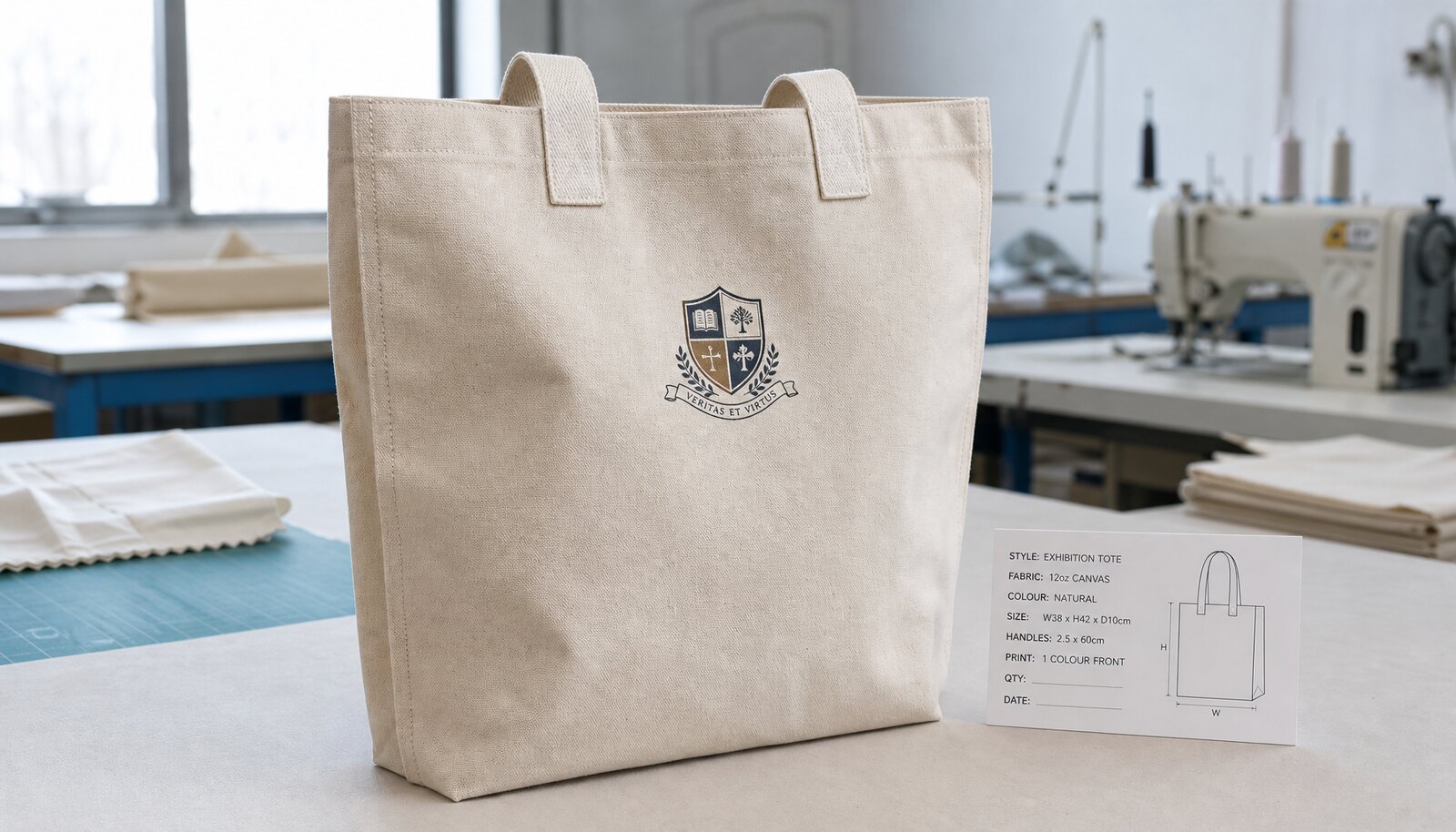
Why print method matters on a school exhibition tote
A school exhibition tote looks simple, but the print method drives the real buying outcome. It affects unit price, how many approvals the order needs, how the logo sits on natural canvas, and how much risk sits between sample sign-off and shipment. For a deadline-driven school event, that risk matters as much as the quote itself. A low unit price that triggers rework or a missed delivery is not a good buy.
The buyer question is not "which method is best" in the abstract. It is which method fits the artwork, the order size, the school calendar, and the tolerance for failure. A tote handed out at an open day can usually accept a simpler print and a narrower use life. A tote sold in a school shop or given to donors needs a cleaner finish, better color control, and a print that still looks acceptable after folding, carrying, and occasional cleaning.
That is why the most useful comparison is procurement-led, not style-led. Screen print, DTF, transfer, and embroidery each solve a different buying problem. If the supplier is quoting one blended number for all of them, the buyer does not have enough information to compare risk. The job is to turn the tote into a controlled specification, not a loose creative brief.
- One-color artwork and complex artwork do not belong in the same sourcing logic.
- Natural canvas changes contrast, so the same logo can look sharper or duller depending on the background and ink.
- The lowest setup cost is not always the lowest-risk choice when the event date is fixed.
Lock the bag spec before you compare print
The print decision only makes sense once the bag construction is fixed. Canvas weight, gusset depth, handle length, seam allowance, and finished size all change how a print behaves. For most school exhibition tote bags, 10 oz to 12 oz canvas is the practical middle ground. It is light enough to keep the bag affordable and easy to fold, but substantial enough to carry brochures, folders, and light sample packs without feeling flimsy.
Go lighter only when the tote is a short-life giveaway. Move heavier only when the bag needs to carry books, show a premium handfeel, or support repeated use. Heavier canvas does not automatically improve the print; it can slow sewing, increase material cost, and make the bag stiffer after decoration. If the logo sits near the top hem or handle anchor, ask for a sample that proves the print does not interfere with the stress points or distort when the bag is filled and folded.
Material origin matters here too. If the buyer needs traceability, ask whether the canvas is cotton, recycled cotton, or a cotton blend, where the yarn or fabric is sourced, and whether the supplier can provide a content declaration. For public-sector or institutional buyers, that documentation can be as important as the decoration method because it affects sustainability claims and downstream compliance.
- Specify finished size, handle drop, gusset depth, and canvas weight together instead of as separate loose notes.
- Ask the supplier to confirm the print safe zone in millimeters from the seam and top hem.
- If the bag will be folded for carton packing, check that the print still looks clean after folding and unpacking.
What each print method actually does on canvas
Screen print remains the strongest baseline for simple school logos. It pushes ink through a mesh onto the canvas, so the result is usually more opaque and more durable than a surface film when the artwork is simple. The tradeoff is setup. Every color adds a screen, every screen adds time, and every late artwork change adds cost. Screen print performs best when the design is stable, the bag quantity is meaningful, and the buyer wants a clean, matte look on natural canvas.
DTF and heat transfer solve a different problem. They are better when the artwork is detailed, the order is small, or the design may change late. They avoid the screen-making step, which helps speed and flexibility. The weakness is the printed layer itself. On a folded canvas tote, that layer can crack, edge-lift, or feel plasticky if the film system is not well chosen. For a school event bag that will be packed flat and distributed quickly, that may still be acceptable. For daily reuse, it is a risk that needs to be tested, not assumed away.
Embroidery is a premium option, not a default. It gives depth and perceived value, but it can distort a front panel, obscure small text, or look overworked on a simple school tote. A woven label is often the cleaner premium compromise when the buyer wants a more refined brand cue without heavy stitching across the bag face.
- Screen print is usually the best fit for one to two spot colors and a reusable bag.
- DTF and transfer are usually better for gradients, small runs, and variable text.
- Embroidery should be reserved for small marks, donor gifts, or retail-style merch where perceived value matters more than lowest cost.
Compare the commercial break-even points, not just the method names
Procurement buyers need a working cost model, not a list of techniques. In practice, screen print usually has the lowest unit cost once setup is spread over enough pieces, but the economics depend on artwork simplicity and color count. DTF or heat transfer often wins the first-order quote because setup is smaller, but the unit price stays higher. That means the break-even point moves depending on how many colors the logo uses and whether the order is repeated later.
A useful rule of thumb is this: for a one-color logo, screen print often becomes cheaper than DTF somewhere around 300-500 bags if the artwork is stable and the supplier is not charging unusual setup fees. For a two- or three-color design, the break-even may move up to roughly 500-800 bags because screen setup rises with each color. These are not universal numbers; they are buyer planning numbers. Use them to decide whether a quote should be challenged, not to replace a factory quote.
Example: if screen print adds $120 in setup and saves $0.40 per bag versus DTF, the break-even is 300 bags. If the design uses two colors and setup rises to $240, the break-even moves to 600 bags. That is why buyers should ask for quote lines by blank bag, decoration, sample, packing, and freight assumption. The economics are only visible when the quote is split correctly.
- Ask suppliers for price at 100, 300, and 1,000 pieces on the same artwork.
- If the order may repeat next term, include repeat-order pricing because screen print often improves materially on the second run.
- Do not compare quotes that use different bag weights, different folding methods, or different carton counts.
How MOQ and lead time really move by method
MOQ is not just a factory preference; it is a function of setup. Screen print usually needs enough volume to spread screen cost and press time, so a few hundred pieces per artwork is common. DTF and digital print can support smaller runs because the setup is lighter, but the buyer pays for that flexibility in unit cost. Embroidery often sits in the middle, where stitch time and backing push the run above a pure pilot quantity even when the design is simple.
Lead time is usually decided by three gates: artwork lock, sample approval, and production slot availability. A supplier can promise a fast turnaround and still miss the date if the artwork changes after the proof is sent. For school buyers, the only useful schedule is one that names the latest date to lock the logo, the date the sample must be approved, and the date the factory can start bulk. Without those dates, the lead time is not a plan.
As a rule, if the buyer needs fewer than 100 pieces and the artwork is not fixed, DTF or digital print is often the safer commercial choice. If the buyer needs 300-1,000 pieces of a simple crest and the artwork is frozen, screen print usually gives a better landed cost. If the buyer needs a premium donor item or a gift-shop style tote, embroidery or a woven label can justify the higher price because the perceived value is the point.
- Define MOQ per artwork, per color, and per version.
- Ask for the latest artwork lock date if the event date cannot move.
- If there are multiple campuses or event dates, get a version-control plan before the PO is issued.
How to source a capable supplier, not just a cheap quote
Sourcing advice should go beyond "find a factory with tote bag experience." Ask where the canvas is sourced, whether the supplier can declare fiber content, and whether they can provide evidence for any claim they make about recycled content, organic cotton, or compliance testing. If the buyer needs a sustainability statement, the factory should not be improvising it after the order is won.
Then check the print-house capability itself. A supplier that outsources printing may still be viable, but the buyer needs to know who owns the ink choice, who signs off the strike-off, and who controls the first-off print. Ask how they verify registration, how they cure or finish each method, and whether the production line has enough space to avoid print face scuffing during handling. For a school tote, a neatly sewn bag with poor curing is still a poor shipment.
Third-party documents matter when the buyer has compliance or brand-risk concerns. Ask for a fabric composition declaration, a dye or chemical test report if the institution requires one, and any available certification relevant to the claim being made. If a supplier cannot supply those documents cleanly, treat that as a sourcing risk even if the unit price is attractive. The goal is to buy something that can pass internal review, not just something that can be sewn cheaply.
- Ask for fiber content, fabric origin, and any claim-supporting certificate before quoting on large orders.
- Confirm whether printing is in-house or outsourced, and who signs off the first-off sample.
- Request a photo of the actual print line, not only a finished marketing sample.
Use an RFQ that forces comparable answers
Many tote quotes are hard to compare because the buyer asked a vague question and got a vague answer. Start with the finished bag size, canvas weight, handle spec, and packing method. Then add the artwork file, print position, and a clear note on whether you want one color, multiple colors, or variable text. If the artwork will be reused across campuses or event dates, state that up front so the supplier prices the version control correctly.
The RFQ should also force commercial clarity. Ask for blank bag cost, decoration cost, sample cost, and packing cost as separate lines. Ask what ink, film, or thread system will be used and how it is cured or fixed before packing. Ask for the production tolerance on placement and the rework policy if the first-off sample misses spec. If they can only quote as one blended number, you cannot tell whether you are buying efficiency or just absorbing hidden risk.
A good RFQ also tells the supplier what the buyer will reject. That can include off-center printing, weak opacity on natural canvas, crushed hems, mispacked cartons, and wrong version labels. Clear rejection criteria are not aggressive. They are what keep the supplier from pricing ambiguity into the order.
- Use one quote matrix for every supplier with the same columns for blank, decoration, sample, packing, and freight assumptions.
- Ask for MOQ and price at multiple quantities, not only at the target volume.
- If there are multiple versions, require version-specific carton labels and a carton segregation method.
Sample approval should test the full bag, not only the print
A blank sample is useful, but it is not the approval point that matters. The decorated pre-production sample made from the final canvas weight, final print size, final print position, and final folding method is the sample that should be signed off. That sample should show real ink coverage, real placement against the sewn bag, and real behavior after the tote is folded. If the print looks good only while the bag is open and flat, the sample has not proved anything about the finished product.
For school exhibition tote bags, the sample should be checked for dry rub, wet rub, and fold performance. If the tote is meant to be reused, ask for a short wash or soak check as well. For multi-color artwork, inspect registration and edge clarity on the first-off sample, not just the final output. If the supplier cannot show how they hold the print on textured canvas, simplify the artwork or move to a different method before bulk starts.
The acceptance decision should be written. Include placement tolerance, color reference, visible defect limit, and what happens if the first-off sample misses the target. A signed sample photo or a marked physical sample should stay with the buyer team and receiving team. Without that reference, every later discussion becomes subjective.
- Approve against the final folded and packed condition, not against an open prototype.
- Use a placement tolerance of plus or minus 3 mm for small logos and plus or minus 5 mm for larger graphics as a practical buyer target.
- Keep one signed reference sample or reference photo for receiving and claims handling.
Define QC acceptance criteria before production starts
Quality control for school totes should be specific enough that production can use it and receiving can verify it. Start with defect classes. A wrong logo, missing handle, torn seam, or unreadable event date is critical. Major defects include print placement outside tolerance, obvious color mismatch, or severe puckering. Minor defects include a small thread tail or slight trim variation that does not affect use or appearance. A practical starting point is AQL 2.5 for major defects, AQL 4.0 for minor defects, and zero tolerance for critical defects.
Then define measurable print criteria. For natural canvas, ask for a color tolerance against the approved sample, ideally Delta E 3.0 or less if the supplier can measure it. Require dry rub and wet rub performance that is acceptable for the use case, with a buyer target of dry rub grade 4 or better and wet rub grade 3-4 or better by AATCC 8 or equivalent. For washable totes, a short wash test of 3 cycles at 30 C is a useful floor, with no visible cracking, peeling, or major color loss.
Finally, inspect the structural areas that printing can affect. Handle stitching should remain straight and secure. Top hems should not pucker. Embroidery should not distort the front panel. Cartons should be count-checked, labeled correctly, and packed so the print face does not rub against hard labels, raw seams, or carton flaps. If the bags will be distributed to schools, the receiving checklist should mirror the factory QC checklist so problems are caught before handover, not after complaints start.
- Reject off-center print outside the agreed tolerance.
- Reject pinholes, streaks, peeling, cracking, or shadowing that were not approved on the sample.
- Reject any carton count or version mismatch, even if the bag decoration itself is correct.
Packing, labeling, and delivery need the same discipline as print
Packing can erase the benefit of a good print method if it is left vague. For school distribution, define whether the bags are folded once, twice, or three times; whether they are polybagged; and whether the printed face must face inward during packing. If the tote is flat-packed, ask how the factory prevents scuffing on the print surface during carton loading and transit. If labels or barcodes are applied, put them where they will not rub against the logo.
Carton labeling should support receiving, not confuse it. Each carton should show the school name, artwork version, quantity, and carton number. If the order contains multiple campus names or event dates, each version should be separated physically and labeled in a way that a warehouse team can verify at a glance. Mixed cartons are a small factory mistake that become a large school receiving problem.
Freight planning is easier when carton dimensions and gross weight are known early. Ask for them before the PO is finalized so the buyer can check palletization, warehouse fit, and any shipment weight thresholds. That is especially important on larger tote orders because the bags are light individually but bulky in aggregate.
- Define fold method, inner pack count, carton count, and carton marks before bulk starts.
- Ask for carton dimensions and gross weight before freight booking.
- Keep version-specific cartons separate when campus names, dates, or donor names change.
Specification comparison for buyers
| Spec decision | Recommended option | Typical cost / MOQ / lead-time pattern | Buyer risk to check |
|---|---|---|---|
| One-color school crest or event logo | Single-color screen print on 10-12 oz canvas | Setup often adds about $50-$150 per color. MOQ is commonly 200-500 pieces per artwork. At 300-500 pieces, screen print often becomes cheaper than DTF on a one-color design. Bulk lead time is often 7-15 working days after artwork lock and sample approval, if fabric is in stock. | Check opacity on natural canvas, cure quality, and placement accuracy on the pre-production sample. Ask for the exact ink system and whether the bag passes dry rub before packing. |
| Multi-color crest, gradient, or detailed event artwork | DTF or heat transfer | Setup is usually lower than screen print, often $20-$60 per file or per heat transfer setup. MOQ can be 25-200 pieces per variant. Lead time is often 5-12 working days, but proofing and pressing capacity can become the bottleneck. | Check cracking on fold lines, edge lift, and whether the finish feels too stiff for repeated school use. Ask for a fold test, not only a flat sample. |
| Premium donor, alumni, or retail-style merch | Embroidery plus a small print or woven label | Digitizing and setup often add $40-$100 per logo, plus stitch time. MOQ is commonly 100-300 pieces because machine time and backing increase complexity. Lead time is often 10-20 working days. | Check puckering, backing stability, and whether small text survives at normal viewing distance. Confirm stitch density before bulk. |
| Variable names, dates, or campus-specific versions | Digital print, transfer, or screen print with shared base bag | Setup depends on the number of versions. MOQ must be confirmed per artwork and per version. Lead time grows when each campus or event date needs separate QA and carton segregation. | Check version control, spelling, carton separation, and proof approval for each variant. Ask how the factory prevents mix-ups between cartons. |
| Fast turnaround with a simple logo | Single-color screen print, or DTF if artwork is still changing | Screen print is fastest after screens are approved, but only if the art is frozen. DTF can be faster when the art is complex or likely to change because there are no screens to remake. | Check sample sign-off timing, production slot availability, and whether the factory can reserve material after approval. A cheap quote is not useful if the slot is not real. |
| Very small pilot order | Digital print or heat transfer | Lower setup and lower risk on small runs, but the unit price stays higher than screen print at scale. For 25-100 pieces, DTF often avoids the setup cost that makes screen print uneconomic. | Check small-order surcharges, print feel, and whether the quote includes a one-off sampling fee. Ask for the price difference at 100, 300, and 1,000 pieces. |
| Reusable daily-use tote | Screen print on 12-14 oz canvas | Mid-to-low unit cost at volume, with better durability than surface-applied films if the ink is fully cured. At roughly 500+ pieces, screen print often becomes the lowest landed decoration cost for a simple logo. | Check rub resistance, fold-line cracking, and handle seam strength. Ask the supplier how they verify cure before packing. |
| Flat-packed distribution to schools or campuses | Any print method with controlled folding and carton labeling | Packing cost is separate from print cost. Lead time can slip if inner count, carton marks, or fold method are not defined early. A good decoration quote can still fail in receiving if cartons are not labeled correctly. | Check fold orientation, carton compression risk, barcode accuracy, and receiving instructions. Make sure printed faces are protected from abrasion in transit. |
Buyer checklist before sampling
- Confirm finished bag size, gusset depth, handle drop, seam allowance, and canvas weight in oz or GSM. Do not approve a quote that only says "heavy canvas" or "good quality canvas".
- State the print position in millimeters from the top hem and side seam, and define a safe zone around handle stitching and side seams.
- Send vector artwork with Pantone or CMYK references, smallest text size, minimum line thickness, and approved spelling. If the crest has fine details, ask the supplier to show what they can actually hold on woven canvas.
- Ask for one blank sample and one decorated pre-production sample made on the final canvas weight and final print size.
- Require the supplier to state the ink, film, or thread system, plus the curing or finishing method before packing.
- Define packing rules: fold count, inner polybag or no polybag, pieces per carton, carton marks, and whether printed faces must be kept inward or separated.
- Ask for the supplier's defect threshold, rework policy, and evidence of first-off print approval before bulk starts.
- Request carton dimensions, gross weight, and shipping document list early so freight and warehouse planning do not get pushed to the end of the order.
Factory quote questions to send
- What canvas weight do you recommend for this tote size, and what tolerance do you hold on the finished fabric weight or GSM?
- Please quote blank bag cost, decoration cost, sample cost, and packing cost as separate lines for each print method.
- What is your MOQ per artwork, per color, and per SKU version? If we split by campus name or event date, what changes in setup and price?
- What is the sample lead time, the bulk lead time after approval, and the latest point where you need artwork locked to keep the schedule?
- What ink, film, or thread system do you plan to use, and how do you cure, fix, or finish it before packing?
- What registration or placement tolerance do you guarantee, and what is your rework or rejection policy if the first-off sample misses it?
- Can you quote packing separately, including fold method, inner pack count, carton count, carton marks, and export carton dimensions?
- What QC checks do you perform before shipment, and can you share production photos of the first-off print and the final carton loading?
- If the order is reused across multiple schools or campuses, how do you control version changes so the wrong artwork does not enter the wrong carton?
Quality-control points to confirm
- Agree an actual canvas weight range before production, not a vague description. If the supplier quotes a range, ask for the acceptable upper and lower limit for the full lot.
- Set an AQL before production. A practical starting point for tote bags is AQL 2.5 for major defects, AQL 4.0 for minor defects, and zero tolerance for critical defects such as the wrong artwork or a missing handle.
- Print placement should stay within a practical tolerance. For small logos, a target of plus or minus 3 mm is reasonable; for larger graphics, plus or minus 5 mm is usually the upper limit before the bag starts to look off-center.
- Ask for color tolerance against the approved strike-off on the same canvas. If the supplier can measure color, a Delta E of 3.0 or less is a useful procurement target for logos and solid fills.
- Solid fills on natural canvas should be opaque enough that the weave does not distract from the logo. Reject prints with pinholes, streaks, or obvious transparency unless that effect was approved intentionally.
- Ink should be fully cured or fixed before packing. A dry-to-touch surface is not enough if the bag will be folded, stacked, or rubbed during distribution.
- Use dry rub and wet rub checks on a decorated sample. A common buyer target is dry rub grade 4 or better and wet rub grade 3-4 or better by AATCC 8 or an equivalent method.
- If the tote will be reused or washed, ask for a short wash test, such as 3 home-launder cycles at 30 C, and check for cracking, edge lift, or color loss against the approved sample.
- Multi-color art should not show shadowing, ghosting, or visible misregistration between layers. A small shift can make school crests and text look low quality very quickly.
- Handle stitching and top hems should remain straight and secure after decoration. Reject pieces where print or embroidery interferes with seam strength or causes puckering around the upper panel.