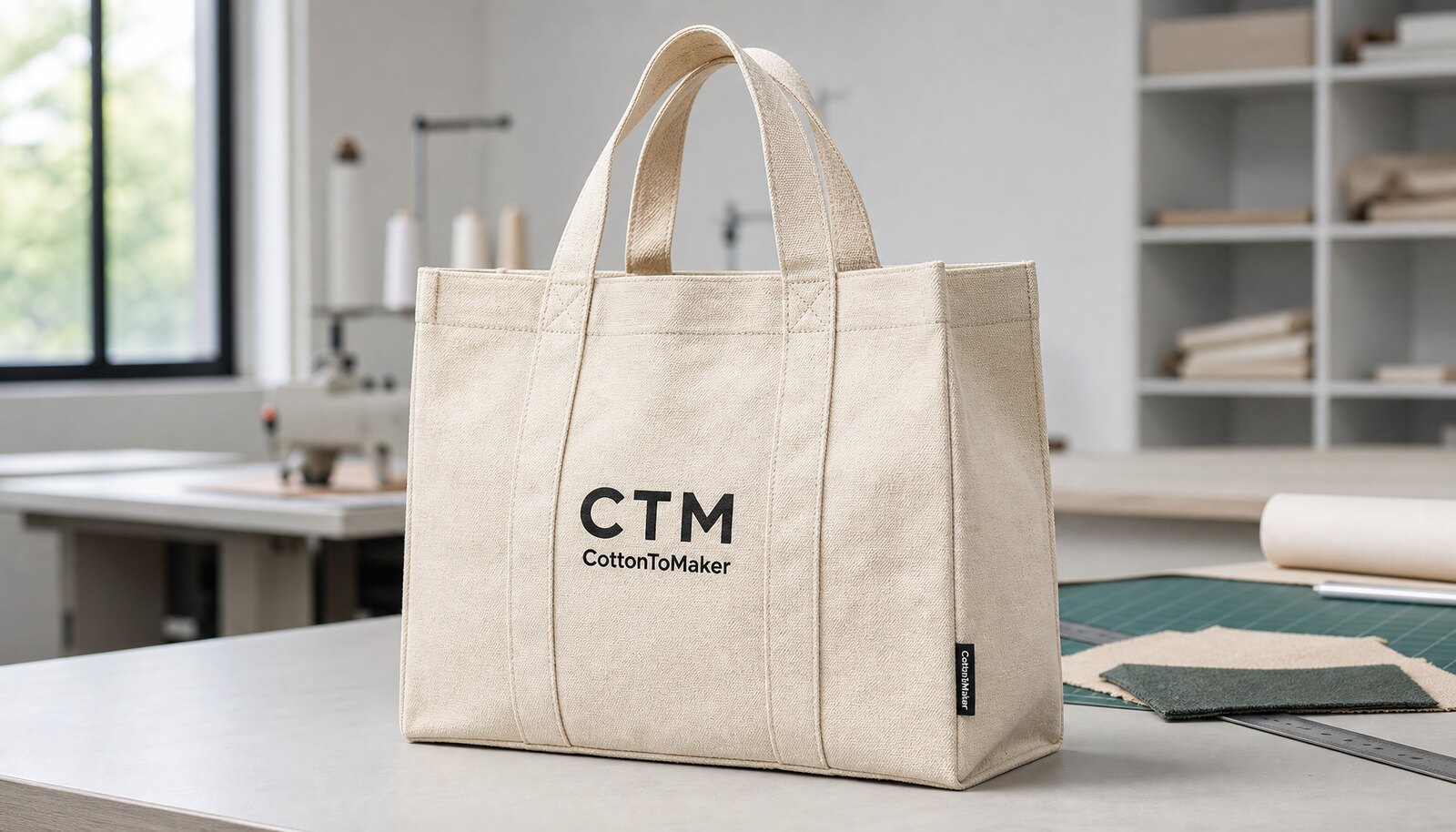
Why retail launch totes fail when they are treated like promo bags
A retail launch tote is not the same as a random giveaway bag. It has to support the brand at the shelf, survive store handling, and still look credible when a customer carries it out of the mall or uses it again later. That means procurement needs to buy for appearance, load performance, and repeatability, not only for the lowest landed price.
The main mistake is under-specifying the bag because the launch volume looks small. Retail teams often want a cleaner logo, thicker handles, better print coverage, or custom packing into cartons that fit a distribution center workflow. Those details add cost, but they also prevent the common failures: thin fabric that wrinkles badly, handles that stretch, print that cracks after a few uses, and cartons that waste warehouse labor.
- A launch tote should feel closer to a retail accessory than a trade-show handout.
- The bag spec should match how it will be distributed: in-store checkout, VIP gift, or bundled with merchandise.
- Retail buyers should define the acceptable look after one month of consumer use, not only at first unpacking.
Set the base spec before you compare suppliers
For most canvas exhibition tote bags used in retail launches, 12 oz to 16 oz cotton canvas is the practical range. Twelve oz is usually the floor if the bag needs to feel decent on the rack and hold printed artwork without showing through. Fourteen oz is a strong middle point for chain launches because it gives structure without pushing the bag into a heavy premium category. Sixteen oz makes sense when the tote is part of a higher-price campaign, carries heavier items, or needs a more substantial hand feel.
Do not stop at fabric weight. The shape of the bag changes the way the launch looks in store and the way it performs in use. A flat tote is cheaper and easier to pack. A gusseted tote carries more and presents better when placed on shelves or in gift sets. Handle length matters as well: a 25 to 30 cm drop is generally more usable for retail customers than short handles designed only for hand carry.
- For print-heavy artwork, ask for a smooth enough weave to hold crisp edges without showing excessive slub variation.
- If the bag will hold apparel or boxed products, define a gusset and a realistic safe load target.
- If the bag must look premium at first touch, ask for washed or better-finished canvas rather than rough greige fabric.
Choose the print method based on artwork and run size
Print method drives both appearance and launch risk. Screen print is usually the most economical choice for one to three spot colors, especially when the artwork is bold and the order is repeated across stores. It gives strong color and good opacity on canvas, but it needs proper screen setup and it is less forgiving with very fine details or large solid areas if the factory is not disciplined.
Heat transfer, digital transfer, and direct digital print help when the artwork uses gradients, small typography, or complex imagery. The tradeoff is usually cost and hand feel. Some transfer methods sit on top of the canvas and can feel stiffer than the cloth itself. For a retail launch, that can be acceptable if the artwork is complex, but it needs to be approved on a real sample under the lighting used in store.
- Use screen print for stable branding and predictable replenishment.
- Use digital or transfer methods when the launch art cannot be simplified without losing brand value.
- Ask for a strike-off or print proof on the actual canvas color, not on paper or a generic swatch.
How MOQ and pricing behave in retail chain programs
MOQ is rarely one number. It can change by fabric color, print version, label style, and carton configuration. A supplier may quote a low MOQ for the bag body but still require a minimum run for each screen or each packaging variant. That is where chain buyers get trapped: the headline MOQ looks manageable, but the real order structure forces them to buy too much of one variant or pay setup charges multiple times.
For retail chain launches, it is smarter to think in terms of total program logic. If the same tote will go to 40 stores, one larger production run often lowers the price and stabilizes print quality. If the launch needs regional artwork, seasonal messaging, or language changes, split the order only where the commercial value justifies the extra setup. The cheapest quote is often the one that ignores the hidden cost of variant complexity.
- Ask whether the MOQ applies to each colorway, each print plate, and each packaging version.
- Confirm if a higher quantity lowers only the bag price or also the setup charge per unit.
- Request pricing at three levels: pilot run, launch quantity, and replenishment quantity.
Compare sourcing routes instead of comparing only unit price
The right sourcing route depends on how fast the retail launch is moving and how much control the buyer wants over the spec. A direct factory is the best route when the team has a stable design, enough lead time, and the ability to manage sampling and production communication carefully. A trading company can reduce coordination friction when the launch requires multiple items, mixed packaging, or quick commercial alignment across teams. A local converter can be useful for a short-run launch or urgent replenishment, but the unit cost is usually higher and fabric choice may be narrower.
Procurement teams should compare routes on more than price. The important questions are who owns the artwork approval, who checks fabric consistency, who absorbs rework, and who can actually ship on the date the store reset needs. A supplier that looks cheap at quote stage can become expensive if they cannot manage label placement, carton marks, or last-minute packaging changes.
- Use direct factory sourcing when repeat orders are likely and the spec is already tight.
- Use a trading company when you need one commercial contact across multiple bag categories or packaging requirements.
- Use local conversion when speed matters more than the lowest ex-factory cost.
Sample approval should test the retail reality, not just the logo
A proper sample process starts with fabric confirmation, then print proof, then pre-production sample. If the launch depends on a specific off-white tone, a clean black logo, or a subtle brand tag, the sample has to be approved under store-like lighting and handled like a real product. A bag that looks acceptable on a phone screen can read very differently when it is hung on a peg, stacked in a box, or carried under fluorescent retail lights.
The sample should also be used to lock the technical details that are easy to overlook: handle symmetry, stitch density at the stress points, the flatness of the bottom seam, and whether the label interrupts the interior or exterior finish. If a factory resists giving a true pre-production sample, that is a warning sign. It usually means the bulk run will be treated as the first real test, which is too late for a retail launch.
- Compare sample fabric weight against an agreed reference swatch or spec card.
- Check print edges at close distance and from normal retail viewing distance.
- Load the sample with the actual intended items and watch for handle stretch, seam pull, and distorted shape.
Quality control thresholds that matter for chain rollouts
Retail chains need acceptance criteria that are simple enough for the factory to follow and strict enough to protect the brand. Start with finished size tolerance, then define acceptable stitch appearance, print placement, and carton count. If the artwork is front-centered, even a small shift can look careless once 5,000 bags are stacked in a store back room. If the handle reinforcement is not consistent, the customer will notice the failure before anyone notices the bag branding.
Do not rely on general language like 'good quality' or 'export standard.' Put measurable limits into the PO or tech pack. That gives the supplier a target and gives procurement a basis for rejecting out-of-spec production without arguing after the fact. For a retail launch, the first production lot is usually the most important lot, because it sets the standard for replenishment and affects how the brand is perceived at store opening.
- Define tolerance for width, height, gusset, and handle drop.
- Set a clear rule for print misalignment, color deviation, and visible defects.
- Require packed carton counts and outer carton marks that match the distribution center receiving process.
Packing and barcode details can create hidden cost at the DC
Packing is often the difference between an easy launch and a warehouse problem. If the totes are folded inconsistently, nested too tightly, or packed in oversized master cartons, the distribution center will spend time reworking them before stores ever see the product. For retail buyers, the right pack format depends on whether the bags move straight from carton to shelf, or whether they need to be re-labeled, tagged, or bundled before release.
Unit-level barcodes, side labels, and inner polybags should be specified early. If a side label is part of the brand presentation, confirm its exact position so it does not interfere with the logo or create extra sewing steps. If the launch uses folded insert cards, define the card stock, insertion method, and whether it is packed before or after final inspection. These details add up quickly across a chain order.
- Keep carton weight practical for manual handling in the DC.
- Specify whether totes ship flat, folded once, or folded with tissue and insert card.
- Use barcode placement that is readable without reopening the inner pack.
Lead time risk is usually caused by late decisions, not sewing time
A factory can only start cleanly when fabric, artwork, trims, and packing are all locked. In real retail programs, the biggest delays usually come from late logo changes, packaging revisions, or uncertainty over whether the launch quantity will split by region. The sewing time itself is often not the problem; the problem is waiting for approvals that should have been finalized before the order was sent.
Build the schedule backward from the in-store launch date. Leave time for sampling, corrections, bulk production, inspection, and export transit. If the launch has a fixed marketing date, do not treat the tote as a low-risk accessory. It needs the same discipline as other branded launch materials because it may be one of the first physical items customers touch.
- Separate sample approval time from bulk production time in the PO timeline.
- Reserve contingency for artwork corrections, packaging changes, or supplier rework.
- Ask whether the factory can commit to weekly production updates and photo evidence.
What a useful quote should include before you compare landed cost
A usable quote is more than unit price. It should break out the bag construction, print setup, sample cost, packaging, inner pack configuration, carton size, and any extra charges tied to label sewing or special folding. Without that detail, procurement cannot compare suppliers fairly, and the cheapest quote may simply be the least complete one. For a retail launch, the landed cost should include the full route from ex-factory to distribution center, because warehousing and handling can erase the savings of a slightly lower factory price.
When comparing landed cost, look for what changes when volume changes. A factory that looks expensive at 1,000 pieces may become the lowest-cost source at 5,000 if the setup charge is spread correctly. Likewise, a supplier with a higher bag price may actually be better if they include better packing, cleaner print setup, and fewer inbound issues at the DC. The real goal is not the cheapest tote. It is the tote that arrives on time, looks right, and needs the least intervention before store launch.
- Compare ex-factory, packing, inspection, freight, duty, and DC handling separately.
- Ask for a price ladder at different quantities so you can forecast replenishment economics.
- Use the same spec across all quotes before judging value.
Specification comparison for buyers
| Spec decision | Recommended option | When it fits | Buyer risk to check |
|---|---|---|---|
| Sourcing route | Direct factory for repeat SKUs and tighter cost control | Best for retail chains that can commit to a spec and forecast volume | Lead time can slip if artwork, trims, or packaging are not frozen early |
| Sourcing route | Trading company for mixed-category launches and faster coordination | Useful when the launch needs multiple bag styles or split-shipment support | Margin stacking can hide the true factory cost and reduce room for changes |
| Sourcing route | Local converter for urgent replenishment or small test runs | Good for pilot stores, promo resets, or domestic compliance needs | Unit price is usually higher and fabric options may be limited |
| Fabric weight | 12 oz to 16 oz canvas for retail launch bags | Fits a bag that must feel substantial, print cleanly, and survive store carry use | Too light looks cheap; too heavy raises cost and can distort print registration |
| Handle build | Cross-stitched handles with 25 to 30 cm drop | Comfortable for a tote that carries catalogues, folded apparel, or premium samples | Short handles hurt usability; weak reinforcement fails under load testing |
| Print method | Screen print for 1-2 spot colors; heat transfer or digital for complex art | Use screen print when the launch identity is simple and volume is predictable | Fine gradients, small type, or large solids can crack, blur, or vary between runs |
| MOQ logic | Set MOQ by fabric color and print setup, not only by bag style | Best when retail wants multiple store regions, sizes, or artwork versions | Hidden MOQs on trim color, label type, or carton configuration can break the rollout plan |
| Packing format | Flat-packed with barcode-ready inner bundles and controlled master cartons | Best for distribution centers that rework or label units before store send-out | Loose packing can increase warehouse labor and damage rates during inbound handling |
| Sample path | Pre-production sample after fabric, print strike-off, and packaging mock are approved | Needed when brand color, handle feel, and retail presentation are all launch-critical | Skipping a true pre-production sample often causes spec drift and carton surprises |
Buyer checklist before sampling
- Define the bag's retail job: carrier, purchase-with-purchase item, event handout, or premium launch gift, because the spec changes with load, appearance, and price ceiling.
- Freeze size, fabric weight, handle length, print colors, label type, and packing format before asking for quotes.
- Request fabric swatches with actual GSM or oz data, not only a photo of canvas.
- Confirm whether the price includes printing plates, screens, sampling, inner packing, carton marks, and export cartons.
- Set an acceptable tolerance for finished size, stitch density, and print position before sampling starts.
- Ask for production lead time and shipping-ready date separately, since a factory can finish goods before export paperwork is ready.
Factory quote questions to send
- What is the exact fabric spec, including cotton content, GSM or oz weight, weave style, and whether the cloth is pre-shrunk, bleached, dyed, or greige?
- How many colors are included in the quoted print price, and what are the setup charges for screens, plates, or digital preparation?
- What is the MOQ by fabric color, print version, and carton configuration?
- What size tolerance do you hold for width, height, gusset, handle length, and stitch alignment?
- What sample stages are included before bulk production, and can you share photos of the first bulk pieces for approval?
- What is the standard packing method, master carton quantity, carton weight limit, and barcode or label handling at unit level?
- What is the realistic production lead time after sample approval, and what events can extend it?
- What inspection documents can you provide for bulk order release, such as in-line checks, final inspection photos, or third-party reports?
Quality-control points to confirm
- Fabric weight matches the approved range and does not vary visibly between panels or between sample and bulk.
- Seams are straight, secure, and reinforced at the handle stress points and side seams.
- Print registration is clean, with no obvious ghosting, bleeding, pinholes, or color shift against the approved artwork.
- Handle length and symmetry are consistent from bag to bag, and the tote hangs level when loaded.
- Finished dimensions stay within agreed tolerance and the gusset opens properly without twisting.
- Labels, side tags, and barcode stickers are positioned consistently and do not cover artwork or stitching defects.
- Cartons are packed to the agreed count and weight, with no crushed corners, mixed variants, or loose contamination inside.
- The first bulk run matches the pre-production sample in fabric hand feel, print sharpness, and overall construction.