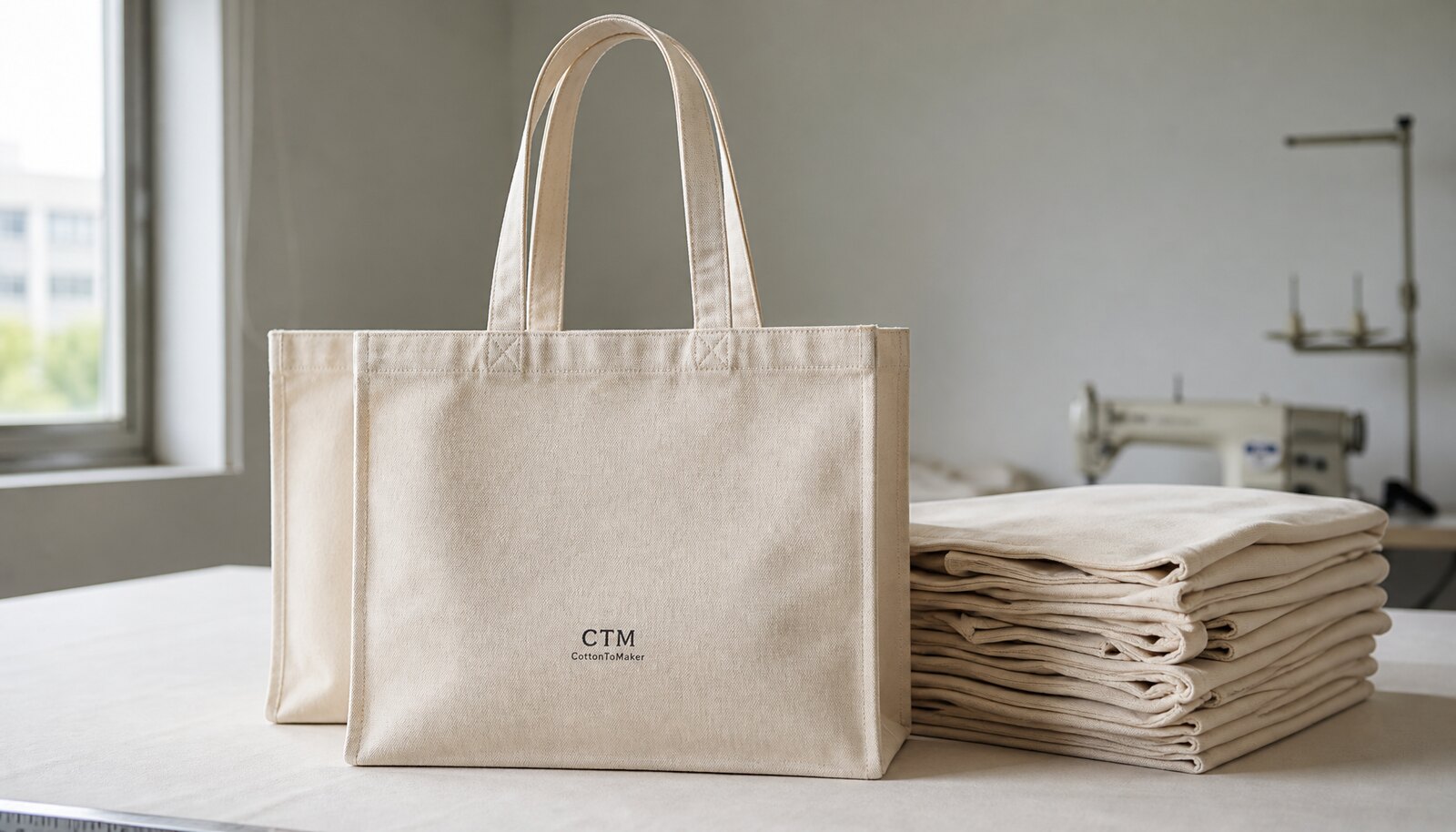
Buy the program, not the tote
Canvas exhibition tote bags for retail chains are rarely a one-off promo item. They may move through trade shows, store events, loyalty campaigns, warehouse replenishment, or even resale, which means the bag needs to behave like a repeatable SKU. Procurement should therefore buy the use case first and the price second.
The right spec depends on where the bag enters the chain. A handout bag can be softer, lighter, and packed more densely. A store-facing or resale bag needs better shape retention, cleaner print presentation, and tighter control over seam finish. If the same bag must serve multiple channels, lock the most demanding use case as the baseline and quote down from there only when the factory can prove the tradeoff.
For buyer alignment, decide three things before you talk price: who will receive the bag, how it will be used, and whether a reorder is likely. That will tell you whether you are buying a giveaway, a merchandising tool, or a branded retail item.
- Define the bag's job before comparing suppliers.
- Name one final approver for artwork, sample signoff, and packing rules.
- Keep a sealed master sample and signed spec sheet with the PO so reorders can be checked against the same reference.
Size and carry behavior are operational, not cosmetic
Bag dimensions change how the tote performs in the field. A narrow bag can look underbuilt even if the fabric is good, while an overly wide bag can collapse in carton and waste space in the DC. The buyer should work from finished dimensions, not a casual catalog description, because cut size and finished size are not the same thing.
Handle drop matters just as much as body size. It determines whether the tote is carried in hand, on the forearm, or over the shoulder, and that changes both customer experience and packing behavior. If the bag will carry folded apparel, catalogs, boxed merchandise, or a gift-with-purchase kit, measure the widest item first and build clearance around that actual load.
Retail chain teams often need the bag to fit a display rack, a shipping carton, or a store kitting process. That is where a spec line like body width plus gusset plus handle drop becomes useful. It gives operations and procurement the same target instead of leaving the factory to interpret a shape from a drawing.
- Specify finished size, not cut size.
- Confirm whether handle drop is measured from the top edge or seam line.
- Leave enough clearance around the logo so seams, handles, and folds do not interfere after production.
Fabric weight and finish change both look and landed cost
For most retail chain programs, 10 to 12 oz canvas is the practical center of gravity. Ten ounce canvas is lighter and can reduce freight, but it may drape more softly and show print distortion on large blocks of color. Twelve ounce canvas is usually the safest default because it gives the bag more body without making it feel overly stiff.
Fourteen ounce canvas is the better fit when the bag must carry heavier inserts, survive repeated use, or present as a premium retail item. The tradeoff is not only unit price. Heavier canvas increases carton weight, can raise freight cost, and may change the way the logo sits on the surface.
Finishing matters too. Ask whether the fabric is natural, bleached, dyed, pre-shrunk, or sanforized, and whether the weight is measured before or after finishing. Those details affect shrink behavior, print clarity, and reorder consistency. If a chain expects the same bag months later, the question is not only what weight is quoted. It is whether the supplier can source the same material lot or a true equivalent.
- Use 10 oz for lighter handouts and event literature.
- Use 12 oz as the default retail chain spec when you need a stable body.
- Move to 14 oz only when the bag needs more structure or a premium feel.
Decoration should follow the artwork, not the mood board
Screen printing remains the most dependable option for simple logos and reorderable chain programs. It handles one to three solid colors well and gives predictable results across lots, which makes it easier for procurement to control presentation from one reorder to the next. The catch is that the artwork must be designed for woven fabric, not a screen display.
Fine lines, tiny type, and gradients can look clean in the PDF and still fail once they hit canvas. If the logo sits close to a seam or a fold, ask for a strike-off on the actual fabric before bulk approval. A digital proof can confirm placement, but it cannot prove opacity, edge sharpness, or how the ink behaves once the bag is folded and packed.
Heat transfer and DTG can work for short runs or more detailed art, but they should be treated as method-specific choices rather than universal answers. If the item will be reused often, handled roughly, or stacked in shipping, ask for rub and flex checks. If the tote is supposed to feel premium at retail, a woven label or sewn patch can help, but it also changes the hand feel and can create a snag point.
- Keep the color count low when you want a stable reorder path.
- Set the smallest text and line width with the factory before approving art.
- Request a strike-off or sample on actual canvas whenever the logo is close to a seam or fold.
Use the sourcing route that matches volume and reorder risk
Direct factory sourcing is usually the right path when the chain expects repeat orders or wants control over material, printing, and packing. It gives procurement better visibility into the real production line and makes it easier to hold the supplier to a fixed spec. The key is traceability: the buyer should know who is cutting, printing, sewing, and packing the bags.
A trading company can still be useful when the buyer needs one contact for multiple categories or wants help managing communication across time zones. The risk is that the factory can become invisible, which makes it harder to compare true process capability or follow the same lot on a reorder. If the supplier cannot name the actual factory and the lot code, the buyer should treat that as a red flag for repeat programs.
A local decorator can be acceptable for a small emergency run or a short lead-time event, especially if the order is under a few hundred units and the artwork is simple. For a chain rollout or anything that will be reordered, local convenience usually gives way to higher unit cost and weaker control over fabric consistency. The practical test is simple: if merchandising asks for the same bag again in six months, can the supplier prove they can match it?
- Ask who owns fabric purchase, printing, and final packing.
- Request the factory lot code, not just the sales sample.
- Confirm who signs the QC report and whether in-line photos come from the actual run.
Write the RFQ like a spec sheet, not an email
The fastest way to get unusable quotes is to send a loose tote request. One supplier will assume a pre-shrunk 12 oz bag, another will quote unshrunk fabric, and a third will price a different handle length or different fold method. Procurement ends up comparing numbers that do not describe the same product.
A better RFQ separates the job into clear blocks: product spec, artwork, sample path, packing, quality, and commercial terms. That structure makes the bid easier to normalize and easier to defend internally. It also helps the factory identify where the cost is coming from, which usually means cleaner counteroffers instead of vague price drops.
If the chain has a fixed launch date, include it in the RFQ with the receiving route. The factory needs to know whether the bags go to one DC, multiple store clusters, or a kitting partner. That is not a small detail. It affects carton labeling, pallet pattern, partial shipment planning, and the amount of buffer the supplier should hold.
- Quote one artwork, one size, one colorway, and one packing format per line item.
- Show setup fees separately so first-run and reorder pricing can be compared correctly.
- Lock incoterms, sample fee policy, and quote validity in writing.
Sample stages should remove disputes before bulk cutting starts
A disciplined sample path starts with a digital proof, moves to a decoration test or strike-off, and ends with a pre-production sample made from the actual fabric and actual print method. Buyers often skip the middle step because the artwork looks simple, but that is when issues appear later as a logo that prints too dark, a bag that measures slightly off, or a handle that sits differently than expected once the tote is folded.
For retail chains, the sample should also be checked in the way the bag will actually travel. That means folding it the way the DC will fold it, packing it the way the store will receive it, and checking whether the carton count and carton marks make sense for receiving. A sample that looks right in a studio but fails in the warehouse is not really approved.
The most effective approvals are written. Record the approved material, decoration method, size, fold, carton pack, and any label or barcode rule. Then keep one signed sample with the buying file. If the supplier later changes fabric lot, handle material, or pack format, re-sample the change instead of treating it as a minor revision.
- Approve logo size in millimeters or centimeters, not just visually.
- Use the pre-production sample as the master reference for the PO and reorders.
- Re-sample whenever the supplier changes fabric lot, print method, handle material, or carton pack.
QC rules should be strict enough to enforce and simple enough to measure
The best QC language is concrete and tied to the approved sample. For a standard tote, many buyers start with body dimensions within about plus or minus 8 to 10 mm and handle drop within about plus or minus 5 mm. If the bag has a shelf-fit requirement, a kit insert, or artwork that lands close to the seam, the tolerance should be written tighter and agreed before the order starts.
Color and print placement need the same discipline. A common starting point is plus or minus 5 mm for logo placement and a color match checked against the approved standard under the agreed light source. If the brand depends on exact color, instrument-based Delta E control can be used, but only if both sides agree on the method. Otherwise, the factory and buyer may be measuring two different things and arguing over the result.
Stitching and construction defects are usually where the real failures show up. Check for skipped stitches, open seams, broken bartacks, and thread tails that are too long on visible edges. If the bag must carry heavier retail items or sample kits, ask for a load check such as a static hang or equivalent buyer-defined test. If your team uses AQL, write the defect classes into the PO so the inspection report maps back to the commercial agreement.
- Use AQL 2.5 for major defects and 4.0 for minor defects only if your quality team already works that way.
- Treat wrong size, wrong artwork, missing bartacks, broken seams, and unreadable carton labels as critical defects.
- Keep the QC rule in the PO so the inspection standard is not left to memory.
Packing, carton data, and DC intake can move the final cost
Packing is not a minor detail. Bulk pack lowers material and labor cost, but the bags can arrive more creased and are more exposed to ink rub. Individual polybags cost more, but they can protect retail presentation and reduce complaints when the tote is shelf-ready or gift-ready. The right decision depends on where the bag enters the supply chain.
If the order goes to a distribution center for kitting or later store allocation, bulk cartons may be the best fit. If the bag will be opened and handed directly to customers, a cleaner presentation pack can be worth the extra cost. Either way, the buyer should ask for carton dimensions, gross weight, inner pack count, and barcode rules before the PO is issued, because those numbers affect freight, warehouse fit, and receiving speed.
Retail chains often need split shipments, destination labels, or store-cluster allocation. Build those requirements into the packing spec early. If the supplier only learns about destination labeling after the sample is signed, the shipment can still be technically correct and operationally wrong.
- Use bulk pack when warehouse efficiency matters most.
- Use individual polybags when cleanliness, crease control, or shelf presentation matters more.
- Match carton marks to the buyer's SKU structure so receiving teams can sort by size, color, and artwork without relabeling.
Lead time only matters after the approvals are frozen
A credible lead time is more than a sewing estimate. It includes artwork setup, fabric sourcing, decoration setup, sample approval, bulk production, inspection, and packing. If the supplier already has the right canvas in stock and the art is simple, the production window can be short. If the fabric must be dyed, the print has multiple colors, or the order lands in peak season, the schedule can stretch quickly.
For chain programs, the buyer should ask for a stage-by-stage schedule rather than one blanket promise. The factory should tell you when the fabric is physically on hand, when the artwork is approved, when the screens or transfer setup are complete, when bulk sewing starts, and when final packing finishes. That schedule makes it easier to manage the launch and to see where slippage actually comes from.
First orders and reorders should not be treated the same. On a reorder, a supplier may already have the approved spec, screen setup, and carton plan, which can save time. But if the fabric lot changes, the packaging changes, or the launch falls into a congested freight window, the reorder still needs buffer. The safest approach is to identify every variable that can move the ship date and add time only where it is justified.
- Separate first-order lead time from reorder lead time.
- Freeze artwork and packing before the factory buys fabric or sets screens.
- Add buffer for dyed fabric, multiple print colors, split shipments, new supplier onboarding, and peak freight periods.
Specification comparison for buyers
| Spec decision | Recommended option | When it fits | Buyer risk to check |
|---|---|---|---|
| Fabric weight | 10 oz natural canvas | Light handouts, event literature, or low-reuse programs where the bag carries soft, light items | The bag may drape softly and large solids can show more print waviness |
| Fabric weight | 12 oz pre-shrunk canvas | Default choice for most retail chain programs that need a stable body and repeatable reorder quality | Usually the safest balance, but confirm that the measured weight matches the quote method |
| Fabric weight | 14 oz heavy canvas | Premium resale, sample kits, repeated carry, or heavier inserts where the bag must hold structure | Adds material weight and freight volume, so carton math should be checked before approval |
| Print method | 1-3 color screen print | Repeat orders and simple logos where the brand needs consistency across multiple batches | Thin text and fine rules can fill in, so ask for a strike-off on actual canvas |
| Print method | Heat transfer or DTG | Short runs or detailed artwork that would be expensive to separate into screens | The finish can age differently under folding and handling, so rub and flex behavior should be tested |
| Handle construction | Self-fabric handles with bartacks | Standard tote programs where appearance and cost need a balanced spec | Check stitch density and handle drop; weak bartacks are still a common failure point |
| Handle construction | Webbing handles | When the bag needs extra carry strength or a more structured retail look | Higher cost and a different visual profile; confirm the width does not overpower the body |
| Sample path | Pre-production sample after artwork approval | Any chain rollout that needs repeatability, especially when the logo is near a seam or bottom edge | Digital proof alone will not show fabric body, opacity, or print density on the actual canvas |
| Packing | Bulk pack with carton marks | DC intake, kitting, or low-touch storage where freight efficiency matters more than retail presentation | Wrinkling and ink rub are more likely unless carton compression is controlled |
Buyer checklist before sampling
- Final bag size with the finished body width, body height, gusset, and handle drop
- Fabric weight in GSM or oz, plus whether the canvas is natural, bleached, dyed, pre-shrunk, or sanforized
- Logo file format, PMS targets, print method, print area, seam clearance, and the smallest approved text or line width
- Target quantity by SKU, size, and color, plus the expected reorder volume if the program repeats
- Packing spec for retail or DC receiving: bulk pack or polybag, inner pack count, carton mark format, and barcode label rules
- Required sample stages: digital proof, strike-off, pre-production sample, and shipment sample if your team requires it
- Acceptable lead time window, launch date hard stop, and whether partial shipment is allowed
- Quality thresholds for stitching, print registration, shade consistency, and dimensional tolerance
Factory quote questions to send
- What exact fabric weight are you quoting, and is that measured before or after finishing?
- Is the MOQ based on one artwork, one colorway, one size, or one production lot across all sizes?
- What setup costs apply for screens, plates, digital print preparation, color separations, or label application?
- Can you quote the same bag with self-fabric handles and webbing handles so we can compare landed cost?
- What sample fee applies, is it deductible from bulk order value, and which sample stage is included in the fee?
- What are the approved packing options, inner pack count, carton dimensions, and gross carton weight?
- How do you measure print placement tolerance, seam alignment, and handle stitch strength during QC?
- What is the production lead time after sample approval, and which part of that time is fabric procurement?
- Can you separate FOB, CIF, and DDP pricing so we can compare freight impact correctly?
- Who signs the final inspection report, and can you share your in-line and final QC checkpoints?
Quality-control points to confirm
- Fabric weight should match the approved spec within the buyer's agreed band. If you use a numeric tolerance, make sure the factory measures the same way, because pre- and post-finishing weight can differ.
- Finished body dimensions should stay within about plus or minus 8 to 10 mm on a standard tote, or within the tighter band written into the sealed sample for sizes with shelf-fit or insert-fit requirements.
- Handle drop should stay within about plus or minus 5 mm of the approved sample unless the bag design or packing method justifies a different band.
- Print placement should stay within about plus or minus 5 mm of the approved position, but seam-adjacent artwork or large all-over graphics may need a separate placement rule.
- Spot colors should be checked against the approved standard under the agreed light source. Use Delta E 3 as a practical benchmark only if the supplier and buyer both agree to instrument-based color control.
- Stitching should show no skipped stitches, no broken bartacks, and no loose thread tails longer than about 3 to 5 mm on visible seams.
- If the bag is meant to carry heavier retail items or sample kits, ask for a static hang or equivalent load test and write the pass/fail rule into the PO.
- If your team uses AQL, many buyers start with AQL 2.5 for major defects and 4.0 for minor defects. If your compliance team uses another method, put that inspection rule directly into the PO.
- Packing counts should be exact, carton marks legible, and barcode labels readable on the first scan without reprint or relabeling.