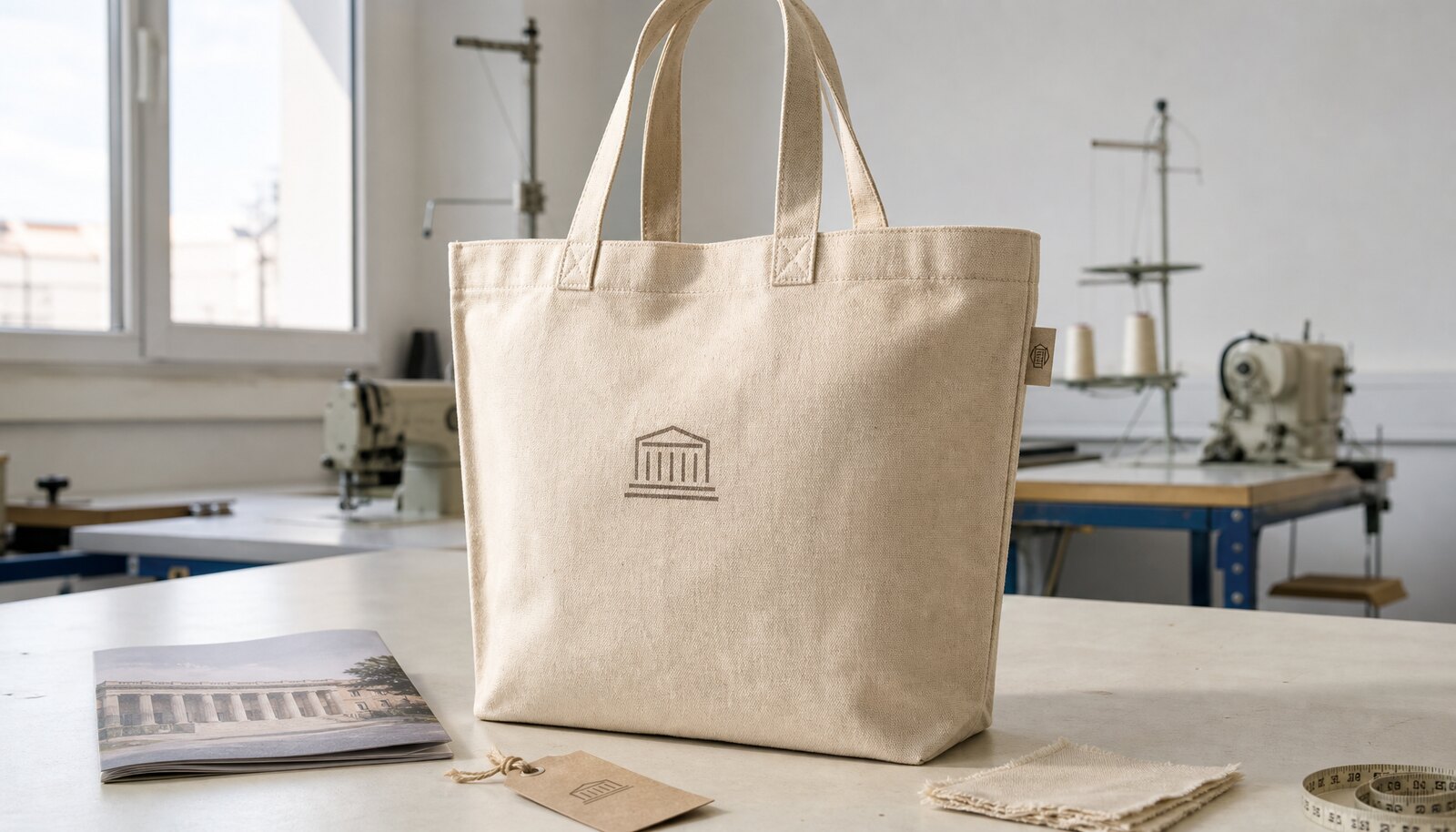
1) Why museum buyers should treat tote bags as retail packaging, not just giveaways
Canvas exhibition tote bags for museums sit in a special procurement category. They are merchandise, but they also behave like packaging: they carry catalogs, exhibition collateral, members’ gifts, and purchased retail goods out of the shop and into the visitor’s daily life. That makes them part of the visitor experience and part of the museum’s sustainability story at the same time. A tote that looks fine in a quote sheet can still fail the program if it feels flimsy on the shelf, folds badly in the back room, or wears out too quickly for a retail price point.
Procurement teams often underestimate how many decision layers are hiding inside a simple tote order. The same style might be used for an opening-night pack, a retail resale item, a membership premium, or a multi-site replenishment program. Each use case changes the acceptable fabric weight, the acceptable print method, the pack format, and even the acceptable defect level. If the museum is comparing sustainable packaging formats, the tote itself and the way it is packed should be considered together, not separately.
The practical sourcing question is therefore not “What is the cheapest canvas tote?” It is “Which spec gives us the best mix of usability, shelf appeal, repeatability, and freight efficiency for the museum’s actual use case?” Once that question is framed properly, the buyer can ask better supplier questions, compare landed cost more honestly, and avoid the common trap of approving a sample that does not match bulk production.
- Treat the tote as a visible retail item and a packaging component at the same time.
- Compare durability, presentation, and freight impact together.
- Use the actual use case to define the spec before asking for price.
2) Start with the museum scenario: exhibition calendar, retail sell-through, or member program
A museum buyer will get much better quotes if the order is written around the actual scenario. A tote sold in the retail shop to support exhibition books and souvenirs is not the same as a tote handed out at a preview event. Retail sell-through demands sturdier construction because customers will compare the tote to other merchandise on the shelf and may reuse it for months. An event bag can be lighter, but it still needs to survive transport, crowd handling, and the occasional heavy brochure or catalog.
Exhibition calendars also matter. Many museums run launches around a spring or autumn program, then reorder if sell-through exceeds forecast. In that case, the tote spec should be stable enough to repeat without visible drift between batches. A custom-dyed trim, unusual zipper color, or hard-to-source label can become a problem when the shop needs a second order and the first batch has already sold through. If the tote is meant to repeat annually, the safest procurement strategy is a simple construction with a stable material base.
Multi-site museums need another layer of logic. A flagship shop, an off-site branch, and an event venue may all need the same product but in different quantities and time windows. That means the supplier has to support consistent carton labeling, predictable pack-out, and clean SKU segregation. Buyers should think about replenishment path as early as artwork: if the bag is sold across several sites, every detail that slows receiving or relabeling becomes a real operating cost.
- Retail resale needs stronger construction and cleaner finishing than an event handout.
- If the tote will be reordered, avoid rare trims and unstable finishes.
- For multi-site shops, ask for label and carton logic that matches receiving workflow.
3) Fabric weight, weave, and finish: the spec details that make quote comparison possible
Fabric weight is where quote confusion starts. Some suppliers quote only in ounces, some only in GSM, and some use a nominal number without saying whether it is measured before or after finishing. For museum procurement, that is not precise enough. A lighter 8 oz canvas may be right for brochures or event packs, while 10 oz is a more balanced choice for general museum shop use. If the bag must carry books, catalogs, bottled items, or repeated daily use, 12 oz usually gives better retail confidence and less risk of premature sagging.
Weight alone does not tell the whole story. Weave density affects print sharpness and how the fabric behaves at the seam. A tighter weave usually gives a better print face and more stable edges. Finish also matters: greige, bleached, dyed, washed, and pre-shrunk fabrics will not behave the same in production or after use. If the supplier does not define the finish clearly, the buyer has no way to judge shrinkage risk, hand-feel, or whether the tote will keep the same dimensions in a reorder.
For procurement, ask for the exact basis of measurement, the finished size tolerance, and the expected shrinkage. If you are comparing several suppliers, insist that each quote be written against the same basis. A quote that appears cheaper may simply be using a lighter fabric or a less controlled finish. In a museum retail program, that can become a hidden cost because the bag loses shelf appeal faster or requires replacement sooner than planned.
- Ask for both oz and GSM, plus whether the number is pre- or post-finishing.
- Request finished size tolerance and shrinkage range in writing.
- Use weave density and finish as part of the decision, not just fabric weight.
4) Print method, artwork complexity, and long-term wear in shop use
Museum tote graphics are often simple: a logo, an exhibition title, a date, or a restrained artwork reference. That simplicity usually works in the buyer’s favor. For recurring exhibition programs, screen print is often the most practical option because it provides clean edges, repeatability, and stable unit economics once setup is complete. If the museum plans to reorder the design across several months or another season, screen print is often easier to keep consistent than a more complex decorative method.
Transfer print and digital print are not wrong; they are simply more situational. Transfer can make sense for short runs or artwork that is too detailed for a straightforward screen setup. Digital print can be useful when the museum wants richer art reproduction or a test run before committing to volume. The procurement question is whether the visual gain is worth the tradeoff in cost, hand-feel, or abrasion resistance. A sample that looks excellent on the approval table may not age the same way once the tote is folded, carried, and shelved in a shop.
For museum buyers, the right test is practical: ask how the print holds up after real folding, not just on a flat swatch. If the tote will be sold in retail channels, request a pre-production sample with final artwork and then inspect it after handling and reload. The goal is not laboratory perfection; it is repeatable appearance across the actual life of the bag.
- Screen print usually gives the best repeatability for simple museum branding.
- Transfer and digital are useful when art complexity or short-run economics justify them.
- Check print after folding and handling, not only on an untouched sample.
5) Sustainable packaging comparison: flat-pack, paper band, polybag, or retail-ready wrap
Sustainability coverage becomes useful only when it is tied to a packaging decision. For museum tote bags, the comparison usually comes down to four formats: flat-packed bulk, flat-packed with a paper band or barcode label, individually polybagged, or retail-ready wrapped packs. Each one has a different impact on waste, labor, shelf presentation, and warehouse receiving. The most sustainable option is not automatically the one with the fewest materials; it is the one that delivers the required protection and presentation with the least unnecessary handling.
Flat-packed bulk is usually the baseline for museum back rooms because it reduces carton cube and keeps receiving simple. A paper band or barcode sticker adds identification without much waste and is often enough for internal control or simple shelf presentation. Individual polybags are usually only justified when the tote is being sold in a premium retail context, needs dust protection, or must stay pristine during long transit. If the tote is part of an exhibition retail line and the museum wants a finished, gift-like presentation, a paper wrap or branded band may be enough without moving to plastic.
The procurement task is to compare all pack formats side by side with the supplier. Ask for unit price, labor impact, carton count, carton size, and estimated waste by option. That is especially important when the museum is comparing sustainable packaging formats across sites or exhibitions. A format that looks “green” in a marketing deck may add labor and cube in practice. A format that looks plain may actually be the best fit for warehouse efficiency and reordering.
- Compare packaging formats by labor, cube, waste, and retail presentation.
- Use individual polybags only when protection or premium display justifies them.
- Ask for carton and pack-out data before choosing the sustainability option.
6) How to compare quotes on landed cost, not just unit price
A procurement quote is only meaningful when the buyer knows what is included. Two bags with the same headline unit price can have very different landed costs because one includes lighter fabric, simpler stitching, and generic packing while the other includes better finishing, stronger handles, and a carton plan that reduces freight and warehouse handling. In museum programs, that difference matters because the tote often becomes a repeat item and the error repeats with every reorder.
The most reliable quote comparison is to normalize the spec first and then break the cost into drivers: fabric, print, handles, sewing labor, packing labor, carton cube, gross weight, and freight mode. That is how you detect whether one supplier is underquoting by quietly reducing material quality or by omitting a packing step that your team will end up handling later. The museum may also need to consider revenue protection: a better bag can support a stronger retail price, while a poor one may sit unsold or trigger complaints.
A simple landed-cost proof point request helps here. Ask each supplier to provide carton dimensions, pieces per carton, gross weight, and packing format alongside the ex-works or FOB quote. If one quote is slightly higher but uses a tighter carton plan or lower warehouse handling, it may be the better overall purchase. Procurement should make that comparison explicit before awarding the order, especially for a program that will be repeated or rolled out across several sites.
- Compare the same finished size, handle type, artwork count, and pack format across all quotes.
- Ask for carton dimensions and gross weight so freight impact is visible.
- Use landed cost, not ex-works price alone, when the tote is part of a repeat museum program.
7) Supplier verification: documents, mill traceability, and compliance proof
Sourcing advice becomes much more useful when it moves beyond generic best practices. For museum buyers, the first question is whether the supplier can prove where the fabric came from and who actually made the bags. If the order depends on a sustainability claim, that proof becomes even more important. A supplier should be able to identify the production site, explain whether the fabric is mill-made or purchased through a trader, and share batch-level traceability where available. If the supplier cannot explain the material path, the buyer should assume the claim is weak until proven otherwise.
The document set should match the risk of the order. For a standard retail tote, ask for business registration, factory address, invoice and packing list format, and recent quality references if available. For a tote that will carry sustainability claims or appear in institutional reporting, ask for relevant certification documents and the exact scope of each claim. That may include GOTS for organic cotton, OEKO-TEX or similar safety references, recycled content declarations, and, where needed, transaction or chain-of-custody documents that link the claim to the actual shipment. If the claim is only on a supplier brochure and not on the shipment batch, it is not enough for procurement.
This is also where buyers should check compliance documents and supplier credibility without turning the process into bureaucracy for its own sake. Ask who owns the certificate, whether it is current, what product scope it covers, and whether the certificate name matches the factory or a subcontracted operation. If the supplier uses multiple locations, request the name and address of the actual production site for your order. That one detail often reveals whether the quote is coming from a real manufacturer or a reseller with limited control over quality and schedule.
- Verify the actual factory address and production site for the order.
- Ask for batch-linked proof when sustainability claims are part of the product story.
- Check that certificates are current, in scope, and matched to the correct legal entity.
8) Sample approval, pre-production checkpoints, and what the buyer should actually inspect
A museum tote sample should prove three things: the bag holds its shape, the print is clean, and the pack format fits the receiving workflow. A blank sample alone cannot do that. It can show fabric hand-feel and basic construction, but it does not confirm print registration, final size after finishing, or whether the tote still looks right once folded for packing. For procurement approval, request a pre-production sample with final artwork, actual handle construction, and the exact pack format that will be used in bulk.
Sample billing should be agreed before the first request. Many suppliers charge for blank samples, printed samples, revised samples, and courier separately. That is normal, but the buyer should know the cost structure before asking for multiple revisions. If internal stakeholders will review artwork, brand color, and retail presentation separately, it helps to confirm whether the sample fee can be credited against the bulk order. That avoids friction later and keeps the process focused on quality rather than unplanned charges.
When you inspect the sample, do it like a store buyer, not only like a spec checker. Load the tote with actual museum-use items, then check how the handles feel, whether the seam pulls, whether the bottom stands correctly, and whether the printed artwork still looks aligned after folding and reopening. If the tote will be sold in the museum shop, ask the supplier to show the approved fold direction and carton arrangement so the bulk shipment matches the approved visual standard.
- Approve a printed pre-production sample, not only a blank swatch.
- Confirm sample charges and courier charges before requesting revisions.
- Load-test the sample with real books, catalogs, or gift items before sign-off.
9) Practical QC thresholds for museum buyers: seams, print, size, and carton control
Quality control should separate appearance defects from functional defects. A loose thread is not the same as a crooked handle, a misaligned logo, or a seam that opens under load. Museum buyers need those standards written down before production starts because once the shipment arrives, the discussion becomes much harder. The supplier should know what happens if the tote misses the agreed size, print placement, or stitch quality. That includes whether the bag is reworked, replaced, or counted as a reject.
For canvas exhibition tote bags for museums, the main functional checks are seam strength, handle symmetry, print durability, and finished size. Appearance checks should include stain control, color consistency, edge finishing, and clean trimming. If the bag is sold at retail, add an inspection step for fold behavior and shelf presentation. The tote may look neat when empty but become lopsided or unattractive once it is loaded with books or boxed merchandise. That is the condition the buyer should care about.
A practical QC process is simple: inspect the sample, inspect the first carton, and inspect a balance shipment if the order is large enough. Keep the same defect language across all suppliers so the scorecards are comparable. That way, one supplier is not measured on aesthetics while another is measured on function. For multi-site programs, consistency in defect language is just as important as consistency in fabric weight.
- Define acceptable size, stitch, and print tolerances before bulk production.
- Inspect handle reinforcement, seam strength, and print placement on actual production pieces.
- Use the same QC language across all suppliers and all reorder cycles.
10) Museum procurement checklist: reorders, sell-through, and multi-site replenishment logic
The final buyer decision should reflect how the bag will behave after it enters the museum’s operation. A tote that works for a one-off exhibition handout may not work as a retail line that needs to survive several months on the shelf and then reorder cleanly. Museums with stable merchandise programs should prefer specs that are easy to repeat: one fabric source, one handle style, one print method, one carton plan, and one fold method. That reduces the risk of subtle variation when the next exhibition or shopping season comes around.
Sell-through matters because it changes the sourcing threshold. If the tote sells well in the shop, procurement may need to plan a reorder before the first batch finishes. In that case, choose components that are easy to replenish and avoid details that depend on a one-time fabric lot or a special trim. If the tote is being used as part of a broader retail assortment, ask the supplier to keep a stable lead time and stable pack-out so the shop can reinsert the SKU into inventory without redesigning the workflow.
Multi-site museum logic is similar but more operational. The buyer may need to support a flagship shop, a satellite store, and an event venue at the same time. The best way to avoid stock imbalances is to standardize the tote spec and let quantities vary by site. That keeps procurement simple and makes it easier to compare sales performance between locations. It also helps sustainability goals because the museum can buy one repeatable product rather than several one-off versions that are harder to replenish and track.
- Keep the tote spec stable if the museum expects annual reorders or multi-site replenishment.
- Choose easy-to-source fabric and trim if the product may sell through faster than forecast.
- Standardize one core SKU and vary quantities by site rather than creating many versions.
Specification comparison for buyers
| Decision area | Option to quote | Best fit for museums | Tradeoff / landed-cost note |
|---|---|---|---|
| Fabric weight | 8 oz / 10 oz / 12 oz canvas | 8 oz for brochures and light handouts; 10 oz for exhibition packs and moderate retail use; 12 oz for books, catalogs, and resale durability | Heavier canvas costs more in material and freight, but can reduce premature wear and returns; compare by usable life and shelf performance, not just unit price |
| Fabric finish | Greige / bleached / dyed / washed / pre-shrunk (sanforized) | Pre-shrunk or washed for reorders where consistent finished size matters; bleached or dyed when visual consistency is part of the retail line | Unclear finishing creates shrinkage risk, shade variation, and inconsistent fold behavior; ask for finished-size tolerance and shrinkage basis |
| Certification and claim basis | GOTS organic cotton / recycled content / OEKO-TEX / supplier self-declaration | Use certified claims only when the museum needs sustainability language on the product or in reporting | Certifications add cost and documentation burden; if claims are marketing-facing, request certificates, transaction docs, and batch linkage before award |
| Print method | 1-color or 2-color screen print / transfer print / digital print | Screen print for repeated exhibition graphics; digital or transfer only when art complexity or short-run economics justify it | Transfer and digital can look strong in sample form but may age differently under fold and abrasion; ask for wear expectations and reorder consistency |
| Handle construction | Self-fabric handles / cotton webbing handles / reinforced cross-stitch or bar-tack | Webbing or reinforced handles for retail books and boxed goods; self-fabric only for lighter event use | Thin handles reduce cost but often reduce comfort and load confidence; ask for stitch count, reinforcement pattern, and load test method |
| Shape and capacity | Flat tote / 10-12 cm gusset / boxed bottom | Gusseted or boxed bottom for catalogs, merchandise, and gift sets; flat tote for light literature | More structure improves usability but raises sewing time and labor; match shape to the real merchandise mix |
| Closure and trim | Open top / snap / zipper / inner pocket | Open top for fast shop use; zipper or pocket only for premium resale or travel-oriented merchandise | Extra trims add cost, lead time, and defect points; only specify them if the museum actually needs them |
| Sustainable packaging format | Flat-packed bulk / paper band + barcode / individual polybag / paper wrap | Flat-packed bulk or paper-banded packs for most museum backrooms; polybag only when protection or premium retail display justifies it | Packaging choice affects waste, carton cube, labor, and receiving speed; request three pack options if sustainability is a key buying criterion |
| Sourcing route | Direct factory / trading company / sourcing agent | Direct factory for repeat exhibition programs and reorders; trader or agent for mixed SKU bundles or smaller teams | Intermediaries can hide fabric origin, packing labor, and subcontracting; demand named production site, spec ownership, and QC responsibility |
Buyer checklist before sampling
- Define the use case before you request quotes: retail resale, exhibition carry pack, member gift, event handout, or multi-site replenishment. Each one changes fabric weight, print durability, and packing format.
- Write the finished size, fabric weight in oz and GSM, handle length, gusset depth, seam allowance, and finish basis into the RFQ. Ask whether the weight is measured pre- or post-finishing.
- Lock artwork count, print positions, print size, and whether the museum will reuse the same artwork across exhibitions. Every added color or location changes setup cost and comparability.
- Request proof for sustainability claims: fiber certification, recycled content declaration, transaction certificate or chain-of-custody where relevant, and the exact batch the claim applies to.
- Ask for a sample policy in writing: blank sample, printed sample, pre-production sample, courier cost, and whether sample fees are credited to bulk if the order is placed.
- Require a carton plan before approval: pieces per carton, carton dimensions, gross weight, carton markings, barcode format, and whether packing is optimized for export freight or warehouse receiving.
- Compare landed cost, not only unit price. Include packing labor, cube, freight weight, inspection cost, rework risk, and any special labeling or polybag labor.
- Set measurable acceptance rules before mass production: measurement tolerance, print registration, stitch quality, stain allowance, and how defects will be sorted, reworked, or rejected.
- Verify supplier capability with documents, not just promises: factory name and address, tax or business registration, recent audit summary if available, machine list, and the actual production site for your order.
- Plan reorder logic around exhibition calendars and shop sell-through. If the tote will repeat annually or across sites, keep the fabric, handle, and pack format stable so replenishment stays consistent.
Factory quote questions to send
- What exact canvas weight do you quote in oz and GSM, and is that measured before or after finishing?
- Please identify the fabric state: greige, bleached, dyed, washed, or pre-shrunk. If you use a mill, can you name the mill and provide the fabric lot or roll reference?
- If we need sustainability claims on the product or hangtag, what documents can you provide: GOTS, OEKO-TEX, recycled content declaration, or transaction certificate linked to the shipment?
- How many print colors, print positions, and setup charges are included in the price? What is the cost of each additional screen or artwork revision?
- What handle construction do you recommend for museum books or boxed goods, and what internal load or pull test do you use?
- Is the quote based on flat-packed goods, individually polybagged goods, or packed with paper bands, inserts, or barcode labels? Please break out each packing option.
- What are the finished size tolerance and shrinkage tolerance after washing, steam finishing, or heat exposure? How do you verify them before shipment?
- Can you share a pre-production sample stage with final artwork, actual stitching, and full packing format, not just a fabric swatch or digital proof?
- What defect allowance do you use for stitching, stains, print misalignment, loose threads, size deviation, and carton damage?
- Who owns the production schedule, quality inspection, and final carton count: your factory, a trader, or a subcontractor?
Quality-control points to confirm
- Measure fabric weight from the actual cut panel lot or mill certificate, not from a catalog description. Record whether the value is oz or GSM and whether it is pre- or post-finish.
- Ask for mill traceability when the order is large or sustainability claims matter. The supplier should be able to identify the fabric source, batch reference, and how the claim maps to your shipment.
- Inspect handle attachment for bar-tack, cross-stitch, reinforcement stitching, and consistent stitch count. The question is not only appearance; it is whether the strap will survive repeated book-carrying use.
- Check seam symmetry, seam allowance, edge finish, and inside thread trimming. Raw-edge fray should only be accepted if the buyer explicitly approves it for a non-retail use.
- Verify print alignment on production pieces, not only on the approval sample. Reject blurred edges, pinholes, streaking, washed-out ink, and shade drift against the approved standard.
- Confirm finished dimensions after sewing and finishing. Canvas can change slightly after stitching, pressing, washing, or steam finishing, and that affects shelf fit and carton count.
- Inspect the bag under realistic load with museum-use items such as catalogs, hardback books, catalogs plus gift items, or boxed merchandise. Empty-bag appearance is not enough.
- Check odor, lint, dust, and stain control, especially for white or natural canvas destined for retail sale. A clean visual finish matters in museum merchandising.
- Review the pack-out with the first carton: fold pattern, label placement, barcode scan, and whether the bag returns to the same shape after unpacking.
- Match carton markings and barcode labels to the packing list and internal SKU system. Warehouse relabeling takes time and often causes receiving errors.