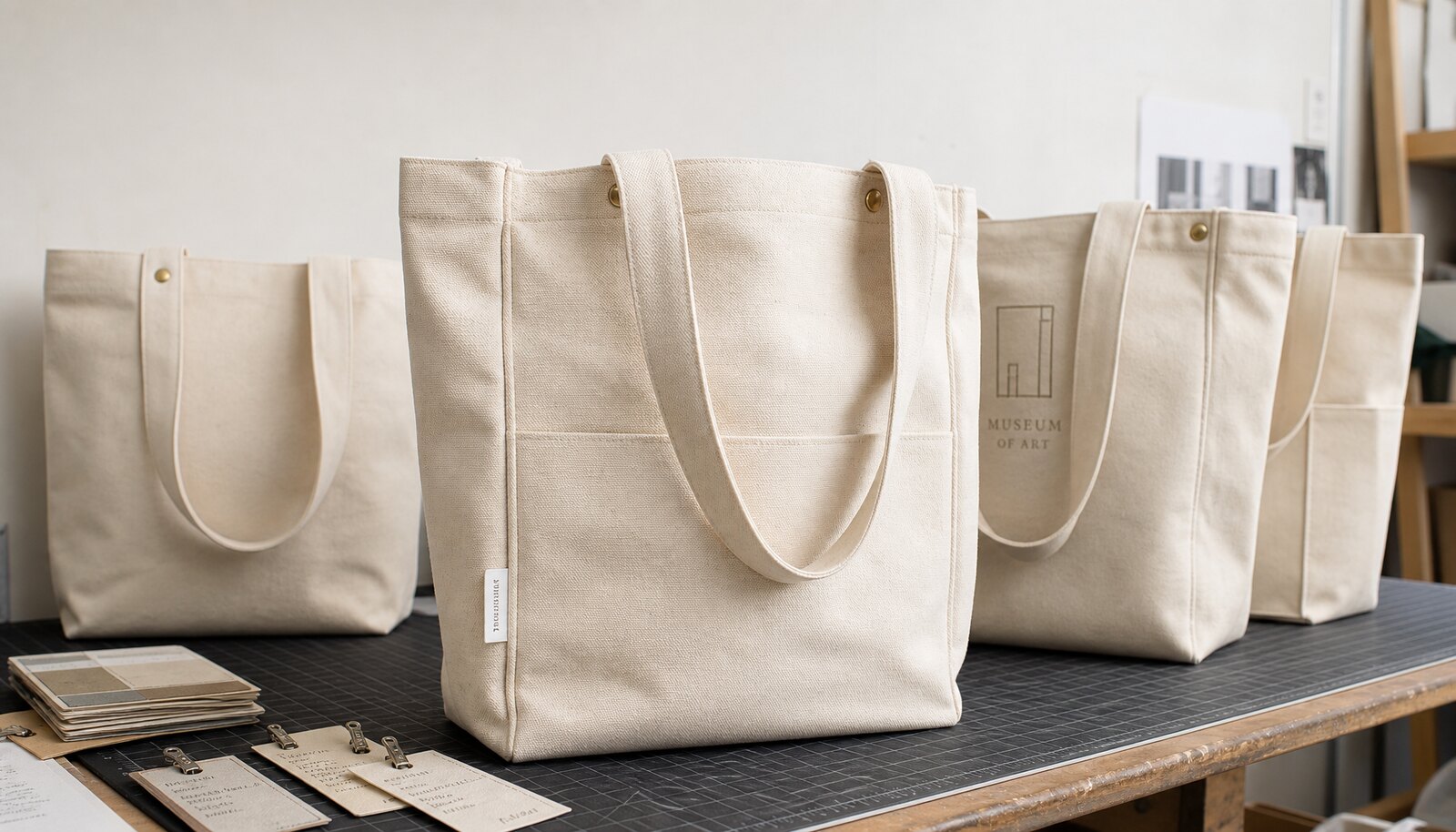
Why museum buyers need a sourcing plan, not just a tote quote
Canvas exhibition tote bags for museums often look simple, but procurement mistakes usually happen in the details. The bag has to support exhibition branding, carry brochures or gift-shop purchases, fold well for storage, and still feel like a legitimate retail item. A quote that only lists size and print method is not enough if the museum cares about shelf presentation, private label placement, or repeat replenishment.
The sourcing plan should start with the commercial use case. A tote for an exhibition opening may need a cleaner print and a lower MOQ. A tote for museum retail shelves may need stronger fabric, more consistent folding, and packaging that looks ready for sale. If the buyer defines the use case early, the factory can quote the right fabric weight, label construction, and packing method instead of guessing.
- Event giveaway bags and retail SKUs do not use the same spec.
- A small change in fabric weight or label method can move the bag into a different cost band.
- The best RFQ is the one that tells the factory what the bag must do after it leaves production.
Choose the canvas spec around use, not just appearance
For museum private label programs, 12 oz to 14 oz natural canvas is usually the safest starting point. In GSM terms, that is roughly 340 to 470 GSM depending on weave density and finishing. It holds a print cleanly, keeps a better shape on retail shelves, and feels more substantial in the hand than light promotional canvas. If the bag must support catalogs, hard-cover books, or boxed souvenirs, lean toward the heavier end of that range.
Handle construction matters as much as the body fabric. Self-fabric handles cost less and can look clean on a minimalist museum tote, but cotton webbing handles often feel stronger and are easier to control for repeat production. If the bag is expected to be loaded heavily, use reinforced seam ends and bar-tacks or X-stitching at the stress points. Buyers should not assume that thicker canvas alone solves carry failure if the handle attach points are weak.
- Use 12 oz canvas for lighter exhibition retail bags and lower-cost launch orders.
- Use 14 oz canvas when the bag must hold books, catalogs, or heavier gift-shop items.
- Ask for finished GSM, not only nominal fabric weight, because washing, calendaring, and shrinking can change the final feel.
Print method decisions: what looks good on canvas and what survives use
Screen print is the default choice for most museum totes because it gives good color density on natural canvas and stays cost-effective on medium runs. A one-color logo, exhibition title, or simple graphic usually prints cleanly without driving up setup cost. If the artwork is complex, has fine tonal details, or uses multiple colors, the buyer should compare screen print, heat transfer, and digital print with actual sample strikes on the selected fabric.
Heat transfer can help with small launches or image-heavy art, but it should be treated carefully on canvas. Some transfers look sharp at first and then crack, lift, or show edge wear after folding and friction. For a museum retail tote that will be handled often, buyers should prefer a print method with proven rub performance and ask the supplier what test they use for dry rub, wet rub, and fold-line durability. A print that looks good on a flat proof is not enough.
- One-color screen print is usually the safest balance of cost and durability.
- Multiple print colors increase setup charges, registration risk, and reject risk.
- If the museum artwork has gradients or fine line detail, request a printed sample on actual canvas before confirming bulk.
Private label structure: keep the branding useful, not crowded
Private label on a museum tote should support the retail program without competing with the main artwork. A small woven side label, a woven interior tag, or a neat care label is usually enough. If the museum wants a premium look, a side seam label sewn into the bag is more durable than a loose hangtag alone. If the tote is for resale, the buyer may also need a barcode sticker area or a hangtag format that works with the store’s POS system.
The biggest mistake is over-branding the bag. Too many labels, multiple logo placements, or oversized care inserts can make the tote look crowded and increase sewing steps. For private label sourcing, buyers should define which brand elements are mandatory and which are optional. That gives the factory room to price the bag correctly and prevents the sample from drifting into a cluttered retail look.
- Best practice: one main print, one private label element, and one care label if resale requires it.
- Side labels should be positioned so they do not interfere with the seam or handle stress area.
- If the museum expects a gift-shop presentation, specify whether the label must be visible or hidden.
Supplier route comparison for museums and retail buyers
The quote source matters as much as the quote itself. A factory with in-house cutting, sewing, printing, and packing usually gives more predictable repeat orders because the same team controls the bag from fabric to carton. Trading companies can be useful when the buyer wants easier communication or mixed product sourcing, but they may add markup or lose detail between departments. For a museum launch with a fixed exhibition date, the risk is not only price; it is also response speed, sample control, and accountability for defects.
If the buyer is comparing multiple sourcing routes, the right question is how much control the supplier actually has over the bag. Ask who owns print screens, who approves label placement, who packs the cartons, and who signs off on the final sample. When those answers are vague, the landed cost can look attractive while the actual project risk gets pushed onto the buyer.
- Prefer a supplier that can show the same spec across sample, production, and packing photos.
- If the supplier outsources printing or packing, make sure the quote says where each step happens.
- For repeat museum programs, consistency matters more than a slightly lower first-order unit price.
Comparison table: sourcing routes and what buyers should expect
Use the table below to compare sourcing routes before asking for a final quote. The point is not to pick the cheapest option immediately. The point is to match the route to the order size, launch timing, and private label complexity so the museum does not pay later in rework, carton issues, or delayed replenishment.
If the order is small, a stock-body route may be sensible. If the tote is a core museum retail SKU, a factory-led private label route usually gives better long-term control.
- Write decisions in measurable language, not only descriptive wording.
- Ask for sample photos plus one physical approval sample for important orders.
- Keep quotation, sample approval, and inspection notes tied to the same spec version.
What makes up the quote: where cost changes hide
Two quotes for the same canvas tote can differ by a surprising amount because the supplier may be pricing different assumptions. Fabric weight, fabric finishing, handle length, print colors, label stitching, packing style, and carton size all move cost. A lower unit price often means the supplier excluded one of those items or assumed a lighter fabric than the buyer intended.
For buyers building a private label museum program, it helps to separate the quote into material, decoration, packaging, and logistics. That makes it easier to compare apples to apples. Ask the factory for a breakdown that shows fabric cost, sewing labor, print setup, label cost, packing labor, and carton cost. If the supplier refuses to split the quote, the buyer loses the ability to control value engineering.
- Fabric cost increases sharply when moving from 10 oz to 12 oz or 14 oz canvas.
- Each extra print color usually adds setup and labor, even if the tote itself does not change.
- Retail packing often costs more than buyers expect because it adds labor, inserts, and carton volume.
MOQ logic: how to structure the first order without overcommitting
Museum buyers often need to balance launch risk against inventory pressure. A good first order is large enough to justify setup costs but small enough to survive artwork changes or exhibition schedule shifts. If the supplier offers a low MOQ, confirm whether that MOQ applies to stock canvas only or to a fully private labeled bag with custom print and custom packaging. Those are very different production routes.
A practical approach is to separate the order into a base bag and a branded layer. For example, the factory may keep the same bag structure but change the print, woven label, and insert card for different exhibitions. That can reduce development time and make replenishment easier. Just remember that if the buyer changes too many variables at once, the MOQ effectively rises because each custom element creates extra setup and inspection work.
- Stock fabric + custom print = lowest development risk for first orders.
- Custom fabric color + custom label + custom packing = higher MOQ and longer lead time.
- Ask the supplier to quote both a test order and a repeat-order price so you can see the learning curve.
Sample approval: what a museum tote sample must prove
A real sample is more than a printed bag. It should prove fabric hand feel, final size, handle balance, label placement, print density, and packing fit. If the tote is meant for retail, the sample should arrive packed the same way the bulk order will ship. That reveals whether folding, belly bands, barcodes, or inserts create wrinkles or slow down store receiving.
Buyers should inspect sample points with a simple acceptance mindset. Does the bag stand upright when filled with a typical museum purchase? Does the print sit square and dark enough on the natural canvas? Does the label look intentional rather than afterthought? If the answer is no, the buyer should revise the spec before approving the order, not after production starts.
- Compare the sample against the final artwork file, not against a mood board.
- Fill the sample with the actual items the bag is expected to carry.
- Approve stitching, handle length, print coverage, and packing together as one package.
Packing, carton count, and shipping decisions that affect landed cost
Packing is a cost driver, not a minor detail. Bulk packing lowers labor but may require extra de-crease work at the retail destination. Individual polybagging improves shelf condition and protection, but it adds labor, material, and carton volume. For museum distribution to multiple stores, carton count and bag count per carton should be fixed early so the warehouse can receive quickly and accurately.
Carton size also influences freight cost. A tote with heavy canvas and a large handle fold can waste cubic space if packed loosely. Buyers should ask the supplier to show how many pieces fit in each carton and what the gross weight will be. If palletizing is needed, confirm pallet height limits, carton stacking strength, and whether the supplier can mark outer cartons by SKU and destination.
- Bulk pack is cheapest but may not be retail-ready.
- Individual polybags protect print and help shelf presentation, but raise total cost.
- Master carton marks should include SKU, color, quantity, and destination if there are multiple store drops.
Specification comparison for buyers
| Supplier option | What to verify | Commercial advantage | Buyer risk to control |
|---|---|---|---|
| Direct sewing factory | fabric swatch, approved sample, seam close-ups, logo test photos, packing pilot, and final inspection evidence | Better sample-to-bulk control and faster production feedback | May be weaker on export paperwork or branded packing unless checked early |
| Trading company | Factory name, production photos, trim-source proof, and who owns QC decisions | Can coordinate small mixed orders and extra services | Markup can hide real factory capability and slow defect decisions |
| Specialized bag workshop | bag size, gusset, handle drop, seam allowance, stitch density, reinforcement patch, and loading expectation | More practical for detailed construction, trims, and repeat programs | Capacity may be limited during peak seasons |
| Low-price general supplier | 8-12 oz cotton canvas, 120-220 gsm cotton, recycled cotton, or blended fabric selected by use case and target price | Useful for simple promotional runs with loose specs | Material downgrades, weak packing, and vague inspection scope can erase savings |
| Retail-ready supplier | fold method, inner bundle, carton count, carton mark, moisture protection, SKU separation, and warehouse receiving needs | Can handle labels, SKU separation, carton marks, and receiving rules | Higher unit cost must be compared against reduced warehouse work |
| Compliance-focused supplier | Fabric records, labeling review, test plan, and production traceability | Safer for retail programs and repeat brand orders | Documentation claims need evidence, not only sales language |
| Local sample room plus bulk factory | Signed sample, bulk factory handoff, first-piece photos, and deviation owner | Good for complex branding before large production | Sample room quality may not match bulk line unless handoff is controlled |
Buyer checklist before sampling
- Confirm the tote size, fabric weight, handle length, and whether the bag must stand open on retail shelves.
- Define the print artwork in vector format, number of colors, print size, and acceptable color variation.
- State whether the museum needs private label elements such as woven side label, care label, hangtag, or barcode sticker.
- Choose the pack format: bulk, individual polybag, belly band, or retail insert card.
- Set the target MOQ, target delivery window, and whether the order is for a launch, replenishment, or event date.
- Request a pre-production sample built with the final fabric, print method, trims, and packing method.
Factory quote questions to send
- What fabric weight, yarn count, and finished GSM are included in your quote, and is shrinkage already allowed for in cutting?
- Which print method is quoted, how many colors are included, and what is the setup charge per color or per screen?
- Is the quoted MOQ for stock fabric only, or does it also apply to custom size, custom color, and custom label orders?
- What exact packing method is included, and how many bags per carton with carton size and gross weight?
- How many sample rounds are included before production, and is the pre-production sample charge refundable after order placement?
- What is the production lead time after sample approval, and what steps could extend it, such as label approval or fabric dyeing?
- Which inspection standard do you use for stitching, print defects, measurement tolerance, and carton count accuracy?
- Are there extra charges for woven labels, care labels, hangtags, barcode stickers, palletizing, or drop-shipping to multiple destinations?
Quality-control points to confirm
- Fabric weight tolerance should be agreed before mass production, with a practical range of about +/- 5% unless a tighter spec is necessary.
- Print should be checked for density, edge clarity, registration, and wash rub resistance before approving bulk production.
- Seam strength at the handle attach points should be reinforced with consistent bar-tacks or X-stitching and no skipped stitches.
- Bag dimensions should be measured after sewing, not just on flat cut pieces, because canvas shrinkage and seam allowance affect final size.
- Private label placement should be centered, level, and stitched without puckering or needle marks that distort the retail look.
- Carton count, carton size, and packing orientation should be verified against the distribution plan to avoid store receipt delays.