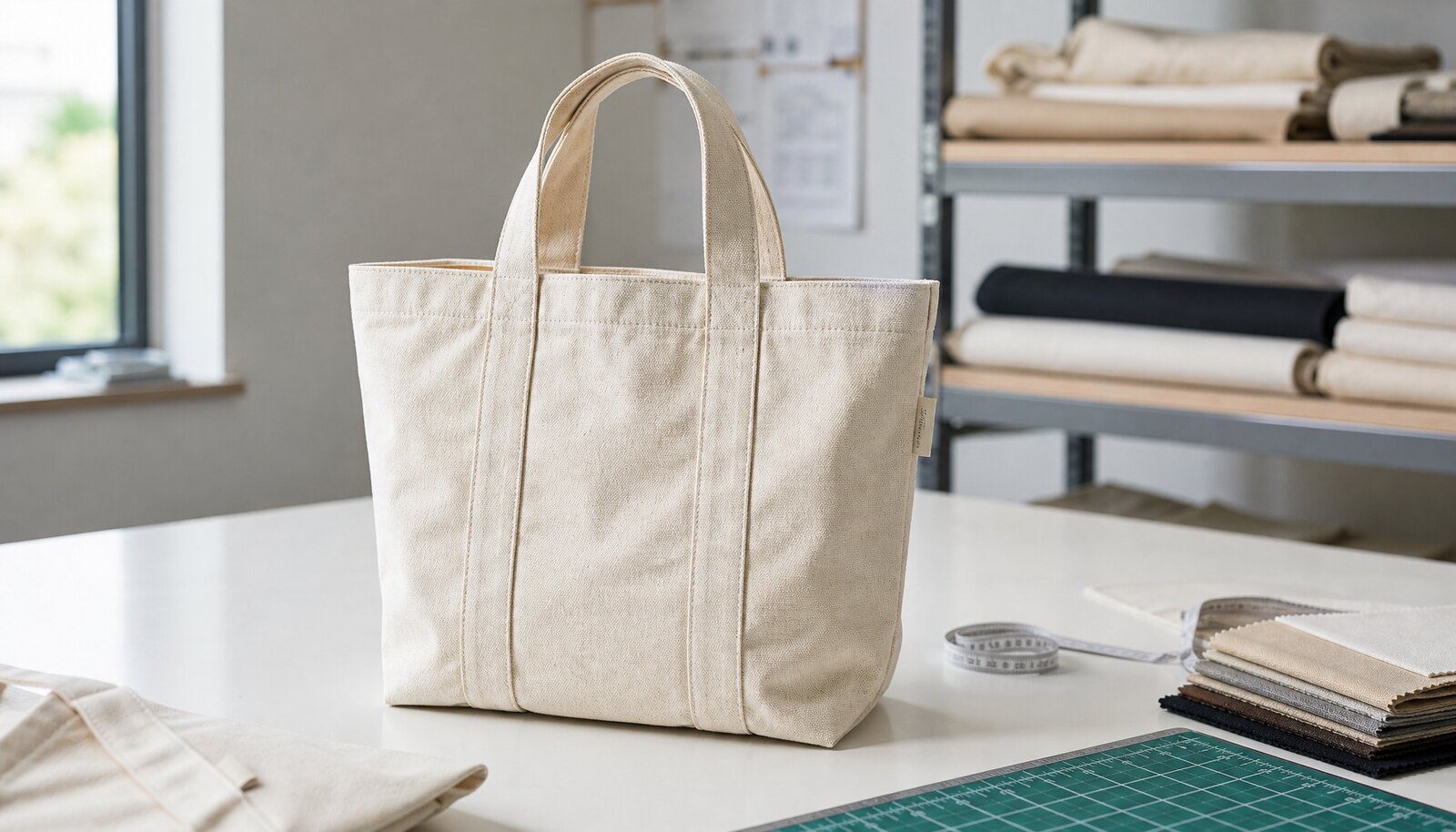
Why museum tote bags need a different specification than a generic promo bag
Canvas exhibition tote bags for museums sit between retail merchandise and operational packaging. They may be sold in a gift shop, included in an exhibition bundle, handed out at a member event, or used to carry catalogues, brochures, and small boxed items. That combination creates a different buying brief than a standard promotional tote. The bag has to look deliberate on a shelf, feel substantial in the hand, survive repeated carrying, and still ship efficiently in carton quantities that make sense for the warehouse.
The main procurement mistake is to buy only to a printed image. A tote can look elegant in a mockup and still fail in practice if the fabric is too light, the handles are too short, the print sits too close to the seam, or the folding method creates deep wrinkles that soften the retail presentation. Museum programs also vary more than many buyers expect. A tote for a one-month exhibition opening may only need to carry a brochure and a small takeaway, while a core gift-shop SKU may be handled daily for years. That is why the spec should begin with how the bag will be used, how it will be stocked, and what needs to happen after it leaves the factory.
Good specification also reduces internal friction. If marketing wants a premium look but operations wants low freight and easy receiving, the tote spec is where those priorities are reconciled. Define the practical target first, then match the material and packing decisions to that target. That avoids the common pattern where the buyer upgrades one feature after another until the bag becomes more expensive to ship and harder to manage than the original brief required.
- Retail gift-shop tote: prioritize shelf appearance, logo clarity, and flat-fold pack-out.
- Event giveaway tote: prioritize unit cost, predictable packing, and acceptable print durability.
- Premium member or exhibition bundle tote: prioritize fabric handfeel, handle comfort, and neat finishing.
- Document carrier tote: prioritize size accuracy and the ability to hold A4 or letter-size inserts without distortion.
Start with the end use: museum retail, exhibition kit, member gift, or event giveaway
The right canvas exhibition tote bags for museums packaging specification guide starts with use case segmentation. A museum retail SKU is judged differently from a launch-night giveaway. Retail buyers care about appearance on a peg or shelf, repeatability across reorders, and whether the tote still looks clean after heavy handling. Event teams usually care more about fast pack-out, simple decoration, and acceptable presentation for a specific date. Member gifts and patron packs may justify a stronger handle, a cleaner interior, or a more controlled print finish because the bag carries brand value beyond the event itself.
This distinction matters because it changes what the factory should quote. A tote intended for brochures and light souvenir items may not need the same fabric weight or reinforcement as one expected to carry books or boxed gifts. Likewise, a design that needs to sit flat in a retail display may require a different gusset depth than a tote intended to sit upright on a counter. If the museum sells the tote as a standalone retail item, visual consistency and print durability matter more than if the bag is one component in a temporary event kit. The buyer should write the use case into the RFQ so the supplier is quoting the correct structure rather than guessing from a picture.
A practical way to brief the market is to name the primary use and the maximum expected load. For example: 'gift-shop SKU for A4 brochures and light merch,' or 'exhibition bundle tote for catalogues and boxed souvenirs.' That single line improves sourcing quality because factories can immediately decide whether to propose a lighter, midweight, or heavier canvas, and whether the handles need reinforcement or webbing instead of self-fabric.
- Museum retail SKU: emphasize shelf presentation and reorder consistency.
- Exhibition bundle tote: emphasize load-bearing, neat folding, and clear packing instructions.
- Event giveaway: emphasize speed of packing and cost discipline.
- Member/patron gift: emphasize premium handfeel, print finish, and clean interior presentation.
Fabric, weave, and GSM: what to ask for beyond a simple ounce label
For most museum programs, 10 oz / 340 GSM cotton canvas is a practical baseline, but the useful decision is not the number alone. GSM is only one part of how the tote behaves. The weave density, yarn quality, finish, and whether the fabric is bleached, natural, dyed, or washed all affect drape, print sharpness, and perceived value. Two suppliers can quote the same nominal weight and still deliver very different results. One may feel soft and open, the other dense and structured. That is why the buyer should request a physical swatch and, where possible, a measured fabric spec with tolerance rather than relying on a catalog description.
A heavier option such as 12 oz / 400 GSM is often appropriate when the tote must carry books, boxed merchandise, or a thicker exhibition catalogue. The trade-off is not only cost. Heavier fabric can improve structure and shelf presence, but it can also increase sewing bulk at seams and corners. That means thread selection, seam allowance, and machine setup become more important. If the museum wants a softer retail look, a washed or lightly finished canvas may be acceptable, but it should still be tested against the actual contents. Softness is not a substitute for structure.
For more conservative procurement, ask the supplier to quote at least two fabric constructions side by side: one standard museum retail option and one heavier option for comparison. That is more useful than asking for a single 'best' suggestion because it exposes the cost curve and makes the trade-off visible before approval. If the supplier proposes a fabric below 300 GSM, require a clear explanation of why it is appropriate and what load it can safely carry without visual distortion.
- Ask for fabric GSM, weave density, finish type, and shade reference—not just 'canvas'.
- Request a swatch against the approved master reference before bulk.
- Use 10 oz / 340 GSM as a starting point for many retail and event programs.
- Use 12 oz / 400 GSM where the tote must feel firmer or carry heavier contents.
- Treat lighter canvas as a use-case exception, not a default saving measure.
Construction choices that affect strength, appearance, and inspection risk
Construction is where a museum tote either feels like retail merchandise or like a low-cost giveaway. The buyer should define the body shape, gusset depth, top finish, handle type, and reinforcement details in the spec sheet. Simple options often work best: a clean open-top tote with a standard hem, side gusset, and reinforced handles. But even a simple build has several points that can go wrong if not specified. A top edge that is too soft can roll and distort the logo. A gusset that is too narrow can reduce usable capacity. A handle that is too short can make the bag awkward to carry over the shoulder.
Handle construction deserves more attention than it often gets. Self-fabric handles can look cohesive and understated, which suits many museum brands. Cotton webbing handles can add comfort and better load distribution, especially if the tote is meant to carry heavier items. Either option can work if the reinforcement is strong enough. What matters is not only the material but the attachment method: bar-tacks, stitch length, handle width, and how the load transfers into the body panel. If the handles are sewn too close to a seam, the pull point can concentrate stress and cause distortion. That is why it is useful to ask the factory to show the handle reinforcement layout in the tech pack or sample photo set.
If a closure is required, it should be added because the use case needs it, not because it sounds premium. Zippers, snaps, and magnetic closures all add inspection complexity, component sourcing risk, and longer lead time. For most museum exhibition totes, open-top construction remains the cleanest and most reliable choice unless the contents need protection or the tote is positioned as a higher-value retail item.
- State body width, body height, gusset depth, and top finish.
- Choose self-fabric handles for visual coherence or webbing for higher carry comfort.
- Require reinforcement details: bar-tack count, stitch density, and handle drop.
- Add closure hardware only when the use case clearly needs it.
- Keep the construction simple unless premium positioning justifies extra risk.
Print method, artwork control, and how to reduce rejection risk
For museum totes, screen print remains the most dependable method for logos, exhibition titles, and simple graphic systems. It usually delivers the best balance of cost, clarity, and durability when the artwork is one or two colors. The buyer should still ask how the print will be applied: on a flat panel before assembly, or on the finished bag after sewing. Flat-panel printing can give cleaner registration and better repeatability for some designs, while finished-bag printing may be necessary when the art must align with the final shape. Either way, the factory should state the print area, color count, and curing process in writing.
More complex art can justify heat transfer, digital print, or hybrid decoration, but these methods introduce different risks. Heat transfer can be useful for small runs or detailed graphics, yet it can crack, lift at the edges, or feel less natural on canvas if the material and adhesive are not matched properly. Digital print can support color complexity and fine lines, but it can be more expensive than necessary if the artwork is simple. The buyer should not default to a 'modern' method unless the design actually needs it. For museums, restrained and durable often sells better than visually complicated.
Artwork control is one of the most common sourcing failures. The museum should provide vector artwork whenever possible, define Pantone targets where color consistency matters, and approve a placement proof with measured margins from the edges and seams. If the logo, title, or sponsor mark must sit in a precise position, specify the allowed movement in millimeters. Ask the supplier for a production reference sample that reflects the final ink, print method, and fabric color. A sample made on the wrong base fabric can be misleading even if the logo itself looks correct.
- Use screen print for most museum logos and exhibition identities.
- Use heat transfer or digital print only when the art complexity justifies it.
- Specify print size, placement, and edge distance in millimeters.
- Request curing/fixation details and a production reference sample.
- Approve vector artwork and Pantone targets before screens or plates are made.
Packaging specification: folding, inner packs, carton counts, and shelf readiness
Packaging is not a final afterthought for canvas exhibition tote bags for museums; it is part of the spec. The fold direction, compressed size, inner pack count, and carton count determine not only freight cost but also how the product arrives at the museum warehouse or gift shop. A loose fold can increase carton volume and create wrinkles. An overly tight pack can press sharp creases into the canvas or mark the print. The buyer should tell the factory exactly how the tote should be folded and how many units belong in each inner bag or carton layer.
For museum programs, packing should match the receiving model. If the order is going directly to a single store, the carton can be optimized for shelf replenishment and quick counting. If the order is moving to a distribution center, the outer labels need to be precise and the packing count should be easy to verify without opening multiple cartons. If the tote is part of a special exhibition kit, mixed-SKU packing may be needed, but that needs to be written into the plan rather than assumed. Vague instructions such as 'bulk pack neatly' often create the most expensive receiving problems later.
The pack spec should include fold size, whether a polybag or dust bag is required, label placement, and carton markings. If individual polybags are used, confirm whether they are needed for dust control, moisture protection, or simply to keep the totes clean in transit. For museum retail, odor control matters as well: a sealed bag can trap finishing odors, which can be a problem when the product is opened in a store or exhibition environment. If the tote is shelf-ready, the buyer should also define how the bag should present when opened: flat, folded, or lightly stuffed to hold shape.
Carton planning should be specific enough for freight and warehouse teams to use without guessing. State the target gross weight per carton, the carton dimensions, the master carton count, and the outer label contents. If the route is long-distance or involves multiple handoffs, ask the supplier to use carton strength appropriate to the shipment—not just the cheapest corrugated option available.
- Define fold method and folded dimensions.
- Specify inner pack count and master carton count.
- Set outer carton labels: PO, style, color, quantity, gross weight, and carton number.
- State whether polybags are for dust, moisture, or retail presentation.
- Avoid vague terms like 'bulk pack nicely' or 'standard export packing' without detail.
MOQ, pricing bands, and why small first orders can be expensive
Museum buyers often want a cautious first order because exhibition demand is uncertain. That is understandable, but the lowest quantity is rarely the lowest commercial risk. Printing setup, fabric reservation, cutting, sewing line setup, and packing labor are all spread differently across 800 pieces than they are across 5,000 pieces. A quote at a low MOQ can look flexible while hiding the reality that the unit price is carrying a large share of fixed costs. If the program is likely to continue after the exhibition, ask for pricing at pilot, target, and reorder quantities in the same quote.
The most useful quote is one that shows how the price moves when quantity changes. That tells the buyer whether the factory is pricing honestly and whether the bag can become a permanent museum SKU. If the price drops meaningfully at a higher run, procurement can decide whether to buy a larger initial batch or hold back for a reorder. If the price barely changes, it may indicate that the real constraint is fabric, print setup, or packing labor rather than volume. That information is more helpful than a single MOQ number.
Buyers should be careful with broad MOQ claims in the market. Some suppliers can technically produce a smaller batch if the bag is blank or lightly decorated, but the cost per unit may be so high that it undermines the retail model. Others may advertise a low MOQ but shift complexity into sample fees, setup charges, or packing surcharges. The correct approach is to compare total landed cost at a matched spec, not only the headline unit price. Ask the supplier to state what is included in the price, what is extra, and what changes the quote if the artwork or packing is revised after approval.
- Request pilot, target, and reorder pricing in one quote.
- Compare total landed cost, not only unit price.
- Ask what is included: fabric, print setup, labels, packing, and cartonization.
- Treat low MOQ claims carefully if setup or packing fees are not transparent.
- Use reorder pricing to judge whether the tote can become an ongoing museum SKU.
Lead time, production planning, and where museum schedules usually slip
Lead time for canvas exhibition tote bags is usually decided before sewing starts. The slowest parts are often artwork approval, sample revision, fabric confirmation, and packing instruction changes. If the museum changes the exhibition name, sponsor logo, or opening date after sample approval, the supplier may need to redo screens, labels, or carton marks. That is why the quote should define the lead-time basis clearly: is the clock starting from inquiry, deposit, final artwork approval, or pre-production sample sign-off? Without that clarity, internal stakeholders will assume the order is faster than it really is.
A better planning method is to split the timeline into three phases: sampling, bulk production, and shipping. Sampling may take longer if the design is new or the buyer needs to compare two fabric weights. Bulk production time depends on fabric availability, sewing capacity, and print complexity. Shipping time depends on route, season, and whether the cartons are moving by air, sea, or domestic carrier. A quoted lead time that ignores shipping is not wrong, but it is incomplete for procurement planning.
For museums with fixed event dates, buffer time is not optional. Leave space for the sample round, a production hold if the artwork is adjusted, and export or warehouse booking. If the tote is tied to a launch or exhibition opening, the buyer should also tell the supplier whether partial delivery is acceptable. Partial shipment can reduce risk in some programs, but only if the receiving team is ready to handle it and the carton labels are set correctly. Otherwise partial delivery becomes another source of confusion.
The most practical way to reduce timing risk is to freeze the decisions that trigger rework: fabric color, print placement, label text, fold method, and carton marking. A factory can usually move quickly when the spec is stable. It slows down when every department is asked to approve one more detail after the order is already in motion.
- Start the lead-time clock only from a defined approval point.
- Separate sampling, bulk production, and shipping time.
- Freeze artwork, labels, fold method, and carton markings early.
- Ask which changes trigger a schedule reset.
- Confirm whether partial shipment is allowed before production starts.
QC and inspection checklist: what a serious museum tote order should actually verify
Quality control on canvas exhibition tote bags should be measurable, not descriptive. If the order is for a museum gift shop or exhibition program, the buyer should ask for an inspection standard before bulk production begins. AQL-based final inspection is a practical baseline because it creates a clear method for deciding whether the shipment passes, needs sorting, or must be remade. The exact AQL level should be written into the purchase order or quality agreement, along with the defect categories. Without that structure, one party may call an issue minor while another treats it as a rejection.
At minimum, the inspection plan should cover fabric, sewing, print, packing, and carton condition. Fabric checks should confirm the agreed GSM or ounce weight, shade consistency, and any surface flaws. Sewing checks should review seam straightness, skipped stitches, loose threads, handle reinforcement, and the neatness of the top edge. Print checks should look at registration, opacity, edge sharpness, curing quality, and whether the design sits where the approved sample placed it. Packing checks should verify fold size, inner pack count, label accuracy, and carton compression or crush risk.
A serious QC checklist should also include simple performance checks tied to use. A pull or load test at the handle junction helps confirm that the tote can carry the intended contents without immediate stress failure. The threshold should be agreed in writing and matched to the use case; the requirement for a catalog bag is not the same as for a heavier merchandising tote. The buyer should keep a sealed approved sample and a retained bulk reference to support any dispute on color, print, or construction.
Odor deserves a line item as well. Museum retail environments are sensitive to strong chemical smells, mildew, or sealed-in packaging odors. If polybags are used, test the bags after unpacking, not only at the warehouse. A tote that passes stitch inspection can still be unacceptable if it arrives with a noticeable finish odor. For that reason, the release checklist should include both appearance and sensory review. If the order is for public retail, it is reasonable to hold cartons that fail either one.
- Use an AQL-based final inspection with written defect classes.
- Check fabric GSM, shade, and surface quality.
- Inspect seam straightness, handle reinforcement, and loose threads.
- Test print registration, opacity, edge sharpness, and cure quality.
- Add a handle pull/load check tied to the real contents.
- Review odor after unpacking, especially if polybags are used.
- Keep retain samples for dispute handling.
How to compare factory, trading company, and converter without getting misled
A museum buyer will often receive quotes from a factory, a trading company, and a local converter in the same sourcing round. Those options are not interchangeable. A direct factory is usually the strongest choice when the tote needs controlled fabric, consistent sewing, and custom packing. The reason is simple: the factory usually owns or controls the cutting, printing, and sewing process, which makes artwork control and corrective action easier when something goes wrong. A trading company can still be useful if it provides project coordination, broader supplier access, or a faster response for a complex multi-item order. A converter may be best for local speed or special packaging needs, but may have a narrower fabric range or less favorable unit economics.
The sourcing issue is not only price; it is accountability. Ask who owns the tooling, who approves the artwork proof, who keeps the sample record, and who signs the final inspection. In a direct factory relationship, the chain of responsibility is usually shorter. In a trading company arrangement, the buyer should clarify whether the trading company can authorize rework or whether the factory must be consulted first. That matters if there is a print defect or packing error and the order has a fixed museum launch date.
A good supplier comparison should also include sample accountability. If the supplier cannot explain how the pre-production sample is stored, which version is binding, and how artwork changes are tracked, the procurement risk increases. Museum buyers should ask for transparent dispute handling: what happens if the bulk print differs from the signed sample, who pays sorting or remake costs, and how the supplier documents corrective action. Those questions are not aggressive; they are standard commercial hygiene for a branded retail item.
One practical rule: if the supplier is vague about where the bag will actually be made, how the sample is controlled, or who resolves defects, the quote is incomplete even if the unit price is low. A museum tote is a customer-facing product. The buyer needs a supplier that can answer process questions, not only price questions.
- Direct factory: strongest control over sewing, printing, and packing.
- Trading company: useful when it adds genuine coordination or supplier access.
- Converter: useful for local speed, but check material options and accountability carefully.
- Ask who owns tooling, artwork approval, sample retention, and final sign-off.
- Clarify remake responsibility and defect handling before PO issue.
Specification comparison for buyers
| Spec decision | Recommended option | When it fits | Buyer risk to check |
|---|---|---|---|
| Supplier route | Direct factory with in-house cutting, printing, sewing, and packing; use a trading company only if it adds real project management value | Best for repeat museum programs, controlled artwork, carton-level packing, and stable reorder quality | Confirm who actually owns tooling, who approves artwork, and who signs off the pre-production sample; ask for production photos from the real factory, not only showroom images |
| Canvas weight | 10 oz / 340 GSM for standard retail tote programs; 12 oz / 400 GSM for heavier exhibition use; use lighter or heavier weights only with a use-case justification | 10 oz suits gift shop price points, catalog handouts, and moderate daily use; 12 oz fits books, boxed merchandise, and bags expected to feel more premium | Do not rely on GSM alone; weave density, yarn quality, finish, and sewing construction affect feel and strength. Ask for a measured fabric tolerance and a physical swatch |
| Fabric type | Natural cotton canvas, bleached canvas, or dyed canvas matched to museum brand and retail positioning | Natural canvas works for most heritage and museum retail programs; bleached or dyed canvas can support a more refined visual system | Confirm shade consistency against approved master swatch; ask whether the color is reactive-dyed, piece-dyed, or finished after sewing because that affects shade variation and handfeel |
| Print method | 1-color or 2-color screen print for volume; multi-color or fine-detail art only when the artwork truly requires it | Screen print is usually best for exhibition titles, logos, donor marks, and simple line graphics | Ask for print adhesion standard, curing process, and whether the design is printed on flat panels before bag sewing or on the finished bag. Poor curing is a common failure point |
| Handle construction | Cross-stitched self-fabric handles for understated retail look; cotton webbing handles where higher load or better shoulder comfort is needed | Use self-fabric for branded gift-shop presentation; use webbing for load-bearing or premium tote applications | Check bar-tack count, stitch density, and handle attachment reinforcement. Handle failure is often a sewing issue, not a fabric issue |
| Closure or opening | Open top for retail, event giveaways, and fast packing; zipper or snap closure only when the contents justify the extra cost and inspection burden | Open top is the default for most museum totes; closures fit document kits, high-value bundles, or premium members’ packs | Zippers add component quality risk, metal risk, and extra lead time. Confirm slider type, tape match, and end-stop quality if a closure is specified |
| Interior finish | Unlined for cost control and simpler sewing; light lining only when the use case needs a cleaner interior or extra structure | Unlined suits most catalogs, souvenirs, and handout programs; lining fits premium retail positioning or improved interior presentation | Lining adds bulk at seams and corners. Ask for a finished-turn sample so the buyer can inspect corner shape and seam cleanliness |
| Packing route | Bulk pack in master cartons with optional polybag or dust protection; item labels, SKU labels, and carton labels should be defined in the RFQ | Suitable for importers, museum store groups, and distribution to multiple locations | Do not accept vague wording like 'bulk packed nicely.' State fold size, inner pack count, outer carton count, and label placement |
| QC method | AQL-based final inspection plus in-line checks on fabric, sewing, print, and packing | Best for museum programs where presentation and defect control matter on arrival | Ask for the inspection standard, defect classification, and photo report format; confirm whether the supplier can hold the agreed AQL level |
Buyer checklist before sampling
- Confirm finished bag size, tolerance, fabric weight, and whether the tote must fit A4 or letter-size exhibition material, a catalogue, or boxed merchandise.
- Lock the artwork file format, print placement, Pantone targets, and whether the graphic appears on one side, both sides, or the gusset.
- State the use case clearly: retail shelf SKU, exhibition giveaway, member gift, sponsor pack, or document carrier, because each use case changes fabric, finish, and packing.
- Define handle length, handle width, handle reinforcement, seam allowance, and whether the bag must carry a stated load without distortion.
- Approve fold method, inner pack count, master carton count, carton dimensions, gross weight limit, and outer label content before production starts.
- Require a blank sample if the bag is new, then a pre-production sample with the exact print method, trim, label, and packing intended for bulk.
- Set acceptance criteria for stitch quality, print clarity, odor, dimension tolerance, and carton condition on arrival.
- Clarify whether partial shipments are allowed, whether the supplier can hold buffer stock, and who owns reprint or remake responsibility if artwork or packing is wrong.
Factory quote questions to send
- What fabric GSM, weave density, and finished handfeel do you recommend for this museum use case, and what is the price difference between 340 GSM and 400 GSM on the same construction?
- Can you quote the same tote in two construction options, such as self-fabric handles versus cotton webbing handles, so we can compare cost and load performance?
- Which print method will you use, how many colors are included, what is the setup fee, and what is the cure or fixation method for the ink?
- Where will the graphic be applied: before sewing on a flat panel or after assembly on the finished bag, and how does that affect tolerance and print placement?
- What is the MOQ by artwork version, color, and construction, and how does the unit price change at pilot, target, and reorder quantities?
- Can you provide the seam allowance, stitch density, bar-tack detail, and thread specification in the quotation or tech pack?
- How will the totes be folded, packed, labeled, and cartonized, and what are the inner pack count, master carton count, carton size, and gross weight?
- What sample stages are included: blank sample, pre-production sample, and production reference sample, and who pays for courier and re-sampling if changes are needed?
- What is your standard production lead time after sample approval, and which issues most commonly extend it: fabric booking, artwork changes, packing changes, or export booking?
- If there is a defect in printing, sewing, or carton labeling, what is your remake policy and who approves the corrective action?
Quality-control points to confirm
- Use an AQL-based inspection plan for final random inspection. State the inspection level and defect classification in the PO or quality agreement so minor, major, and critical defects are handled consistently.
- Fabric weight should be measured against the agreed GSM or ounce spec with a documented tolerance. Do not accept an unlabeled substitute fabric simply because it looks similar.
- Check finished dimensions in multiple points: bag opening width, body height, gusset depth, and handle drop. Define the acceptable tolerance before production, not after inspection.
- Inspect stitch quality at the top hem, side seams, gusset corners, and handle attachment points. Reject skipped stitches, broken threads, loose thread tails, needle damage, and uneven seam runout.
- Apply a pull or load check to the handle attachment area on pre-production and bulk samples. The exact threshold should be agreed in writing and tied to the tote’s intended use, not copied from an unrelated product.
- Verify bar-tack count, stitch density, and reinforcement placement at load-bearing points. A tote can look clean and still fail if reinforcement is too short or too light.
- Check print adhesion by using a supplier-agreed rub or tape-style adhesion test and by reviewing edge sharpness, registration, opacity, and cure quality. Reject cracking, peeling, smearing, or ink bleed.
- Review odor on opening and after unpacking. Bags with strong chemical or musty smell should be held until the cause is explained and corrected, especially for museum retail environments.
- Inspect fold quality and carton compression marks. If the tote must arrive shelf-ready, the fold should not create hard creases across the logo or distort the bag shape.
- Confirm carton strength, carton sealing, outer label accuracy, and pallet stability where used. Include a carton drop or transit-risk check appropriate to the shipping route if the cartons will move through multiple handoffs.