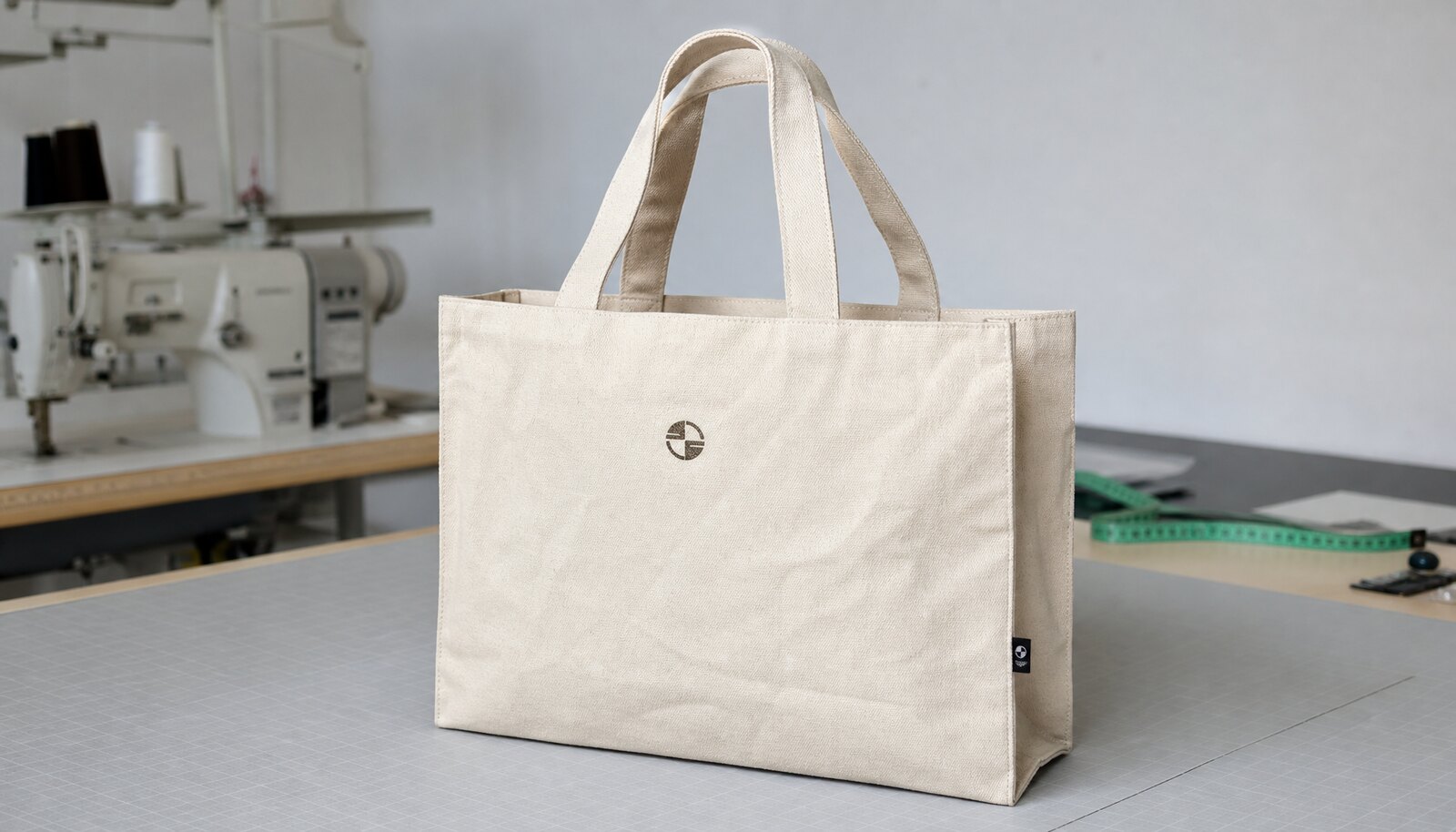
Why the print method matters more than the artwork file
For canvas exhibition tote bags for hotels, the logo file is rarely the real sourcing problem. The real problem is matching the print method to the bag’s fabric weight, the expected handling at the event, and the hotel’s brand standard. A logo that looks crisp in a PDF can still become fuzzy on rough canvas, too glossy on a luxury tote, or too expensive once the supplier adds setup, color matching, and packing labor.
Buyers often receive quotes that cannot be compared directly because one supplier is quoting screen print on 12 oz raw canvas, another is quoting heat transfer on 14 oz washed canvas, and a third is quoting embroidery on a lighter body with a woven label. If you want clean comparison, the RFQ has to define the same bag structure first and then separate the print method as its own decision.
- Use the same bag dimensions, fabric weight, handle spec, and packing method before comparing print prices.
- Treat print method as a cost and risk choice, not just a decoration choice.
- If the bag will be reused by hotel guests, durability matters more than the lowest decoration price.
Choose the canvas weight first, then the decoration method
Most hotel exhibition totes work well in the 12–16 oz canvas range. At 12 oz, the bag usually feels flexible, easier to pack, and lighter in freight. At 14 or 16 oz, it feels more substantial, stands better on a display table, and tolerates heavier contents such as brochures, samples, bottle-size giveaways, or room amenity kits. Below 10 oz, the tote can feel too soft for a hotel environment unless it is strictly for light literature.
The fabric choice changes the print result. Natural raw canvas accepts screen print well, but the surface is uneven enough that very thin lines may break up. Washed canvas gives a softer hand-feel and a more retail look, but the same printing method can appear slightly less sharp if the fabric has heavy texture. For hotels, that tradeoff matters because the bag is often seen close-up at check-in desks, conference counters, or event registration tables.
- 12 oz: good starting point for general conference and exhibition use.
- 14 oz: better if the bag needs a premium hand-feel without moving into heavy retail territory.
- 16 oz: suitable when the bag carries heavier inserts or needs a more rigid presentation.
- Raw natural canvas: best for cost control and straightforward screen printing.
- Washed canvas: better when the hotel wants a softer, more finished brand image.
Print method comparison: what actually changes cost and appearance
Screen printing is still the most practical option for many hotel tote programs when the artwork is one or two solid colors. It gives good opacity, works well on medium-to-heavy canvas, and usually offers the best repeat-order economics. The drawback is setup: every color needs screens and registration control, so artwork with gradients, tiny type, or many spot colors becomes expensive or risky.
Heat transfer and digital transfer are useful when the buyer needs quick sampling, small quantities, or a full-color logo. They reduce setup complexity, but the finish can look less natural on coarse canvas. Embroidery has a premium feel, yet it works best as a logo accent rather than a large detailed graphic. Woven or sewn labels are useful when the bag needs a restrained, durable brand mark and the hotel prefers a quiet look instead of a strong promotional print.
- Screen print: best for bold logos, repeat orders, and moderate to large MOQ.
- Heat transfer/digital transfer: best for short runs, artwork revisions, or multi-color logos.
- Embroidery: best for premium positioning, small logos, and front-pocket branding.
- Woven label: best as a secondary brand element when the main bag surface should stay minimal.
How to compare supplier quotes without being misled
A good quote for canvas exhibition tote bags for hotels should separate body price, print price, setup charges, packaging, and freight assumptions. If a supplier gives a single unit price with no detail, you cannot tell whether the quote is based on 12 oz or 16 oz canvas, whether it includes one side or two sides, or whether the packing is bulk or retail-ready. That is where landed cost surprises usually start.
The most useful quote comparison is a side-by-side view of the same bag in different routes. For example, ask for 12 oz raw canvas with one-color screen print, then the same body with a two-color screen print, and a second version with heat transfer. That gives you a real picture of how each method changes setup cost, labor, and lead time. If the quote also includes master carton size and carton weight, your freight calculator becomes much more accurate.
- Separate base bag price from decoration price.
- Ask whether setup charges are one-time or repeated on every order.
- Use the same packing spec across suppliers when comparing landed cost.
- Include carton dimensions in the quote to estimate volume weight.
Decision table: sourcing routes that matter to hotel buyers
The right sourcing route depends on order size, artwork complexity, and how strict the hotel is about appearance. Some buyers should prioritize repeatable screen printing from a factory with stable sewing lines. Others need a low-MOQ route with digital transfer because the event program is still changing. The table below is meant to help procurement teams compare practical supplier options instead of comparing vague promotional claims.
When suppliers say they can do everything, the useful question is which route gives the lowest combined risk for your specific use case. A 5,000-piece conference program does not need the same solution as a 300-piece VIP welcome kit, even if both are technically canvas tote bags.
Sample approval: what to inspect before you release production
For hotel programs, sample approval should cover more than the logo image. The sample needs to show the actual fabric hand-feel, the finished handle length, the print edge quality, and the bag’s shape when empty and lightly loaded. If the tote is intended to sit on an event registration counter, the body should stand neatly enough to look intentional rather than collapsed.
A proper approval sample should be made from final production fabric, not a generic fabric substitute. If the supplier sends a random pre-print prototype or a photo of a similar bag, you may approve something that cannot be reproduced at scale. The sample should include the same color reference, same print method, and same side label or woven tag that will appear in production.
- Measure bag width, height, and gusset against the approved spec.
- Rub the printed area lightly to check for scuffing or transfer.
- Inspect the top edge and handle attachment for symmetry.
- Load the sample with typical hotel contents and observe shape retention.
- Verify any woven label, side label, or care label placement before production release.
QC thresholds that prevent avoidable complaints
The most common complaints on canvas exhibition totes are not dramatic defects; they are small inconsistencies that show up in bulk. Print placement drifts slightly left or right, one handle looks shorter than the other, or the tote body varies enough that the bag sits crooked on a table. Those issues are visible in hotel environments because the bags are often lined up in reception, conference registration, or hospitality suites.
A practical QC standard for this product should focus on print clarity, stitch reinforcement, and dimensional consistency. It is usually better to allow a reasonable fabric tolerance than to reject too many bags for natural canvas variation. What matters is that the bags look like one coordinated set, not a random mix from different sewing days.
- Print should be visually centered and consistent across the carton sample set.
- Handle length should match within the agreed tolerance so the tote hangs evenly.
- Top edge should not wave or curl from poor folding or heat damage.
- Seams should not open when the bag is loaded with standard event materials.
Packing and carton planning for hotel and exhibition distribution
Packing is part of product quality, not just shipping convenience. If the bags are folded too tightly, screen print can crease; if they are packed too loosely, cartons become bulky and freight cost increases. For hotel distribution, a clean flat fold with consistent stacking is usually the best compromise. If the bag has a structured bottom or heavy embroidery, the packing style may need to change so the carton does not crush the shape.
For buyers handling international freight, carton math matters. Ask for the number of bags per carton, master carton dimensions, and gross weight before final approval. That gives procurement a real landed-cost view and helps logistics teams avoid surprises at booking. If the bags are being sent to multiple hotels, retail stores, or conference venues, carton labeling should be simple and readable so receiving teams can sort quickly.
- Prefer consistent flat-fold packing for screen-printed canvas totes.
- Use outer polybags only when the destination or brand standard requires extra protection.
- Confirm carton count against the packing list before release.
- Request carton labels that show style, color, quantity, and PO number clearly.
Lead time, MOQ logic, and the hidden schedule risks
Lead time on these totes usually stretches for three reasons: artwork approval, material availability, and decoration method. Screen print often has a stable production flow once the screens are made, but the setup step can slow the start. Heat transfer may be faster for sampling, yet it can bottleneck if the artwork changes late. Embroidery adds digitizing time and machine scheduling. For hotel campaigns tied to conferences or seasonal events, a few days lost in approval can become the real delay.
MOQ should be treated as a function of the print route and bag body, not as a random supplier demand. A factory may offer a lower MOQ on a standard 12 oz body with one-color screen print because the sewing line and print line are stable. The same factory may require a higher MOQ for embroidery, multi-color transfer, or custom dyeing because each step adds setup waste. If you need a smaller run, it is often cheaper to simplify the artwork than to force a low-volume premium method.
- Plan extra time for artwork cleanup and sample approval.
- Expect higher MOQ for embroidery and multi-color decoration.
- Use standard fabric colors and standard body shapes when lead time is tight.
- Avoid changing print position after sample signoff unless you are prepared for rework.
Landed-cost comparison: where the budget really moves
For procurement, the bag price is only part of the budget. Freight volume, packing density, setup charges, and rework risk all affect the true landed cost. A cheaper print method can become more expensive if it causes higher reject rates, more sample cycles, or extra labor at the warehouse. On the other hand, paying for a more durable print method can reduce complaint handling and replacement cost when the tote is used as a guest-facing hotel item.
The most disciplined way to compare options is to calculate three numbers: unit ex-factory price, packing and carton cost, and freight impact per carton. Then add the likely cost of sample iterations. A hotel buyer planning a 2,000- to 10,000-piece program often gets more value from a stable, repeatable 1-color screen print than from a cheaper-looking quote that lacks control on packing or print consistency.
- Compare unit price only after matching fabric weight and print route.
- Include setup and sampling cost in total program cost.
- Use carton volume to estimate sea or air freight impact.
- Factor in reject risk when deciding between premium and low-cost decoration.
Specification comparison for buyers
| Spec decision | Recommended option | When it fits | Buyer risk to check |
|---|---|---|---|
| Print method | 1–2 color screen print on 12–16 oz canvas | Hotel exhibition totes with a clear logo, short copy, or one-side event mark | Fine lines may fill in; white on natural canvas can look uneven if ink deposit is too light |
| Print method | Heat transfer or digital transfer | Small runs, multi-color artwork, variable names, or fast sample needs | Transfers can crack, lift, or look glossy if the base fabric is too textured |
| Print method | Embroidery on pocket or front panel | Premium gifting, staff kits, or low-ink luxury positioning | Stitch density can pucker lighter canvas and increase unit cost quickly |
| Print method | Woven or sewn side label plus blank or minimal print | Brands that want a restrained hotel look and flexible stock reuse | If the bag depends on the label alone, the main print area may feel underbranded |
| Fabric weight | 12 oz canvas minimum; 14–16 oz for heavier retail feel | Most hotel exhibition use where the bag must hold brochures, samples, and giveaways | Too light leads to slouching; too heavy raises freight and sewing cost |
| Handle construction | Self-fabric handles with bar-tack reinforcement or cross-stitch | Daily event handling and repeated use by guests or attendees | Handle attachment failure is the most common functional complaint on low-spec totes |
| MOQ route | Factory standard body with custom print | Buyers seeking lower risk and quicker quote alignment | Low MOQ can hide setup charges that make landed cost worse than expected |
| Sample route | Pre-production sample with final fabric, print, and packing | Any order where hotel brand color, print placement, or packing matters | Approval based on image alone often misses shade shift, print sharpness, or seam alignment |
| Packing route | Bulk packed with polybag and carton label; retail packing only if needed | Distributor and procurement buyers focused on land cost and warehouse efficiency | Overpacking increases labor and carton volume without improving usability |
Buyer checklist before sampling
- State the exact canvas weight in ounces or GSM, plus whether the quoted fabric is washed, bleached, or raw natural.
- Define the print method by artwork size, number of colors, and print position; do not accept a vague 'custom printing' line.
- Include bag dimensions, gusset depth, handle length, and handle width so suppliers quote the same structure.
- Specify intended load: brochures only, mixed event giveaways, or retail resale, because this changes fabric and stitch reinforcement.
- Request a pre-production sample using final fabric, final ink or thread, and final packing method.
- Ask for carton count, master carton dimensions, and net/gross weight to estimate landed freight accurately.
- Set an acceptable sample tolerance for print placement, shade variation, seam wobble, and handle length.
- Confirm whether the supplier quotes setup charges, plate charges, embroidery digitizing, or transfer film separately.
Factory quote questions to send
- What canvas weight, yarn count, and finished fabric width are you quoting, and is the fabric raw, dyed, or washed?
- Which print method are you recommending for this artwork, and what are the setup costs, running costs, and repeat-order costs?
- Can you quote the same bag in two options: 12 oz canvas and 16 oz canvas, so we can compare landed cost and hand-feel?
- What is the minimum order quantity per color and per print method, and how do mixed colors or mixed artwork affect MOQ?
- Will the sample be made from final fabric with final print placement, or only a visual reference sample?
- What is your standard seam reinforcement on handles and top stress points, and can you show a close-up photo from a previous production sample?
- How do you pack each bag and carton them for export, and what is the master carton size for your quoted packing method?
- What lead time applies to sample approval, production, and replenishment, and what conditions usually extend the schedule?
Quality-control points to confirm
- Canvas weight should stay within an agreed tolerance, typically around ±5% of the quoted GSM or ounce weight for bulk production.
- Print placement should be centered within a defined tolerance, commonly 0.5–1.0 cm on simple one-side layouts, unless the artwork is deliberately off-center.
- Screen print opacity should cover the base fabric without patchy show-through on the first visual inspection under bright neutral light.
- Heat transfer edges should be fully bonded, with no lifting at corners after a light rub test and no visible wrinkling from packing pressure.
- Embroidery should sit flat enough that the backing does not create a hard lump or distort the bag panel.
- Handle stitching should include reinforcement at both attachment points, with no skipped stitches, loose thread tails, or uneven bar-tacks.
- Seam alignment and gusset depth should match the approved sample so the bag does not twist when loaded.
- Carton count should match the packing list, with random inner-bag inspection for dust, stains, color transfer, and print scuffing.