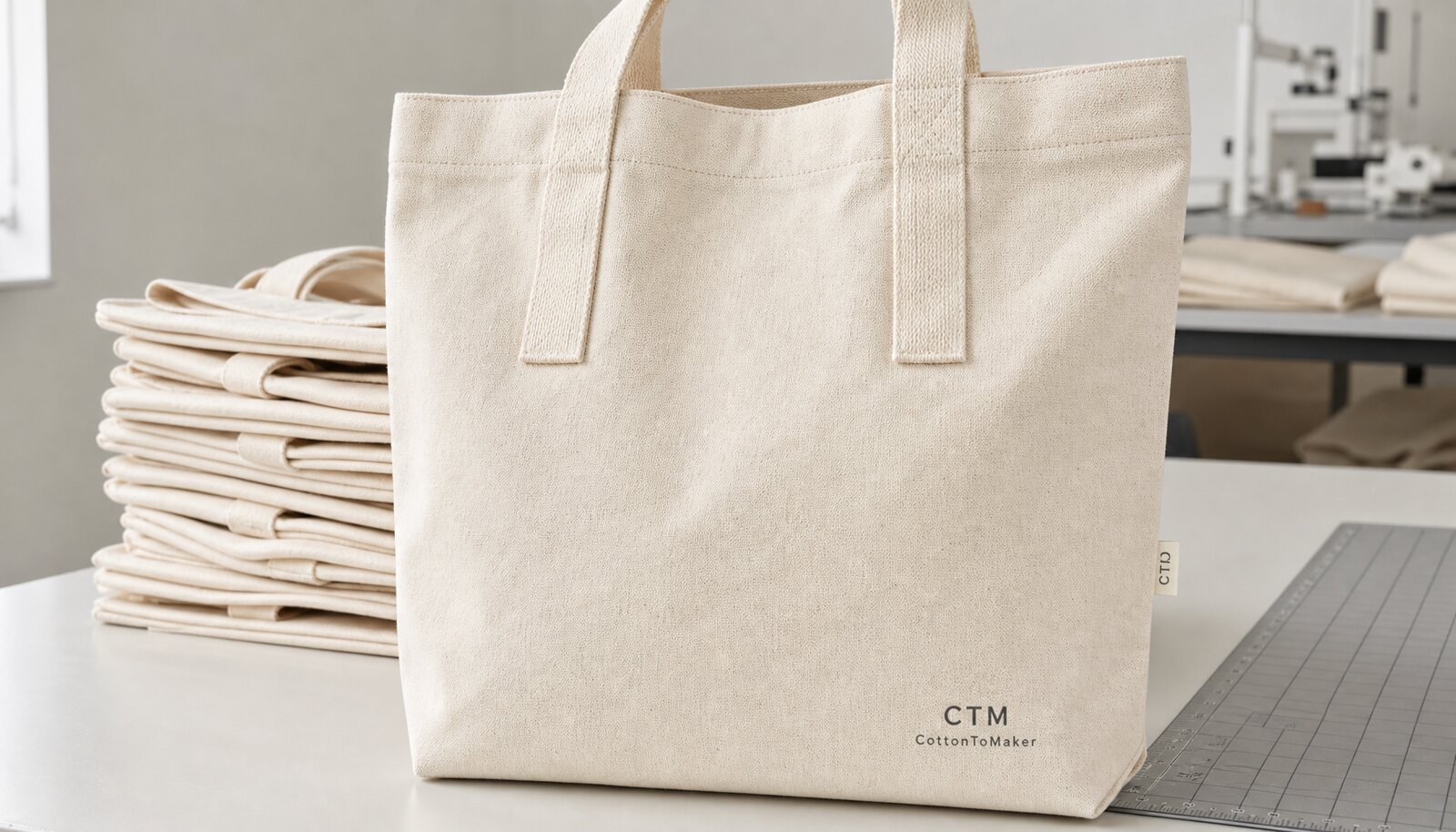
Start with the retail job, not the tote shape
A gift shop launch fails when the bag spec is treated like a generic promotional tote. The real job is more specific: the bag has to look good on a shelf, survive customers picking it up and putting it back, and still feel worth the price after the logo is printed. For canvas exhibition tote bags in a gift shop setting, that usually means a cleaner silhouette, a controlled print area, and enough fabric body to avoid a floppy, low-value look.
Before asking suppliers for a quote, define the use case in plain buying terms. Is the bag meant to carry books, folded garments, souvenirs, or flat printed items? Will it hang on a peg board or sit folded in a basket? The answer changes the size, the handle drop, the fabric weight, and the finishing detail. If you start with the shelf and the contents, the rest of the spec becomes much easier to control.
- Set the target retail role: impulse add-on, main souvenir SKU, or premium gift bag.
- Choose one primary carrying use, because a bag designed for postcards is not the same as one built for books.
- Decide how the bag will be displayed, since hanging, stacking, and folding all affect shape and print placement.
Choose canvas weight and construction for a real retail shelf
For most gift shop launches, 12 oz canvas, or roughly 340 to 400 gsm finished, is the safest starting point. It has enough body to feel like a proper retail item without moving into expensive heavyweight territory. A 10 oz bag can work for lighter souvenir programs, but it can also feel thin if the weave is open or if the print is large and dark. At the other end, 14 oz and above can look premium, yet the extra material and sewing time can push the item out of the expected price band.
Construction matters as much as cloth weight. A flat tote with self-fabric handles is cheaper, but a gusseted body with cotton webbing handles usually sells better in retail because it stands up to handling and looks more deliberate. If the buyer expects repeat use, a bottom seam with reinforcement or a small board insert can help the bag keep its shape. Do not let a supplier reduce cost by quietly removing reinforcement, changing the handle width, or swapping to a looser weave.
- Use 10 oz canvas when the item must hit a lower price point and carry only light contents.
- Use 12 oz canvas as the default for most gift shop launches.
- Use 14 oz canvas only when the retail shelf price and brand position can absorb the added cost.
- Confirm whether the quoted GSM is finished weight, not raw fabric weight.
Match the print method to artwork and order size
Print choice is where many first orders lose margin. Screen printing is usually the most practical method for one to three solid colors, especially when the logo needs sharp edges and repeatability. It carries setup cost, but the unit economics improve when the order scales. For a gift shop launch, that makes screen print the usual default unless the artwork is too detailed or the first order is intentionally small.
Digital transfer or heat transfer makes sense when the art has gradients, fine lines, or multiple colors that would be expensive to separate for screen print. The tradeoff is a different surface feel and a higher risk of edge lift or wear if the cure and transfer quality are poor. Embroidery, woven patches, or a sewn-on label can work well for premium versions, but they usually fit a restrained logo better than a full illustration. A strong launch often uses one main SKU with a simple print and, if needed, a second premium version with a label or patch rather than forcing one method to do everything.
- Use screen print for bold logos, simple icons, and repeat orders.
- Use transfer methods for small runs or complex art, but test fold and abrasion resistance.
- Use woven labels or patches when the brand wants a cleaner, more premium retail look.
- Specify artwork size and placement in millimeters, not just "center front".
Read MOQ and price quotes as a production buyer
A useful quote separates every cost that changes with the spec. The base bag should be priced separately from print setup, color count, handle material, folding method, hanging tag, and carton pack. If a supplier gives one lump sum with no detail, you cannot judge whether a lower quote is truly cheaper or just missing work that will reappear later as an add-on. For launch buying, the hidden costs are usually setup fees, packaging additions, and freight-ready carton upgrades.
MOQ logic should be tied to the production process, not just the supplier's preference. One size, one fabric color, one artwork version, and one print method usually gives the cleanest starting point. The moment you split into multiple colorways or sizes, the effective MOQ per SKU rises and the unit cost moves up. A good factory quote will tell you the minimum order per color and the minimum order for each print version, because those are the numbers that affect launch risk more than the headline total quantity.
- Break the quote into base bag, print, packing, and freight-ready carton cost.
- Ask for MOQ per SKU, per artwork, and per color, not only one overall minimum.
- Treat unusually low unit pricing with caution if setup, packing, or carton charges are vague.
- If possible, lock one launch SKU first and add variants only after sell-through data is visible.
Pick the supplier route that fits your launch risk
Direct factory sourcing is usually the right route when the bag spec matters and the buyer needs control over fabric weight, stitch detail, and print quality. It is also the best path when the launch may turn into a reorder, because the factory keeps the production record and can repeat the same build more reliably. The drawback is that the buyer must be precise. A direct factory will often quote exactly what is written, so a loose RFQ becomes a loose bag.
A trading company or sourcing agent can help when the launch involves more than one product line, multiple countries of origin, or a smaller buying team that needs one point of contact. That convenience has a cost. Margin may be layered in, and the buyer needs to know who actually controls the fabric, sewing, and print decisions. Stock distributors are faster, but they usually trade away exact spec control and retail branding flexibility. For a first gift shop test, stock can be useful; for a branded launch, the supply route should support repeatability rather than speed alone.
- Direct factory: best control, best for repeat orders, requires a tighter RFQ.
- Trader or agent: useful for mixed sourcing or small buying teams, but clarity on accountability is essential.
- Stock distributor: fastest path, but limited artwork and inconsistent spec control.
Approve samples against retail use, not just artwork
The sample stage should prove that the bag sells and survives handling, not only that the logo is in the right place. Start with a pre-production sample that matches the intended fabric weight, print method, handle width, and finishing. Then test the bag under normal retail use: fold it, hang it, load it with the product category it is meant to carry, and inspect the seams after repeated handling. If the bag changes shape badly or the print cracks when folded, the order is not ready even if the art looks correct on a flat table.
A good approval process uses one reference sample and one clear acceptance note. Record the approved fabric shade, handle length, gusset depth, print placement, and packing method. If the factory sends a revised sample, compare it to the reference under daylight, not only under warehouse lighting. Small differences in cream tone, handle stiffness, or logo position can matter more in retail than they do in a simple promotional giveaway. Once the sample is signed off, do not keep changing the spec unless the PO is revised at the same time.
- Load-test the sample with the actual gift-shop contents or a close weight equivalent.
- Inspect print fold resistance by creasing the panel in the same way a shopper would.
- Confirm the approved sample is tagged and retained as the production reference.
- If the launch has multiple sizes, approve each size separately because the same print can land differently.
Write packing and carton details before production starts
Packing is not an afterthought on a retail launch. A good tote can arrive damaged, wrinkled, or hard to merchandise if the packing method is weak. Decide whether the bag ships folded in bulk, with an insert card, in an individual polybag, or with a belly band and barcode. For a gift shop, the packaging choice should balance display convenience and cost. A simple folded pack may be enough if the bag goes straight into backstock; a shelf-ready item may need a barcode label and a tidy fold that stays flat.
Carton details also affect launch speed. The supplier should confirm carton count, carton size, gross weight, and whether the goods are mixed by art or packed one SKU per carton. If the bag is printed on both sides or has a sewn label, packing direction matters because the product should open without extra steaming or refolding at receiving. For importers, the carton spec is part of the landed-cost calculation because it affects pallet fit, freight density, and the amount of handling required in the warehouse.
- Define the fold, polybag, insert card, and barcode position before the order starts.
- Lock carton count and carton dimensions so freight and warehouse planning are accurate.
- If the bag is retail hanging stock, specify hangtag hole placement and label orientation.
- Ask whether mixed SKUs can be packed by carton or must be separated by production lot.
Protect the launch calendar with realistic lead times
Lead time should be broken into sample time, bulk production time, and freight booking time. A factory may move fast on an urgent sample, but a launch can still slip if artwork is late, print approval takes longer than expected, or carton materials are held up. For a retail buyer, the critical date is not the day the factory says the order is finished. It is the date the product is on the shelf and sale-ready. Build the calendar backward from that point and include a buffer for artwork signoff, re-sample, and customs or forwarding delays.
Launch risk rises when the first order tries to combine too many variables. Multiple colors, multiple prints, custom packaging, and new artwork all add failure points. A cleaner approach is to launch one controlled version first, then add a second color or premium variant after sales data confirms the demand. That is especially true for gift shops where the bag may be an impulse buy. If the first batch misses the season, the best spec in the world will not recover the lost selling window.
- Separate sample lead time from bulk lead time in the RFQ.
- Add a buffer for rework on print registration or packaging errors.
- Do not treat shipping transit time as production time.
- Use one controlled launch SKU when the retail calendar is tight.
Compare landed cost before you place the PO
The landed cost of canvas exhibition tote bags is shaped by more than fabric and sewing. Print setup, packing method, carton size, consolidation fees, freight mode, duty, and local warehouse handling all affect the final number. A bag that looks cheap on the factory quote can become expensive once the buyer adds decorated packaging and a low-density carton pack. For gift shop launches, landed cost should be evaluated against the expected shelf price and the margin the retailer needs after markdown risk.
The simplest way to compare options is to normalize the quote on the same basis. Compare one finished, packed bag against another finished, packed bag, not raw bag versus printed and labeled bag. If the supplier cannot quote on the same basis, ask for a revised line-by-line version. In many first orders, the best commercial result is not the lowest factory price. It is the option that gives enough margin to absorb freight, allows a clean presentation in store, and still leaves room for a reorder if the item performs well.
- Compare quotes on the same pack format, same print method, and same carton count.
- Include freight, duty, local handling, and warehousing in the decision, not only ex-factory cost.
- Watch for low unit price with oversized setup or packaging charges.
- Keep one reorder-friendly spec if the launch bag proves the concept.
Specification comparison for buyers
| Spec decision | Recommended option | When it fits | Buyer risk to check |
|---|---|---|---|
| Supplier route | Direct factory with tote-bag sewing and print capability | Best for a launch SKU that needs repeatability, custom spec control, and lower unit cost after setup is absorbed | Confirm that the factory actually cuts, sews, prints, and packs on site rather than passing work through unknown subcontractors |
| Supplier route | Trading company or sourcing agent | Useful when the buyer needs one contact point for mixed products, multi-country sourcing, or smaller initial order quantities | Watch for vague spec ownership, hidden markup layers, and unclear accountability if the print or sewing quality misses target |
| Supplier route | Stock distributor or local wholesaler | Fits urgent launch calendars, temporary retail tests, and buyers who need a fast replenishment path | Risk is weak brand fit, limited artwork control, and inconsistent carton counts or lot-to-lot shade variation |
| Fabric weight | 12 oz canvas, roughly 340 to 400 gsm finished | A strong default for gift shops because it feels substantial without turning into an expensive premium item | Check whether the quoted GSM is before or after printing, washing, or finishing, because finished weight can move |
| Fabric weight | 10 oz canvas, roughly 280 to 340 gsm finished | Works for lighter souvenir bags, lower target retail price, or launches where price sensitivity is high | Risk is a bag that feels too soft or shows print strike-through if the fabric weave is open |
| Print method | Screen print for one to three solid colors | Best for logo-driven retail launches with repeat orders and simple front-panel branding | Confirm artwork separation, mesh count, curing method, and whether the ink will crack after folding or abrasion |
| Print method | Digital transfer or heat transfer for small runs with detailed artwork | Useful when the launch art has gradients, many colors, or a short test run before scale-up | Check hand feel, wash resistance, edge lift, and whether the transfer sits well on textured canvas |
| Handle and structure | Cotton webbing handles with a gusseted body and clean bottom seam | Works for higher perceived value, heavier contents, and retail settings where buyers touch and inspect the bag | Confirm stitch count, bar-tack placement, handle drop length, and whether the bag sits flat on shelf |
Buyer checklist before sampling
- Locked size, fabric weight, handle length, gusset depth, and target retail price before sending the RFQ
- Artwork supplied as vector file with color references and print placement marked in millimeters
- One clear approval sample path: pre-production sample, then top-of-production sample if the order is large
- Packing spec defined: folding method, insert card, barcode label, carton count, and master carton dimensions
- MOQ confirmed per color, per print version, and per size, not just the total order volume
- Lead time split into sample time, bulk production time, and freight booking window
- Tolerance limits written down for fabric weight, shade variation, print registration, and seam alignment
- Inspection method chosen: in-house final check, third-party inspection, or buyer-specified AQL
Factory quote questions to send
- What is the finished fabric weight in gsm, and is that measured before or after printing and finishing?
- Which print method are you quoting, how many colors are included, and what are the setup or plate charges?
- What are the MOQ values per size, per color, and per artwork version?
- Are the handles self-fabric or cotton webbing, and what is the handle width, length, and stitch pattern?
- Does the quote include folding, inner stuffing, hangtag, barcode label, and carton pack, or are those extra?
- What is the sample cost, how many rounds are included, and what changes trigger a re-sample fee?
- What are the standard bulk lead time, production buffer, and shipping handoff date after sample approval?
- What overrun or underrun percentage do you allow, and how do you handle shortages on the final carton count?
Quality-control points to confirm
- Fabric weight matches the approved spec within a practical tolerance, usually around plus or minus 5 percent
- Body panels are cut square, with no visible distortion, twisting, or uneven gusset depth
- Handle attachment uses reinforced stitching or bar-tacks that do not pucker the fabric or pull on the seam
- Print sits in the approved position with acceptable registration, coverage, and cure; no smearing, pinholes, or cracking in the test fold
- Color shade matches the approved sample under daylight; no obvious lot variation inside the same purchase order
- Bag opens and closes cleanly, stands or folds as agreed, and does not shed loose threads after light handling
- Carton pack count is exact, with labeled master cartons and no mixed artwork unless the PO allows it
- Final sample matches the approved reference for size, handle drop, print placement, and accessory items