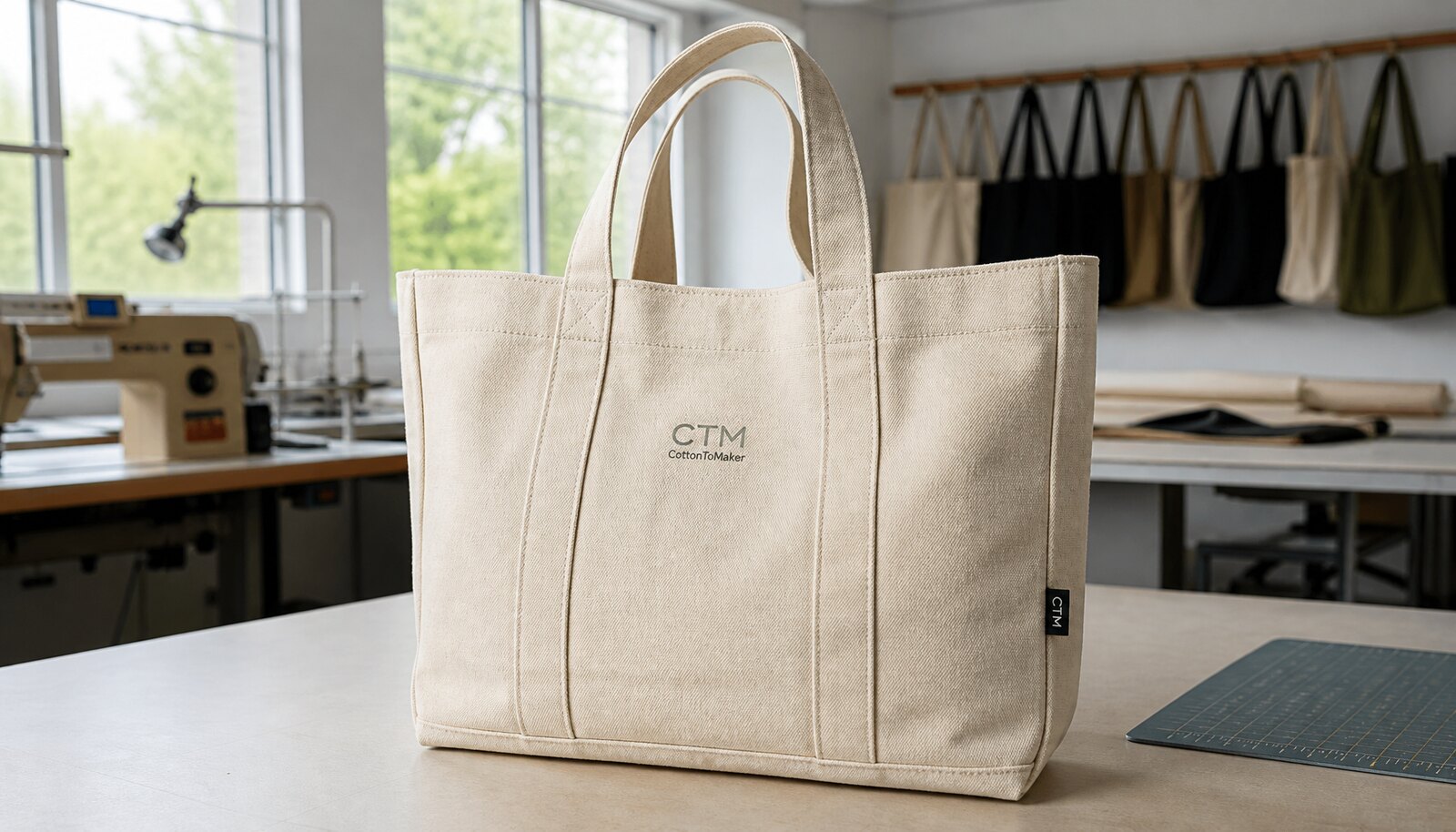
Start With the Retail Job, Not the Bag Body
For gift shops, canvas exhibition tote bags are not just carry bags. They are retail SKUs that have to sell visually, survive daily handling, and still leave room for margin. That means the first sourcing decision is not fabric or print. It is the retail job: souvenir item, premium branded gift, seasonal event item, or checkout impulse buy. Each of those use cases pushes the spec in a different direction. A souvenir tote can tolerate a simpler build if the art is strong. A premium gift item usually needs better handfeel, cleaner finishing, and packaging that looks deliberate on shelf.
If you do not define the job early, suppliers will quote different products under the same name. One may price a light promotional tote with thin canvas and quick print. Another may quote a heavier private-label bag with reinforcement, labels, and more packing labor. Those bags are not interchangeable. The right procurement move is to define the retail role, shelf presentation, and replenishment pattern before you ask for pricing. That gives the supplier a real target and gives you a quote you can compare without guessing what was assumed.
- Define the selling channel: museum shop, venue retail, tourist gift shop, or checkout add-on.
- Decide whether the tote must feel giftable, functional, or premium enough to justify a higher price point.
- Set the reorder pattern now: one-off seasonal buy, repeat core SKU, or event-driven replenishment.
Choose a Spec Band That Matches Shelf Life and Freight Reality
Fabric weight drives how the bag feels in hand, how it prints, and how it survives merchandising. For this category, the most practical quoting range is usually in the middle of the canvas market, not the lightest or heaviest end. A useful target band is often around 280-380 gsm for basic retail use, 320-420 gsm for a more premium feel, and above that only when the bag is expected to carry heavier contents or intentionally read as a premium object. Buyers should treat those as procurement bands, not absolute rules. The point is to match the canvas to the retail promise.
Size and handle design are just as important as fabric. A small, neat tote may display well but lose utility if it cannot carry the products the store actually sells. A longer shoulder handle can improve usability but change the silhouette and sometimes the perceived price. Ask for a dimensioned tech pack that includes body width, body height, gusset depth, handle width, handle drop, seam allowance, and the exact print area. When those numbers are fixed, it becomes much easier to compare samples and price changes later without re-litigating the basic product definition.
- Use GSM as a merchandising decision, not just a cost line.
- State the real load target, such as leaflet-and-gift weight, rather than vague terms like medium duty.
- Request a dimensioned tech pack instead of a loose description like basic canvas tote.
Compare Supplier Routes Before You Compare Unit Price
The same tote can come from several very different sourcing routes, and each route changes the quote structure. A direct sewing factory usually gives the best control over spec, repeatability, and lead-time feedback. A trading company may be useful if you need mixed sourcing, extra coordination, or help consolidating packaging and shipping. Stock wholesalers and local decorators can be fast, but they usually narrow your control over canvas weight, seam construction, and retail presentation. The key is to compare the route, not only the unit price.
The most common mistake is assuming every supplier is quoting the same product. One quote may include cut-and-sew production, woven labels, and barcode stickers. Another may be a blank stock bag with a simple logo print. Those are not equivalent offers, even if the product photo looks similar. Build a route comparison first, then decide which path fits your launch window, replenishment needs, and retail standard. If you need speed and low MOQ, accept the tradeoff openly. If you need repeatable private label quality, pay for the route that actually supports it.
- Use the same RFQ pack with every supplier so the route comparison is fair.
- Ask who owns factory selection, QC decisions, and final shipment release.
- Treat a very low MOQ as a sign that some part of the spec is being simplified.
Set the Fabric and Construction Rules That Drive Quality
For a gift shop tote, the construction rules matter as much as the artwork. Fabric weave, thread count, seam allowance, reinforcement method, and handle attachment all affect whether the bag feels retail-ready or promotional. If the bag is meant to stand upright, the fabric needs enough body and the bottom construction needs enough structure to avoid collapsing into a soft lump on the shelf. If it is meant to fold flat for display, that same stiffness may work against the merchandising plan. Put that decision in the spec before sampling starts.
Construction details are where the low-cost substitute often appears. A supplier may switch to a thinner handle webbing, shorten reinforcement, or reduce stitch density while still producing a bag that looks acceptable in a photo. Procurement should prevent that by naming the seam standard, handle width, and reinforcement method explicitly. For this category, it is usually better to standardize a simple but durable build than to chase decorative complexity. Clean seams, consistent handle drops, and a stable print surface matter more to buyers than gimmicky design features that add cost without helping the shelf sale.
- Specify whether the bag must stand upright, fold flat, or do both well enough for retail.
- Require reinforcement at handle attachment points and at the top edge if the bag will carry real weight.
- Ask the factory to confirm whether the fabric is pre-shrunk or whether size drift should be expected after finishing.
Choose Branding That Reads as Private Label, Not Just a Promo Print
On canvas, the branding method changes how the bag feels to the buyer. Screen print is still the most practical route for simple logos and one-to-three color artwork because it is cost-efficient and visually clean when registration is controlled. Woven labels, side labels, and interior labels matter when the gift shop wants the item to feel like its own retail brand rather than a generic promotional item. Embroidery can work, but it only makes sense when the canvas body is sturdy enough to support the stitch load and when the added cost is justified by the shelf price.
For many private-label programs, the best result is a restrained front print plus one permanent branding cue such as a woven side label or interior label. That keeps the tote usable and visually calm while still giving the store brand ownership. Full-bleed artwork and large-area decoration can work, but only if the supplier has proven registration control and the art is built for the fabric weave. Ask for a strike-off or print sample on the actual canvas, not only on a digital mockup. A photo on a screen can hide the problems that matter in real retail use: edge fray, misalignment, and dull ink coverage.
- Use screen print for simple artwork and predictable unit cost.
- Add a woven or interior label when the goal is private-label ownership, not just logo visibility.
- Reserve embroidery for premium tote programs where the added labor visibly supports the price point.
Write the RFQ So Quotes Are Actually Comparable
A useful quote starts with a useful RFQ. If suppliers receive a vague request, they will fill in the blanks differently and your comparison becomes misleading. The RFQ should state the exact bag size, fabric GSM band, color target, handle construction, decoration method, packaging format, and expected annual or seasonal volume. It should also state what is not allowed: no hidden substitutions, no alternate labels without approval, and no material changes after sample signoff. The goal is to eliminate avoidable assumptions before pricing begins.
Procurement buyers should also ask for line-item pricing wherever possible. Separate the cost of the bag body, the print, the label, the packaging, and the freight assumption. That makes it clear whether a higher quote is actually more complete. A bare-bag quote can look cheaper until you add label sourcing, packing labor, and retail barcodes. Ask each supplier to quote one base version and, if needed, a clearly labeled upgrade version. Do not let them fold multiple assumptions into a single number. The more visible the cost drivers are, the easier it is to decide what really belongs in the retail spec.
- Use one base spec for every quote so the numbers are comparable.
- Request separate pricing for bag body, decoration, labels, packing, and freight assumption.
- Treat unusually low pricing as a prompt to verify fabric weight, seam quality, and packing scope.
Read MOQ as a Manufacturing Constraint, Not a Negotiation Trick
MOQ is usually driven by fabric booking, cutting efficiency, print setup, label sourcing, and packing labor. If a supplier offers a low MOQ, that is not automatically a problem. It usually means they are using stock canvas, limiting color options, reducing decoration complexity, or simplifying the packaging spec. The buyer's job is to understand exactly what became less flexible to hit that number. Otherwise, the order may look small and easy at the quote stage but become expensive once the missing details are added back in.
For gift shop programs, MOQ should fit the sell-through pattern. A seasonal exhibition tote may be safer in a smaller first batch if demand is uncertain. A core retail item can justify a larger opening order if the spec is stable and the reorder path is clear. Ask the supplier to break MOQ by variable: one number for body fabric, one for print, one for labels, one for packing. That lets you choose the lowest total-risk configuration instead of accepting a single number that hides the tradeoff. If the supplier says yes to everything, ask where the extra cost will reappear later.
- Separate MOQ for the bag body, decoration, and packaging if they are sourced or run differently.
- Use sales data or expected season volume to set order size, not convenience.
- If you need a lower MOQ, accept the tradeoff in color limits, packaging simplicity, or longer unit cost.
Use Samples to Lock the Standard Before Bulk Starts
Sampling is the point where most preventable problems can still be removed. The first sample should confirm the dimensions, the fabric handfeel, and the sewing logic. The decorated sample should confirm print quality, label placement, and pack-out. If the sample already feels wrong in the hand, bulk production will not fix it. A retail bag needs to be judged as a complete object, not as a fabric swatch with a logo. That means sample review should include loading the tote with a realistic retail weight, checking how the handles sit, and checking whether the body keeps its shape after being folded and reopened.
The approval sequence should be disciplined: blank sample, decorated pre-production sample, and sealed gold sample. The blank sample proves the construction. The decorated sample proves the branding and packing. The sealed gold sample becomes the reference for reorders and dispute resolution. Record the approved dimensions, photo angles, artwork version, and label placement in one control file. If the factory is good, they will appreciate the clarity. If they are not, the sample process will expose that before you are committed to bulk. The buyer who skips this step usually ends up arguing about what the product was supposed to be.
Turn Quality Control Into Acceptance Thresholds
QC is stronger when it is written as thresholds instead of broad language. For example, size tolerance should be quantified in the PO, not described as approximately the same as sample. A practical retail spec might allow body length and width within plus or minus 0.5 cm, gusset depth within plus or minus 0.3 cm, and handle length within plus or minus 0.5 cm. Stitch density on the main seams should be consistent and strong enough to avoid skipped stitches or loose ends, with reinforcement at the load-bearing points. Print placement should stay within a small offset window, and the artwork should match the approved strike-off in color and clarity.
A good inspection plan also defines what constitutes a reject. Open seams, broken stitches at the handle, obvious misregistration, mixed shade cartons, stains, strong odor, or missing labels should be treated as critical or major defects depending on your category standard. Many buyers use an AQL framework, but the exact threshold matters less than consistency and enforcement. If you want formal control, put the acceptance plan in the PO and inspect against the sealed gold sample. Also check carton variance. Carton dimensions should remain close to the approved spec, and carton count should match the packing list exactly. A factory can make a good bag and still create a bad shipment if carton counts, labels, or folding direction are sloppy.
- Use a quantified size tolerance instead of words like close enough.
- Check stitching, print registration, odor, stains, and carton count on random units before release.
- Keep the sealed gold sample with the buying file so future batches are judged against the same reference.
Treat Packing, Compliance, and Freight as Part of the Product
Packing has a direct effect on retail readiness and landed cost. A tote shipped in bulk may be cheap to move, but it may arrive with strong fold marks or uneven stack height that makes it look less finished on shelf. Individual polybags, barcode labels, hangtags, and insert cards add cost, but they also reduce handling work for the retailer. For private-label gift shop programs, the question is not whether retail-ready packing costs more. It does. The question is whether that added cost is lower than the work the retailer would otherwise do after receipt.
Compliance and traceability should be handled the same way. If you need country-of-origin marking, fiber-content labeling, or a traceable production record, say so in the RFQ. Do not assume a supplier who says yes can demonstrate the process later. Ask for carton marks, SKU separation logic, and the packing list format before approval. Freight should also be evaluated as part of the product because carton size, fold direction, and unit density change landed cost. A slightly better bag can be a worse purchase if it ships in inefficient cartons that waste cube and add cost at the warehouse.
- Specify whether the tote should be flat folded, accordion folded, or stuffed for presentation.
- Confirm barcode placement and scanability before approving production.
- Ask for master carton dimensions and gross weight because they affect freight and receiving cost.
Specification comparison for buyers
| Supplier option | What to verify | Commercial advantage | Buyer risk to control |
|---|---|---|---|
| Direct sewing factory | fabric swatch, approved sample, seam close-ups, logo test photos, packing pilot, and final inspection evidence | Better sample-to-bulk control and faster production feedback | May be weaker on export paperwork or branded packing unless checked early |
| Trading company | Factory name, production photos, trim-source proof, and who owns QC decisions | Can coordinate small mixed orders and extra services | Markup can hide real factory capability and slow defect decisions |
| Specialized bag workshop | bag size, gusset, handle drop, seam allowance, stitch density, reinforcement patch, and loading expectation | More practical for detailed construction, trims, and repeat programs | Capacity may be limited during peak seasons |
| Low-price general supplier | 8-12 oz cotton canvas, 120-220 gsm cotton, recycled cotton, or blended fabric selected by use case and target price | Useful for simple promotional runs with loose specs | Material downgrades, weak packing, and vague inspection scope can erase savings |
| Retail-ready supplier | fold method, inner bundle, carton count, carton mark, moisture protection, SKU separation, and warehouse receiving needs | Can handle labels, SKU separation, carton marks, and receiving rules | Higher unit cost must be compared against reduced warehouse work |
| Compliance-focused supplier | Fabric records, labeling review, test plan, and production traceability | Safer for retail programs and repeat brand orders | Documentation claims need evidence, not only sales language |
| Local sample room plus bulk factory | Signed sample, bulk factory handoff, first-piece photos, and deviation owner | Good for complex branding before large production | Sample room quality may not match bulk line unless handoff is controlled |
Buyer checklist before sampling
- Lock the bag size, fabric GSM band, handle length, and seam reinforcement before requesting quotes.
- Specify the retail role: souvenir, premium gift item, seasonal promo, or checkout add-on.
- Set the expected load target in kilograms or in a real retail use case, not just 'heavy duty'.
- Choose the branding package up front: print only, print plus woven label, or full retail-ready label set.
- Define the shelf behavior: stand upright, fold flat, or hang on a peg.
- State the target color standard using a Pantone reference or approved physical swatch.
- Ask every supplier to quote the same carton count, pack style, and barcode position.
- Require separate line items for body, decoration, labels, packaging, and freight so quotes can be compared fairly.
- Approve a blank sample, a decorated sample, and a sealed gold sample before bulk starts.
- Set your reorder trigger date based on sell-through and shipping lead time, not only on warehouse stock.
Factory quote questions to send
- What is the exact fabric composition, weave, and GSM range, and is that the same fabric you will use in bulk?
- What are the body dimensions, gusset depth, handle length, handle drop, and seam allowance included in your quote?
- What is the stitching specification for load-bearing seams, including reinforcement at handle attachment points?
- Which decoration method is included in the price, and how many colors or placements are covered?
- What MOQ applies to the bag body, the print design, the label, and the packaging, and are those MOQs different?
- Can you quote a stock-blank version and a fully private-label version so we can compare landed cost?
- What sample charges apply, and will those charges be credited if the order goes ahead?
- What is your assumed packing configuration: bulk packed, individual polybag, hangtagged, barcoded, or shelf-ready set?
- What is your production lead time after artwork approval, and which steps are most likely to extend it?
- Which QC checkpoints do you perform before shipment, and can you share a sample inspection report format?
Quality-control points to confirm
- Size tolerance should be tight enough for retail presentation: body length and width within +/-0.5 cm, gusset depth within +/-0.3 cm, and handle length within +/-0.5 cm versus the approved sample.
- Handle drop should match the approved spec within +/-0.5 cm so the bag hangs and carries consistently across cartons.
- Load-bearing seams should use a consistent stitch density, typically 7-9 stitches per inch, with no skipped stitches, loose tails, or open seam ends.
- Handle attachment points should show full reinforcement and no thread breakage after a standard loaded lift test using the agreed retail weight.
- Print placement should stay within +/-2 mm for small logos and within +/-3 mm for larger artwork, with no visible double images, color bleed, or haloing.
- Print registration should match the approved strike-off, and ink coverage should be even with no patchiness, pinholes, or edge washout.
- Fabric weight should stay within the approved GSM tolerance, typically within +/-5% of the target or within the agreed gram range on the spec sheet.
- Carton count must match the packing list exactly, with no mixed SKUs in the same carton unless the PO allows it.
- Carton dimensions should stay within +/-2 cm of the approved carton spec and gross weight should stay within +/-5% so freight and warehouse handling remain predictable.
- Use an AQL plan in the PO if you want a formal standard; many buyers use zero tolerance for critical defects, AQL 2.5 for major defects, and AQL 4.0 for minor ones.