1. Start With the Retail Job, Not the Tote
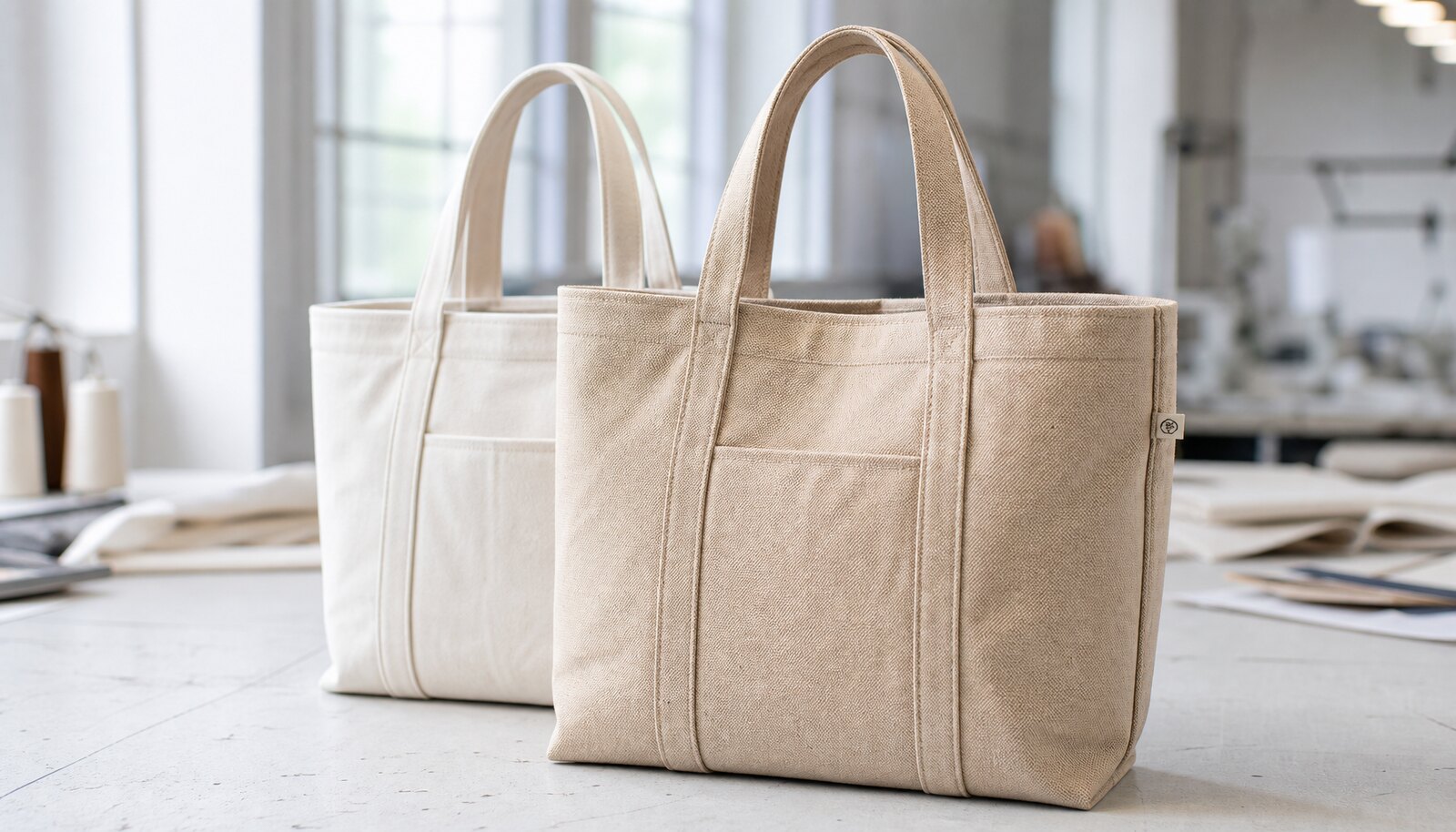
Canvas exhibition tote bags for gift shops are judged by how they sell and how they survive use, not by fabric weight alone. The same tote can work as a museum counter souvenir, a trade-show bookstore bag, or a venue retail item, but each setting pushes the spec in a different direction. If you start with a generic tote and let the supplier fill in the details, you usually get a bag that is either too soft for display or too expensive for the price point.
The right first question is what the bag has to do on the shelf and after purchase. A gift shop that relies on impulse purchases usually needs a flat folded profile, clear logo visibility, and a price that leaves room for margin. A venue store that expects brochure loads or repeated use needs stronger handle attachment, better shape retention, and a print that still looks clean after friction. That business choice is what should determine the tote spec, not the other way around.
For SEO and procurement purposes, the phrase canvas exhibition tote bags for gift shops bulk pricing plan should map to a practical buying brief: define the retail job, set the target sell price, and ask suppliers to quote against the same use case. That keeps the conversation commercial instead of decorative.
- For impulse retail, prioritize shelf appeal, a flat folded profile, and a logo that reads clearly from a short distance.
- For heavier brochure or catalog loads, prioritize handle reinforcement and seam security over decorative extras.
- For premium gift shops, ask for a sample that matches the actual production method, not a showroom mockup.
- If the tote will be paired with books, catalogues, or souvenir sets, tell the supplier the expected load range up front.
2. Lock the Base Spec Before You Ask for Quotes
Most tote pricing mistakes start with an incomplete spec. If buyers only say “canvas tote” or “exhibition tote,” quotes will vary in ways that are hard to compare. The base spec should always include finished size, gusset depth, handle length and width, fabric weight, canvas finish, print method, and packing format. Without those details, one supplier may quote a lighter fabric with simpler stitching while another prices a heavier bag with retail packing and stronger reinforcement.
For many gift-shop programs, 8 oz canvas, or roughly 270 GSM, sits at the lower end of the useful retail range. It works when the tote is mainly a souvenir or a light carry item. Around 10 oz or 340 GSM is usually the most balanced spec for core retail because it improves hand feel, print opacity, and shape without pushing the price too high. Around 12 oz or 410 GSM is better when the bag needs more structure, a more premium impression, or heavier day-to-day use. Those are planning bands, not universal standards, but they are useful for quote alignment.
The fabric finish matters too. Natural canvas is generally the easiest route for bulk pricing. Bleached canvas can improve the visual effect for some artwork but may carry a small premium. Dyed or washed canvas adds look and feel, but it also increases shade-control and finishing complexity. If the bag will be printed, ask whether the supplier is quoting the fabric in its finished state or assuming post-production shrinkage. A quote that ignores shrinkage may look cheaper while hiding a later size problem.
- 8 oz / about 270 GSM: useful for lighter souvenirs and lower opening price points.
- 10 oz / about 340 GSM: the most balanced option for many gift-shop tote programs.
- 12 oz / about 410 GSM: better for premium presentation and stronger body feel.
- Ask whether the finished size already includes shrinkage allowance or whether the supplier is cutting oversize to compensate.
3. Build a Bulk Pricing Plan Before You Compare Suppliers
The article title matters less than the math behind it. A useful bulk pricing plan shows what the tote should cost at different quantities before freight and duty, then shows the landed cost after import and receiving. That is what lets a buyer decide whether a quote is actually workable for the gift shop margin.
For standard sourcing from China, a practical planning view for a simple one-color natural canvas tote might look like this: about USD 0.95-1.55 FOB at 1,000 pieces, USD 0.72-1.05 at 3,000 pieces, and USD 0.58-0.88 at 10,000 pieces. Move to 10 oz canvas with a retail fold and insert card, and the range can shift to roughly USD 1.35-2.10 at 1,000, USD 1.05-1.55 at 3,000, and USD 0.82-1.25 at 10,000. Step up to 12 oz with reinforced handles and individual polybag packing, and the planning range often moves to around USD 1.85-2.95 at 1,000, USD 1.45-2.15 at 3,000, and USD 1.15-1.75 at 10,000. Dyed, multi-color, or premium packed programs sit higher still.
Those numbers are not promises. They are budgeting bands that help buyers spot outliers and compare offers. A quote below the band may be efficient, or it may be missing a requirement. A quote above the band may still be acceptable if it includes better packing, lower reject risk, or a more stable reorder path. The point is to force the supplier to explain the gap.
When the supplier gives only one number, ask for the cost stack: fabric, sewing, decoration, packing, and freight basis. Once those are separated, the real buying decision becomes visible. If your gift shop buys across seasons, keep a simple pricing matrix for test order, core order, and reorder volume so the business can forecast instead of renegotiating from scratch.
- Use price bands by quantity, not a single headline unit price.
- Compare FOB or EXW only after the spec is fixed and the packing method is identical.
- Add freight, duty, and receiving before comparing suppliers on margin.
- Treat unusually low quotes as a request for clarification, not a win.
4. Compare the Right Spec Combinations, Not Just the Sourcing Route
Procurement teams sometimes compare supplier routes instead of products. That misses the real issue. What matters is the same tote spec being priced across the same quantity bands. If one supplier is quoting an 8 oz bulk-packed bag and another is quoting a 10 oz retail-packed bag, the prices are not comparable even if the product photos look similar.
A useful comparison for gift shop buying is to hold the shape and artwork constant and vary only one lever at a time. Start with a natural 10 oz one-color screen print in bulk pack, then test the price impact of adding a second color, switching to 12 oz canvas, changing to retail fold with insert card, or moving to dyed fabric. That gives you a commercial map of which features are actually expensive and which are cheap enough to keep.
Region and incoterm also matter. A China FOB quote may look lower than a domestic stock option, but once freight, duty, inland delivery, and receiving labor are included, the cheapest factory number may no longer be the lowest landed price. By contrast, a local blank tote with local decoration may cost more on paper but can be better if the store needs fast replenishment or has very small batches. Buyers should choose the route after the landed-cost view is visible, not before.
If your team wants a quick benchmark, ask every bidder to quote the same finished size, same artwork, same packing, and the same delivery basis. Then compare only the price delta caused by fabric weight, print complexity, and packaging. That is the point where a supplier comparison becomes operational instead of descriptive.
- Quote the same finished size, handle dimensions, and gusset depth for every supplier.
- Ask for unit price at 1,000, 3,000, 5,000, and 10,000 pieces so you can see break-price behavior.
- Include retail packing in the comparison if the bag will sit on a shop shelf.
- Never compare bulk-packed and retail-packed bags as if they are the same product.
5. Write an RFQ That Forces Comparable Answers
A clear RFQ reduces price noise. If you want comparable tote quotes, your request should name the finished size, canvas weight, weave or finish, handle construction, print location, number of colors, artwork file type, packing style, and target volume. If the bag is for a gift shop, say so directly and explain the expected retail use. That tells the supplier whether the bag needs to look premium at the counter or simply survive a seasonal promotion.
The RFQ should also force assumptions into the open. Ask the supplier to state whether sample fees, screen or plate fees, color matching, packing labor, barcode labels, and freight terms are included. EXW, FOB, and DDP are not interchangeable, and many comparison errors come from that confusion. A quote that excludes freight or customs may look attractive until the landed cost is calculated. If the supplier offers DDP, ask exactly what is included and what is excluded when customs or local delivery fees change.
For repeat programs, it helps to standardize the RFQ into a one-page template. That way every seller responds to the same fields, and your team can compare offers without translating them by email. It also makes reordering easier next season, because the approved spec is already documented instead of living in a chain of messages.
- Attach artwork as a vector file if possible and note whether Pantone matching is required.
- State whether print is one-sided or double-sided.
- Clarify whether the bag must be retail-ready, bulk-packed, or palletized for warehouse receiving.
- Request separate lines for sample, production, packing, and shipping so the landed cost is visible.
6. Set MOQ and Breakpoints by Artwork, Pack, and Reorder Risk
MOQ is rarely a single number. For canvas tote production, MOQ can change by fabric color, artwork color count, print method, and packing format. A simple one-color natural canvas tote may be available at a lower threshold than a dyed bag with retail inserts. If the supplier only gives you one MOQ figure, ask whether it applies to the base bag only or to the fully packed version you intend to sell.
For planning, many gift-shop buyers work with three bands: a test run, a core order, and a reorder tier. A test run may be around 500-1,000 pieces if the spec is simple and the supplier is flexible. A core order often sits around 3,000 pieces, where setup costs start to spread more efficiently. Reorders may improve again around 5,000 or 10,000 pieces, especially if the factory can reuse screens, labels, carton specs, and the approved sewing method. These are not universal thresholds, but they are useful planning anchors.
The reason break pricing changes is usually simple: setup costs are diluted, fabric yield improves, or packing labor drops per unit. If a quote gets materially cheaper at a higher tier, ask what changed. A genuine breakpoint is fine. A hidden spec downgrade is not. The best supplier will state exactly how the price changes between volume bands and what remains identical across those bands.
For procurement teams that need to budget a season in advance, the right output is a small pricing ladder, not a single quotation. That ladder should show price, MOQ, included packing, and the date through which the quote is valid.
- Ask for MOQ by artwork, colorway, and packing style.
- Treat a low MOQ quote carefully if the supplier cannot explain the production method behind it.
- Request price at multiple tiers so setup cost dilution is visible.
- Confirm whether reorders can use the same screens, labels, carton spec, and approved sample without new fees.
7. Compare Decoration Methods by Detail, Durability, and Reorder Behavior
Decoration can change the economics as much as fabric weight. Screen print is still the most common choice for bulk orders because it is efficient, durable, and predictable on natural canvas when the artwork is simple. It usually gives the best value for one- to three-color logos or bold retail graphics. Digital print can handle more detailed art, gradients, or smaller batches, but it may carry a higher unit price and depend more heavily on substrate consistency. Heat transfer or vinyl can be useful for short runs or special effects, but the buyer should verify how the finish behaves after handling, folding, and storage.
The more ink coverage, color overlap, or fine detail the artwork has, the more likely the quote will move. Dark canvas, metallic effects, small lettering, and large ink fields all raise registration and opacity risk. If you need a premium presentation, request the pre-production sample on the actual fabric color and production method. A white-sample proof is not a valid substitute if the bulk order will run on dyed or washed canvas.
For reorderable retail programs, the method also matters because it determines how easy it is to reproduce the same look next season. Screen print is often easier to repeat if the supplier retains the screens and maintains the same ink system. Digital print can still work, but the factory should explain how they control color matching and whether file settings, calibration, or fabric prep will be preserved for the reorder.
- Use screen print for simple logos, bold artwork, and repeat bulk orders.
- Use digital print for more detailed art where setup cost would otherwise be too high.
- Treat dark or dyed canvas as a higher-risk substrate for print opacity and color matching.
- Ask whether the same screens or digital settings can be reused for reorders.
8. Price Packing and Cartons as Part of the Product
Gift shops often lose money by treating packing as an afterthought. A tote that is sold on the shelf needs a different pack than a tote that goes straight to a warehouse. Shelf-ready bags may need a consistent fold direction, insert card, barcode label, and clean polybag or paper wrap. Bulk-stock bags may need a different carton count, stronger cartons, or a pallet pattern that works for internal handling. Each option affects labor, carton material, shipping density, and damage risk.
Packing also affects customer perception. Crooked folds, dusty polybags, loose handles, and wrinkled inserts can make an otherwise good tote look lower-end. Put the packing instruction in writing before sample approval and ask the supplier to show a packed sample. If the tote is going to multiple stores, carton marks should match the warehouse and store allocation logic so receiving teams can sort stock without opening every case.
Moisture and transit exposure matter too. Canvas can absorb warehouse dust, and long shipping lanes can introduce humidity issues. For premium retail programs, a liner bag, desiccant, or stronger outer carton may be worth the extra cost if it reduces complaints on arrival. The key is to price those decisions explicitly rather than absorbing them later as freight or damage overruns.
- Confirm carton quantity per size and keep it consistent across reorders when possible.
- Specify whether the bag needs a hang tag, barcode, insert card, or shelf-ready fold method.
- Ask for outer carton marks that match your PO, SKU, and store allocation rules.
- For export or long transit, confirm whether palletization, carton strength, or moisture control changes the price.
9. Define QC Limits That Are Defensible, Not Arbitrary
QC needs measurable limits, but they should be tied to the spec and the risk level rather than copied blindly from another project. Finished dimensions usually need a tolerance window, often around ±0.5 cm to ±1.0 cm depending on the bag size and construction. Handle placement and symmetry should be tight enough that the tote hangs evenly and does not twist on display. Stitching should be consistent, and the factory should not ship bags with skipped stitches, loose thread, broken seams, or weak handle attachments.
Print quality needs its own criteria. Registration tolerance for simple art is often around 2-3 mm, but the right threshold depends on the artwork and the print method. Ink should be fully cured, with no tackiness, heavy smearing, or flaking. On natural canvas, some strike-through is normal; what matters is whether the print still matches the approved sample and whether the image remains crisp enough for retail display. If the canvas is dyed, washed, or softened, define the acceptable shade range by lot and note that some variation is part of the material, not a defect.
AQL-style inspection is useful because it gives the shipment a real gate. Many buyers use AQL 2.5 for major defects and 4.0 for minor defects on standard retail programs, but that is a starting point, not a rule. Premium museum stores, seasonal launches, or short-turn promotions may justify tighter inspection. Keep one sealed golden sample with the buyer and one with the factory, and label both with version date, artwork revision, fabric spec, and packing standard. That is the fastest way to avoid subjective reorder disputes.
- Measure width, height, and gusset depth against the approved drawing.
- Set a stitch and reinforcement standard that the factory can actually verify.
- Use a print registration tolerance and confirm full ink cure before packing.
- Define shrinkage, shade variation, and carton integrity in writing.
- Keep a sealed golden sample on both sides for reorder control.
10. Turn the Quote Into a Landed-Cost Decision
The factory quote is only the starting point. For a procurement team, the buying decision should use landed cost per sellable unit, not just the factory-gate number. That means product, decoration, packing, freight, duty, and receiving all need to be visible. A tote that looks inexpensive at FOB can become a weaker choice once shipping and handling are added, especially if it is bulky or retail packed.
A practical buying plan is to compare at least three scenarios: a test run, a core order, and a reorder volume. For each scenario, calculate landed cost and compare it against the gift shop retail price target. If the lower unit-price option has higher freight or more complex packing, it may lose once the bag reaches the store. If the higher unit-price option is simpler to receive and more durable in display, it may actually protect margin better.
A simple example helps: a 10 oz natural canvas tote with one-color print might quote lower at 1,000 pieces, but once shipping, duty, and carton handling are added, the landed cost may narrow enough that a 3,000-piece order becomes the better business decision. In another case, a premium 12 oz tote may cost more at the factory but still make sense if it supports a higher shelf price and fewer quality complaints. That is why the pricing plan should be built around sell-through, not only purchase cost.
The most reliable operating model is simple. Fix the spec, compare quote bands, separate setup from recurring cost, and lock the golden sample before production. If the gift shop program needs multiple price points, build a base SKU and a premium SKU instead of forcing one bag to do everything.
- Compare landed cost at multiple quantity bands, not just one unit price.
- Build separate calculations for EXW or FOB plus freight, duty, and local receiving if importing.
- Keep one entry-level SKU and one premium SKU if the store serves different customer segments.
- If a larger run drops sharply in price, confirm that the fabric, print, and packing spec did not change.
Specification comparison for buyers
| Spec / sourcing choice | Typical quote band | Land-and-duty context | Best-fit use case | Buyer checks before award |
|---|---|---|---|---|
| 8 oz natural canvas, one-color screen print, bulk pack | FOB China planning range: about USD 0.95-1.55 at 1,000 pcs, USD 0.72-1.05 at 3,000 pcs, USD 0.58-0.88 at 10,000 pcs | Lower freight weight and simpler packing, but still add duty, freight, and receiving before comparing suppliers | Entry souvenir tote, short-run exhibit store promo, light daily carry | Confirm GSM or oz tolerance, print coverage, seam reinforcement, and whether the quote includes screens and packing |
| 10 oz natural or bleached canvas, one- to two-color screen print, retail fold with insert card | FOB China planning range: about USD 1.35-2.10 at 1,000 pcs, USD 1.05-1.55 at 3,000 pcs, USD 0.82-1.25 at 10,000 pcs | Retail packing and inserts raise warehouse and freight cost per sellable unit, so compare total landed cost, not unit price alone | Core gift-shop SKU that needs better shelf shape and stronger perceived value | Ask for MOQ by artwork, colorway, and packing style; verify carton pack and barcode handling |
| 12 oz canvas, larger print area, reinforced handles, individual polybag | FOB China planning range: about USD 1.85-2.95 at 1,000 pcs, USD 1.45-2.15 at 3,000 pcs, USD 1.15-1.75 at 10,000 pcs | Heavier fabric and more stitching increase both product cost and shipping weight | Premium museum shop or destination retail tote with stronger shelf presence | Check handle tape width, stitch density, shrinkage allowance, and whether the sample is pre-shrunk or cut oversized |
| Dyed canvas, multi-color print, retail packing, special labels | FOB China planning range: about USD 2.40-4.25 at 1,000 pcs, USD 1.90-3.20 at 3,000 pcs, USD 1.55-2.55 at 10,000 pcs | Color matching, setup, and reject risk drive cost more than fabric alone | Branded program where visual finish matters more than the lowest landed price | Request setup fees, Pantone method, print registration tolerance, and shade control by lot |
| Stock blank tote plus local decoration | Buy-in price is often lower on the blank bag, but local decoration can erase the savings if labor is slow or small-batch priced | Good for domestic distribution or urgent replenishment when freight time matters more than exact factory spec control | Emergency replenishment or pilot retail test before committing to factory production | Confirm blank stock consistency, reorder availability, and whether local print can match the approved artwork |
| Direct cut-and-sew factory with in-house decoration | Best for repeat programs; break prices improve when volume is steady and the supplier owns more of the process | Often the cleanest option for repeat import programs because QA ownership is easier to assign | Recurring orders where one supplier must own sewing, print, and packing | Verify what is truly in-house and what is subcontracted |
| Trading company with factory network | Useful when you need option management, sampling speed, or multi-factory sourcing | Can add margin, but it may also reduce coordination cost if the team lacks a procurement office in-region | Teams that need comparison shopping or broader supplier access | Ask for named factory, audit evidence, and QC responsibility in writing |
| Low-MOQ marketplace seller | Cheap to start, but quote consistency and re-orderability are often weaker | Useful mainly when the goal is speed, not a locked repeat program | First-pass market validation with limited volume risk | Verify fabric weight, sample-to-bulk consistency, and exact reorderability |
Buyer checklist before sampling
- Define the finished size, gusset depth, handle length, and whether the bag must stand upright on a shelf.
- State the target canvas weight in GSM or oz, plus whether the fabric must be natural, bleached, dyed, or washed.
- Specify print method, artwork size, Pantone references, and the exact number of print colors in the quote.
- Confirm handle tape width, stitch pattern, reinforcement points, and whether the bag needs a boxed bottom or side gusset.
- Request MOQ per artwork, per colorway, and per packing format instead of relying on a single headline MOQ.
- Ask for a line-by-line quote showing unit price, setup charges, sample fees, packing charges, and freight terms.
- Require a pre-production sample or sealed golden sample before mass production starts.
- Lock carton quantity, carton size, barcode placement, and retail pack method before approval.
- Set written tolerances for size, print placement, stitch quality, and shrinkage allowance.
- Confirm production lead time from sample approval, not from the date the PO is issued.
Factory quote questions to send
- What is the unit price at 1,000, 3,000, 5,000, and 10,000 pieces, and what changes the break price?
- Is the quote based on EXW, FOB, or DDP, and what exactly is excluded?
- Are sample charges, print screens, plates, and color-matching fees separate or included?
- What exact canvas weight, weave style, and shrinkage allowance are included in this price?
- How many print colors are included, and what is the add-on for extra colors or a larger print area?
- What carton pack quantity and master carton dimensions are planned for this order?
- Can you share photos or measurements of a recent similar production run?
- What is the timeline for sample, production, packing, and shipment after approval?
- What MOQ applies if we change only artwork but keep the same tote spec?
- What are the price changes if we switch from bulk pack to retail polybag plus insert card?
Quality-control points to confirm
- Finished width, height, and gusset depth should stay within the agreed tolerance window, usually about ±0.5 cm to ±1.0 cm depending on size and construction.
- Handle length, handle symmetry, and handle placement should match the approved sample; left and right handle lengths should not differ by more than 0.5 cm unless the design calls for it.
- Stitch density should be consistent across seams; a common planning range is 7-9 stitches per inch where the construction allows it, but heavier canvas or thicker thread may justify a different standard if the factory documents it.
- No skipped stitches, broken thread, loose seams, or weak handle attachment points; bar-tacks or box-X reinforcements should be fully formed and centered.
- Print placement should stay within the agreed registration tolerance, often around ±2-3 mm for simple one-color art; tighter tolerances should only be used if the supplier can prove repeatability.
- Ink opacity should be sufficient for the chosen canvas color; some show-through on natural canvas is normal, but smudging, cracking, pinholes, or heavy strike-through should be rejected against the sealed sample.
- Fabric shrinkage after finishing should remain within the pre-approved limit; many buyers set a ceiling around 3%, but the correct limit depends on whether the bag is washed, softened, or intentionally oversized before finishing.
- Natural canvas shade variation is acceptable within the agreed lot range, but stains, oil marks, broken weave, slubs outside the standard, and fabric holes are not acceptable.
- Folding method, polybag count, barcode placement, carton markings, and any insert card should match the packing instruction exactly.
- Use an AQL-style inspection plan before shipment; many buyers use general inspection at AQL 2.5 for major defects and 4.0 for minor defects, but premium retail programs often tighten those limits.