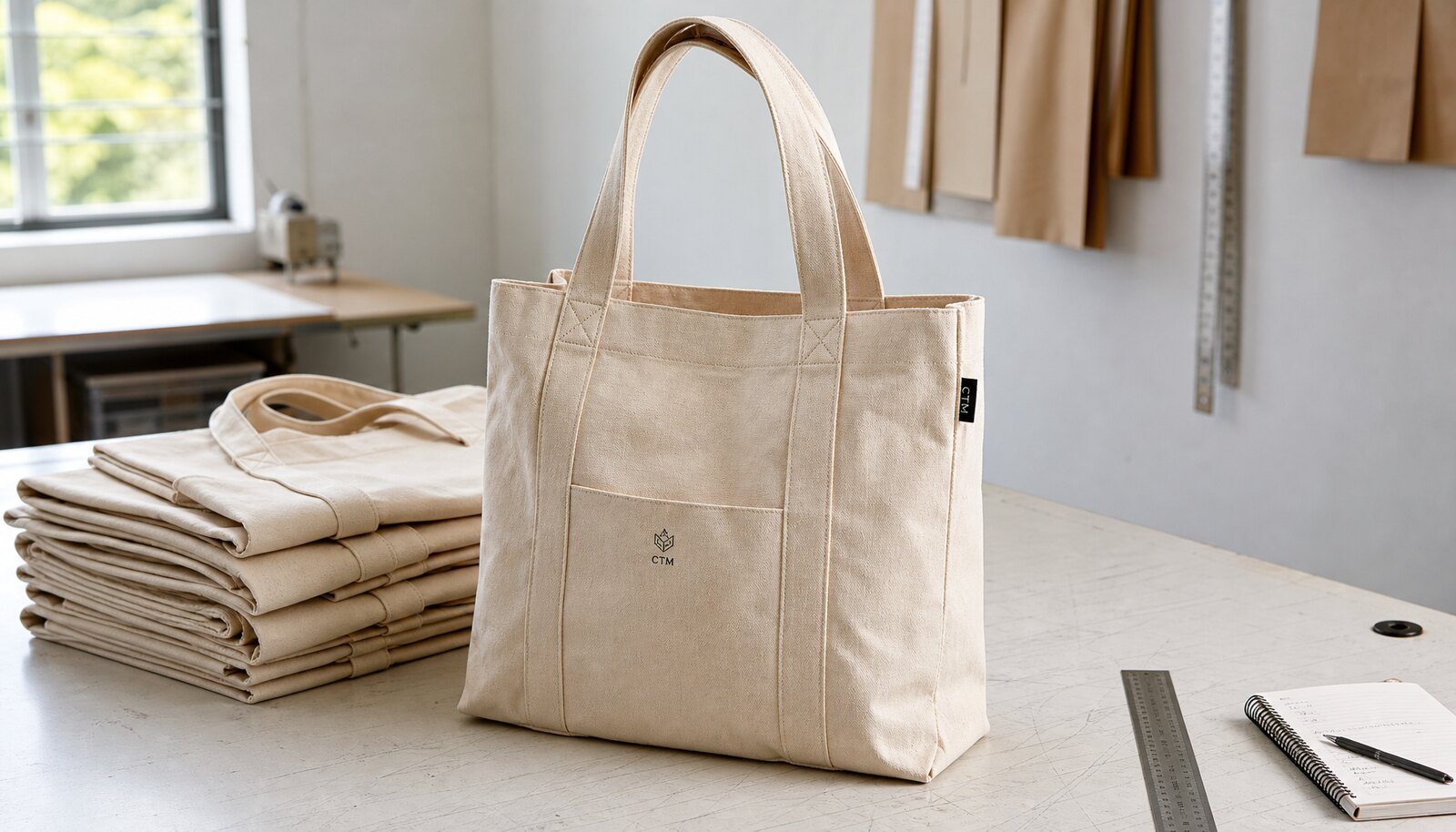
Why this tote needs a tighter QC plan than a standard giveaway bag
Canvas exhibition tote bags for farmers markets sit between a promotional item and a retail carry bag. They have to look good on a table, survive repeated handling, and keep a printed logo readable after folding, stuffing, and transport. If the buyer treats them like a simple event giveaway, the first weak point usually shows up in the handle seam, print surface, or carton packing, not in the showroom photo.
The practical buying issue is not whether the bag looks acceptable in a sample photo. It is whether the same bag can move from sample room to bulk without losing shape, print registration, or stitching quality. That is why the best RFQs for this product are built around measurable specs: canvas GSM, handle construction, print method, and inspection thresholds.
- Treat the bag as a reusable retail item, not a one-time promo tote.
- Build the RFQ around measurable construction details, not just logo placement.
- Assume the first quality failures will come from seams, handles, or packing damage.
Start with the fabric: GSM, weave, and shrinkage control
For farmers market use, a 10–12 oz canvas, roughly 340–400 GSM, is the most practical range for most importers. It gives the bag enough body to stand on a table and enough strength to carry produce, catalogs, or packaged foods. Below that range, the tote can look thin and collapse at the opening. Above it, the bag becomes more expensive, heavier to ship, and less flexible for retail display.
The weave and finish matter as much as the weight. A tight plain weave gives cleaner print edges and fewer surface defects. If the bag is pre-shrunk or washed, the buyer gets better size stability after finishing and a lower risk of customer complaints when the tote is cleaned or exposed to moisture. If the supplier does not state shrinkage control, assume the finished size can drift after production and packing.
- Ask for both oz and GSM; some factories quote only one and hide a lighter cloth under a familiar name.
- Require a fabric swatch or measured sample before approving the bulk roll.
- If the bag is unlined, inspect the inside of the canvas for stray fibers and weave gaps that can affect print-through.
Choose the right print method for market use, not just for artwork complexity
Most buyers will get the best balance of cost and durability with screen print. It works well for one to three solid logo colors, gives good opacity on natural canvas, and holds up better than fragile transfer methods when the bag is folded or rubbed. If the design has fine gradients or many colors, some suppliers will suggest heat transfer or digital printing, but those methods should be evaluated against real handling conditions, not just visual sharpness in the sample room.
A common sourcing mistake is approving a print sample that looks acceptable on a flat table but fails after the first full carton is compressed in transit. For that reason, the print check should include rub resistance, edge sharpness, and fold-line behavior. If the design sits close to a seam, pocket edge, or gusset, the buyer should inspect distortion after sewing because the artwork can shift during assembly.
- Screen print is usually the safest default for bold logos and repeat orders.
- Heat transfer can fit short runs, but inspect for cracking and peeling at fold points.
- If the logo has small text, confirm minimum line thickness before production starts.
Compare sourcing routes before you compare unit prices
The cheapest quote is not always the lowest-risk route. Direct factories usually give better control over material, stitching, and print repeatability, especially for ongoing farmers market programs. Trading companies can be useful when the buyer wants smaller mixed assortments, faster one-off coordination, or multiple bag styles in a single shipment, but the real factory must still be identified if the buyer needs corrective action later.
For procurement teams, the right comparison is not just unit price versus unit price. It is quote transparency, sample responsiveness, inspection access, and how much hidden cost appears in packaging, artwork setup, or freight coordination. If the supplier cannot show where the fabric, print, and assembly are coming from, the buyer will have a harder time resolving defects when the first bulk shipment lands.
- Ask for a clear explanation of who owns fabric sourcing, printing, and final inspection.
- Compare quote inclusions line by line: artwork setup, labels, packing, and carton marks.
- Use the same sample approval criteria across all suppliers so the comparison is not subjective.
Supplier route comparison for canvas exhibition tote bags
The table below is the simplest way to compare sourcing routes for this product. It focuses on what changes the landed result: control, flexibility, documentation, and risk. Buyers often discover that a slightly higher factory quote can still win if it reduces rework, missed deadlines, or packing failures.
Use the comparison to separate the path that fits a recurring retail program from the path that fits a small launch or market test. The wrong sourcing route usually shows up later as inconsistent fabric lots, delayed sampling, or cartons that fail warehouse receiving.
- Write decisions in measurable language, not only descriptive wording.
- Ask for sample photos plus one physical approval sample for important orders.
- Keep quotation, sample approval, and inspection notes tied to the same spec version.
What to approve in the sample before you greenlight bulk
A good sample approval is not a yes-or-no photo decision. The buyer should physically measure the bag, inspect the handle attachment, check seam quality, and test how the bag sits when empty and when loaded. A tote that looks strong flat on a table can still twist at the handle root or collapse at the gusset once filled.
For first orders, ask for a pre-production sample if the fabric, print, or construction has changed. The sample should reflect the final roll of canvas, the final ink mix, and the actual sewing method. If the supplier sends a hand-made sample that differs from bulk production, the approval is not reliable and should not be used as the final reference.
- Measure finished width, height, gusset, and handle drop against the approved spec sheet.
- Check logo placement relative to seams, pocket edges, and centerline.
- Rub the print lightly and fold the bag along normal use lines to see whether the finish cracks or smears.
Inspection thresholds that matter on this bag style
For canvas exhibition tote bags for farmers markets, the critical defects are usually easy to define. Broken seams, missing bartacks, major print misalignment, wrong fabric weight, and bad odor should never pass. Major defects include crooked handles, visible stains, size drift beyond tolerance, or print coverage that makes the logo look weak from a normal retail distance. Minor issues such as small thread tails can sometimes be sorted, but only if they do not affect display or resale.
A useful inspection plan also includes a simple load and pull test. The buyer does not need laboratory language for every program, but the factory should know that handle attachment and seam integrity will be judged against actual use. For market buyers, the tote must survive repeated stuffing, carrying, folding, and countertop display without losing shape or shedding thread.
- Reject any bag with broken stitches at handle roots or seam openings.
- Treat print bleeding, severe misregistration, and wrong logo color as bulk-level defects.
- Set size tolerances before production, not during inspection.
Packing details that protect the print and reduce receiving issues
Packing is where many otherwise acceptable totes lose value. If the bags are compressed too tightly, the printed area can mark against itself and arrive with crease shadows. If the cartons are underfilled, the bags move too much and suffer edge wear. The best packing plan depends on the route to market: wholesale distribution, retail relabeling, or direct shipment to a warehouse that will rework the bags later.
For import programs, the buyer should always confirm inner pack count, carton quantity, and outer carton dimensions before production. Those numbers affect freight cost, warehouse handling, and the risk of deformation. If hangtags, woven labels, or inserts are included, they should be packed in a way that avoids print abrasion and keeps the tote flat enough for counting.
- Require carton marks that match SKU, color, quantity, and PO number.
- Keep print surfaces separated with tissue or a clean polybag if the artwork is sensitive to rubbing.
- Set a carton weight target that warehouse staff can handle without damage or repacking.
Lead time and MOQ logic for realistic planning
For a standard custom run, a realistic production window is often 20–35 days after sample approval, with transit added on top. If the supplier has to source a special canvas weight, custom-dyed fabric, or nonstandard closure hardware, the timeline can stretch. The buyer should separate sampling time from bulk production time, because delays often happen before the order is even released to the line.
MOQ should be judged against setup cost and production efficiency, not against a marketing promise. For this product, a factory may quote 1,000–3,000 pieces per color or artwork as a reasonable range for custom logo work. Lower MOQs can work, but only if the buyer accepts a higher unit price, limited color flexibility, or a more basic packing method. For recurring market programs, a slightly larger MOQ often lowers the landed cost enough to justify the inventory.
- Split sample lead time from bulk lead time in the PO schedule.
- Expect extra time for artwork changes, custom labels, or special packing.
- Treat low MOQ offers carefully if the quote is vague on fabric source or QC responsibility.
Build the quote around landed cost, not just ex-factory price
A useful quote from the supplier should let the buyer estimate the real landed cost. That means the quote should show fabric weight, print method, size, handle spec, packing, and any add-ons such as labels or hangtags. If the supplier only gives a unit price and a vague sample promise, the buyer cannot compare routes fairly and may miss costs that appear later in freight, customs paperwork, or rework.
When buyers compare quotes for canvas exhibition tote bags for farmers markets, the best practice is to normalize the spec first. Equalize fabric GSM, print colors, handle type, and packing standard, then compare. Otherwise, one supplier may look cheaper simply because the bag is thinner, the print is weaker, or the packing standard is lower than the rest.
- Break quote data into fabric, printing, sewing, packing, and optional extras.
- Match cartons and pack counts across suppliers before comparing freight estimates.
- Use the same approval sample and inspection criteria for every quote you receive.
Specification comparison for buyers
| Spec decision | Recommended option | When it fits | Buyer risk to check |
|---|---|---|---|
| Fabric weight | 10–12 oz canvas; 340–400 GSM for retail-grade structure | Best for farmers market displays, repeated reuse, and logo retention | Too light and the bag sags; too heavy can raise cost and reduce foldability |
| Weave and finish | Tight plain weave with pre-shrunk or washed finish | When buyers want a cleaner surface and lower shrinkage claims | Loose weave can distort print edges and cause uneven stitching after washing |
| Print method | Screen print for bold logos; heat transfer only for short-run color complexity | Screen print suits most exhibition and market bags with simple branding | Transfers can crack or peel if the bag is folded often or washed incorrectly |
| Handle construction | Self-fabric handles or folded-webbing handles with bar-tack reinforcement | For bags carrying produce, catalogs, or giveaways at events | Thin handle seam allowance can fail at load points; check stitch density and pull strength |
| Closure style | Open top for quick access or snap button for higher retail value | Open top for market traffic; snap closure when contents must stay covered | Closures add cost and can slow packing; weak hardware creates complaint risk |
| Supplier route | Direct factory for recurring programs; trading company for very small mixed assortments | Direct sourcing works when you need repeat color control and quote stability | Trading routes can hide the real factory, complicating QC accountability and correction timing |
| MOQ logic | 1,000–3,000 pcs per color/artwork as a realistic factory range | For custom logo runs where setup cost must be spread over volume | Too-low MOQ often means higher unit cost, fewer quality controls, or hidden freight surcharges |
| Packing method | Bulk pack in inner polybags with carton counts suited to destination channel | For importers who repack at DC or sell through wholesale | Over-packed cartons crush print areas; under-packed cartons raise freight and carton cost |
| Lead time | 20–35 days after sample approval for standard build, plus transit | For seasonal farmers market programs with a planned launch window | Artwork changes after approval are the biggest cause of schedule slip and rework |
Buyer checklist before sampling
- Define the target use: farmers market retail sell-through, promotional giveaway, or exhibition carry bag, because the structure and print durability are not the same.
- Lock the fabric spec in writing: canvas weight in oz and GSM, weave type, and whether the cloth is pre-shrunk or washed.
- Approve one print reference for color, line thickness, and placement before bulk production starts.
- Confirm handle length, handle width, reinforcement method, and the maximum practical load for the bag size.
- Specify seam details: side seam allowance, stitch count, bartacks at stress points, and any binding or lining requirements.
- Agree on packing counts, carton dimensions, and whether the bags must be polybagged, tagged, or pre-inserted with hangtags.
- Require production samples or a pre-production sample for first orders, repeat orders, or any artwork or fabric change.
- Set inspection limits for critical defects such as broken stitches, print misregistration, oil stains, size drift, and handle pull failure.
Factory quote questions to send
- What is the exact canvas construction, including GSM, yarn count, weave density, and whether the fabric is pre-shrunk?
- Which print method is quoted, how many colors are included, and what is the setup charge for each artwork change?
- What are the handle materials, width, stitch pattern, and reinforcement points, and are those included in the quoted unit price?
- What is the MOQ per color and per logo version, and can mixed colors share the same fabric roll or cutting plan?
- What sample stage is included in the lead time: digital mockup, material sample, pre-production sample, or production sample?
- What is the packing standard: bulk, individual polybag, carton quantity, carton size, and master carton weight limit?
- Which defects are treated as critical, major, and minor during inspection, and what is the remake or credit policy if they are found?
- How many days after sample approval does bulk production start, and what parts of the schedule can slip without penalty?
- Are fabric shrinkage, print rub resistance, and stitch pull strength tested before shipment, and can the results be shared?
- What is included in the quoted price versus charged separately, such as hangtags, woven labels, carton marks, and export documents?
Quality-control points to confirm
- Fabric weight matches the agreed range within a practical tolerance, typically ±5% if the buyer did not specify a tighter requirement.
- Canvas surface is clean, evenly woven, and free from oil spots, thick yarn knots, holes, and visible streaks that affect print appearance.
- Print alignment is centered within the approved tolerance, with no ghosting, bleeding, cracking, pinholes, or color shift outside the approved sample.
- All critical seams are straight, with no skipped stitches, broken thread tails, seam puckering, or loose bartacks at handle roots.
- Handle attachment withstands a reasonable pull test for the intended use, especially on larger market totes carrying produce or brochures.
- Finished dimensions stay within the buyer’s allowed size range, including gusset width and handle drop, so the tote stacks and displays correctly.
- Odor, moisture, and stain control are acceptable for retail handling; bags should not arrive damp, moldy, or with transfer marks from packing.
- Packing counts, carton labels, and outer master carton markings match the purchase order and are legible for warehouse receiving.