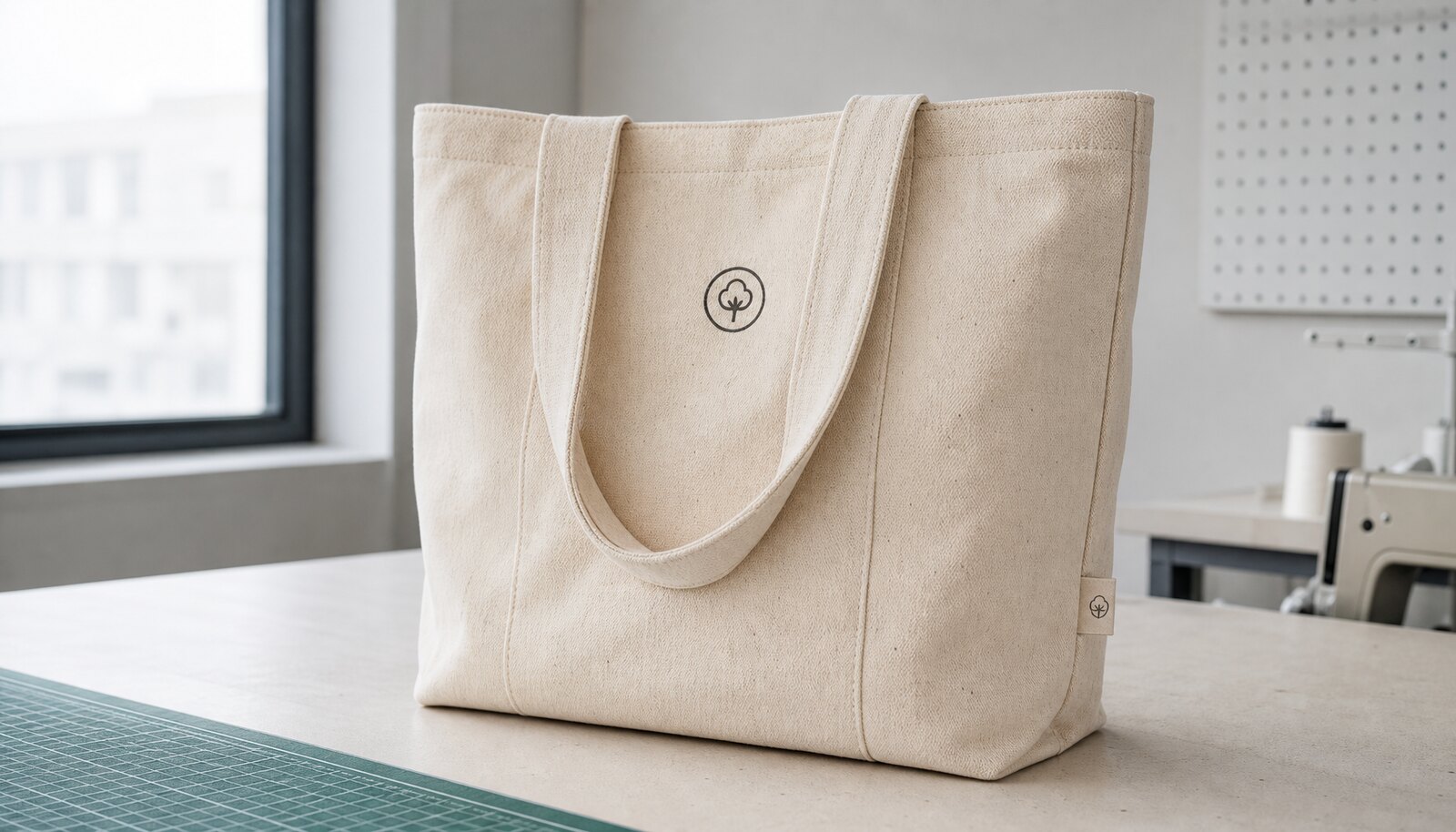
What the tote has to do in a farmers market program
A canvas exhibition tote for a farmers market giveaway has a very different job from a standard promo bag. It may carry peaches, herbs, bread, brochures, sponsor samples, or a small retail purchase, and it also has to look acceptable after a few folds, a commute home, and maybe a rinse in the kitchen sink. That is why procurement planning starts with use case, not artwork. One bag can serve as a quick booth handout. Another needs to behave like a reusable shopping tote. Those are different buys, even if the logo is the same.
The biggest sourcing mistake is to price the bag as if every recipient uses it the same way. A shopper who only carries a flyer and a coupon can live with a lighter build. A shopper who loads produce, jars, and bottled drinks needs body, seam strength, and handles that stay comfortable in the hand. The right spec is the one that survives the first real outing without feeling flimsy. If the bag looks cheap at first touch, the event team loses value before the campaign has a chance to work.
Event context changes the packing plan too. If volunteers hand the tote out at a booth, the cartons need to open fast and the bags need to grab cleanly. If the tote is inserted into a sponsor pack, the bag should fold consistently and avoid crushing other items. If the order supports a seasonal market series, the bag may need enough durability to become a repeat-use carryall instead of a one-day freebie. Those practical differences affect fabric choice, print method, and carton count.
For procurement, the right starting question is simple: what must this tote survive before the customer gets home? If the answer is one walk from the booth to the parking lot, the order can stay light and economical. If the answer is a basket of produce, a bottle of olive oil, and a train ride back, the program needs sturdier cloth, stronger sewing, and a cleaner print finish. Defining the load early keeps the supplier from quoting the wrong bag.
A second question matters just as much: how long should the tote remain in circulation? A one-day giveaway can tolerate a simpler build, but a market bag that will be reused across a season should be treated more like a branded utility item. That changes the buyer’s tolerance for loose stitching, thin handles, and weak print adhesion. The specification should reflect how long the brand name will stay in public view, not only the cost of getting it printed once.
- One-day handout: prioritize easy packing, low setup cost, and simple decoration.
- Repeat-use market bag: prioritize stronger seams, stable canvas, and comfortable handles.
- Retail-style giveaway: treat the bag like a merch item, not a flyer carrier.
- If produce or glass is expected, design for weight and abrasion first.
Choose fabric weight and structure before you ask for a quote
Fabric weight is the first meaningful cost and performance lever. For this category, 8 oz canvas, roughly 270 to 300 GSM depending on weave and finish, is usually the lower-cost end that still feels reusable. It fits light event handouts and short-term promo use. Around 10 oz, often near 340 GSM, is the practical sweet spot for farmers market programs because the bag has more body, folds better in use, and feels less disposable in hand. Heavier cloth can be appropriate, but only when the buyer wants a premium hand-feel or expects frequent reuse. The unit price, decoration cost, and freight all rise with every extra ounce.
Because suppliers sometimes quote loosely, buyers need more than a single GSM number. Ask for the fabric spec in both GSM and ounce weight, plus the weave type if it matters to your program. If the supplier has multiple mills or stocks similar fabric weights, ask whether the quoted cloth is a finished weight or a greige weight after sewing loss and washing allowance. That distinction helps explain why two quotes at the same nominal weight may not feel the same in the hand. In a real procurement comparison, that variation matters because the bag’s stiffness, drape, and print appearance change with the actual fabric build.
Construction is the next decision. A flat open-top tote is fine for lightweight handouts. A gusseted or boxed-bottom bag is more useful when the tote must stand up on a table or carry uneven produce. The bottom shape affects fill volume, and fill volume affects whether the bag feels like a real market carryall. Ask the supplier to state the gusset depth, side seam style, and top hem finish in writing. Those features are often more important than an extra few grams of fabric because they determine how the bag behaves at the moment of use.
Handles deserve the same level of attention. Short handles are easier to hang and hand out, but they can be awkward on the shoulder. Wider handles are more comfortable and usually feel more substantial. The attachment method matters just as much as the handle material. A handle that is stitched into a narrow seam without reinforcement can pull out under real load even if the canvas body is strong. For heavier market use, ask where bartacks are placed, how many stitches are in the reinforcement, and whether the handle root is backed.
When you write the brief, include body width, body height, gusset depth, handle width, handle length, top hem style, and seam type. That spec sheet prevents sample drift and keeps competing suppliers on the same construction. It also gives procurement a defensible reason to accept one quote over another when price differences are driven by structure rather than simply by sales margin.
- 8 oz / 270–300 GSM: best for light promotional handouts.
- 10 oz / about 340 GSM: usually the most balanced option for farmers market reuse.
- Gusseted or boxed-bottom: better for produce, bottles, and uneven purchases.
- Ask for seam type, handle reinforcement, and top hem style in the quote.
- Use GSM and ounces together so suppliers cannot hide a loose interpretation of weight.
Match the decoration method to artwork complexity and service life
Screen print is still the most reliable option for simple logos on natural canvas. It gives strong color, clean edges, and a cost profile that works well when the run is large enough to absorb the setup. One-color and two-color prints are usually the most stable from a procurement perspective because they reduce registration risk and keep the bag’s hand-feel closer to the base fabric. If the logo is bold, flat, and easy to separate into clean ink layers, screen print usually produces the best mix of durability and price.
DTF, heat transfer, and similar methods are useful when the artwork needs gradients, small lettering, or a short production window. They can solve design problems that screen print cannot, but the buyer needs to inspect the tradeoff on canvas. Some transfers sit visibly on the weave, which may be acceptable for a seasonal giveaway and less acceptable for a tote that should look reusable over months. Ask for a rub test, a fold test, and a close-up of the edge after pressing. If the printed surface cracks, peels, or feels heavy, the decoration may be right for a pilot run but wrong for a broader market campaign.
For multi-color work, the hidden cost is not only setup. It is registration control. Canvas is textured, and fine text or narrow letter spacing can break visually when the ink lands unevenly across the weave. That is why procurement should ask for the actual artwork size, the smallest text height, and whether the supplier recommends simplifying the logo for better reproduction. A slightly cleaner artwork file often lowers defect risk and makes the bag easier to approve at sample stage.
Logo placement should also follow distribution context. Center-front printing is a safe default, but if the tote will hang from a shoulder, sit in a stack, or be photographed on a booth table, the upper-front placement can improve visibility. If the event needs sponsor logos, a woven label or side tag may carry secondary branding more cleanly than crowding the print area. That decision can affect cost and readability at the same time.
For repeat programs, the best procurement question is not “which method is fanciest?” It is “which method will still look acceptable after the bag is folded and reused?” On that point, simple screen print on stable canvas is often the safest answer. Use more complex decoration only when the artwork genuinely needs it, not because a vendor offered it as an upgrade.
- Use screen print for bold logos, limited colors, and repeat orders.
- Use DTF or heat transfer when the art needs detail, gradients, or short-run flexibility.
- Approve print on the actual canvas weight, not on a generic sample sheet.
- Ask for a fold test and rub test when using transfer decoration.
- Keep the smallest text large enough to survive the fabric texture.
Compare bag constructions, not just supplier types
A sourcing comparison becomes much more useful when it compares actual bag constructions. The point is not simply whether the vendor is a factory, decorator, or trading company. The point is how the bag is built and what that means for the event. Two canvas totes can look similar in a photo and still behave very differently once they are loaded, stacked, or handed out in a busy booth. One may be fine for brochures. Another may be better for produce and bottles because of the way the seam, bottom, and handle are built.
For a procurement team, the comparison should reveal why a particular structure is worth the price. A flat 8 oz tote with narrow handles and standard stitching is cheap to make and quick to distribute, but it is not the same product as a 10 oz gusseted tote with reinforced handle roots. The latter takes more fabric, more sewing steps, and often a more careful packing plan. That extra cost may be justified if the bag is expected to stay in circulation beyond the event. If the buyer can see that relationship clearly, it becomes easier to defend the spend.
It also helps to compare the bag by user behavior. If shoppers need to carry irregular produce, the bottom must stay flat enough to keep items stable. If the bag will be loaded quickly at a booth, the opening needs to stay accessible and the carton pack must allow easy pull-and-go access. If the tote is a branded giveaway for a seasonal campaign, the print and handle finish may matter more than maximum capacity. Construction choice should match the actual handoff scenario, not just the item description in the catalog.
The table below is most helpful when a buyer wants to see the real tradeoffs in one glance: load behavior, decoration options, and inspection risk. It is not meant to replace a spec sheet. It is meant to show where the price is coming from and which features are worth paying for when the tote has to perform in a public setting.
- Compare seam type, handle reinforcement, gusset depth, and packing method side by side.
- Use one view for load behavior and another for decoration risk.
- Treat reuse value as a procurement benefit because it changes the cost per impression.
- If two bags look alike in photos, compare construction photos and sample finishes.
Read the quote as a landed-cost worksheet, not a sales price
A serious quote for canvas exhibition tote bags for farmers markets should show more than a unit price. It needs the product size, fabric weight, construction, print method, print colors, sample charges, setup fees, carton pack, and lead time. If any of those are vague, the landed cost is probably incomplete. A buyer comparing two suppliers needs to know whether the difference is coming from the cloth, the print setup, the packing, or just the way the quote was written. That matters because the cheapest factory price can become the most expensive delivered buy once freight, duty, and rush charges are added.
The most useful internal metric is landed cost per usable bag. That means factory price plus one-time setup, packing, freight, duty, destination fees, and any labor needed to receive or repack the cartons. If one supplier quotes a lower price but ships with awkward carton sizes or poor packing density, the freight and warehouse cost can erase the saving. For event giveaway planning, timing is also part of cost. An on-time shipment with slightly higher unit price is usually better than a lower price that forces emergency air freight or a replacement order.
Separate recurring costs from one-time costs. Screen charges, plate fees, artwork changes, and samples usually sit in the one-time bucket. Fabric, sewing, decoration, and carton packing sit in the recurring bucket. That split helps buyers see whether the price improves because of volume or only because a vendor is smoothing setup cost across a larger run. It also clarifies the break point for a pilot order versus a full event order. If the first order is small, setup can dominate the unit price; if the order is larger, recurring production cost becomes the main lever.
Ask the supplier to state overrun and underrun tolerance in writing. A plus or minus percentage is not a minor detail; it affects inventory, freight, and event readiness. An overrun can leave the team with extra stock that has to be stored, reassigned, or written off later. An underrun can create a very public shortage on the event date. A well-written quote makes those tolerances visible before the PO is issued, which is the right time to resolve them.
If the bag will be used repeatedly, ask whether the quote changes when the same print setup is reused on a future order. Repeat setup can reduce cost, but only if the supplier retains the screens, files, and construction details in a controlled way. That is a good lever for buyers planning seasonal farmers market campaigns.
- Ask for factory price, setup, packing, freight, and destination costs separately.
- Compare landed cost per usable bag, not just piece price.
- State the delivery term clearly: EXW, FOB, CIF, or DDP.
- Get overrun and underrun tolerance in writing before award.
- Ask how repeat setups are priced if the program will reorder.
Check supplier capability before award and ask for proof, not promises
The lowest quote is not necessarily the safest award. For canvas tote sourcing, you want to know who actually cuts the fabric, sews the bag, prints the logo, inspects the output, and packs the cartons. A direct factory can offer better control, but only if it really performs the work in-house. A trading company or agent may help coordinate multiple items or shipping steps, but the buyer should still know the real production site and the real handoff points. If the production chain is unclear, date risk increases immediately.
The fastest way to test credibility is to ask for evidence that matches the bag you plan to buy. Request a dimensioned spec sheet, close-up photos of the stitch line, print edge, handle join, and carton mark, plus a photo of finished goods or packing. If the supplier only sends polished product renders, that is not enough for a sourcing decision. You need to see the kind of detail that shows whether the sample is built to the same standard as the bulk order. For a seasonal event order, real production evidence is more useful than a general capability statement.
It is also fair to ask about outsourcing. Some suppliers outsource print, embroidery, or carton packing even when they present themselves as a one-stop source. Outsourcing is not automatically bad, but it changes the risk profile. It can affect lead time, sample control, and defect responsibility. The buyer should know whether the bag is made, decorated, and packed in one location or moved between facilities. That affects both accountability and the chance of sample drift.
Ask how the supplier controls fabric lot consistency. If the sample and bulk use different rolls, the bag may show shade variation or change in hand-feel. A capable supplier can explain what happens when the requested cloth is unavailable, whether substitution is allowed, and who signs off on any change. That answer is more valuable than a generic claim of experience because it shows whether the supplier manages real process control.
If the event date is hard, request progress photos during sewing and packing, not just a final shipment photo. That gives procurement a chance to stop the line if the handle length is off or the print is misaligned. It also creates a record that helps resolve disputes later. For high-visibility giveaway programs, that evidence is cheap insurance.
- Ask who cuts, sews, prints, inspects, and packs the bag.
- Request close-up photos of seam, handle join, print edge, and carton marking.
- Confirm whether the same fabric lot can be used from sample to bulk.
- Require disclosure of outsourced steps so hidden handoffs do not appear after award.
- Ask for production photos during sewing and packing when the schedule is tight.
Approve the right sample and test it like an event bag
Do not approve from a mockup alone. The sample path should start with a reference sample or spec sample, then a pre-production sample made from the actual material and actual decoration method planned for bulk. For canvas exhibition tote bags for farmers markets, that means the same fabric weight, the same handle construction, and the same print process. If the sample uses substitute cloth or a different decoration setup, it may look close on paper while hiding a bulk problem. Procurement needs to see the bag the way it will really ship.
The sample is where the useful surprises show up. Check body width, body height, gusset depth, handle length, handle symmetry, stitch alignment, top hem finish, and print placement. Then test the bag with a realistic market load. Fill it with the kind of items shoppers actually carry: produce, bottled drinks, or a few packed goods. The bag should feel stable when lifted and should not distort badly when set on a table. A tote that looks fine empty can still fail the moment it is loaded.
The acceptance standard should be written before the sample is approved. A buyer may allow a small variance in print position but not in handle length or seam strength. Agree the tolerance with the supplier so the bulk inspection does not turn into a debate over what is close enough. If the order is repeat business, keep the approved sample, the artwork file, and the size sheet as the master record. That makes future reorders faster and reduces the chance of silent changes.
If the supplier offers a sample on the wrong cloth, the wrong print method, or a construction that differs from the quote, treat it as a warning rather than a convenience. In procurement terms, that sample is not validating the order. It is validating a different product. The value of a pre-production sample is in matching the bulk run closely enough that the buyer can sign off with confidence.
- Measure dimensions and handle symmetry against the approved spec.
- Inspect print registration, ink coverage, and edge sharpness on the actual sample.
- Test the bag with a real market load, not just empty handling.
- Reject samples made from the wrong fabric lot, wrong print method, or wrong carton pack.
- Keep the approved sample as the control master for reorders.
Set measurable QC points for stitching, print, odor, and packing
Quality control on tote bags is more useful when it has clear pass/fail language. A practical inspection plan should check stitch count consistency, seam alignment, handle reinforcement, print registration, print coverage, fabric shade, carton count, carton marks, and odor. Because the bag is often handed out in public, a small defect can become visible immediately. That makes inspection worth the effort even for relatively simple products. A weak handle or a poor print edge can undermine the whole event.
For stitching, look beyond loose threads. Check whether the stitch line stays straight, whether the top hem is even, whether bartacks are placed where the load actually pulls, and whether the handle root shows stress or opening. A bag can pass a quick glance and still fail at the first heavy use if the reinforcement is short or the seam allowance is too narrow. The QC checklist should name the exact seam location and the defect to watch for. That makes inspection consistent across inspectors and across reorders.
For print, confirm registration, edge sharpness, and coverage across the weave. On canvas, ink can sit unevenly if the weave is coarse or the print pressure is inconsistent. Ask for a practical tolerance before production starts, especially on multi-color logos. A small shift may be acceptable for a giveaway bag; a blurred or banded logo is not. If there is fine text, test it at the distance a shopper will actually see it, not just under close inspection. That is the real user environment.
Packing checks matter more than most buyers expect. Carton marks should include style code, color, quantity, carton number, and gross/net weight, and they should be readable on at least two sides. If the shipment will be stored before the event, confirm that cartons are dry and that the bags do not arrive with strong odor from dye, solvent, or mildew. For buyers who need a formal approach, an AQL-style sampling plan is the cleanest way to make acceptance repeatable. It gives the buyer a defined sample count and a consistent pass/fail rule, which is more defensible than eyeballing cartons after a long transit.
A practical receiving routine is to inspect cartons from the front, middle, and end of the shipment. That helps reveal lot drift, packing inconsistency, or late-stage damage. If one carton looks different, the buyer can stop the receiving process before the issue spreads to the whole event inventory. For a date-driven program, catching a defect early is worth far more than saving a little time on inspection.
To keep QC usable in the field, define rejection thresholds before the shipment leaves the factory. Examples include broken stitches at the handle root, obvious print misregistration, damp cartons, unreadable carton marks, or odor strong enough to concern end users. Clear thresholds reduce back-and-forth and make supplier correction faster.
- Use an AQL-style sampling plan for higher-risk orders.
- Check stitch count consistency, seam alignment, and handle reinforcement.
- Set a practical print registration tolerance before production starts.
- Reject cartons with unreadable marks, dampness, or strong odor.
- Inspect cartons from the start, middle, and end of the shipment.
Plan packing, cartonization, and receiving labor around the event
Packing affects labor, storage, and delivery speed. For event giveaway programs, bulk packing in inner cartons is often the best default because staff can distribute the bags quickly without opening individual retail polybags. If the tote will be handed out at a booth, a warehouse, or a sponsor activation site, ask the factory to fold it in a consistent direction so the logo does not crease unnecessarily and the bag is easy to grab. Overpacked cartons can flatten the body of the tote and make a new product look used before the event starts.
The carton plan should fit the receiving point, not only the shipping lane. If volunteers move cartons by hand, keep carton weight manageable and make outer marks easy to read in low light. If the bags will go through a retail warehouse, barcode labels, carton sequence, and pallet count may matter more. Good packing choices reduce repacking, reduce damage, and reduce the chance that staff open cartons early just to confirm the contents. Those are real labor costs, not just convenience issues.
Moisture protection is worth discussing even for simple canvas. If the shipment will sit in a humid storage room or travel through rainy receiving conditions, ask whether the supplier can add a liner bag, a stronger carton seal, or desiccant. The right answer depends on route and dwell time. A few extra packing measures can cost far less than replacing damaged stock or hand-repacking cartons before the giveaway. That is especially true when the event has a fixed date and there is no time to rework damaged goods.
Carton dimensions also affect freight math. Larger cartons may reduce handling but increase dimensional weight and storage space. Smaller cartons may be easier to move but take more labor and more carton count. When you compare quotes, ask for gross weight, carton size, and pack count so logistics can estimate freight and receiving time accurately. Packing is part of landed cost, not an afterthought.
If the order is part of a retail-style activation, ask whether the supplier can sort by carton number, label by color, and palletize in a way that matches your warehouse process. The more the carton plan matches the downstream workflow, the less time the event team spends reorganizing inventory after delivery.
- Use bulk inner cartons when speed of distribution matters more than shelf presentation.
- Specify fold direction so the logo does not crease inside the carton.
- Confirm outer carton marks, carton count, and gross weight before shipping.
- Add moisture protection if the bags will sit in storage before the event date.
- Match carton size to receiving labor, not only to shipping efficiency.
Build lead time and replenishment around the event calendar
Lead time for a canvas tote includes more than sewing. It covers fabric sourcing, sample approval, print setup, bulk production, inspection, packing, and transit. Buyers often lose days by leaving artwork changes too late or by assuming bulk can start before the sample is approved. For farmers market event planning, the calendar is usually the real constraint. Once the event date is fixed, work backward and leave room for one sample correction cycle if needed.
Seasonality can tighten the schedule. If the order overlaps with a busy promotional period, the factory may have longer fabric lead times, slower print queues, and less freight flexibility. That is one reason repeat programs benefit from a control file. Keep the approved dimensions, fabric weight, seam details, print file, packing spec, and shipping history together so the next order moves faster and with less drift. Reorders are easier when the master specification is clean and owned by procurement.
A realistic replenishment plan should include a buffer, not a best-case guess. If the giveaway date cannot move, the order should not be built on a perfect schedule. Leave time for sample correction, production checkpoints, and transit contingency. If the supplier offers a rush option, ask what changes. Sometimes rush means less inspection time or reduced freight flexibility. That is a tradeoff to see clearly before the PO is issued.
For recurring market programs, ask whether the factory can retain the print setup or repeat the same bag construction on future orders. That can reduce quoting time and improve consistency, but only if the supplier maintains the relevant records and does not substitute materials later. Even on a repeat order, it is still worth checking fabric weight, handle construction, and carton packing because a small sourcing change can change the whole feel of the tote.
The buyer’s objective is simple: avoid a situation where the bags arrive late, arrive inconsistent, or arrive in a packing format that slows distribution. Lead time planning is valuable because it protects the event, not just the purchase order.
- Build in time for one sample correction cycle.
- Freeze the spec before peak season.
- Keep one master approval sample and spec sheet for future reorders.
- Ask for the schedule in writing, not just a verbal estimate.
- Check whether repeat orders can reuse the same print setup and bag spec.
Specification comparison for buyers
| Spec decision | Recommended option | When it fits | Buyer risk to check |
|---|---|---|---|
| Direct factory sourcing | Best when you need control over fabric weight, seam construction, print method, carton pack, and inspection in one contract | Use for repeat programs, custom sizes, custom handle lengths, or orders that need sample-to-bulk consistency | Verify the factory actually cuts, sews, prints, and packs in-house; ask which steps are outsourced if any |
| Trading company or agent | Useful when you need coordination across multiple SKUs or when internal sourcing bandwidth is limited | Use for mixed event kits, sponsor packs, or programs that need one point of contact for art, packing, and shipping | Check whether the quoted factory is fixed or can be swapped after award, and whether subcontracting is disclosed |
| Local decorator or regional printer | Good for very short lead times and small regional runs | Use for pilot giveaways, emergency replenishment, or when transit time matters more than the lowest unit price | Confirm the blank bag source because canvas weight, handle reinforcement, and seam quality can vary by batch |
| 8 oz canvas, one-color screen print | Lowest-cost option that still feels reusable when the giveaway is light | Use for flyers, postcards, lightweight sponsor packs, and short-duration booth handouts | Check whether the bag collapses too easily; that can make it look thin and reduce repeat use |
| 10 oz canvas, one-color screen print | Best balance for farmers market use because it carries more weight without becoming too expensive | Use for bags that may be reused beyond the event and should look substantial on first touch | Confirm handle reinforcement, stitch count, and side seam strength instead of judging only fabric weight |
| 10 oz canvas, boxed-bottom or gusseted build | Better structure for produce, jars, or heavier purchases | Use when shoppers are likely to load uneven items that need base support | Check gusset depth, bottom seam reinforcement, and whether the bag stands up without tipping |
| Multi-color art with DTF or heat transfer | Good when the logo needs gradients, fine text, or more than two ink colors | Use for short runs, seasonal artwork, or campaigns that change often | Check hand feel, crack resistance, and whether the print looks plastic on natural canvas after folding |
| Bulk packed in inner cartons | Best for giveaway distribution where staff need fast access and low unpacking labor | Use for booth handouts, warehouse pick-and-pack, or event kits | Confirm fold direction, carton count, carton marks, and whether bags crease under overfilled cartons |
| Pre-production sample from bulk material | The safest approval route before a full run | Use for any custom order where fabric shade, print placement, handle length, or label position matters | Reject samples made from substitute cloth or a different print setup than the planned bulk order |
Buyer checklist before sampling
- Lock the bag size, fabric weight, handle length, handle width, and gusset depth before asking for prices.
- State the exact logo method, number of print colors, print area, and whether branding is front only or front and back.
- Ask for a sample made from the same canvas weight, same dye lot if relevant, and same print process planned for bulk.
- Confirm MOQ by style, print color count, label option, and packaging method, not only by bag shape.
- Request carton pack count, carton dimensions, gross weight, and palletization details so shipping comparisons are real.
- Define the delivery basis you want quoted, such as EXW, FOB, CIF, or DDP, so freight and destination charges are not hidden.
- Set the acceptance standard for stitch count, print alignment, handle symmetry, odor, moisture, and carton marks before production starts.
- Ask the supplier to state overrun and underrun tolerance, rework policy, and replacement timing in writing.
- Reserve time for a pre-production sample, production inspection, packing review, and transit before the event date.
- If the order is repeated, keep one approved master sample, spec sheet, and artwork file as the control record for reorders.
Factory quote questions to send
- What exact fabric weight will you use, in GSM and ounces, and what tolerance do you allow on that fabric roll?
- Is the quote based on screen print, DTF, heat transfer, embroidery, woven label, or another decoration method?
- What is the MOQ for this bag, and does it change if we add a second print color, a woven label, or custom packaging?
- What seam construction is included: single needle, double needle, bound seam, or reinforced top stitch, and where are bartacks applied?
- What handle width and handle attachment method are included, and is the handle length measured from top edge or stitch point?
- Does the unit price include sample cost, setup cost, plate or screen fees, packing cost, and carton labeling, or are those separate?
- What are the allowed overrun and underrun quantities, and can you state them as a percentage of the order?
- What is the standard production lead time after sample approval, and what steps would extend it?
- Can you confirm the carton pack count, outer carton size, gross weight, and whether bags are bulk packed, polybagged, or stacked with tissue?
- Will the bulk order use the same fabric lot and the same print setup as the approved sample, or can either change?
Quality-control points to confirm
- Fabric weight should match the approved sample within an agreed tolerance, and the weave should not be visibly looser or thinner than approved.
- Handle stitching should be even, with bartacks or reinforcement at the stress point, and the handle root should not open under a realistic load test.
- Stitch density should be consistent along side seams, top hems, and handle joins, with no skipped stitches, broken thread, or long loose tails.
- Print placement should match the approved artwork position, and registration should stay within the agreed tolerance for multi-color prints.
- Ink coverage should be even with no pinholes, banding, bleeding, or feathering beyond the approved edge condition.
- Bag size, gusset depth, handle length, and handle width should stay within the stated tolerance on a random sample from bulk.
- Cut edges and inside seams should be clean, with no oil spots, fabric holes, puckering, or uneven top hems.
- If the order includes odor-sensitive end users, the bags should pass a basic odor check at unpacking and not smell strongly of dye, solvent, or mildew.
- Moisture condition should be acceptable at packing and loading, with no damp cartons, wet bag feel, or visible condensation inside the shipment.
- Carton marks should include item name, style code, color, quantity, carton number, and gross/net weight, and be readable on at least two sides.