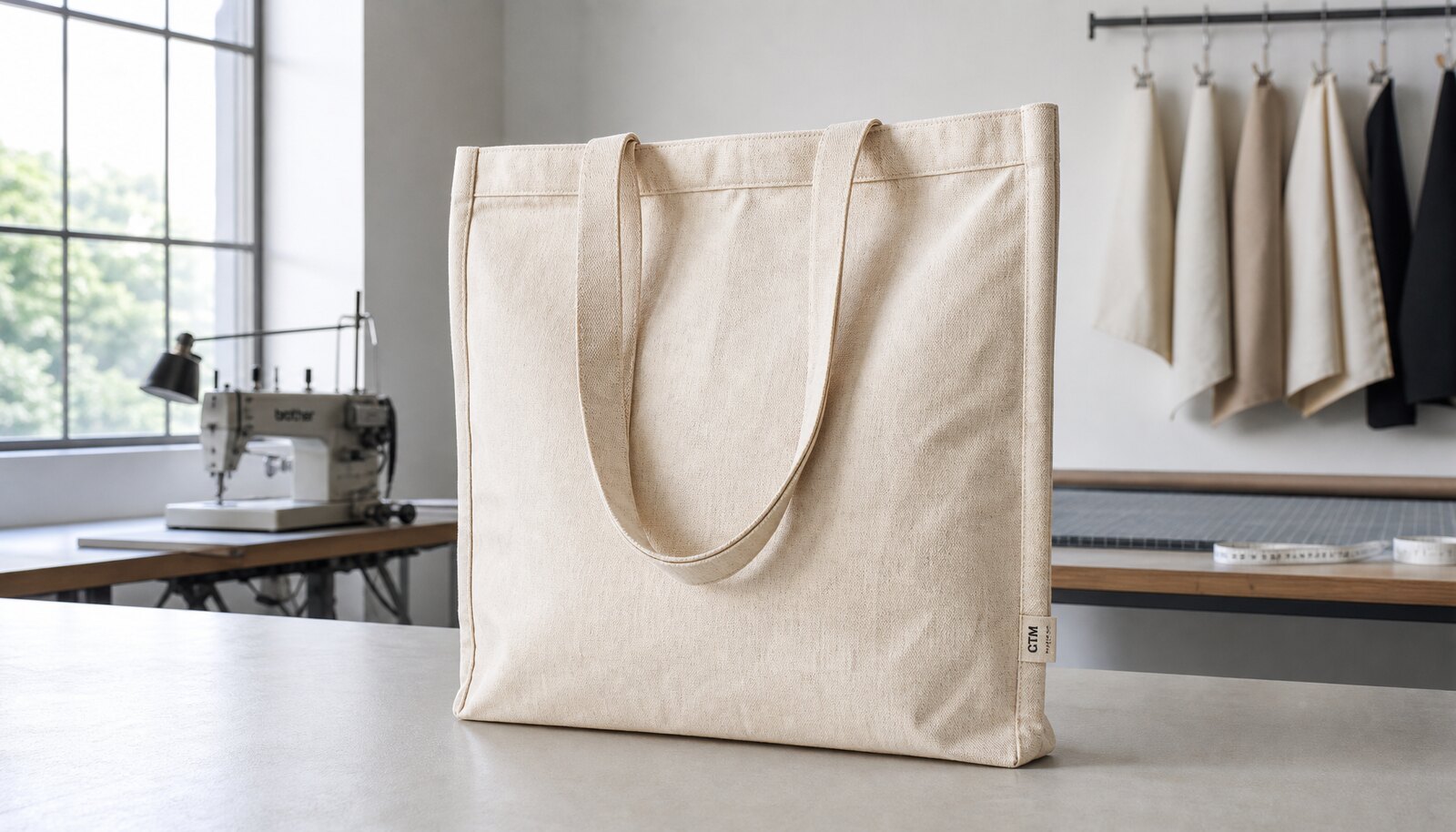
Why material selection matters more than most tote-bag buyers expect
A canvas exhibition tote for an ecommerce brand has to do more than carry a logo. It needs to survive transport, look presentable in a booth or event hall, pack efficiently for shipping, and feel appropriate for the brand it represents. Material choice affects all of that at once. A fabric that is too light can make the tote feel flimsy, distort the print, or collapse under samples. A fabric that is too heavy can push up freight cost, slow folding, and raise the landed cost without giving a meaningful benefit.
For procurement teams, the key point is that canvas weight alone does not define performance. Weave tightness, finishing method, and sewing quality can change the final result as much as the headline ounce or GSM number. Two bags with the same nominal fabric weight can behave very differently once printed, folded, and loaded. That is why the buying decision should be based on use case first, then material, then decoration method, rather than on price per unit alone.
For ecommerce brands, exhibition totes often sit between promotional packaging and retail merchandise. That middle position changes the buying logic. If the tote is only meant to hand out brochures or small inserts, a lighter and less expensive canvas may be appropriate. If the bag is meant to be reused after the event, show up on social media, or serve as a branded product in its own right, the material needs enough structure to look intentional. In other words, the right fabric is not the heaviest option. It is the one that matches real use, expected lifespan, and the brand image the bag is supposed to carry.
Start with use case, load, and lifespan before you look at fabric weight
The most useful procurement question is not, 'What canvas weight is standard?' It is, 'What will this tote actually carry, how often will it be reused, and how visible will it be to customers after the event?' Those answers determine whether you need a light promotional bag, a balanced all-purpose tote, or a heavier premium piece. A tote that only carries a notebook and leaflet pack does not need the same cloth as one that holds product samples, a water bottle, and a catalog.
A practical way to spec the bag is to define a realistic load in kilograms or pounds. Then decide how much stiffness you want in the body. A bag that will be filled once and handed out can be more relaxed. A bag that should stand up on a display table or survive repeated use needs more structure. Buyers sometimes over-spec material because they equate heavier fabric with better quality. In reality, poor stitching or weak handle reinforcement can fail long before the fabric itself does.
Procurement also needs to separate brand perception from durability. A natural canvas tote may feel premium because it looks authentic and tactile, even at a moderate weight. A bleached, very heavy canvas may feel durable but also more rigid and less flexible in packing. If the program requires a custom print, the buyer should think about how the bag will look in a booth, how it folds in a carton, and whether it will still feel acceptable after a few uses. Those are the factors that should drive the choice, not a habit of defaulting to the thickest cloth available.
Choose a fabric weight range that fits the channel, not one that looks impressive on paper
For most ecommerce exhibition tote programs, the practical weight range is roughly 340-540 GSM, or about 10-16 oz depending on how the mill measures and finishes the cloth. That range covers the majority of use cases without creating unnecessary freight burden. At the lower end, the bag folds flatter, ships cheaper, and works well for light promotional distribution. At the higher end, the tote feels more substantial, holds shape better, and supports a more premium unboxing or event presentation.
A lighter bag can still be correct if the brand is aiming for broad distribution and low landed cost. The tradeoff is that lighter canvas usually offers less body and can show print texture more strongly. A medium-weight bag, particularly around 14-16 oz or 475-540 GSM, is often the best procurement balance for ecommerce brands because it supports clean decoration, looks credible at first touch, and remains practical in packing. Heavy canvas above 18 oz or 610 GSM should usually be reserved for specific premium use cases where stiffness, durability, or resale value justify the cost.
When comparing supplier quotes, ask for the actual target weight and the accepted tolerance. A quote that says 'canvas tote' is not meaningful. A quote that says '14 oz natural canvas, 475-500 GSM, with ±5% tolerance' can be checked against receipts, samples, and production output. That one line removes a lot of ambiguity. If the supplier cannot state the fabric clearly, the buyer should assume the quote may be based on a lower-cost substitution or a loosely defined stock cloth.
Weave, finish, and color affect print quality as much as the cloth weight does
Canvas is not a single material experience. The same nominal weight can feel firmer, rougher, smoother, or more open depending on weave and finishing. A tight weave generally supports cleaner print edges and less ink sink. A looser weave can be acceptable for simple graphics, but it gives a more textured print surface and may make small text harder to read. That matters when the tote is carrying a brand mark that needs to remain legible at a glance.
Finish is another factor buyers often under-specify. Unbleached natural canvas gives an honest, organic look that many ecommerce brands like, but it also brings slub, yarn variation, and subtle shade changes. Those are normal characteristics, not defects, unless the buyer failed to define the acceptable range. Bleached canvas offers a cleaner background and more contrast for artwork, but it can show fold lines and handling marks more easily. Washed canvas softens the hand-feel, though the factory must account for shrinkage and texture changes before cutting and stitching.
The key procurement move is to tie finish to the artwork and the brand image. A minimal one-color logo can look excellent on natural canvas even if the cloth has a bit of texture. Fine typography, small icons, or multi-element graphics often need a tighter weave and cleaner background. Buyers should ask for a physical swatch or cut piece from the actual bulk material and review it under normal warehouse lighting, not just under studio lights or a supplier's edited product photo.
Select the print method and the canvas together, not as separate decisions
Decoration method changes both the appearance and the acceptable fabric spec. Screen print is still the most dependable choice for many canvas exhibition tote bags because it handles simple graphics well, gives decent durability, and scales efficiently for repeat orders. It works best when the artwork is bold, the color count is low, and the fabric has enough body to support a clean ink layer. If the tote will carry a simple brand mark or short campaign message, screen print on a medium-weight canvas is usually the least risky route.
Transfer methods and digital decoration make sense when the design is more complex, the run is small, or the launch window is tight. The tradeoff is that these methods can expose rough fabric texture, create a slightly glossy appearance, or lift at the edges after repeated handling if the process is not well controlled. On very textured canvas, a transfer print can look less integrated with the fabric than a screen print, even if the artwork itself is technically accurate. Embroidery can elevate a small logo, but it should only be used when the canvas weight, logo size, and placement can handle stitch density without puckering the cloth.
For procurement, the practical question is not which print method is theoretically best. It is which method gives the required result on the chosen canvas at the required volume, within the required lead time. Ask the factory to quote the decoration method explicitly, including setup charges, number of colors, print size, and any limitations on artwork detail. The more the supplier can separate print method from fabric spec, the easier it is to compare offers that actually mean the same thing.
Use a smaller, deeper comparison when you evaluate sourcing routes
Comparing suppliers only by unit price hides too much. Procurement buyers should compare the production route, because the route determines how much control you actually have over the fabric and the final bag. Factory-direct cut-and-sew sourcing is the cleanest option when the supplier truly controls fabric sourcing, sewing, printing, and packing. It offers better traceability and makes repeat orders easier to standardize. The risk is that sampling may take longer if your spec sheet is incomplete or if the factory has to source non-standard cloth.
Trading company or agent sourcing can help when you need rapid quotes across several factories or when internal resources are limited. The upside is coordination. The downside is that the actual sewing or printing line may be hidden behind a margin layer. That matters because a supplier can quote one specification while producing another unless the buyer asks for proof of the actual factory, actual material source, and sample origin. A bag quote is only as reliable as the chain behind it.
Stock-bag-and-decorate routes are good for urgent campaigns, small launch tests, or low-risk handout programs. They are the least flexible, though, because you are buying from pre-existing stock constraints on weight, size, and color. This route can work, but buyers should accept that the material may not match a fully custom spec and that substitution risk is higher. The right procurement comparison is not 'Which quote is lowest?' It is 'Which route gives the most controlled result for the commercial risk we are taking?'
What a usable tote-bag quote should include, beyond the unit price
A quote for canvas exhibition tote bags should be readable without a second call. It should identify fabric composition, weave, weight, finish, dimensions, handle length, print method, and packing format. It should also tell you what is excluded. If the supplier leaves out setup fees, carton charges, labels, or packaging, the buyer may compare an incomplete offer against a complete one and make the wrong decision. That is a common procurement mistake in tote sourcing because the bags themselves are simple, but the production variables are not.
The most reliable quotes also state assumptions. For example: whether the bag is cut from natural unbleached cloth, whether the print is one color or multiple colors, whether the handles are the same fabric or webbing, whether the bag is sewn with single or double stitching, and whether the quote uses factory-direct production or includes an outside print shop. Those details do more to de-risk a purchase than a lower headline price ever will. If the supplier is vague about any of them, treat the quote as provisional rather than comparable.
A strong RFQ does not need to be long, but it does need to be specific. Send one spec sheet to every supplier and require the same response structure back. Ask the supplier to separate material cost, sewing labor, print setup, packing, and freight assumptions if applicable. That way your team can normalize the quote before choosing a supplier. The goal is not paperwork for its own sake. The goal is to compare apples to apples and avoid a low offer that is only low because the supplier quietly changed the cloth or simplified the build.
MOQ, pricing, and custom features: where material choices change the economics
MOQ usually rises when the material or construction becomes harder to source or slower to produce. A natural canvas tote with one-color print is typically easier to quote at lower quantities because the factory does not have to manage dyed fabric lots or multiple decoration steps. Once you add lining, zipper, pocket, piping, or custom color matching, the supplier needs more material coordination and more sewing time, and that usually pushes MOQ upward. The buyer should ask whether MOQ is driven by fabric roll usage, print setup, or carton packing. The reason matters, because it tells you whether the factory is truly flexible or simply unwilling to break a standard batch structure.
Pricing should be broken into components whenever possible. A unit price alone can hide a lower fabric weight or reduced finishing standard. A clear quote should show what is included in the tote itself, what setup charges apply, and whether packing or labels are separate. It should also indicate if the quoted number assumes bulk fabric already exists or if the mill order still needs to be placed. If a supplier is offering a very aggressive price, ask which element is being simplified. The answer is often the most useful part of the negotiation.
For ecommerce brands, the landed-cost view matters more than the factory-gate view. Canvas totes are bulky, so a small change in fold method or carton size can affect freight materially. If two suppliers quote nearly the same unit price, the one with a more efficient pack might still be cheaper at destination. That is why procurement should ask for packed carton dimensions, units per carton, and gross weight at the quote stage rather than after sample approval.
Approach samples in the right sequence so you can catch fabric problems early
Sampling is where many tote programs fail quietly. A buyer may approve a clean showroom sample and only later learn that the bulk fabric feels thinner, rougher, or less stable. The better sequence is simple: material swatch or cut piece, blank bag in the actual fabric, then pre-production sample with final print. That order lets the team validate the fabric first and the decoration second. If the supplier skips the blank sample, the buyer loses the chance to judge body, drape, and hand-feel before the logo goes on.
The sample should be approved against measurable criteria. Check dimensions after finishing, handle length, gusset depth, seam path, and print position. If the bag is supposed to fold to a certain size for fulfillment, fold it exactly that way and measure the packed dimension. If the tote needs to fit inside another retail carton, test the fit physically. A sample that photographs well but does not pack efficiently is not a successful sample for an ecommerce brand.
It is also worth asking where the sample came from. A sample made from off-roll cloth, a different mill, or a different finishing batch can mislead the buyer. The supplier should identify whether the sample is made from the same bulk lot, a close match, or only a reference fabric. That detail helps procurement decide whether the sample is a reliable production signal or only a design reference.
QC should be operational: define pass/fail limits, not just general expectations
Quality control for canvas totes should focus on the defects that actually create receiving problems, customer complaints, or rework. The important checkpoints are fabric weight, size tolerance, seam integrity, print placement, stain control, and packing consistency. A factory may describe a bag as acceptable even when the print shifts slightly, the stitch density varies, or the shade differs between cartons. To avoid that, buyers need written acceptance criteria before production starts.
A practical QC standard should distinguish between critical, major, and minor defects or use an equivalent AQL-style framework. For example, a stain or broken seam near the handle attachment is critical because it affects function. An off-center print outside the allowed tolerance is major because it affects presentation. A small, non-functional thread tail might be minor if it does not affect appearance or use. Those categories help the factory understand what cannot be shipped and prevent arguments after inspection.
Natural canvas deserves its own approval language. Slub, small yarn knots, and subtle shade variation are normal in many canvas constructions. That does not mean anything goes. It means the buyer should define an acceptable visual range in advance and ask the supplier to hold to it. For larger orders, request top-of-line and middle-of-line checks so problems are caught while the run is still active. If the bags go directly to fulfillment, add a packing check for fold consistency, carton count accuracy, and readable labels so the receiving team does not need to open and sort cartons one by one.
Specification comparison for buyers
| Option | Best fit | Tradeoff buyers should accept | Procurement note |
|---|---|---|---|
| 10-12 oz / 340-410 GSM natural canvas | Light event handouts, brochure inserts, low-cost ecommerce promotions | Lower freight and a flatter fold, but less structure and softer print edges | Use only when the bag will carry light contents and the brand can tolerate a more casual look |
| 14-16 oz / 475-540 GSM natural or lightly finished canvas | Default choice for most ecommerce exhibition bags | Higher unit cost and carton weight, but better structure, nicer hand-feel, and stronger perceived value | This is the most balanced spec for repeat orders, simple logos, and mixed event/retail use |
| 18 oz / 610 GSM+ heavy canvas | Premium resale, durable reuse programs, or heavier product samples | Stiffer fold, higher freight, and more sewing wear if construction is weak | Request seam and handle reinforcement details; heavy cloth without stronger stitching is not enough |
| Unbleached canvas | Natural, earthy branding and cost-sensitive programs | Shade variation, slubs, and fiber marks are normal and must be approved by range, not by exact shade | Best when the artwork is bold and the buyer is willing to define acceptable natural variation |
| Bleached or white canvas | Cleaner print background and sharper visual contrast | Can show fold lines and surface marks more easily | Useful for fine typography, small logos, and retail-facing packaging |
| Screen print | Simple logos, repeat orders, and medium-to-high volume | Less suitable for gradients and very fine text | Ask for ink coverage, register tolerance, and cure standard |
| Heat transfer / digital transfer | Short runs, multi-color art, faster sampling | More risk of edge lift, gloss mismatch, or rough-canvas cracking | Require abrasion expectation and visual approval on the actual canvas texture |
Buyer checklist before sampling
- Define the actual use case: event giveaway, ecommerce order insert, retail resale, or paid merch, because the load, finish, and durability target are different.
- Lock the spec in measurable terms: fabric weight, weave, finish, handle length, gusset depth, stitch count, and print size.
- Ask for the fabric source, not just the supplier name: mill, roll type, weave, and whether the canvas is bleached, unbleached, washed, or dyed.
- Request a material swatch and a blank sample from the same bulk cloth before approving final artwork.
- Check carton pack, folded size, polybag requirement, and gross weight before comparing supplier prices.
- Write down acceptable variation: shade range, slub level, print position tolerance, and seam appearance so natural canvas does not become a dispute later.
- Confirm whether production is in-house or partly outsourced for printing, sewing, or packing, and make the supplier identify each step on the quote.
- Ask for a defect standard or inspection method before bulk starts, not after a shipment problem appears.
Factory quote questions to send
- What is the exact fabric composition, weave, and finished weight in GSM or oz, and is the canvas bleached, unbleached, washed, or dyed?
- Where is the fabric sourced, which mill supplies it, and can you identify the roll or lot used for sampling and bulk?
- Is sewing, printing, and packing done in-house, or is any part outsourced to another factory or print shop? If outsourced, who is responsible for final QC?
- What is the MOQ by color, print method, and add-on features such as lining, pocket, zipper, or piping?
- What is included in the unit price: fabric, cutting, sewing, print setup, labels, packaging, cartons, and inland handling?
- What sample will you send first: swatch, blank bag, or pre-production sample from bulk material?
- What are the packed carton dimensions, units per carton, and gross weight?
- Which QC checks are performed before shipment, and what defect limits do you use for seam strength, print alignment, stains, and size tolerance?
- Can you show photo evidence of the actual sample or production line if the quote is coming through a trading company or agent?
- What lead time is committed for sample approval, bulk production, and shipment, and which part of the schedule is most likely to move if anything changes?
Quality-control points to confirm
- Fabric weight within agreed tolerance; if the spec is 14-16 oz or 475-540 GSM, the supplier should state the actual target and allowed deviation in writing.
- Finished bag dimensions within tolerance for width, height, and gusset after sewing and pressing.
- Handle attachment secure at the top seam and stress points, with bartacks or reinforcement exactly where specified.
- Print position within agreed tolerance; the graphic should not drift beyond the approved artwork window.
- Ink coverage consistent across the lot, with no major registration errors, cracking, or ghosting on the approved print method.
- No oil stains, water marks, needle damage, broken threads, loose seam loops, or unapproved shade mixing.
- Natural slub, knot, and surface variation acceptable only within the approved visual range for the chosen canvas type.
- Carton count accurate, labels readable, and folding consistent enough that the bags can go directly to warehouse intake or fulfillment without repacking.
- For large orders, request an AQL-style visual inspection plan or an equivalent factory defect standard, with clear pass/fail categories for critical, major, and minor defects.