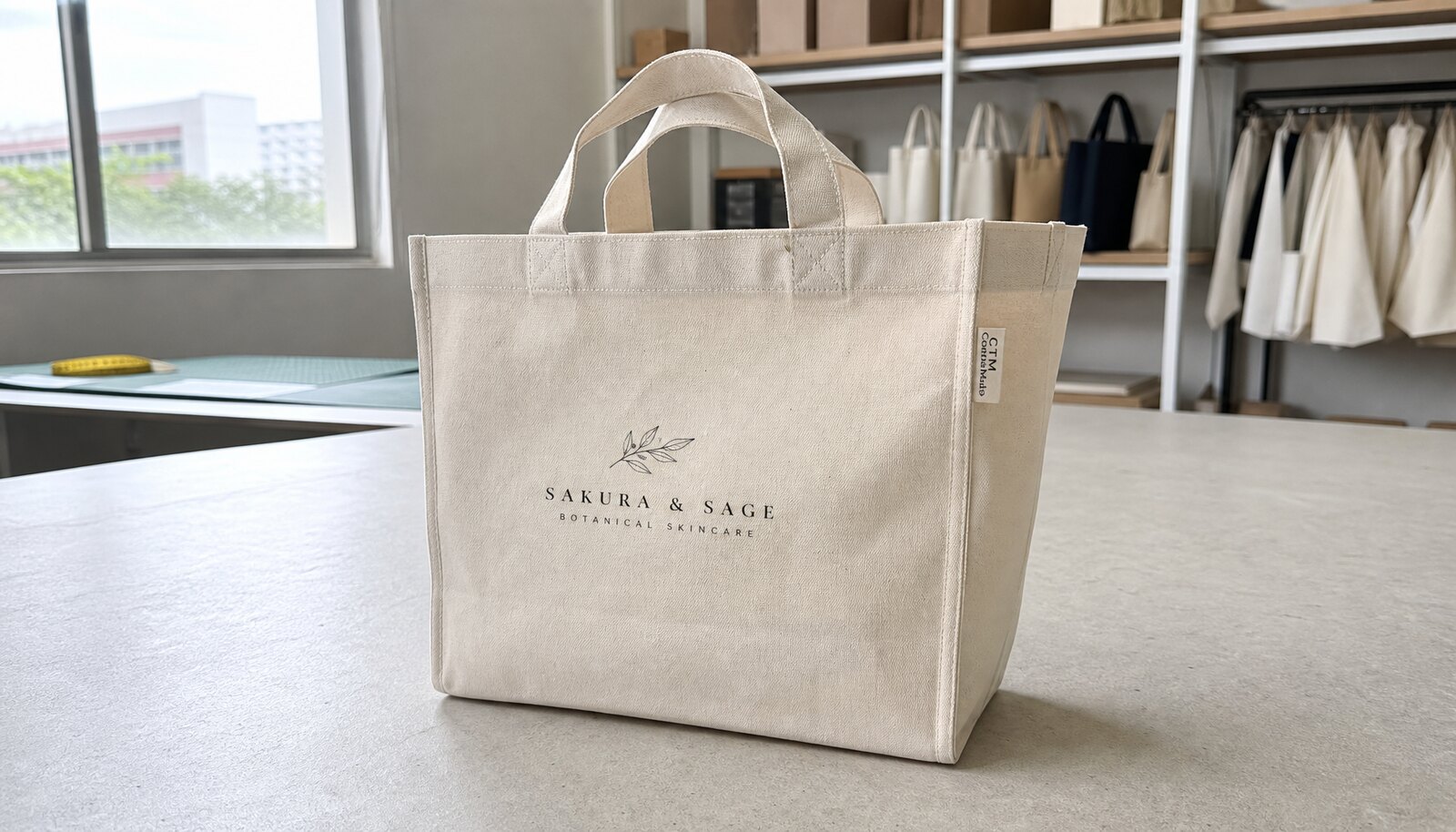
Why cosmetic brands use canvas exhibition tote bags differently
For cosmetic brands, an exhibition tote is not just a giveaway bag. It is carrying samples, brochures, testers, and sometimes a purchase incentive set, so the bag has to look clean under booth lighting and survive repeated handling through the show floor. That means the buying decision is usually about print quality, fabric hand feel, and packing consistency, not just the lowest unit price.
The most common sourcing mistake is treating every tote as the same product. A bag that works for a general retail handout can fail for a beauty launch if the logo is too small, the canvas is too thin, or the seams fray after a few uses. Cosmetic buyers should write the RFQ around the actual use case: event handout, PR mailer, press kit, or premium retail bundle.
- Event use needs quick distribution and a neat retail look.
- Sample kits need stronger handles and better internal cleanliness.
- Premium launches need tighter print control and better fabric consistency.
- Distributor orders need repeatable packing and carton efficiency.
Fabric weight, feel, and the point where cost starts to move
For canvas exhibition tote bags, the practical range is usually 10 oz to 12 oz for most cosmetic brand programs. Ten oz gives a lighter, softer bag that keeps cost controlled, while 12 oz gives a firmer body and a more premium look on the shelf or in hand. If the bag will hold sample jars, catalogs, and event inserts, 12 oz is often the safer buying choice.
Once you move above that, freight and sewing cost start to climb for a reason. Heavier canvas uses more yarn, takes longer to cut and sew, and increases carton weight. If your design does not need a structured shape, paying for 14 oz or heavier canvas can be wasted money. The best approach is to define the target content load, then pick the lowest weight that still avoids wrinkling, transparency, and seam distortion.
- 10 oz: better for light event handouts and budget campaigns.
- 12 oz: balanced choice for beauty kits and exhibition use.
- 14 oz+: only when structure, durability, or premium positioning is clearly needed.
- Ask for the fabric weight in both oz and GSM if your team compares vendors across markets.
Print method comparison: where cosmetic artwork looks right and where it fails
Print method affects both appearance and quote structure. For most cosmetic brand tote bags, one- or two-color screen printing is the cleanest option when the logo is bold and the artwork area is simple. It is economical at scale and usually gives a sharper retail look than a rushed digital process on coarse canvas. Heat transfer can work for small runs or multi-color graphics, but it needs a smooth application process and good adhesion testing.
The failure point is usually artwork complexity. Fine gradients, tiny taglines, and very thin lines tend to disappear on woven canvas, especially on natural or heavily textured fabric. If the brand team wants a photographic or shaded artwork, confirm the exact panel size and request a production-like strike-off. Do not approve a web mockup alone; the logo that looks sharp on screen can break apart on real canvas.
- Screen print: best for simple logos, strong colors, and repeat orders.
- Heat transfer: useful for smaller runs or more detailed graphics, but test wash and rub resistance if needed.
- Embroidery: premium feel, but expensive and slower on large flat graphics.
- Woven label or sewn patch: good for understated branding and premium packaging.
Use the right sourcing route: factory, trader, or hybrid quote
The best quote is not always the cheapest line item. A direct factory quote gives you better control over fabric, print, and packing, but only if the supplier can show real production capability, not just sales-language. For canvas exhibition tote bags, the source of the fabric, the stitching line, and the print workshop all matter. If those steps are outsourced loosely, your price may look low and your quality risk may be high.
A trader or sourcing agent can help when you need multiple decoration methods or a mixed shipment across products, but the buyer still needs transparency. Ask who actually makes the bag, where the print happens, and what the QC checkpoint is before packing. If the answer is vague, the landed-cost gap may disappear after rework, delayed dispatch, or missed artwork approvals.
- Direct factory: better for repeat styles and controlled reorders.
- Trader: useful for mixed baskets or urgent consolidation, but confirm source factory identity.
- Hybrid: workable if the supplier manages packaging or print subcontracting with documented approval.
MOQ logic that protects price without forcing bad inventory
For exhibition totes, MOQ should be built around production efficiency, not marketing imagination. Changing fabric color, handle length, print color count, or closure style can each create a separate setup and separate MOQ. If the bag shape stays consistent, cosmetic buyers can often reduce risk by sharing the same base structure across multiple campaigns and changing only the print artwork or a small label detail.
A clean MOQ discussion should separate structure MOQ from decoration MOQ. For example, the factory may accept one body spec at a certain minimum, but each additional print version or Pantone match may increase the setup burden. Buyers should ask the factory to quote both the base bag and the incremental cost of a second print version. That makes campaign planning easier and avoids a false unit-price comparison.
- Keep one body spec and vary artwork when possible.
- Split MOQ by color only if the color supports brand consistency and inventory turnover.
- Request tiered pricing by quantity so you can see the break between launch quantity and reorder quantity.
- If the factory quotes a very low MOQ, confirm what changes are excluded from that number.
Sample approval: the fastest way to stop avoidable production errors
A good sample process for cosmetic tote bags is not about approving a nice-looking photo. It is about locking the physical standard that production will copy. Request one pre-production sample made with the actual fabric weight, handle construction, print method, and packing format. Then measure it, load it, and inspect it under the same lighting conditions that your retail team or event team will use.
There are a few sample checks that matter more than the rest. Measure the finished size after the bag has settled, not while it is still creased from sewing. Rub the print lightly to see whether pigment smears. Check the top edge, handle joins, and inside seam cleanliness. If there is a zipper, test the slider several times. What fails in the sample usually fails in the lot, just faster and more expensively.
- Compare the sample to a signed reference sample, not only to the artwork file.
- Record acceptable size tolerance, stitching style, and print placement in writing.
- Approve the packing mock-up if the tote will ship retail-ready or be re-packed at destination.
- If the logo sits close to a seam, confirm that the seam does not distort the graphic.
Packing and carton planning for exhibitions and distributor orders
Packing is one of the easiest places to lose margin. An over-packed carton can raise volumetric freight costs and crush the tote shape, while an under-packed carton can create wasted space and handling inefficiency. For canvas exhibition tote bags, flat packing is usually the most efficient route unless the buyer needs retail presentation or insert placement inside each bag. If the bags need individual polybags, specify the film thickness and whether the bag should be folded to a fixed size.
Carton count should match the route to market. A distributor warehouse usually wants a clean master carton count and barcode labeling that matches its receiving system. A retail buyer may want inner polybags and more careful fold consistency. A trade-show organizer may care most about fast handout access and low carton damage. The quote should show not only the bag price but also the packing method, carton dimensions, and gross weight per carton.
- Flat-packed cartons usually reduce freight cost.
- Consistent fold size helps event staff repack quickly.
- If inner inserts are included, clarify whether they are packed loose or inserted into each bag.
- Request carton marks that identify style, color, qty, and PO clearly.
Lead time risk: what actually slows a canvas tote order
Buyers often hear a sewing lead time and assume the shipment date is secure. In practice, the schedule is usually delayed by artwork confirmation, sample approval, fabric booking, print capacity, and carton readiness. For a cosmetic brand launch, the safest plan is to separate the timeline into sample phase, production phase, and shipping buffer. The production phase may look short, but the artwork and packaging approval windows can be longer than sewing itself.
If your event date is fixed, build in a cushion for at least one correction cycle. A logo that needs repositioning or a handle that needs reinforcement can add days if discovered late. Ask the factory what material must be locked before mass production starts, and make sure your internal team can sign off quickly. Slow buyer response is one of the most common reasons a tote order misses a campaign date.
- Do not treat sample approval as optional; it is part of the schedule.
- Ask whether the supplier has in-house print and sewing or must queue subcontractors.
- Confirm the time needed for packaging materials if branded cartons or inserts are required.
- Keep one buffer week if the bags support a launch, not just routine stock.
Landed-cost comparison: where the quote looks cheap but isn't
A useful comparison starts with the bag price, but it should end with the full landed cost. For canvas exhibition tote bags, the biggest hidden differences are print setup, sample charges, packing format, carton dimensions, and freight weight. Two suppliers can quote the same unit price and still land very differently if one includes basic packing and the other charges separately for every step.
Procurement teams should compare the quote on a simple structure: base bag, print, packaging, testing or sample cost, and freight impact. Even when the freight is not quoted by the factory, the tote design still affects landed cost because heavier fabric, larger dimensions, and thicker packing all increase shipment weight or volume. The cheapest ex-factory offer can become a weak option if it produces higher damage, longer lead time, or more repacking at destination.
- Compare ex-factory, FOB, and landed cost rather than only unit price.
- Use the same carton count and packing method across vendors for an honest comparison.
- Ask for a second quote with and without zipper, lining, or insert pocket if those features are under consideration.
- Treat rework risk as part of cost when evaluating low-price suppliers.
Specification comparison for buyers
| Spec decision | Recommended option | When it fits | Buyer risk to check |
|---|---|---|---|
| Sourcing route | Direct factory quote with controlled artwork and packing | You need repeat orders, private label control, and stable reorders | Compare whether the quote includes print prep, sampling, carton marks, and export packing or only ex-factory bag price |
| Fabric weight | 10–12 oz canvas for balanced hand feel and cost | Trade-show giveaways, cosmetic launches, and retail-ready promo bags | Lightweight fabric can look cheap under bright booth lighting; overweight fabric raises freight and unit cost |
| Handle construction | Self-fabric handles with reinforced X-box or bar-tack stitching | When bags carry brochures, samples, or light cosmetic kits | Short handles without reinforcement fail at the seam after repeated events |
| Print method | 1–2 color screen print or heat transfer for small runs | Simple brand graphics, logos, or campaign artwork | Fine gradients and tiny type can blur; test the final logo size on the actual bag panel |
| MOQ strategy | Split by colorway or print version, not by every size detail | When you need one core structure across multiple campaigns | MOQ can rise sharply if you change fabric color, handle length, or lining spec too often |
| Inner finishing | Unlined body with clean overlock or binding on raw seams | Cost-sensitive exhibition use where appearance still matters | Rough seam finishing can shed fibers and make the interior look unfinished in premium cosmetic packaging |
| Closure option | Open-top for event handout; zip top only for travel or premium kits | When the bag will hold small cosmetic sets or press samples | A closure adds cost, sewing time, and hardware risk; avoid it unless product security matters |
| Packing format | Flat-packed with size-accurate inner polybag and export carton marks | Bulk shipments to warehouses, distributors, or 3PLs | Overstuffed cartons raise volumetric cost and cause creasing that complicates retail packing |
| Supplier route | Factory with sample-room approval and documented QC checkpoints | When artwork, stitch quality, and repeatability matter more than the cheapest quote | Broker or trading quotes can hide actual production source, lead times, and defect responsibility |
Buyer checklist before sampling
- Confirm finished size, fabric weight in GSM or oz, handle drop, seam finish, and whether the bag is unlined or lined.
- Lock the print method, logo size, Pantone targets, and artwork placement with a real sample or digital proof on the actual bag template.
- State the target MOQ by color and print version so the factory does not quote a theoretical minimum that is impossible to repeat.
- Specify packing: flat-packed or stuffed, polybag requirement, master carton count, carton dimensions, and shipping mark format.
- Request a pre-production sample or sealed reference sample before mass production, then compare stitching, print sharpness, and measurements against it.
- Ask for lead time split into sample, production, and booking buffer so your launch date is not based on only sewing time.
Factory quote questions to send
- What is the exact fabric weight and weave structure you are quoting, and can you confirm it on the sample?
- Does the unit price include print setup, color matching, and one production sample, or are those charged separately?
- What is your MOQ by color, by print version, and by order value if I need one style across multiple cosmetic campaigns?
- How do you reinforce the handle ends, and what stitch count or bar-tack standard do you use?
- Can you quote both open-top and zip-top versions so we can compare landed cost and retail suitability?
- What carton pack count, carton size, and gross weight do you recommend to keep freight efficient?
- What defects trigger rejection at inspection: print misregistration, loose threads, size tolerance, or stain allowance?
- What is your production lead time after sample approval, and how much buffer do you need for artwork confirmation?
Quality-control points to confirm
- Finished size tolerance should stay within a tight practical range: usually about +/- 0.5 to 1 cm depending on bag size.
- Print registration should match the approved sample; visible shift or washed-out ink on logo edges should be rejected.
- Handle stitching must be even, with no skipped stitches, loose ends, or seam puckering at the stress points.
- Fabric should be free of oil marks, yarn knots, and obvious weave defects on the front panel and handle face.
- Cartons should arrive dry, square, and correctly labeled, with bag count per carton matching the packing list.
- If the bag has a zipper or metal accessory, test opening, closing, and alignment on a sample from each production lot.