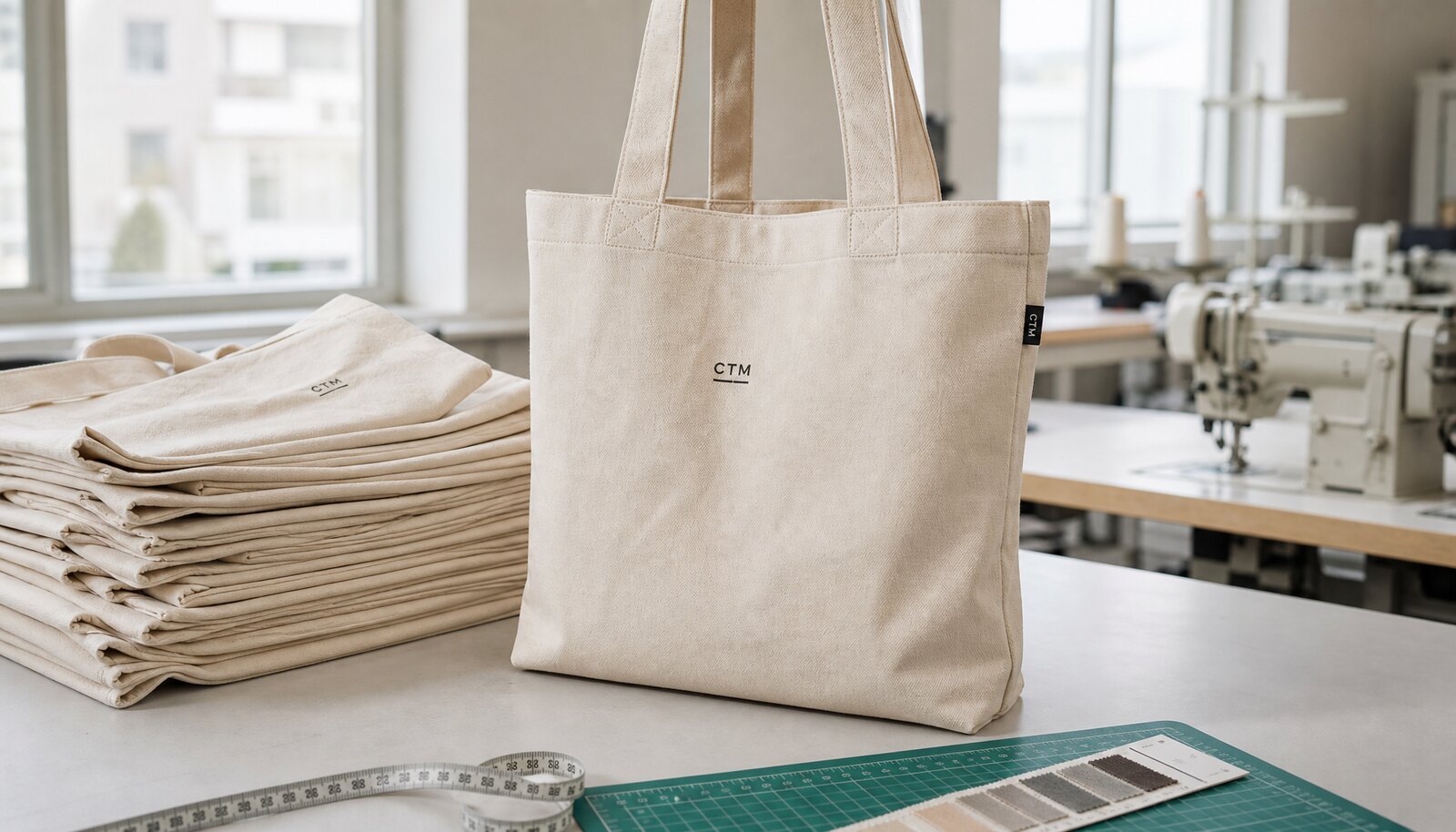
Why exhibition totes are harder to source than they look
Canvas exhibition tote bags for corporate events sound simple until you compare supplier quotes line by line. Most buyer problems come from the same place: the RFQ says 'canvas tote,' but the factory has to guess fabric weight, print area, handle length, and packing method. That is where quotes drift apart and the lowest number usually turns out to be the least complete offer.
For corporate events, the bag is not just a carry item. It has to hold brochures, inserts, samples, notebooks, sometimes a water bottle, and still look presentable after being handed out at a booth. If the bag feels flimsy or the logo prints poorly, the event brand looks weak. The right sourcing method starts with the job the tote must do, not with the cheapest unit price.
- Treat the tote as a functional event product, not a generic promo bag.
- Build the quote around load, print, and packout requirements.
- Expect strong price spread if specs are not defined in the RFQ.
Choose the fabric weight based on what the bag must carry
For most corporate event programs, 10 oz / 340 GSM canvas is the practical default. It gives enough body for a printed logo, holds shape better than lightweight cotton, and usually stays within a manageable freight and budget range. If the bag must carry heavier inserts or a product sample kit, move to 12 oz / 400 GSM or reinforce the bottom seam. If the bag is only for light handouts, 8 oz / 280 GSM may work, but the buyer needs to accept a softer hand and more visible wrinkle lines.
Do not rely on 'thick canvas' as a specification. Supplier quotes often use the same word for different actual weights, weave densities, and finishing styles. Ask for GSM, finished fabric width, shrinkage allowance, and whether the cloth is raw, bleached, or garment-washed. These choices change print behavior, stitch performance, and final appearance more than many buyers expect.
- 8 oz / 280 GSM: lower cost, softer structure, suitable for light inserts only.
- 10 oz / 340 GSM: best all-rounder for conferences and exhibitions.
- 12 oz / 400 GSM: better for premium events or heavier contents, higher freight cost.
Compare supplier routes before you compare unit prices
For canvas exhibition tote bags, the sourcing route matters as much as the spec. A direct factory quote can be more accurate because cutting, sewing, printing, and packing are handled under one roof. That usually improves schedule control and reduces the chance that your artwork approval is one version behind the actual bulk process. Trading companies can still be useful for mixed sourcing programs, but they need to show who actually controls production and QC.
When reviewing offers, separate the supplier type from the price. Ask whether the fabric is sourced locally or imported, whether printing is in-house, and whether packing is done at the factory or at a third party. These details explain why two seemingly similar quotes can differ by 15% or more. If the supplier cannot name the process owner for each step, the risk usually shows up later in delayed samples or inconsistent bulk packs.
- Direct factory: stronger process visibility, better for repeat programs.
- Trading route: useful for bundling, but requires more evidence on QA and process ownership.
- Hybrid route: can work if one supplier controls the full production schedule in writing.
Print method choice should follow artwork and event distance
Screen print is still the most practical choice for many exhibition tote bags because it gives good opacity on canvas and holds cost down when the design uses one or two solid colors. It works especially well for block logos and simple brand marks that need to be legible from a few meters away. If the artwork uses gradients, fine text, or more color detail, a heat transfer or digital transfer may look better at sample stage, but you should test adhesion and wash resistance if the bag will be reused.
Do not let the supplier choose the print method only on convenience. Ask how the artwork will be separated, what mesh count is used, how many passes are required, and whether the print sits on raw canvas or pre-treated fabric. On coarse weave canvas, fine lines can break and small text can fill in. For event use, visual clarity often matters more than photo-level detail, so simplify artwork before you print.
- Screen print: best for solid logos, durable, lowest unit cost at scale.
- Heat transfer: useful for short runs and complex artwork, but inspect for cracking and edge lift.
- Embroidery: premium look, but added cost and possible puckering on lighter canvas.
MOQ logic: why low minimums can cost more than they save
A realistic MOQ for custom canvas exhibition tote bags is usually driven by fabric cutting loss, printing setup, and carton packing labor. For standard one-color corporate bags, 2,000 to 5,000 pieces per design is a common factory range. Below that, the supplier often adds setup charges, limits color changes, or switches to less efficient production planning. A very low MOQ can work for pilot events, but the buyer should expect a higher unit price and less room to customize dimensions or reinforcement.
The better way to manage MOQ is to compare the total program cost, not only piece price. If you need 3,000 pieces for one event and 2,000 more within the same quarter, one consolidated order may beat two smaller orders even if warehouse storage is needed. Ask the factory how MOQ changes with a repeat order, with one-color versus two-color print, and with stock canvas versus dyed canvas. That is where negotiation creates real value.
- Higher MOQ usually lowers setup cost per unit.
- Multiple print colors can push MOQ up because of separate screens and line time.
- Repeat orders often justify tighter unit pricing if the spec stays unchanged.
What a quote should show so you can compare suppliers fairly
A useful quote for sustainable packaging comparison should break out fabric, printing, sewing, packing, and carton cost. If the supplier only gives one lump-sum price, it is hard to see whether the higher cost is from better fabric, better stitching, or simply a wider margin. Buyers should also request the price effect of each change: GSM change, handle length change, print color increase, or inner packaging upgrade. That makes the commercial comparison real instead of emotional.
When comparing quotes for corporate events, landed cost matters more than factory price. A low ex-factory number can turn expensive once you add carton upgrades, extra protective polybags, local handling, and air freight caused by a missed ship date. A clean quote should let procurement estimate the bag cost per event attendee, not just the factory invoice.
- Ask for cost by component: fabric, sewing, print, packing, carton.
- Request alternative pricing for 8 oz, 10 oz, and 12 oz canvas.
- Make suppliers state what changes trigger a new tooling or setup fee.
Sample approval is where most avoidable mistakes are caught
For canvas tote bags, a digital artwork proof is not enough. The pre-production sample should confirm real bag dimensions, handle drop, print opacity, seam quality, and fold behavior. If the bag is meant for a corporate event, the buyer should also check how it looks when lightly filled, because an empty tote can hide poor structure. The sealed golden sample then becomes the reference for bulk production, packing, and final inspection.
The sample should be assessed under normal use, not only on a table. Place brochures or sample inserts inside, lift the handles, and inspect whether the side seams pull or the bottom panel twists. A small issue in the sample stage can become a large problem when 5,000 bags are already packed. If the sample is off by even a few millimeters in print placement or handle symmetry, do not approve bulk until corrected.
- Measure finished width, height, gusset, and handle drop.
- Inspect print opacity under bright light and from normal viewing distance.
- Compare sample sewing against a sealed reference before production release.
Packing details affect damage rate and warehouse receiving speed
For event programs, packing should be simple, countable, and easy to receive. Standard bulk packing is one dozen or two dozen per inner polybag, then master cartons with clear SKU marks, quantity, gross weight, and carton dimensions. If the bags will be stored before an event, ask for a packing method that reduces permanent creasing. A folded canvas tote that is packed too tightly can develop hard fold lines that make it look used before it reaches the venue.
Sustainable packaging comparison should also be practical. An uncoated kraft carton is often enough if the route is stable and the event team can handle some outer scuffing. But minimal packaging does not mean no protection. For printed bags, the print face should not rub against rough carton surfaces or loose staples. If the buyer wants a lower-plastic packout, the factory should still protect the print with a simple tissue sheet or a clean inner wrap where needed.
- Keep packing count fixed to reduce receiving errors.
- Use carton marks that match the buyer SKU and event code.
- Avoid over-compression that creates deep fold creases on the logo panel.
Lead time risk usually starts before production, not during it
Many tote programs run late because sample approval drifts, artwork changes too often, or the buyer waits to lock carton labels. A realistic lead time should be split into sample time, bulk production time, and transit time. For a custom canvas exhibition tote, sample development may take several days to two weeks depending on artwork and material readiness. Bulk production is then often measured in weeks, not days, especially if fabric needs pre-shrinking or special print setup.
If the supplier promises an unusually short timeline, find out where the time was saved. Sometimes the answer is stock fabric, fewer QC steps, or a simplified print process. That may be fine for a rush event order, but the buyer should know the tradeoff. In peak season, the better supplier is not always the cheapest one; it is the one that can show a stable production calendar and a realistic ship window without relying on last-minute overtime.
- Split schedule into sample, production, and transit milestones.
- Lock artwork and packing data early to avoid rework.
- Treat rush offers carefully if they remove QC or limit customization.
Use a buyer checklist and quote questions to force better offers
A good RFQ for sustainable packaging comparison does not need to be long, but it must be specific. When the buyer defines size, GSM, print method, packing, and approval stage clearly, supplier quotes become easier to compare and less likely to hide extra charges. That helps procurement teams, brand owners, importers, and distributors make a commercial decision based on total value, not guesswork.
For repeated event programs, the best supplier is the one that can reproduce the same tote with predictable quality across reorders. The RFQ should therefore create traceability: final art file, approved sample, carton spec, and packing list all tied to one SKU. That is how you avoid production mistakes when the next exhibition order is placed by a different person or a different office.
- Use one product code per size/color/print version.
- Tie every bulk order to the approved golden sample.
- Keep the RFQ and carton label language identical.
Specification comparison for buyers
| Spec decision | Recommended option | When it fits | Buyer risk to check |
|---|---|---|---|
| Fabric weight | 10 oz / 340 GSM canvas for standard event use | Best balance of body, print clarity, and cost for conference or exhibition giveaways | Too thin can collapse and show ink strike-through; too heavy raises freight and unit cost |
| Handle construction | Self-fabric handles with bar-tack reinforcement | Good for broad corporate programs where visual consistency matters | Short bar-tacks or weak stitch density will fail under brochure and catalog loads |
| Print method | Screen print for 1-2 solid colors; heat transfer only for short-run complex art | Useful when logo simplicity and unit cost matter more than photo detail | Fine text can blur; heat transfer can crack if fabric finish and curing are poor |
| Supplier route | Direct factory with in-house cutting, sewing, printing, and packing | Best for repeat orders, tighter QA control, and lower landed cost | Outsourced printing or packing can create color mismatch and missed ship dates |
| MOQ logic | 2,000-5,000 pcs per color/spec for standard custom work | Fits importers and brand buyers who can consolidate event demand | Very low MOQ often hides setup fees, paper-thin fabric, or limited customization |
| Packaging format | Bulk polybagged by dozen, then master carton with carton marks | Appropriate for warehouse distribution and event fulfillment centers | Loose packing can cause crease marks, print rub, and inaccurate carton counts |
| Sample approval stage | Pre-production sample after material confirmation, then sealed golden sample | Necessary when logo placement or stitch density is critical | Approving only a digital proof misses size shrinkage, handle length, and print opacity issues |
| Sourcing route | Factory-direct from a tote specialist rather than a trading-only quote | Works when you need better control over fabric, stitching, and packing detail | Trading quotes can look cheaper but hide QC gaps, slower problem solving, and less traceability |
| Sustainable packaging choice | Uncoated kraft carton and minimal inner poly only when needed | Fits sustainability claims without over-engineering the packout | Overstated green claims or mixed materials can create buyer compliance issues |
Buyer checklist before sampling
- Confirm the exact bag size, seam allowance, and finished handle drop before quoting.
- Lock the canvas weight in GSM or oz, not just the word 'canvas'.
- State the print method, ink color count, and print area in millimeters.
- Specify whether the bag must carry brochures, samples, bottles, or mixed event kits.
- Ask for a pre-production sample and a sealed golden sample for QC reference.
- Set carton pack quantity, carton size target, and label requirements for warehouse receiving.
- Request lead time separated into sample time, production time, and transit time.
- Compare landed cost, not only ex-factory price, including packing upgrades and freight class.
Factory quote questions to send
- What canvas GSM, yarn count, and finished thickness will you use for this bag, and what tolerance do you allow?
- Is the print done in-house or outsourced, and what is the maximum acceptable color variance from the approved artwork?
- What is the exact MOQ per design, per color, and per shipment split?
- Can you provide a sample with final handle length, stitch pattern, and print placement before bulk approval?
- What carton pack, inner packing, and carton marking format do you recommend for this event program?
- Which QC tests do you run before shipment: seam strength, handle pull, print rub, and measurement check?
- What is your standard production lead time after sample approval, and how does it change during peak season?
- If we change from one-color print to two-color print, what cost elements change and by how much?
Quality-control points to confirm
- Fabric weight matches the approved GSM within agreed tolerance.
- Bag measurements are within tolerance on width, height, and gusset if applicable.
- Handle length is even side-to-side and bar-tacks are clean, centered, and secure.
- Print registration is correct, with no smearing, pinholes, or edge break on the logo.
- Stitch density is consistent along side seams, bottom seam, and handle attachment points.
- No oil marks, loose threads, broken needles, or fabric slubs in the visible panel area.
- Carton pack count matches the packing list and carton marks match the buyer's SKU code.
- Sample approval matches bulk production on color tone, hand feel, and logo placement.