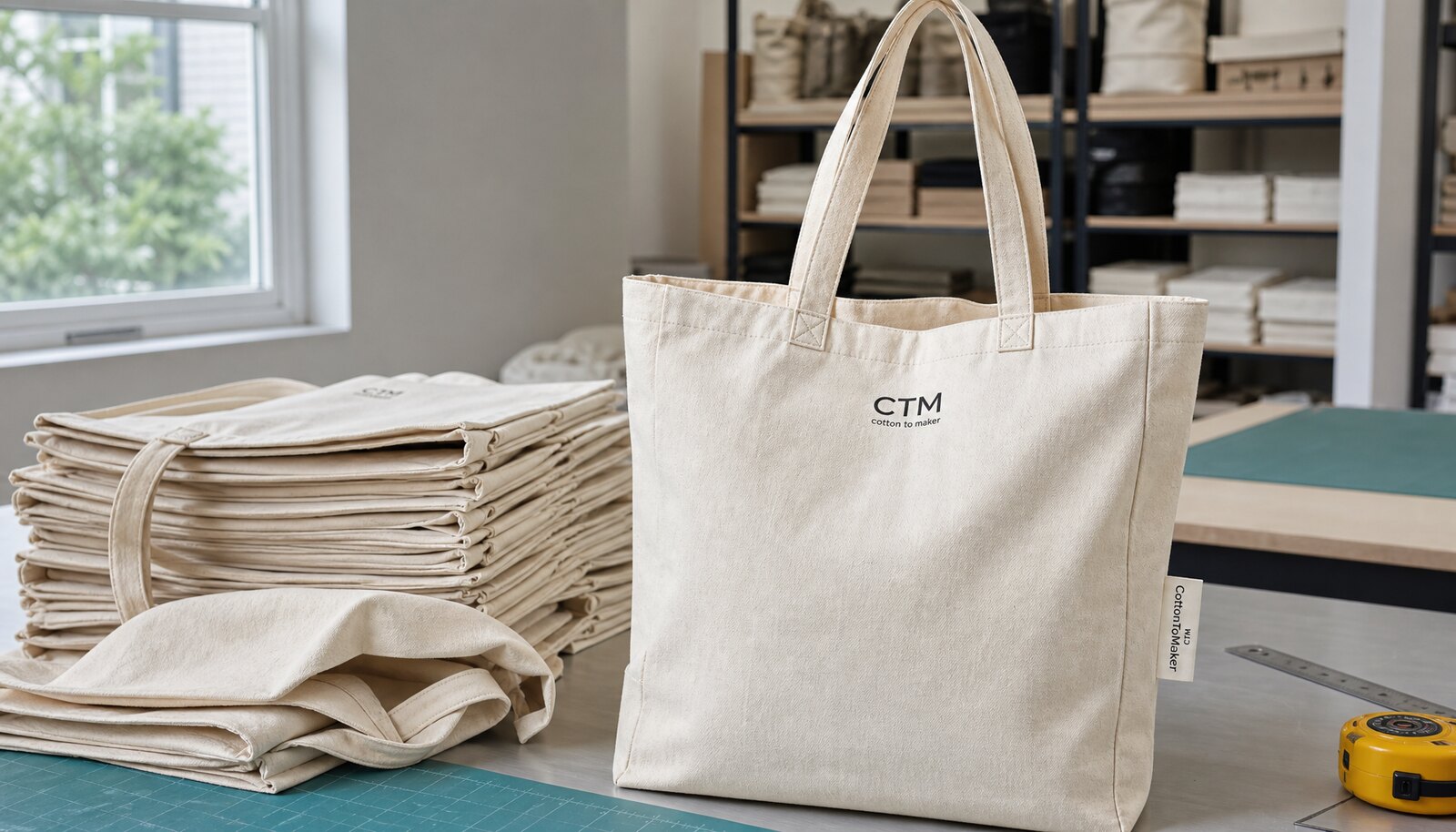
Start With The Buying Outcome, Not The Tote Price
The first number in a tote bag quote is only useful if the buyer knows exactly what it buys. For corporate events, a canvas bag can be a simple brochure carrier, a sample-kit bag, a conference welcome bag, or a reusable branded tote that guests keep after the event. Those use cases do not need the same fabric weight, handle build, print method, or packing method, so the quote has to start from the end use rather than from a generic product name.
This matters because the real cost of a weak spec shows up after the order is placed. A bag that collapses under catalogs, twists at the seams, or arrives with a crooked logo can create replacement cost, rework, and brand damage that dwarfs the unit savings. For procurement, the job is not to find the cheapest headline price; it is to buy the lowest-risk bag that still performs in the event environment.
- Define the load target before quoting: brochures only, 2 to 3 kg sample fill, or a heavier multi-item conference pack.
- Decide whether the bag is expected to be reused after the event, because reuse changes the fabric and handle requirements.
- Fix the print count and print location early so suppliers do not quote a different decoration scope.
The Spec Stack That Actually Drives Cost
Most tote quotes move because of a small set of variables, not because the supplier is trying to hide a secret price. Fabric weight is usually the first lever. A 10 oz canvas bag is common for lighter event use, while 12 oz works better when the bag needs structure or has to carry catalogs, notebooks, or a sample insert. Heavier canvas can improve perceived quality, but it also raises material cost and can make the bag feel stiffer if the finish is rough.
Handle construction and decoration style are the next two major cost drivers. Self-fabric handles are usually cheaper and keep the look simple. Cotton webbing handles often feel more premium and can be more comfortable to carry, but they add a line item and can increase sewing time. A one-color screen print is normally the cheapest decoration for a large run, while multiple print locations, embroidery, woven labels, or special ink effects each add setup, labor, or both.
- Use 10 oz canvas for light event bags and 12 oz canvas when the tote must carry heavier inserts or survive repeated use.
- Ask for finished dimensions, not just nominal size, because a tote that is technically the right size can still fail if the gusset or opening is too narrow.
- Treat woven labels, side flags, and custom packaging as real cost items, not optional extras that can be decided later without price impact.
A Landed-Cost Model Buyers Can Actually Use
A useful bulk pricing plan starts with a landed-cost formula, not an isolated unit quote. The working equation is simple: landed cost per bag equals the sewn bag body, plus decoration, plus labels, plus packing, plus carton allocation, plus inland freight, plus export handling, plus international freight, plus duty or tax, plus brokerage and final delivery. If the quote is DDP, several of those lines may be bundled, but the buyer should still ask for the underlying cost structure so the rate can be benchmarked against another supplier's EXW or FOB quote.
Illustrative example only: a 5,000-piece order for a natural 12 oz canvas tote might be quoted at $0.86 for the bag body, $0.14 for one-color screen print, $0.05 for a woven label, and $0.07 for flat packing and carton allocation. That produces an ex-factory price of $1.12. If inland/export handling adds $0.06, sea freight and destination handling add $0.18, duty or tax at an example 8% rate adds about $0.09, and brokerage plus domestic delivery add $0.05, the landed cost lands near $1.50 per unit. The exact number will change by country and freight mode, but the method is what matters.
- Ask suppliers to break out bag body, decoration, label, packing, carton, and handling instead of bundling everything into one opaque number.
- Normalize all quotes to the same incoterm before comparing, because EXW, FOB, and DDP are not directly comparable.
- Amortize setup and sample charges across the order size so the low-volume price does not look artificially cheap or expensive.
How Setup Costs Change The Price Curve
Bulk pricing does not fall in a straight line. The key reason is setup amortization. If the print setup fee is $120, that fee adds $0.12 per bag at 1,000 units, $0.04 at 3,000 units, and $0.024 at 5,000 units. The ink itself may only be a few cents, but the setup can dominate a small run. The same logic applies to custom woven labels, special carton printing, and artwork revisions that require a new screen or a new digital proof.
This is why procurement should request tier pricing at the same spec. A supplier that looks expensive at 1,000 pieces may become the cheapest choice at 5,000 once setup is spread out. The opposite can also happen if a quote looks low because the supplier has hidden the setup in a separate fee that only appears after sample approval. Compare the full line-item structure, not just the final unit number.
- Request tier quotes at 1,000, 3,000, 5,000, and 10,000 pieces using the same fabric, same print method, same pack-out, and same incoterm.
- Ask for separate setup fees for each print location and each print color, because a second location can be more expensive than adding a small amount of ink.
- If the campaign needs more than one artwork version, ask the supplier to price each version separately instead of blending them into one average.
Compare Supplier Routes Without Getting Misled By The Quote
Supplier route matters as much as the product spec. A direct factory usually gives the cleanest control over fabric, sewing, printing, and packing, which is why it often produces the best cost once the spec is stable. A trading company or sourcing agent can be useful when the buyer needs faster RFQ coverage or wants to compare multiple plants quickly, but the margin stack can hide the true production cost if the line items are not exposed.
Local decorators and nearshore converters can be the right answer when the campaign is time-sensitive or the order is relatively small. They usually cost more per unit than an offshore factory, but they can reduce freight complexity and shorten the production calendar. The mistake is to compare these routes only by headline unit cost. A low EXW number from one supplier can still be more expensive overall if freight, duty, rework, and defect exposure are all higher.
- Use the same artwork, the same dimension sheet, the same pack-out instruction, and the same freight term for every supplier in the comparison set.
- Do not compare EXW from one supplier against DDP from another until freight, duty, and brokerage are normalized to the same basis.
- If a middleman is quoting, request the factory name, the process map, and the actual inspection owner before you accept the number.
MOQ And Tier Pricing: Where The Real Breakpoints Are
MOQ is not just a policy line in the quote. It is the point where setup, cutting waste, print screens, label runs, and carton handling become efficient enough to spread across the order. For a canvas event tote, the cheapest structure is usually one bag size, one body color, one print setup, one label, and one packing method. Every variation adds process time and often changes the minimum quantity needed for the supplier to make the job viable.
When a campaign needs multiple colors or multiple audience segments, it is often better to split the order into a core SKU and a smaller premium SKU than to force one design to handle everything. That makes the MOQ economics clearer and helps the buyer understand which part of the budget belongs to the event giveaway and which part belongs to a higher-value client or VIP pack.
- Ask the supplier to price the same tote at several volume tiers so you can see how much the setup is really costing at each breakpoint.
- Request separate MOQ effects for bag color, print color count, and label type, because those three variables often move the cost more than the bag body itself.
- If the factory offers a price that is unusually low at a small quantity, ask which cost line is being subsidized and whether the larger-run price is still valid.
Sampling And Artwork Signoff Should Mirror Production
A plain size sample is not enough for a bulk order. The buyer needs a sample that uses the actual fabric, the actual print method, the actual label, and the actual packing format that will go into production. Otherwise the approved sample is only a shape reference, not a production reference. For branded event bags, the gap between a blank sample and the finished bulk bag is where most surprises happen: logo distortion, placement drift, handle asymmetry, and fold marks that land on the print.
Artwork signoff should be as disciplined as material signoff. The supplier should receive a vector file, a Pantone target if color matters, the exact print size, the placement in millimeters, and any no-print clearance around seams, rivets, or fold lines. Once the pre-production sample is approved, freeze the artwork version and the packing spec in writing. If the supplier asks to change the screen, the label, or the fold method after approval, treat that as a new cost and a new risk.
- Approve a pre-production sample, not only a blank sample or a studio photo.
- Record the approved sample with date, artwork version, fabric reference, and packing reference so there is one source of truth during production.
- If the logo sits near a seam or fold line, demand a physical check on the printed sample after pressing and folding.
QC Acceptance Criteria That Catch Real Defects
Quality control for tote bags should be measurable. Start with an inspection standard such as ANSI/ASQ Z1.4 or ISO 2859-1, then set the defect classification clearly. For most promotional programs, a common starting point is AQL 2.5 for major defects and 4.0 for minor defects, with zero tolerance for critical defects like wrong logo, wrong size, open seam, missing handle, or carton shortage. If the bags are for a premium brand event or retail-adjacent use, tighten the limits and require a more stringent pre-shipment review.
The inspection itself should check details that buyers can defend in a dispute. Measure the finished dimensions after pressing and folding, not only when the tote is loose. Verify fabric weight against the approved range, usually within plus or minus 5% of the agreed GSM or ounce weight. On seams, check for a minimum stitch density that matches the spec, no skipped stitches over a visible 100 mm span, no puckering, and no thread tails longer than 5 mm on exterior surfaces. Handle attachment should have reinforcement at the anchor point, and the handle should survive a load test at least 1.5x the expected fill weight without tearing or deforming.
- Set dimension tolerances in the RFQ before sample approval so the supplier knows what will be rejected.
- Require a dry rub and wet rub on the print after curing, and reject visible transfer, edge lift, or cracking at the fold line.
- Open cartons during final inspection and verify count, carton marks, color, lot number, and packing integrity against the packing list.
Packing, Carton Math, And Freight Are Part Of The Price
Packing choices change both cost and damage rate. A tote packed in an oversized carton wastes cube and raises freight. A tote packed too tightly can crease the print, deform the handles, or leave scuff marks on the fabric. For bulk event orders, export carton packing is often the cheapest practical approach, but the buyer should still ask for carton dimensions, gross weight, units per carton, and the estimated carton cube before the order is approved. Those numbers are what the freight forwarder will use, so they need to be accurate early.
Freight mode changes the economics in a big way. Sea freight is usually the right choice for larger promotional runs because the bag is light but bulky, which means cube matters more than raw weight. Air freight is only worth paying for when the event date is immovable or the order is too small to justify a sea booking. If the bags need retail presentation, an individual polybag or barcode sticker may be justified, but buyers should treat that as a deliberate cost choice rather than a default habit.
- Request pack count, carton dimensions, gross weight, and cube on every quote so freight can be estimated before sample approval.
- Avoid unnecessary individual wrapping if the bags will go straight to event fulfillment or warehouse storage and do not need shelf presentation.
- If the order is palletized, ask for carton orientation, pallet count, and top-load limits so cartons do not crush during transit.
Lead Time, Duty, And Quote Normalization
A useful lead-time plan breaks the order into stages: sample, artwork approval, material booking, production, inspection, and dispatch. A single promised ship date is too vague to manage. If any stage is unclear, the buyer cannot tell whether the delay sits in the fabric mill, the print shop, the sewing line, or the export booking. That matters because the risk is not just lateness; it is the possibility that the supplier pushes the schedule by substituting a different material or packing method to make the date.
Quote normalization should also cover trade terms and import costs. If one supplier quotes EXW, the buyer needs to add pickup, export handling, freight, duty, brokerage, and domestic delivery. If another quotes FOB, origin charges are already included but freight and import costs still need to be added. If a supplier offers DDP, ask exactly which duty rate, brokerage assumption, delivery zone, and clearance service are included. The same discipline applies to sample charges, artwork revisions, and price validity. A quote that expires in seven days or changes with currency movement is not the same as a locked commercial offer.
- Ask for stage-based timing instead of only a final ship date.
- Request a written validity period and currency basis for the quote so procurement can compare offers over the same window.
- Make the supplier state whether sample charges are refundable, credited on order, or fully separate from the bulk purchase.
Specification comparison for buyers
| Buying option | Price position | MOQ / lead time profile | Defect exposure / buyer watchout |
|---|---|---|---|
| Direct factory | Usually lowest ex-factory once the spec is stable; setup and sample charges are visible | Best for medium to large runs; MOQ is often higher, but repeat orders are easier to hold stable | Watch for outsourced printing, unclear inspection ownership, and weak spec control if the factory is not vertically integrated |
| Trading company or sourcing agent | Typically higher because margin is layered on top of production | Useful when you need fast quoting across several plants or mixed bag styles | Ask who owns the defect; margin can hide the true factory and process steps, so request the factory name and process map |
| Local decorator or print shop | Highest unit cost but lowest logistics complexity for domestic campaigns | Best for low MOQ, rush orders, or events with onshore fulfillment | Fabric options are narrower and carton packing may be basic, so inspect finish, print consistency, and pack-out |
| Nearshore converter | Often higher than offshore but lower freight and schedule risk | Good when replenishment speed matters and order volume is moderate | Check fabric availability, color consistency, and whether trim items are sourced locally |
| Marketplace or aggregator | Quote may look low at first, but comparison is unreliable until the real producer is named | Fast for RFQ coverage but variable by seller and plant | Highest risk of hidden subcontracting, inconsistent samples, and weak after-sale ownership |
| Material | 8-12 oz cotton canvas, 120-220 gsm cotton, recycled cotton, or blended fabric selected by use case and target price | Before price comparison | Different cloth weights, backing, or certification claims make quotes hard to compare |
| Construction | bag size, gusset, handle drop, seam allowance, stitch density, reinforcement patch, and loading expectation | Before sampling | Weak stress points create returns and failed inspections |
| Decoration | screen print, heat transfer, embroidery, woven label, or hangtag matched to fabric texture and brand durability needs | Before artwork approval | The wrong method can crack, bleed, pucker, or fail on the chosen fabric |
Buyer checklist before sampling
- Fix the final bag size, fabric weight, handle build, and print placement before requesting prices.
- State the use case in the RFQ: brochure carrier, sample kit bag, conference welcome bag, or reusable retail-style tote.
- Send artwork in vector format and specify Pantone targets, print colors, print size, and placement tolerance in millimeters.
- Ask the supplier to quote separate lines for bag body, decoration, woven label, packing, carton, inland handling, and export docs.
- Request price tiers at the same spec for 1,000, 3,000, 5,000, and 10,000 pieces so setup amortization is visible.
- Confirm whether the quote is EXW, FOB, or DDP and do not compare different terms without normalizing freight and duty.
- Set acceptance criteria for dimensions, stitch quality, print registration, color shade, and carton counts before sample approval.
- Ask for a pre-production sample made with the same fabric, same print method, same label, and same packing method as the bulk order.
Factory quote questions to send
- What exact fabric weight, width, and finish are you quoting, and is the GSM measured before or after wash treatment?
- What is included in the quoted unit price: bag body, handles, print, woven label, packing, carton, or only the sewn blank?
- How much is the setup fee for each print color, and does the fee change if the artwork requires multiple screens or a second location?
- What MOQ applies to the bag body, the fabric color, the print color count, and the packaging format?
- Can you show the carton pack count, carton dimensions, gross weight, and estimated cube for each pack option?
- Which steps are in-house and which steps are subcontracted, especially cutting, printing, inspection, and carton loading?
- What sample type will be approved before bulk: plain size sample, printed strike-off, or pre-production sample?
- What defect rate do you allow in final inspection, and what is your replacement policy for wrong print, wrong size, or seam failure?
- What is the overrun or underrun tolerance, and do you ship exact quantity or within a stated production variance?
- How long is the price valid, and what currency or exchange-rate assumption is built into the quote?
Quality-control points to confirm
- Use a documented inspection standard such as ANSI/ASQ Z1.4 or ISO 2859-1; for general promotional bags, a common starting point is AQL 2.5 for major defects and 4.0 for minor defects, with tighter limits for premium or retail programs.
- Hold critical defects at zero tolerance: wrong logo, wrong color beyond approved shade band, wrong size, missing handle, open seam, or carton shortage.
- Measure finished dimensions after pressing and folding, not only on a loose sample; set a practical tolerance such as plus or minus 0.5 cm or plus or minus 0.25 in on the critical dimensions you approved.
- Verify fabric weight against the approved range, typically within plus or minus 5% of the agreed GSM or ounce weight for the lot.
- Check seam construction for at least 7 to 8 stitches per inch on visible seams unless your spec says otherwise, and confirm no skipped stitches, puckering, or loose thread tails longer than 5 mm on the exterior.
- Require handle reinforcement at the attachment point, such as X-box stitching or bartacks, and inspect both sides of the handle base for symmetry and consistent stitch length.
- Run a load or pull test at a defined threshold, such as 1.5x the expected event fill weight, and confirm that the handle anchor and side seam do not tear or elongate.
- Test print durability after the ink has fully cured with a dry rub and a wet rub on a hidden area or approved test panel, and confirm no significant transfer, edge lift, or cracking at the fold line.
- Inspect print registration and placement against the approved artwork, with a practical placement tolerance such as plus or minus 2 mm for single-location logos and tighter control if the logo sits close to a seam.
- Open cartons during final inspection, verify carton count against the packing list, confirm top, middle, and bottom cartons if palletized, and check that outer marks, SKU, color, quantity, and lot number match the shipment document.