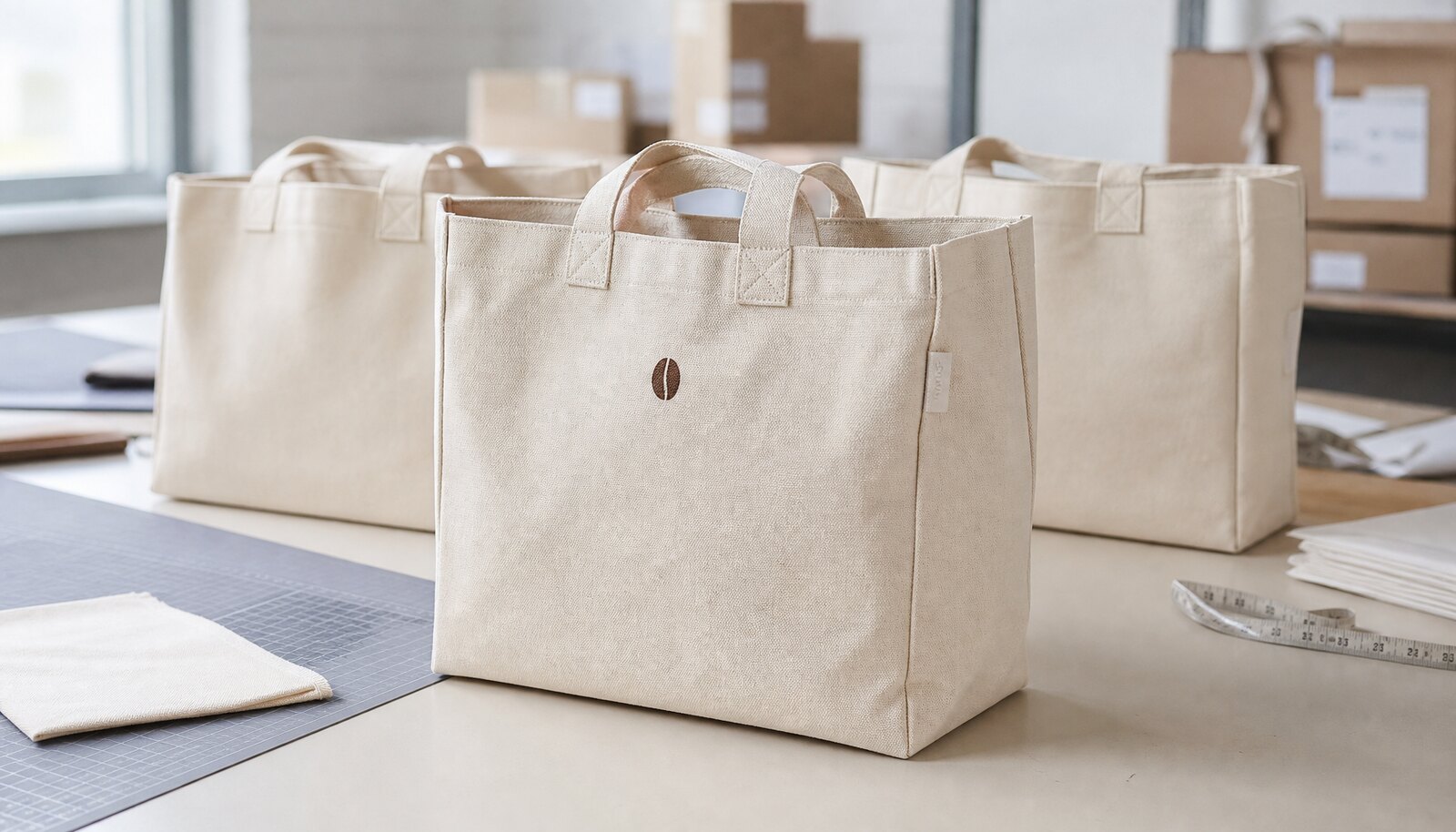
Why coffee brands need a stricter tote standard
Canvas exhibition tote bags for coffee brands are judged fast and at close range. Buyers pick them up at trade shows, load them with samples and brochures, and often keep using them after the event. That means the bag is not just a giveaway. It is a small branded product that has to look clean, carry weight, and support the perception of the coffee line behind it. A weak handle, crooked print, or dirty fold line is visible immediately when the bag is in use.
The coffee-brand context makes this more demanding than a generic promo tote. Natural canvas shows flaws clearly, and the earthy look many coffee brands want can also make stains, thread ends, and ink variation more noticeable. If the bag is being used near packaged food, in a retail environment, or inside a gift set, then odor control, dust control, and clean packing become part of the buying standard. The right QC plan treats appearance and function as the same problem, not separate ones.
- Buy the tote as a branded product, not only as a packaging accessory.
- Set the quality target before production so the factory knows what is unacceptable.
- Assume the bag may be photographed, reused, and compared with premium merchandise.
Turn the tote into a real product spec
The fastest way to get inconsistent quotes is to describe the bag too loosely. "Canvas tote" is not a spec. A procurement-ready spec should state the exact size, fabric weight, handle length, handle width, gusset depth, print position, and packaging format. If you do not lock these details, suppliers will quote different interpretations of the same idea, and the cheapest number may simply reflect a lighter or less complete version of the bag.
Use the use case to choose the structure. A flat tote is usually enough for brochures, small sample packets, and light event kits. A bottom gusset gives the bag more standing shape and more usable capacity without making the sewing too complex. A full gusset supports retail packaging or heavier coffee samples, but it raises the importance of clean seam control and consistent folding. The buyer should define the functional target first, then let the supplier propose the most efficient build around that target.
- Write the spec in measurable terms: size, GSM, handle dimensions, gusset, and print area.
- If the tote will carry product, define the expected load and not just the visual brief.
- Ask the supplier to quote the exact construction, not a generic product name.
Choose fabric and construction for carry strength and presentation
Fabric weight is one of the clearest cost drivers, but it also changes how premium the bag feels. For many coffee programs, 12 oz to 14 oz canvas, roughly 340 to 400 GSM, is a practical range for event handouts and light retail use. If the tote will carry heavier coffee packs, boxed items, or repeated daily use, 14 oz to 16 oz canvas, roughly 400 to 450 GSM, gives a stronger hand feel and better seam stability. Going too light saves a little at purchase but often costs more in brand perception and returns if the bag sags or wears early.
Construction details matter as much as fabric. Handles should be wide enough to distribute load and stitched with enough reinforcement at the attachment points. Self-fabric handles can look cleaner than thin tape, but only if the attachment is strong and even. If the bag needs to stand up on a counter or in a retail kit, a bottom gusset improves presentation. If the tote will be stacked and shipped in volume, ask the supplier how much the panels distort after printing and how they control shrinkage or panel skew before sewing.
- Use heavier canvas when the bag is expected to carry coffee product, not just literature.
- Prefer reinforced handle attachment with a visible, consistent stitch pattern.
- Ask whether the factory pre-shrinks, calenders, or otherwise prepares the canvas before cutting.
Select the print method around logo shape, not habit
Coffee brands often choose a logo treatment before they choose the right production method. That is backwards. The better sequence is to define the logo size, number of colors, opacity requirement, and acceptable hand feel, then pick the method that fits. Screen print is usually the most reliable choice for simple logos on natural canvas because it gives stronger opacity and a cleaner visual read from a distance. It is also easier to control if the brand wants a solid, earthy impression rather than a glossy promotional look.
Heat transfer can work for small runs, multicolor art, or tight launch schedules, but it needs close inspection because some transfers look fine in photos and less convincing in hand. Embroidery or a woven label can add perceived value, but these are not automatically better; they change cost, lead time, and visual style. The key question is whether the artwork should disappear into the bag as a subtle mark or stand out as a central brand statement. That decision should be visible in the RFQ, not left to interpretation.
- Simple logo and strong brand color: screen print is usually the first option to test.
- Complex artwork or very small runs: transfer may be acceptable if durability expectations are realistic.
- Premium retail positioning: consider embroidery or woven labels only if the added texture supports the brand story.
Compare suppliers by production route, not only by price
Two quotes can look similar while hiding very different production routes. One supplier may cut, sew, and print in the same factory. Another may outsource printing or carton work. That difference matters because it changes how fast defects can be corrected, how well color is controlled, and how much leverage you have during sample approval. A direct factory usually gives better accountability when the logo shifts, the handle stitch changes, or the folding method needs adjustment.
When you compare offers, ask where each step happens. Is the canvas stock-held or mill-ordered? Is the print applied before or after sewing? Are cartons standard stock or made to size? Does the supplier use one line for all artwork versions or split production across multiple setups? The cheapest unit price can be a bad deal if it creates rework, delays, or a weak inspection result. For procurement, the relevant number is landed cost at the approved spec, not the first number on the quote sheet.
- Direct factory: stronger control and usually better repeatability.
- Trading route: useful for communication, but confirm the real factory and process ownership.
- Workshop route: flexible for prototypes, but inspect capacity and consistency more carefully.
Use a comparison table that exposes hidden tradeoffs
A useful procurement table should show more than a recommendation. It should show what happens if the decision is too light, too slow, or too vague. For coffee-branded canvas totes, a small deviation in fabric weight or print method can change both the user experience and the complaint rate. The table below is meant to expose those tradeoffs in a way that helps buyers write a cleaner RFQ and a more defensible approval memo.
The practical question is not which option sounds best in isolation. It is which option gives the brand the best balance of appearance, durability, repeatability, and freight efficiency for the actual channel. A trade show handout, a wholesale sample kit, and a retail resale tote do not need identical specs, even if they share the same basic silhouette.
- Use the comparison to choose a spec tier before you ask for prices.
- Tie every row to a visible consequence: sag, blur, lift, crease, delay, or freight waste.
- Keep one approved spec version so the quote, sample, and inspection notes all match.
Build sample approval around real production risk
Photo approval is not enough for this product category. A pre-production sample should use the final fabric, final artwork, final handle dimensions, and final packing method. If the sample is made from nicer or cleaner material than the bulk lot, the actual order may feel weaker or show the print differently. Natural canvas varies by lot, so the sample has to be as close as possible to the real production route, not a best-case version of it.
During review, the buyer should test the bag in the way the end user will use it. Load it with a representative weight. Check whether the bottom sits flat. Look at the print under both natural and indoor light. Fold it the same way it will be packed for shipment. If the bag will be sold retail, confirm that the fold does not press a hard line through the artwork and that the packaging still looks clean when the polybag is opened by a buyer or distributor.
- Approve one physical sample made with the final materials, not only a photo file.
- Check both visual quality and handling behavior before bulk release.
- Keep a sealed reference sample with date, supplier name, and approved carton spec.
Packing, presentation, and compliance-adjacent checks
Packing is part of the product, especially for coffee brands. If the totes are going to an event, bulk packing in export cartons is usually the best value because it reduces freight and handling cost. If the bags are intended for retail shelves or gift kits, a simple polybag or insert card may be worth the extra labor. The buyer should only pay for presentation features that support the channel. A retail-style pack is a waste if the bags go directly into a warehouse kitting operation.
There are also coffee-brand-adjacent presentation concerns that often get missed. Odor is a real issue because the bag may sit beside packaged coffee or inside a gift set. Dust, rust stains, loose lint, and ink rub-off are also more visible on natural canvas than many buyers expect. If your market needs fiber-content labels, care labels, barcode labels, or country-of-origin marks, add them to the artwork and packing spec up front. Those items are easy to overlook and expensive to fix after bulk production starts.
- Use bulk cartons for event inventory unless retail presentation is part of the brief.
- Avoid fold lines across the logo panel if the graphic is a major brand asset.
- Add label and marking requirements to the spec if the bags will be resold or warehoused.
Treat MOQ and lead time as production math, not sales language
MOQ is not just a number; it is a reflection of how the factory plans fabric, printing, sewing, and carton work. A lower price often assumes a simple setup: one artwork version, one print layout, one fabric lot, one packing method. As soon as the order splits into multiple sizes, handle colors, or artwork versions, the effective MOQ goes up because setup time and waste increase. That is why buyers should ask for a quote per exact variant instead of assuming one rate covers a whole family of bags.
Lead time depends on where the order starts. If the fabric is already in stock and the printing is simple, sample development plus bulk production can move on a standard schedule. If the factory must source custom canvas, match a specific ink tone, or make nonstandard cartons, the plan stretches. For many custom canvas exhibition totes, a realistic planning window is 7 to 15 days for samples and 25 to 40 days for bulk after approval, but peak season, mill-ordered fabric, or a multi-version launch can push that out. The buyer should confirm when the factory expects approval and when inspection photos will be shared, because late approvals are where most schedules slip.
- Single design and stable artwork usually give the most efficient MOQ.
- Multiple variants add setup cost and often slow the line.
- Peak season increases the risk of rushed inspection and last-minute substitution.
Close the RFQ with a control sheet the factory can actually follow
The best RFQ is short enough to use and specific enough to prevent interpretation drift. It should include the approved bag spec, artwork file, fabric weight, print method, handle construction, folding method, carton format, and the defect rules that determine pass or fail. If the buyer only says "good quality," the factory will use its own internal standard, which may not match what a coffee brand needs on a trade show floor or in a retail gift set.
A good control sheet also keeps the supplier accountable at every stage. It should show who signs off on the sample, which inspection stage catches what defect, and what happens if the bulk lot drifts from the approved sample. If the factory can provide its own defect classification, that is useful, but the buyer still needs a final call on what matters most for brand presentation. For coffee-branded totes, that usually means print accuracy, handle strength, cleanliness, and packing consistency before anything else.
- Use one version-controlled spec sheet for RFQ, sample, and inspection.
- Make the approval chain visible: artwork, sample, bulk, packing, and shipment.
- Reject vague language; replace it with dimensions, tolerances, and defect categories.
Specification comparison for buyers
| Spec decision | Recommended option | When it fits | Buyer risk to check |
|---|---|---|---|
| Fabric weight | 12 oz to 16 oz canvas, usually about 340 to 450 GSM | Best for expo giveaways, sample kits, and retail carry bags that need a substantial hand feel | Too light creates sagging, seam stress, and a cheap first impression; ask the supplier to confirm the final GSM and the lot tolerance they can hold |
| Bag structure | Flat tote for simple handouts; bottom gusset or full gusset for heavier coffee packs | Choose based on whether the bag carries brochures, sachets, retail boxes, or multiple sample pouches | A flat bag can look neat but loses usable volume; a gusseted bag needs better seam control and cleaner folding |
| Handle construction | Self-fabric handles with reinforced stitching, ideally bar-tack or X-box reinforcement | Best for repeated use, shoulder carry, or samples that may be loaded with coffee product | Thin handle tape, short stitch runs, or uneven handle placement can fail early and make the bag feel underbuilt |
| Print method | Screen print for simple logos; heat transfer only for short runs or complex art; embroidery or woven label for premium accents | Use based on color count, artwork detail, and the brand mood you want on the front panel | Low-opacity print on natural canvas can look patchy; heat transfer can lift or feel plastic if the method is not matched to the fabric |
| Supplier route | Direct factory with in-house cutting, sewing, and printing | Best for repeat orders, tighter QC, and faster problem correction | If printing is outsourced, color control and placement issues are harder to fix and lead times become less predictable |
| Sample approval | Pre-production sample using final fabric, final artwork, final handle length, and final packing method | Use before deposit release or bulk authorization | Photo approval misses hand feel, print density, and crease behavior; one sealed approval sample is better than a gallery of images |
| Packing format | Bulk packed in export cartons for event use; polybag only when cleanliness or retail handling requires it | Fits booth handouts, warehouse efficiency, and lower freight cost | Overpacking increases carton count and freight; underpacking increases dust, wrinkling, and shelf-ready defects |
| Lead time | Sample development usually 7 to 15 days; bulk often 25 to 40 days after approval | Standard for custom printed canvas tote programs when fabric is available and artwork is stable | Peak season, custom mill fabric, and multiple artwork versions can stretch schedules and compress inspection time |
| Quote structure | Separate unit price, setup charge, sample fee, carton spec, packing method, and shipping basis | Use for clean supplier comparison and landed-cost review | All-in quotes can hide changes in fabric grade, finishing, carton strength, or print setup that later become add-ons |
Buyer checklist before sampling
- Lock the final bag dimensions, fabric weight in GSM, handle width and length, and whether the bag needs a bottom gusset or side gusset.
- Specify the logo size, print position, print colors, and the acceptable color range on natural canvas so the factory is not guessing.
- Request a pre-production sample made with final fabric, final print method, and final packing format before bulk approval.
- Confirm reinforcement at handle points, seam allowance, and the load expectation if the tote will carry coffee packs or retail items.
- Define the folding method, carton count, carton dimensions, and gross weight if the bags will ship in bulk cartons.
- State whether inner polybags are required, whether barcode labels are needed, and whether the bags must arrive retail-clean or warehouse-only.
- Collect a quote that separates bag price, print setup, sample cost, carton cost, and shipping basis so each supplier is compared on the same terms.
- Write down your rejection rules for stains, loose threads, print misregistration, odor, needle damage, and mixed packaging.
Factory quote questions to send
- What canvas GSM do you recommend for this size and use case, and what tolerance can you hold across the production lot?
- Is the logo printed in-house, and what print method will you use for the exact color count, placement, and artwork size?
- Will the canvas be pre-shrunk or otherwise prepared before cutting, and how do you control shrinkage or panel distortion after printing?
- How many stitches are used at the handle attachment, and can you describe the reinforcement structure at the stress points?
- What is the MOQ per design, colorway, or size, and what price changes if we split the order into variants?
- What exactly is included in the sample charge, and is the sample fee refundable or deductible after bulk confirmation?
- Can you quote the carton spec, packing quantity, gross weight, and export marking format in the same quotation?
- What are your standard bulk lead time and your peak-season lead time, and at what stage do you share inspection photos?
- Which defects do you classify as critical, major, and minor, and can you share your internal final inspection sheet?
- If we need retail presentation, can you also quote polybagging, label insertion, and any barcode or country-of-origin marking?
Quality-control points to confirm
- Fabric weight matches the agreed spec and does not show thin spots, weak weave lines, or obvious lot inconsistency.
- Cut panels are square, dimensions stay within the buyer's tolerance, and the gusset sits evenly without twisting or puckering.
- Logo placement matches the approved artwork map, with no blur, pinholes, ghosting, color bleed, or obvious edge lifting.
- Handle length, handle spacing, and handle symmetry are consistent across the lot, with no skipped stitches, loose thread tails, or weak starts and stops.
- Reinforcement stitching at the handle and stress points is secure, with no open seams, broken threads, or uneven bar-tacks.
- Seams hold under a manual pull check, especially at the bottom seam, side seam, and handle attachment points.
- Surface condition is acceptable: no oil marks, dust, needle holes beyond tolerance, rust stains, or odor that would make the bag unsuitable for retail display.
- Packing is consistent: correct count per carton, correct folding method, correct carton markings, and no heavy crease line through the logo area.
- If the bag is retail-facing, labels, barcodes, and country-of-origin marks are correct and legible on the agreed placement.
- Final carton condition is intact, clean, and sized for warehouse handling without crushing the bags or distorting the print.