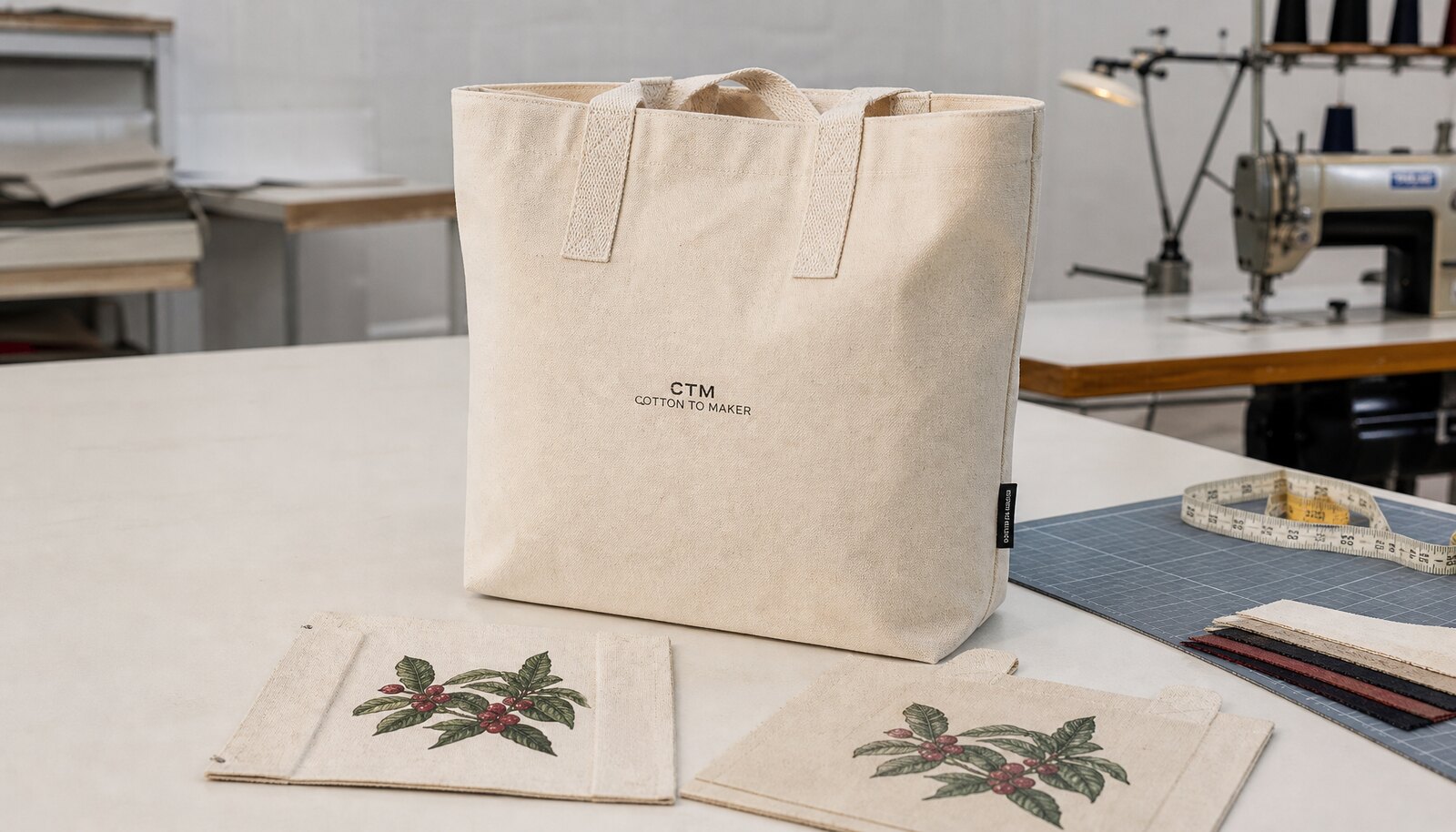
Start With the Use Case, Not the Print Method
For coffee brands, a canvas exhibition tote bag is rarely just a freebie. It usually has a job: carry samples at a trade show, support a seasonal retail launch, or work as a reusable purchase-with-purchase item. That job should decide the print method. If the bag will be handed out in volume and only needs a clear logo, screen print often wins. If the artwork has fine type, gradients, or a campaign illustration, the decoration method becomes part of the buying spec rather than a late-stage choice.
The most common sourcing mistake is asking suppliers to quote "the bag" before defining the brand problem. A 10 oz bag with a one-color logo and a six-color illustration are not the same product in factory terms. Write the brief around usage, artwork complexity, target feel, and the acceptable tradeoff between unit cost and finish. That keeps suppliers from steering you into their easiest process instead of the right one.
- Define whether the bag is for giveaway, resale, sampling, or bundled coffee purchases.
- State the maximum acceptable color shift and whether a Pantone match is required.
- Specify if the bag must look premium in hand or only read clearly from a distance.
- Treat the print method as a cost and quality decision, not a design preference.
Choose the Canvas Before the Artwork
Canvas weight changes how a print looks and how the bag holds up in use. For most exhibition tote bags, 10 oz to 12 oz cotton canvas is the practical range. Roughly, 10 oz is a lighter giveaway build, 12 oz is the standard buyer-friendly choice, and 14 oz or heavier gives a firmer, more retail-ready body. Natural unbleached canvas is cheaper and more common, but the fiber tone affects the perceived color of the print. A white or bright brand color will look softer on natural cloth than on bleached fabric.
The bag construction matters just as much as the print. A coffee brand tote that carries brochures and product samples usually benefits from a reinforced bottom, a clean top hem, and handles around 25 mm to 38 mm wide depending on load. If the bag is meant to look premium, ask for straight seams, balanced gusset depth, and a handle length that sits comfortably on the shoulder. The print method should fit the fabric, not fight it.
- 10 oz canvas works for low-cost handout programs and lighter contents.
- 12 oz canvas is a strong default for exhibition and retail crossover use.
- 14 oz or heavier suits premium merch, bundles, and repeated reuse.
- Use natural canvas when you want a softer, earthy coffee-brand look; use bleached canvas when color accuracy matters more.
What Each Print Method Does to Cost and Quality
Screen print is still the default for simple brand marks on canvas because it scales well and keeps unit cost under control once the order size is large enough. It handles one-color and two-color logos cleanly, and it can hold up well on textured fabric if the ink load is tuned correctly. Water-based screen print usually gives a softer hand feel, which fits eco-positioning and coffee branding. The tradeoff is setup: every color needs work, and complex art becomes expensive or visually compromised.
Heat transfer and digital transfer are better when artwork changes often, when the order is small, or when fine detail matters more than a soft textile feel. They can reproduce gradients and small text more faithfully than basic screen print, but the buyer should inspect the edge durability and fold behavior. Embroidery and woven patches are not print methods in the strict sense, but they are often the right choice for premium coffee merch because they add texture and reduce the risk of ink mismatch. The right answer is usually not one method for every bag; it is one method for the campaign purpose.
- Screen print: best for stable logos, repeat orders, and controlled cost.
- Water-based screen print: best when the brand wants a softer feel on natural canvas.
- Heat transfer or DTF: best for small runs, detailed art, or frequent design changes.
- Embroidery or patch: best when the bag needs a premium retail impression.
Match Supplier Route to Order Size
The supplier route often matters more than the print method itself. A cut-and-sew factory with in-house print control can usually keep color and seam quality more consistent, because one team owns fabric cutting, sewing, decoration, and packing. A trading company can be useful when you need multiple print options and do not want to manage each process step, but the quote should clearly show who is actually doing the sewing and printing. Local decoration on imported blanks can work well for urgent campaigns, especially when the bag body is generic and only the branding changes.
MOQ logic follows the setup burden. Screen print becomes economical faster when the same artwork is repeated across a bigger lot, while transfer and digital routes tolerate smaller quantities because the setup is lighter. For many buyers, the practical threshold is not a single number but a pattern: below a few hundred pieces per design, decoration-heavy methods can be more flexible; above that, in-house screen print starts to win on cost. The supplier should explain the breakpoints clearly instead of hiding them inside one blended unit price.
- Use an in-house factory when you need tighter control of shade, placement, and packing.
- Use a trading route when the project needs coordination across several product variations.
- Use local decoration when the deadline is tight and blank bag availability is secure.
- Ask each supplier to state where the bag body is made and where the decoration is done.
Read the Quote Like a Buyer
A useful quote should break out the real cost drivers, not just give one all-in figure. For canvas exhibition tote bags, that usually means fabric weight, body size, handle type, print method, number of colors, sampling charge, packaging, and carton specification. If the supplier only gives a unit price, you cannot tell whether the low number came from lighter fabric, smaller print area, thinner handles, or a cheaper packing method. That is how buyers end up comparing unlike items and choosing the wrong offer.
The cleanest comparison is to send every supplier the same tech pack and the same artwork file. Then ask them to quote the same size, same canvas GSM, same print area, same finish, and same packing count. If one supplier is quoting a 10 oz bag and another is quoting 12 oz, the price gap is not a print-method issue. It is a spec mismatch. That difference should be visible before commercial discussion starts.
- Look for separate line items for setup, sampling, printing, sewing, packing, and carton charge.
- Confirm whether the quote includes one print location or multiple print sides.
- Check if the quote assumes bulk-packed bags or individual polybags.
- Ask whether the price changes if the order is split across several coffee skus or colorways.
Sample Approval Should Test More Than Artwork
A sample is not just a visual proof. It is the only cheap chance to see how the print behaves on the exact canvas, under the exact size, with the exact seam layout. Hold the sample under daylight and under warehouse lighting, because natural canvas can make the same ink look warmer or duller depending on the environment. Then fold the bag the way an event team or shopper will actually use it. If the print sits too close to the fold line, the decoration may crack or distort long before the bag wears out.
For coffee brands, the sample should also reflect the real handling story. If the bag will carry bags of beans or brochure stacks, load it. If the bag has a retail presentation fold, pack it the same way the factory plans to ship it. The approval should cover placement, color, stitch quality, handle balance, and the printed surface after a few folds. If you only sign off on the front view, you are approving a photo, not a product.
- Approve the sample on the actual canvas lot, not on a generic demo bag.
- Inspect print edges, small text, and solid fills under both natural and indoor light.
- Fold the sample several times and watch for cracking, scuffing, or print lift.
- Load the bag with realistic weight before final approval.
Quality Control Points That Catch Real Defects
The defects that hurt buyers most are usually small and repetitive, not dramatic failures. On canvas tote bags, that means shifted logos, uneven handle stitching, loose thread tails, weak seam corners, and print that looks fine flat but breaks when folded. A practical QC plan sets tolerances before bulk starts. For key logos, a 3 mm to 5 mm placement window is common enough to be useful. For handle seams, consistency matters more than beauty. A neat, repeated stitch pattern is what keeps the bag serviceable after repeated carry cycles.
Print durability matters too. A coffee brand bag often gets folded, stored, and carried repeatedly, so the surface should survive basic abrasion without immediate cracking or smearing. If the design uses fine type, insist on a print that keeps counters and thin strokes readable. If the bag has multiple colors, registration should be tight enough that the artwork does not look fuzzy from normal viewing distance. The buyer does not need lab language here; the buyer needs a pass or fail rule that the factory can actually execute.
- Set a placement tolerance for the main logo before bulk printing starts.
- Reject samples with obvious shade drift between the approved strike-off and the bulk lot.
- Watch the seam corners and handle joins for stress marks or skipped stitches.
- Use a fold-and-rub test for any bag that will be packed flat and reused often.
Packing and Carton Planning for Exhibition Orders
Packing affects both landed cost and how the bag arrives at the event. A tote that is packed too tightly can crease the print, flatten the gusset, or leave a strong fold mark across the logo. For exhibition use, a simple polybag plus master carton is often enough, but retail-facing orders may need a cleaner fold, a belly band, a hang tag, or a labeled inner pack. The right choice depends on whether the bag must look shelf-ready or only arrive efficiently.
Carton planning should not be an afterthought. Keep carton weights practical for warehouse handling, and make sure the carton size fits your freight strategy. If the bags are destined for multiple markets, clear carton marks and SKU labels reduce receiving errors. When a coffee brand order contains several artwork variations, the packing list needs to separate them cleanly or the savings from a lower unit cost disappear in the inbound warehouse.
- Choose a packing format that protects the print from fold marks and compression.
- Use SKU labels on cartons when there are multiple logo or language versions.
- Ask for a carton count that stays manageable for warehouse handling.
- If the bags are retail-ready, define the folding method before production begins.
Lead Time and Landed Cost Risks
Most schedule slips happen because buyers change something after the sample stage. A new logo size, a different Pantone target, or a revised fold can force a new screen or a new print setup. That is why lead time should be discussed by phase, not as one vague promise. A realistic project usually needs time for artwork confirmation, sample production, sample approval, bulk sewing, decoration, packing, and shipping. The exact number depends on the print method, but a buyer who expects the same timeline from transfer and screen print is setting up for trouble.
Landed cost is where sourcing decisions become visible. A local decoration route may look more expensive per unit, but it can reduce freight, lower minimum quantity exposure, and speed launch timing. A factory-direct screen print order may win on unit price when the quantity is stable and the packing is simple. The clean comparison is to build the quote with the same spec, the same packing, and the same delivery point. Otherwise, the cheapest quote may simply be the least complete one.
- Plan for sample approval before booking the bulk production slot.
- Treat art changes after sample approval as a schedule and cost risk.
- Compare landed cost, not only ex-factory unit price.
- Use the same delivery term and final destination when comparing suppliers.
The Practical Buying Path for Coffee Brands
For most coffee brands, the safest buying path is simple: start with the use case, lock the canvas spec, then choose the print route that matches the artwork and quantity. If the logo is simple and the order is steady, screen print on 12 oz canvas is usually the most efficient base case. If the art is more detailed or the order is small and time-sensitive, transfer-based decoration can protect the design better. If the bag is part of a premium retail story, a heavier canvas body with embroidery or a woven patch can justify the higher process cost.
What matters is making the supplier prove the route rather than assume it. A good factory will explain why one method is better for your artwork, show a sample on the right fabric, and quote the cost breakpoints transparently. That is the standard worth buying against. If the supplier cannot connect the print method, MOQ logic, sample approval, packing, and lead time into one coherent plan, the offer is incomplete no matter how attractive the unit price looks.
- Use screen print for stable logos and repeat orders.
- Use transfer routes for detailed artwork, short runs, or frequent design changes.
- Use premium decoration when the bag must support retail pricing and brand perception.
- Choose the supplier that can explain the full production flow, not only the print step.
Specification comparison for buyers
| Spec decision | Recommended option | When it fits | Buyer risk to check |
|---|---|---|---|
| Short-run launch for a coffee pop-up or trade show | Heat transfer or DTF on finished canvas bags from a supplier that can decorate small lots | Artwork may change by city, market, or seasonal campaign and you need a low setup route | Edges can lift after repeated folding; request a fold test and check the hand feel on textured canvas |
| Two-color logo on natural canvas with repeat reorders | In-house screen print at the bag factory | The artwork is stable and the brand wants consistent color at moderate volume | Ink opacity can drop on rough weave; approve a strike-off on the actual fabric lot |
| Pantone-critical retail bag for a coffee brand launch | Screen print with controlled ink mixing and signed sample approval | Brand color must stay close across the same production run and future repeats | Natural canvas shifts perceived color; compare under daylight and warehouse light before bulk |
| Full-bleed illustration or complex artwork | Digital transfer or a hybrid route with pre-printed panels | The design has gradients, fine text, or photographic detail that screen print would simplify too much | Transfer can crack on sharp folds and may feel heavier than direct print |
| Premium merch or gift-with-purchase bag | Embroidery or woven patch combined with a simple print | The bag needs higher perceived value and a more tactile retail feel | Logo size can distort on soft canvas; confirm stitch density and final outline size |
| Many SKUs under one campaign | Factory with shared blank body and late-stage decoration | You need colorway, language, or channel variations without redesigning the whole bag | SKU mixing causes carton errors; require barcode labels and packing list by SKU |
| Very price-sensitive giveaway order | Standard 10 oz to 12 oz canvas with a single-color screen print | The bag is for handout traffic and the artwork is simple | Cheap fabric can show strike-through or weak handles; test seam strength and print coverage |
| Fixed delivery date with little schedule slack | Supplier route with in-house print and cut-and-sew control, or local decoration on imported blanks | Launch timing matters more than lowest unit cost | Subcontracted printing adds handoff risk; ask who owns color approval and final packing |
Buyer checklist before sampling
- Lock the canvas weight, bag size, handle length, and seam construction before comparing print methods.
- Send vector artwork and state whether the logo must match a Pantone reference or only a visual target.
- Specify the print area in millimeters, not just a rough front-panel description.
- Decide whether the bag is for trade show handout, retail resale, or bundled coffee purchase.
- State the target order quantity by SKU, because MOQ logic changes fast when you split colors or sizes.
- Confirm whether you need individual polybags, carton labels, palletizing, or retail hang tags.
- Ask for a pre-production sample on the same fabric lot, not a generic sample from another project.
- Set acceptance criteria for print placement, stitch quality, and packing count before bulk production starts.
Factory quote questions to send
- What canvas weight, weave, and finishing do you recommend for this artwork and use case?
- Which print method is being quoted, and what setup charges apply per color, screen, plate, or transfer size?
- What is the minimum order quantity per design, per colorway, and per print method?
- Will the quote include a pre-production sample, and will that sample use the same fabric lot as bulk?
- What are the packing details per carton, carton dimensions, and gross weight target?
- What lead time should we expect for sample approval, bulk production, and dispatch?
- Who owns color matching and final approval if the print is subcontracted?
- What extra cost applies for woven labels, hang tags, barcode stickers, or retail folding?
Quality-control points to confirm
- Print placement should stay within a clear tolerance window, typically 3 to 5 mm from the approved position for key logos.
- Logo edges should stay sharp enough that fine text, small coffee icons, and registration marks remain readable at arm's length.
- Ink coverage on natural canvas should not show obvious strike-through, patchiness, or excessive shine unless that finish is intentional.
- Handle stitching should be even, with no skipped stitches, loose threads, or distortion where the handle joins the bag body.
- Seams should sit flat after folding, with no puckering that pushes the print out of alignment.
- A sample should pass a basic rub or fold check without immediate cracking, peeling, or smearing.
- Cartons should arrive with correct SKU labels, counts, and packing lists so mixed campaigns do not get separated at receipt.
- If the order is retail-facing, the folded presentation should be repeatable from carton to carton rather than dependent on manual packing skill.