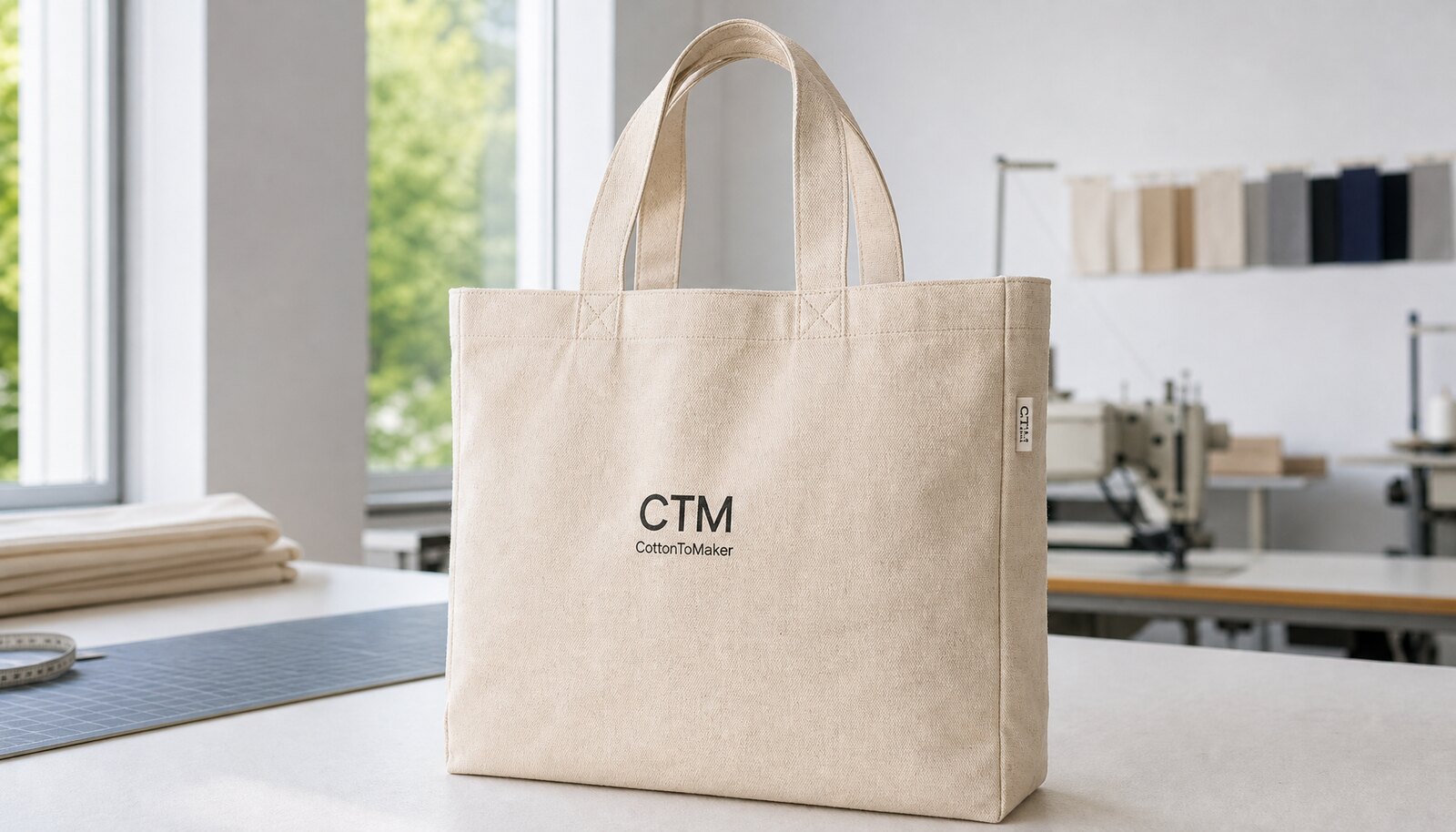
Why Coffee Brands Need a Different Tote Buying Lens
Coffee brands do not buy canvas exhibition totes the same way a generic promo team does. The bag is often handed out at a trade show, used to carry brochures, bean samples, flyers, tasting cups, or small retail purchases, and then kept as a brand reminder after the event. That means the bag has to do two jobs at once: look credible at first contact and survive actual use. For procurement, that changes what matters in the quote. A low unit price is not useful if the bag slumps, the print cracks, or the shipment misses the expo date.
The buying problem is usually not the tote itself. It is the mismatch between how the brand will use the bag and how the supplier priced it. A coffee brand may want a clean natural canvas finish, a logo with fine type, a shoulder drop long enough for all-day carrying, and enough structure to hold 1 kg of product plus paper collateral. If those details are not locked before RFQ, suppliers will quote different assumptions and the comparison becomes meaningless.
- Treat the tote as event packaging plus retail branding, not as a simple giveaway item.
- Define the bag load, carry style, and print standard before comparing factory prices.
- Keep the first order simple enough to learn from, then expand colors or versions later.
Spec the Bag Before You Ask for Quotes
The fastest way to clean up MOQ and lead time is to freeze the base spec early. For most coffee-brand exhibition use, a 10 oz to 12 oz canvas is the practical range. Around 10 oz, the bag is lighter and cheaper, but it can feel soft and may need better seam control. Around 12 oz, the bag stands better, carries heavier inserts more safely, and gives a more premium impression at the booth. If the brand wants a more retail-ready handfeel, 12 oz usually makes the bag easier to sell through after the event.
Dimensions matter just as much as fabric weight. A common event tote size needs enough body width for catalogs and sample packs without becoming oversized in the carton. Handle length should reflect real use, not just visual balance in a mockup. If the tote will be carried over outerwear or a shoulder during a long exhibition day, short handles are a real usability failure. Ask the factory to quote size, fabric, handle length, stitch type, and any gusset in one line so there is no room for interpretation.
- Use one signed spec sheet with dimensions, fabric weight, handle drop, gusset depth, and print placement.
- If the bag must carry bottles or heavier samples, move from lightweight promo canvas to a structured 12 oz build.
- Do not let the supplier replace a gusseted version with a flat version unless the function is truly unchanged.
What Actually Sets MOQ
MOQ is usually driven by setup friction, not by sewing capacity alone. Each additional color, print side, size, fabric shade, label position, or packing variant creates more handling and more material risk. That is why a supplier can quote a low MOQ for one plain natural tote, then raise the minimum sharply when the same bag needs a two-color logo, a side woven label, and retail polybagging. For a coffee brand, the cleanest way to reduce MOQ is to reduce variables before production starts.
The supplier route also changes the minimum. A direct factory is usually better if the program is repeatable and the specs are locked. A trading company may help when the brand wants mixed products or softer communication, but the minimum may be hidden inside higher margins or broader packing assumptions. A local printer can be useful for a very small test run, but the unit economics often stop working once the order grows. The real buyer skill is not hunting the lowest stated MOQ; it is understanding which MOQ is attached to which production choice.
- One color, one size, one logo version is the most efficient starting point for a coffee event program.
- Ask the supplier to state MOQ by style, color, print method, and packing method separately.
- If the supplier says the MOQ is flexible, require the exact condition that makes it flexible.
Compare Supplier Routes Before You Compare Unit Prices
Canvas exhibition tote bags are easy to quote badly because the same item can move through different sourcing routes. A direct factory quote often gives the best visibility into fabric, stitching, and production timing. A trading company quote can be useful when the buyer needs a broader order file or faster response across mixed product lines. A local decorator may be the fastest for urgent branding, but fabric choice, print consistency, and carton efficiency are often weaker. For coffee brands that run seasonal exhibitions or repeated regional events, the wrong sourcing route can create false savings at the PO stage and real cost at the release stage.
The table below is the right way to compare routes. It does not ask which supplier is cheapest in isolation. It asks which route best matches the order size, artwork complexity, and launch deadline. A buyer who compares only unit price misses the setup fee structure, sample path, and production control point, which are the real drivers of lead time and total landed cost.
- Direct factory suits repeat orders with stable artwork and clear QC targets.
- Trading company suits mixed baskets or buyers who need one coordination point.
- Local decorators suit urgent small runs, but the buyer should still verify the actual production source.
Print and Branding Choices That Survive an Expo
Coffee brand artwork often looks simple on screen but difficult on canvas. Fine type, thin lines, gradients, and small registration marks are common failure points. Screen print is usually the most practical method when the design is one or two solid colors and the volume is high enough to spread setup cost. For tighter detail or premium positioning, a woven label or a small embroidery detail may be better than forcing the main logo into a print method that cannot hold the edges. The right answer is not the fanciest decoration. It is the decoration that still looks correct after transport, packing, handling, and event use.
Artwork approval should be technical, not aesthetic only. The buyer should specify Pantone references where relevant, define the print size in centimeters, and state whether the logo sits centered, offset, or near a seam. Any logo that crosses a seam, gusset, or stitch line adds risk and should be treated as a separate approval point. If the brand wants a premium look, a woven side label can do more than a large weak print, especially on natural canvas where the fabric texture already carries the visual identity.
- Use screen print for bold logos, low color count, and repeatable runs.
- Use woven labels or embroidery only when the brand can accept the added setup and lead time.
- Keep fine text away from print methods that cannot hold small detail on textured canvas.
Sample Approval: What to Test Before Bulk
A sample is useful only if it answers the same questions that will appear in bulk production. For a coffee brand tote, that means checking fabric handfeel, print alignment, handle reinforcement, seam finish, and the actual carry feel with a realistic load. A sample that looks good empty can still fail once inserts are added. If the supplier sends a very polished sales sample that is not made from the same fabric lot or the same finishing line, treat it as a presentation sample, not a production reference.
The approval path should be simple and documented. A proto sample tells you whether the design is workable. A pre-production sample tells you whether the final materials and decoration are correct. If the order is important or the artwork is sensitive, a sealed reference sample is worth the extra step because it reduces later arguments. The goal is not to overcomplicate the process. It is to prevent a bulk run from being judged against memory instead of against a signed standard.
- Load the sample with the heaviest expected event contents before approval.
- Measure the sample against the signed spec sheet, not against a verbal description.
- Reject any sample with weak handle stitching, uneven print edges, or visible fabric defects that will scale into bulk.
Packing, Cartons, and Shelf Readiness
Packing is often where a tote quote starts to drift. A bag can be quoted as bulk packed, individually polybagged, or retail-ready with inserts and labels, and each format changes labor, carton dimensions, and shipping volume. For exhibition use, bulk packing is usually enough if the bags are distributed from a warehouse straight to the event. If the same tote will later be sold through retail or bundled with coffee products, individual packing may be required. The buyer should decide that before the RFQ, not after the sample is approved.
Carton planning also affects real cost. Too many bags per carton create compression marks and slow picking. Too few bags per carton waste freight space. Export cartons should be sized to protect the handles and keep the fold line consistent. If the bag has a printed logo or a side label, the fold direction should be fixed so the brand presentation is predictable when cartons are opened. This is a small detail on paper and a major detail in warehouse handling.
- State the inner bundle count, outer carton count, and whether polybags are required.
- Ask for master carton dimensions and gross weight before final PO release.
- If the bags will be displayed at retail, define fold position and label orientation in the packing instruction.
Lead Time Review: Where Schedules Slip
Lead time for canvas exhibition tote bags is rarely a single factory number. It is a chain of decisions: artwork approval, sample approval, fabric availability, print setup, sewing, packing, and shipment booking. A supplier may quote production in three weeks, but that number usually assumes the artwork is approved and the material is already available. If the fabric must be dyed, the print has multiple colors, or the buyer requests a late change, the real timeline stretches quickly. Procurement should separate each step and not accept one blended date as a complete plan.
The safest lead-time review is to build a calendar backward from the event or launch date. Leave room for sample transit, internal approvals, and any correction round. If the tote is tied to a coffee expo, there is usually no tolerance for a missed opening day, so the buyer should protect the schedule with a buffer rather than chase an optimistic promise. When a supplier offers a fast timeline, the question is not whether it is possible in theory. The question is whether it still holds after the order is fully written and the approval chain is complete.
- Ask the supplier to break lead time into sample, pre-production, sewing, packing, and dispatch.
- Treat fabric sourcing and artwork approval as schedule gates, not side notes.
- Build a buffer around event dates; do not schedule a delivery on the same day the bags are needed.
Landed Cost: The Numbers Procurement Should Separate
A useful quote separates factory cost from the rest of the landed cost. For canvas exhibition totes, the buyer should see the bag price, print setup, sample fee, packing charge, carton charge, inland freight to port or warehouse, and any testing or labeling cost. If these items are bundled into one number, it becomes harder to compare suppliers and nearly impossible to diagnose where the quote is expensive. Coffee brands often need a clean unit cost for event planning, but procurement needs a cost stack that explains why one supplier is higher than another.
The same logic applies to quote comparisons across countries and channels. A low ex-works price may still land above a higher factory quote once packing, freight, and handling are included. A quote that appears to save money on unit cost may also carry higher risk if the supplier has weak sample control or vague lead times. The buyer should compare total landed cost against the event deadline and the brand standard. A tote that arrives on time, matches the approved sample, and packs efficiently is usually worth more than a lower quote that creates downstream rework.
- Compare quotes on the same incoterm and the same packing assumption.
- Separate one-time charges from recurring unit charges before approving the order.
- Include sample freight, carton changes, and rush fees in the internal cost review.
Build the RFQ So Quotes Are Comparable
A strong RFQ removes the guesswork that usually creates supplier confusion. For coffee brand exhibition totes, that means the buyer sends one product drawing, one print file, one measurement sheet, one packing note, and one event deadline. The goal is not to over-specify every micro detail. The goal is to make sure each supplier is quoting the same bag, the same decoration, and the same delivery expectation. Once that is true, the response becomes useful for procurement instead of just being a sales reply.
The best RFQs also force the supplier to state assumptions. If the factory needs a minimum order to hold a color, if the print price changes with each additional color, or if the lead time depends on material stock, that should appear in writing. Coffee brands buy exhibition totes for visibility, but procurement buys them for control. Clear RFQs reduce hidden variation, and hidden variation is what usually turns a simple tote order into a schedule problem.
- Attach one final artwork version and forbid quote-based redesign unless explicitly requested.
- Ask every supplier to quote the same size, same fabric weight, same print method, and same packing.
- Require a line for assumptions so the team can compare apples to apples.
Specification comparison for buyers
| Spec decision | Recommended option | When it fits | Buyer risk to check |
|---|---|---|---|
| Fabric weight | 10 oz to 12 oz canvas, with 12 oz used for a more structured retail feel | Coffee brands that want the bag to hold bottles, samples, or catalog inserts without collapsing | Thinner fabric can look fine in a quote but feel soft, show print show-through, or twist after packing |
| Print method | 1 to 2 color screen print for best cost control; woven label or embroidery for premium small branding areas | When the artwork is simple and the order volume is large enough to absorb setup | Fine text, gradients, and low-contrast logos often fail if the supplier tries to force screen print onto the artwork |
| Handle spec | 20 to 24 inch shoulder handles with reinforced cross-stitch or box-X reinforcement | Trade shows, tasting events, and retail handout programs where the bag is carried for several hours | Short handles make the bag awkward over a jacket; weak reinforcement fails after heavy sample loads |
| Bag structure | Flat tote or modest bottom gusset around 10 cm for brochure and sample carry | When the bag must stay light, stack well, and print cleanly on a flat panel | Too much gusset can raise cost, increase fabric consumption, and complicate carton packing |
| Supplier route | Direct factory for repeat volumes, trading company for mixed programs, local printer for very fast small runs | When the buying team needs to balance unit price, communication speed, and artwork control | A quote that hides the actual production site usually creates schedule and QC ambiguity |
| MOQ strategy | One size, one fabric color, one print side, one logo version for the first order | When the goal is to test a coffee brand event program before rolling into retail or regional launches | Multiple colors or print placements multiply setup charges and raise the true minimum far above the stated MOQ |
| Packing method | Bulk pack in export cartons with a counted inner bundle, or individual polybag only when retail presentation requires it | When the bags move through distribution centers, events, or e-commerce prep | Overpacking adds cost and volume; underpacking creates stains, creases, or counting errors |
| Lead time plan | Separate sampling, pre-production approval, and bulk production in the schedule instead of quoting a single date | When the launch date is fixed and the buyer needs to see where delays can be absorbed | If fabric is not in stock, lead time can shift by weeks even when the sewing line is available |
Buyer checklist before sampling
- Final bag size, gusset depth, and handle drop confirmed against the approved artwork sheet
- Fabric weight stated in oz and gsm, with acceptable shrinkage and handfeel noted
- Artwork supplied in vector format with Pantone references and print placement marked in centimeters
- Print method chosen with the number of colors, print sides, and any woven label or embroidery noted
- MOQ defined by style, color, print version, and total order quantity, not just a single headline number
- Sample sequence agreed: proto sample, pre-production sample, and sealed approval sample if needed
- Packing spec confirmed, including inner count, carton quantity, carton mark format, and destination label rules
- Target ship date, approval deadline, and fallback buffer included in the internal buying calendar
- Quote compared on the same incoterm and the same assumptions for accessories, packing, and testing
- Supplier has provided recent photos, size tolerance policy, and a clear production timeline by step
Factory quote questions to send
- What fabric weight are you quoting in oz and gsm, and is that weight before or after finishing?
- Is the MOQ based on one style, one color, one artwork version, or the combined order?
- What are the setup charges for each print color, each side, and each additional label or embroidery position?
- Which sample stages are included, and what is the charge for a pre-production sample versus a sales sample?
- How long is the lead time after artwork approval and after pre-production sample approval?
- What packing method is included by default, and what changes if we require individual polybags or carton labels?
- What size and print placement tolerances do you hold on bulk production?
- What extra charges apply for rush orders, fabric sourcing, carton changes, or destination labeling?
Quality-control points to confirm
- Finished size matches the signed spec within the agreed tolerance, usually tighter on width and handle drop than on overall body height
- Fabric weight and weave feel match the approved sample, with no obvious thin spots or uneven dyeing
- Print position, color density, and edge sharpness stay within the approval sample, with no ghosting or visible misregistration
- Handle reinforcement is secure, with clean box-X or bartack stitching and no loose thread tails at stress points
- Seams are straight and balanced, with no puckering, skipped stitches, or broken thread at the side seams and bottom corners
- Each bag is clean, dry, and free of stains, odor, oil marks, pen marks, or lint before packing
- Carton count is correct, with bundle count, inner packing, and outer marks matching the packing instruction
- Bulk goods visually match the approved sample for color, logo placement, label position, and overall finish