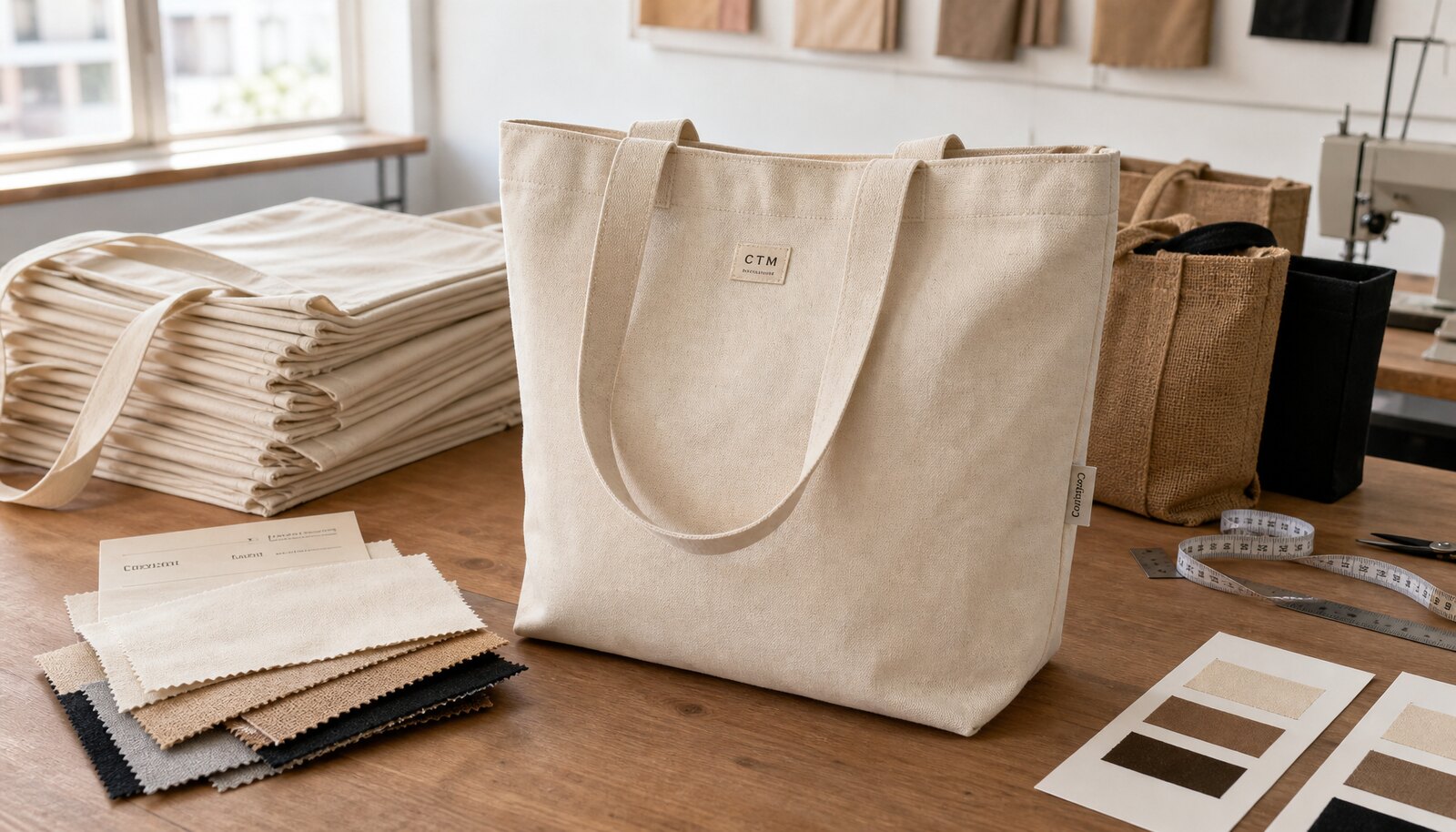
1) Why canvas exhibition tote bags need a material-first sourcing plan
Boutique buyers usually want canvas exhibition tote bags to do more than carry samples or brochures. The bag becomes part of the brand moment: it shows up in the booth, leaves with the customer, and may be used again in retail life. That means the material choice is not a cosmetic detail. It affects structure, print quality, handling comfort, and how the bag presents on a shelf or counter.
A procurement team can usually feel the difference between a bag that was built for brand presentation and one that was simply priced to win a quote. Thin, loosely woven canvas can look acceptable in a flat lay but collapse in the hand. Overly heavy canvas can feel premium but may drive sewing cost, freight weight, and longer lead time without improving the brand result. The right spec depends on whether the tote is a giveaway, a paid add-on, a gift-with-purchase, or a durable retail accessory.
The safest approach is to build the RFQ around use case and visual standard, not just bag size. Say what the tote must carry, how it should look after folding, whether it should stand at display, and how the logo should appear from normal viewing distance. Once those requirements are clear, a buyer can compare suppliers on the same basis and avoid spec drift between sample and bulk production.
- Start with function: event carry, gift packaging, or retail resale.
- Treat the tote as a branded consumer item, not a generic pouch.
- Match material, structure, and decoration to the customer journey, not only to the unit price.
2) Canvas weight, weave, and finish: the three material decisions that drive the quote
Most sourcing teams begin with canvas weight because it is easy to compare, but GSM alone does not tell the full story. Two canvases with the same nominal weight can behave differently if one is tightly woven and the other has a looser structure. For boutique exhibition tote bags, that difference shows up in print sharpness, drape, and the way the bag holds its shape after folding or loading.
A practical mid-range for many boutique programs is roughly 10–12 oz, or about 340–410 GSM. This usually gives enough body for daily show use without pushing the item into a heavy, expensive spec. Lighter cloth can work for short-use giveaways, but it tends to slump, and large logos may look less premium. Heavier cloth can improve structure, but it raises sewing difficulty and freight cost, so the added value should be visible to the customer, not only to the buyer.
Finish matters too. Raw natural canvas has a relaxed look and often quotes well, but it can carry slubs and minor visual variation. Bleached or washed canvas can look cleaner and brighter, which helps when the brand wants a more refined retail feel. However, finishing steps can introduce lot variation, shrinkage behavior, or color inconsistency if the mill process is not controlled. Ask whether the canvas is pre-shrunk, calendared, or enzyme-washed, and ask for the same lot or a stable lot reference for bulk.
- 8–9 oz / 270–310 GSM: suitable for lighter giveaways and lower-load use.
- 10–12 oz / 340–410 GSM: balanced choice for most boutique exhibition and retail add-on programs.
- 14 oz / 470+ GSM: stronger structure and a denser hand feel, but higher cost and higher sewing load.
- Tighter weave usually improves logo edges and overall retail appearance.
- Finish method can affect shrinkage, color tone, and hand feel even when GSM is similar.
3) Fabric verification: how to check mill quality before you approve bulk
Procurement buyers often ask for a sample swatch, but a swatch alone does not prove the mill standard. You want evidence that the actual fabric used for production can be traced and repeated. The most useful supplier answer is not just “canvas available” but the exact fabric source, weave construction, lot consistency, and finishing method. If the supplier cannot identify the source or changes fabric after sample approval, the risk of sample-to-bulk mismatch rises quickly.
When reviewing fabric, look for uneven yarn thickness, slub concentration, loose weave channels, lint shedding, or patchy bleaching. A small amount of natural variation can be acceptable in unbleached canvas, but the buyer should not accept visible roll-to-roll inconsistency if the tote is intended for boutique presentation. Ask for a production swatch, not a catalog card, and compare it under the lighting condition where customers will actually see it.
If the order is sensitive on brand appearance, ask for mill verification details as part of the quote package: mill name, fabric type, yarn count if available, finish description, and whether the supplier is buying from stock or weaving to order. For factory-direct sourcing, this is a practical control point. For trading-company quotes, it is even more important because the trading layer can obscure where the cloth really comes from.
- Request a production swatch and identify the mill or fabric source in writing.
- Check for slub, lint, loose weave, and color variation under normal daylight.
- Ask whether the fabric is stock-supported or reserved for your order.
- Require the supplier to confirm whether the bulk fabric will be the same lot, a matched lot, or a production-equivalent lot.
4) Build the spec around structure: seams, handles, gussets, and shape retention
For canvas exhibition tote bags for boutiques, construction details can matter as much as fabric weight. A good cloth can still produce a weak bag if the handles are poorly anchored, the corners are not reinforced, or the body shape collapses after a few folds. Buyers should specify the geometry of the tote as carefully as they specify the artwork.
Handle construction is one of the most common failure points. Self-fabric handles are usually the simplest and most cost-effective option, but they should still be reinforced with box-X stitching or dense bartacks at the attachment points. The handle drop should be appropriate for the target use; if the bag is meant to be carried over the shoulder or in the hand during an exhibition, a short handle may make it awkward and reduce perceived quality. Ask the supplier to quote handle width, handle length, and attachment method separately so you can compare options line by line.
Gussets and seam finish also affect shelf appearance. A gusseted tote tends to hold its shape better and can support boxed merchandise or folded garments more easily. For retail display, corners and side seams should be clean, with seam allowance controlled and internal thread trimming completed. If the bag is expected to stand upright, do not leave that requirement implied; say it explicitly and ask the factory how they will achieve it.
- Define handle width, handle drop, and reinforcement method in the RFQ.
- Use box-X reinforcement or dense bartacks at stress points for most event-use totes.
- Specify gusset depth if the tote must hold its shape on shelf or counter.
- Ask for seam allowance and corner finish details, not only the outside dimensions.
5) Printing on canvas: choose the method that matches volume, detail, and wear
Print choice can make a tote feel custom and premium, or it can make the bag look rushed. Screen printing is still the most dependable option for simple logos and repeat production because it gives strong color coverage and usually sits well on medium-weight canvas. It is a strong choice when the art has one or two colors and the order size is large enough to absorb setup work.
DTF or heat transfer can be useful when the artwork is detailed, the order is smaller, or the buyer needs to move quickly. These methods offer flexibility, but they also depend heavily on artwork preparation, fabric surface condition, and curing control. If the tote is going to be handled many times, the buyer should ask how adhesion is checked and whether the print is expected to resist cracking, edge lift, or visible degradation after normal use.
Embroidery can create a premium look, but it is not automatically the right answer on canvas. Large filled areas can make the bag feel stiff or distort the panel. For boutique exhibition tote bags, the better procurement question is not “Which print is best?” but “Which decoration method fits the artwork, order size, and expected wear without creating avoidable risk?”
- Screen print: best for simple artwork, stronger coverage, and repeat runs.
- DTF/transfer: useful for low MOQ, detailed art, or faster sampling.
- Embroidery: premium appearance, but not always cost- or structure-efficient on canvas.
- Ask for artwork limits: maximum colors, minimum text size, and approved print area.
6) MOQ, costing, and the hidden economics of option changes
MOQ is often presented as a simple factory rule, but for tote sourcing it reflects several different cost drivers: fabric reservation, cutting efficiency, print setup, and packing labor. The headline MOQ may look manageable, yet the real economic impact shows up when you split the order into different sizes, colors, or artwork versions. If you are sourcing a seasonal boutique program, the supplier should tell you the MOQ by color and by print variation, not just the MOQ for the base bag.
Custom color and special finish are the most common cost multipliers. A natural canvas bag with one-color logo print usually quotes more efficiently than a dyed or washed tote with multiple print positions. If you need multiple boutique locations, ask whether the factory can pool one base spec across all stores with different labels or inserts rather than changing the bag itself. That usually keeps the order more efficient and makes reorders easier.
A useful buyer comparison is the cost curve, not just the first-unit price. Ask for price breaks at 500, 1,000, and 3,000 units. That shows whether the supplier is giving you a real production quote or a quote that only works at one quantity. Also ask what happens if the order is split into several artwork versions. A quote that looks attractive at 1,000 pieces may become expensive once you divide it into three print variants.
- Ask for MOQ by size, color, and decoration version.
- Request tiered pricing so you can see the actual cost curve.
- Use a stock natural canvas base if you need to test demand before a full rollout.
- Be careful when comparing one-sku pricing against multi-sku programs.
7) Compare factory-direct, trading, and hybrid sourcing with real risk checks
Buyer teams often compare only the unit price, but sourcing route matters as much as the number on the quote. A factory-direct quote usually gives stronger control over fabric, sewing, and packing. That makes it easier to manage repeat orders and hold the supplier accountable when the approved sample and the bulk shipment must match. The tradeoff is that the buyer has to provide a clearer spec and cannot lean on the supplier to solve every ambiguity.
Trading companies and hybrid sourcing routes can be useful when you need to combine multiple product types, move quickly, or test a small boutique program. The upside is flexibility. The downside is that fabric source, printing location, and sewing location may be split across different parties. If that happens, ask the supplier to disclose where each step occurs and who is responsible for final QC. Without that clarity, a low quote can hide a subcontracting chain that becomes difficult to audit later.
For procurement decisions, compare more than price. Ask whether the supplier owns the fabric source, whether the printing is done in-house or outsourced, and whether the factory is willing to put the material spec on the purchase order. If a supplier cannot or will not identify the mill source, the risk is not just theoretical. It affects reorders, claims, and consistency when you want the same bag again next season.
- Factory direct: best for repeatability, accountability, and spec control.
- Trading or hybrid: useful for mixed baskets or smaller test programs, but source transparency matters more.
- Ask who buys fabric, who prints, who sews, and who packs.
- Require subcontracting disclosure if any step is outsourced.
8) What a useful sample approval should prove before bulk production starts
A sample should prove more than visual similarity. It should demonstrate that the factory can reproduce the fabric feel, dimensions, print quality, and finishing standards that the buyer expects in bulk. If the sample uses a different canvas weight, a different finish, or a different decoration process, it is not a real approval sample. It is a reference piece, and procurement teams should label it that way to avoid dispute later.
When reviewing the sample, use the tote as a shopper would. Place the intended load inside it. Carry it by the handles. Look at the print from typical viewing distance. Set it on a counter or shelf if display matters. A bag that passes photo review may still fail practical use if the handle drop is awkward, the gusset does not hold shape, or the seams pucker when loaded.
The approval file should include measurements, photo reference, and a written note of any acceptable variation. If the buyer accepts small natural variation in unbleached canvas, say so. If logo placement must be precise, define the acceptable offset. If the bag must stand upright or maintain a premium fold, include that standard in the approval record. This reduces ambiguity when bulk goods arrive and the production line has made a judgment call that was never documented.
- Measure width, height, gusset, and handle drop against the approved spec.
- Test the bag with a realistic load, not just as an empty shell.
- Record acceptable variation for natural canvas, print placement, and fold style.
- Label the sample as approval sample or reference sample so there is no confusion later.
9) QC and inspection: define defects, thresholds, and sample sizes before shipment
Generic QC language is not enough for a manufacturing purchase order. For tote bags, the buyer needs a defect framework that an inspector can use without guessing. The first step is to separate critical, major, and minor defects. Critical defects are the ones that make the bag unusable or unacceptable for retail or event distribution. Major defects affect appearance or function enough to cause customer complaints. Minor defects are cosmetic issues that do not block use but may still matter for premium boutique programs.
A useful procurement standard is to define the defects in plain language. Broken handles, open seams, severe size out-of-tolerance, wrong logo version, wrong fabric color, mold, oil stains, or major print errors should be treated as critical. Off-center print beyond the agreed tolerance, weak reinforcement, uneven hem finishing, or bag shape collapse may be major defects depending on the use case. Small thread tails, slight packing wrinkles, or tiny print variation may be minor if the buyer accepts them in writing.
Inspection sampling should also be written into the PO or QC plan. Buyers commonly use a lot-based sample size tied to AQL or an internal sampling standard. The exact number depends on order size and buyer policy, but the key is to pre-agree the method rather than decide at the dock. If the buyer expects a retail-ready bag, the inspection should include both visual checks and simple functional tests such as handle pull, seam integrity, and print rub resistance where relevant.
Ask the factory to tell you what they consider reworkable versus reject-only defects. For example, a loose thread can often be trimmed, but a misprinted logo, incorrect panel size, or weak handle stitch is not something you should accept as a simple repair. The supplier should know these boundaries before production starts, not after the container is booked.
- Define critical, major, and minor defects in the RFQ or PO.
- Pre-agree inspection sampling size and acceptance method.
- Inspect handles, seams, print, size, packing, and carton condition.
- Write down which defects can be reworked and which must be rejected.
10) Packing, shipping, and landed cost: keep the tote protected without wasting cube
Packing is where a tote can become unexpectedly expensive. Canvas bags are relatively light but bulky, so the way they are folded and packed affects freight cost and the risk of creasing, dirt pickup, and print damage. For many boutique exhibition programs, bulk packing is the most efficient route. If the bag is sold as retail merchandise or gifted as a premium item, a polybag, tissue insert, or cleaner fold may be worth the extra cost, but those choices should be intentional.
Before accepting a quote, ask for carton dimensions, gross weight, and pack quantity by carton. Ask also how the tote is folded and whether the print faces inward or outward. A bag with a large print area can rub during transit if the fold method is careless. If the route involves humidity or long transit times, moisture protection should be part of the packing plan. This is especially important where paper inserts, labels, or natural canvas surfaces could mark or spot.
Landed cost is not just the ex-factory price. Buyers should think through packing labor, carton size, freight cube, and whether the bags arrive ready for shelf or require rework on receipt. A slightly higher unit price can be justified if the cartons are packed efficiently and the bags arrive in a way that reduces receiving labor and damage claims. The best quote is the one that stays clean through shipping, not the one that only looks cheap at the factory gate.
- Confirm carton count, carton dimensions, and gross weight before freight booking.
- Specify fold direction and whether print should face inward or outward.
- Use moisture protection when transit conditions justify it.
- Compare landed cost, not only factory unit price.
Specification comparison for buyers
| Decision point | Lower-risk procurement choice | Better when | What to verify in the quote | Typical buyer risk |
|---|---|---|---|---|
| Canvas weight | 10–12 oz / 340–410 GSM | Most boutique exhibition programs, retail add-ons, and gift-with-purchase bags | Exact GSM, fabric width, weave density, and whether weight is before or after finishing | A quote can look comparable while using a looser or lighter cloth that prints well but carries poorly |
| Weave quality | Tight, even plain weave with low slub and low lint | Logo clarity, premium shelf presentation, and repeat production | Yarn count, visual swatch approval, and whether the mill lot is stable across the order | Uneven weave can distort print edges and create a rough retail appearance |
| Fabric finish | Natural, bleached, or pre-washed canvas with a consistent hand feel | When the bag must look cleaner, brighter, or more premium on display | Finish method, shrinkage behavior, and color tolerance from lot to lot | Over-bleached fabric can yellow, streak, or vary between rolls |
| Handle build | Self-fabric handles with box-X reinforcement or dense bartacks | Daily event carry, folded merchandise, and moderate weight loading | Handle width, handle drop, stitch count, reinforcement method, and thread type | Weak anchors or short handle drop can cause customer complaints and returns |
| Side and bottom structure | Gusseted body with controlled seam allowance and reinforced corners | When the tote needs to stand better or hold boxed or folded merchandise | Gusset depth, seam allowance, corner finish, and whether the bag is expected to stand upright | A non-gusseted bag may save cost but collapse on shelves and in transit |
| Print method | 1–2 color screen print for volume; DTF/transfer for low MOQ and detailed artwork | Simple brand marks, repeated campaigns, or small pilot programs | Artwork limits, color count, registration tolerance, wash/adhesion test method | A beautiful sample can fail bulk if the print process or curing is inconsistent |
| Closure and accessories | Open top by default; zipper, snap, or pocket only when function justifies cost | When the tote is mainly for events, samples, or add-on retail packaging | Accessory spec, zipper brand or gauge, stitch reinforcement, and added lead time | Extra features increase defect points, cost, and line complexity |
| Supplier route | Factory direct for repeat programs; trading route only with clear source disclosure | When you need controlled consistency, transparent QC, and easier claim handling | Factory name, mill source, subcontracting disclosure, and inspection responsibility | A low quote may hide fabric substitution or subcontracted printing |
| Packing method | Bulk pack with moisture protection and carton count optimized for freight | When cube and import cost matter more than retail-ready presentation | Fold method, polybag requirement, carton dimensions, carton gross weight, and loading quantity | Poor packing can crush prints, create dirt pickup, and distort landed cost |
Buyer checklist before sampling
- Define the tote's real use case first: exhibition carry bag, boutique add-on, customer gift, or retail merchandise. The use case should determine fabric weight, structure, and finishing, not the other way around.
- Specify the canvas in procurement language that a factory can quote against: GSM or oz, weave type, finish, color, and whether the fabric should be pre-shrunk, washed, or calendared.
- Set a dimension tolerance in the RFQ rather than relying on a vague size description. A practical buying range is usually ±0.5 cm for cut panels and ±0.5–1.0 cm for finished bag dimensions, depending on construction and fabric behavior.
- State handle requirements in measurable terms: handle width, handle drop, strap length, reinforcement points, and expected carry load. If the tote will hold brochures only, say so; if it must carry boxed product, say that instead.
- Confirm whether the bag must stand upright on a shelf. If shelf display matters, ask for gusset depth, bottom reinforcement, and corner construction that improves shape retention.
- Limit artwork complexity early. For high-volume canvas tote programs, simple 1–2 color logos usually quote and produce more reliably than multi-color gradients or fine detail.
- Ask for the same decoration method on the sample and the bulk order. If the sample uses a different print process or different canvas weight, it should be treated as a reference only, not an approval standard.
- Require packed carton dimensions, units per carton, gross weight, carton labels, and whether the bags are flat-packed, nested, or individually polybagged before comparing freight quotes.
- Ask for supplier compliance documents up front: business license, factory audit if available, material declaration, and any requested testing reports tied to your market or retailer requirements.
- If you are comparing factory and trading quotes, make the supplier identify the fabric source, printing location, sewing location, and packing location so you can see where cost differences are coming from.
Factory quote questions to send
- What exact fabric weight are you quoting, and is it measured before or after finishing? Please also confirm weave density, fabric width, and whether the cloth comes from stock or a reserved mill lot.
- Can you identify the fabric source or mill, and will the same source be used for bulk production if I approve the sample?
- Is the quote for blank bags only or decorated bags? Please separate fabric, cutting, sewing, print setup, print run, accessories, and packing charges.
- What is your MOQ by size, color, and artwork version, and how does unit price change at 500, 1,000, 3,000, and 5,000 pieces?
- What are your standard seam and stitch details for handles, corners, and gussets? Please confirm seam allowance, reinforcement method, thread type, and stitch density.
- What dimensional tolerance do you hold on finished bags and handle drop? If a bag is out of tolerance, what is your rework or rejection process?
- How do you control print registration, ink coverage, and curing? What is your visual acceptance standard for light, dark, and natural canvas?
- What packing method are you using, how many units per carton, and what are the carton dimensions, gross weight, and palletizing plan if required?
- Do you subcontract any step, such as printing or final packing? If yes, which steps are in-house and which are outsourced?
- What documents can you provide for compliance or sourcing verification, such as material declarations, test reports, or factory audit records?
Quality-control points to confirm
- Fabric must match the approved swatch for weight, hand feel, weave density, and finish. A practical GSM tolerance is often ±5% to ±8%, but the buyer should lock the tolerance in writing by fabric type and construction.
- Finished dimensions should be checked on a pre-agreed sample size and at bulk inspection. Typical procurement tolerances can be tighter on width and height than on depth, but the RFQ should define the tolerance for each dimension separately.
- Handle drop, strap length, and handle placement should be measured on the finished bag, not estimated from the pattern. If the bag is meant to sit flat on a table or shelf, handle symmetry matters as much as absolute length.
- Stitching should show no skipped stitches, broken thread, loose ends, or popped seam sections. A good rule is to define the stitch type, minimum reinforcement at stress points, and whether bartacks or box-X stitching are required.
- Print acceptance should cover placement, color density, registration, and surface behavior. Reject if there is ghosting, major misregistration, bleeding through the reverse side where it is not allowed, or visible cracking on the approved use test.
- Edge finishing should not expose raw fabric where the buyer expects a clean retail look. Check side seams, top hems, gusset transitions, and the internal cleanup of thread trimming.
- Cartons should be dry, clean, and structurally intact. Verify carton count, carton labels, pack ratio, and whether units are folded consistently so the print is protected from scuffing.
- A practical AQL plan should be agreed before inspection. For many bag programs, buyers inspect critical defects more strictly than major or minor cosmetic issues, but the exact thresholds should be tied to retailer or market requirements.
- Critical defects should include broken handles, open seams, severe print errors, wrong size beyond tolerance, wrong color lot where color matters, and contamination such as mold, oil stains, or heavy dirt.
- Major defects can include off-center print outside tolerance, weak reinforcement, uneven hems that affect appearance, or packaging errors that make the tote unsuitable for retail presentation.