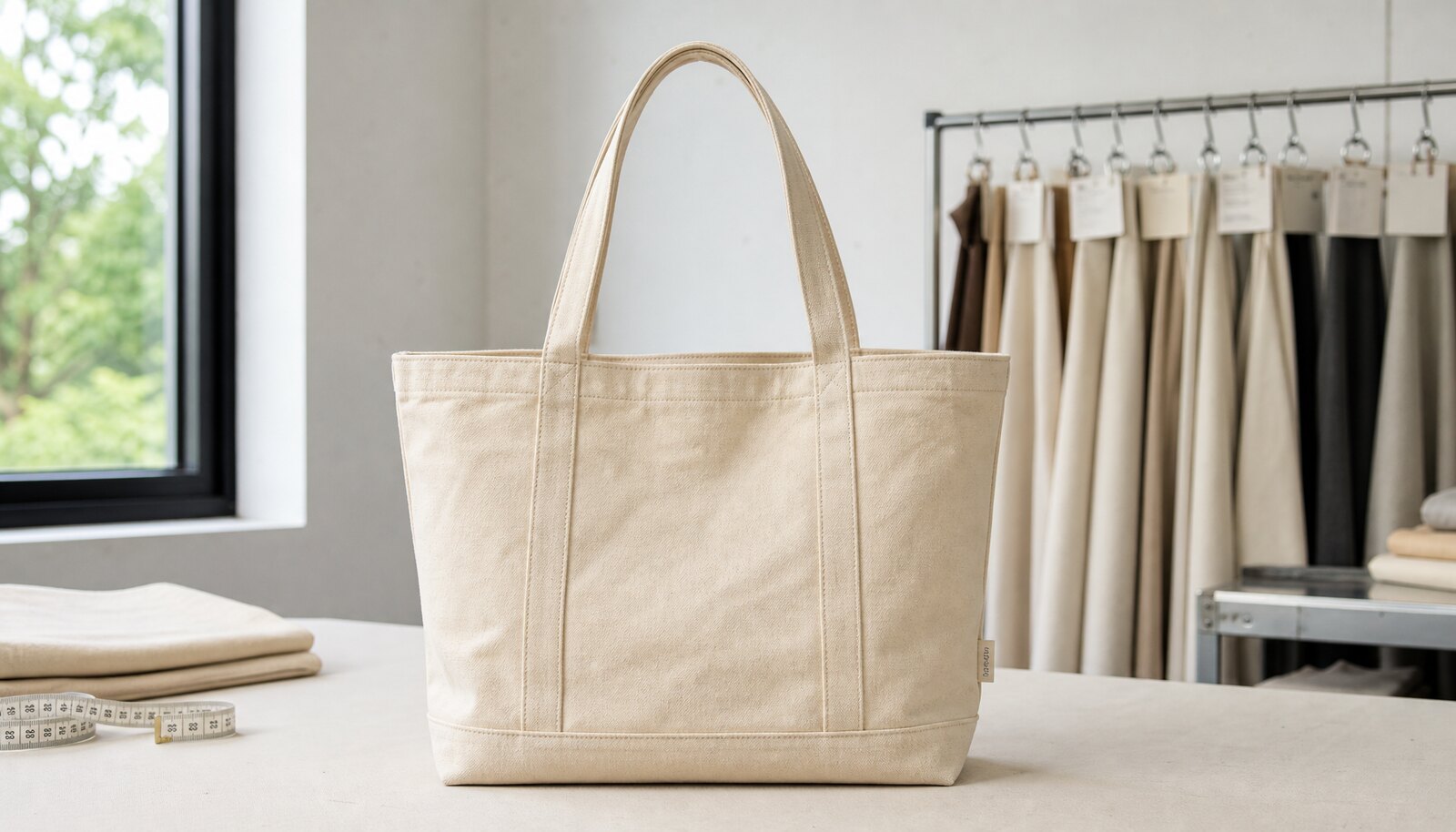
Write the brief around the event, not the logo
Canvas exhibition tote bags for boutiques fail most often at the brief stage, not the sewing stage. If the RFQ only says "canvas tote with logo," the supplier has to guess the load, the finish, the packing format, and the brand standard. Those guesses are where you get a bag that is technically correct but commercially wrong: the body is too limp, the handle drop feels awkward, or the print looks fine on a flat proof but misses the real retail tone once it is on woven canvas.
For event giveaway planning, start from the actual use case. Ask what is going inside the bag, how long the bag needs to last, and whether the bag is meant to be reused after the event. A tote carrying brochures and a lookbook has a very different spec from a tote that also needs to hold samples, purchases, or a bottle. Once the event load is defined, the rest of the sourcing conversation becomes easier to control because size, structure, and landed cost are tied to a real requirement.
- Define the contents first, then size the bag around the contents.
- State whether the tote is a one-day handout, a reusable event bag, or a retail-aligned branded item.
- Version-control the spec from the first sample onward so later changes are traceable.
Size and structure should follow the carry load
The most useful sourcing benchmark is not a generic tote description. It is the carry load. For a light brochure kit, a simpler open-top canvas tote can be enough, especially if the event team wants lower freight weight and faster production. For a standard boutique giveaway that should still feel presentable after the show, a more stable body with a gusset and reinforced handles usually gives better brand value. If the bag is expected to stand upright when filled, that requirement needs to be written into the spec because it affects the base structure and the sewing pattern.
A practical planning range helps buyers compare offers without treating every tote as unique. As a starting point, light event handouts often sit around 280 to 320 GSM. A standard boutique giveaway usually lands around 340 to 410 GSM. A premium reusable tote can move higher, especially if the bag needs a boxier shape or a cleaner retail finish. Those are starting points, not rules. The point is to align fabric weight, body size, and reinforcement to the actual contents, not to pick the heaviest cloth available.
- Light brochure handout: simpler body, minimal structure, lower freight weight.
- Standard boutique giveaway: moderate canvas weight, gusset, and reinforced handles.
- Premium reuse program: firmer body, cleaner seam finish, and a shape that holds up in public use.
Choose fabric and finish for print quality, not just weight
Fabric decisions change how the bag looks in the hand and how the logo prints. Natural canvas can be cost-effective and forgiving on minor sewing variation, but the tone of the cloth will affect whites, pastels, and any color that needs a very clean background. Bleached or lighter canvas gives a more controlled print field and is easier to align with a boutique brand that cares about visual consistency. Recycled or blended cloth can be a good commercial choice when sustainability messaging is part of the program, but the supplier should be able to explain how that choice affects texture, color, and print behavior.
Ask for the fabric details in measurable terms: composition, GSM, finish, and any shrinkage allowance. If the bag must keep its dimensions after packing or handling, pre-shrunk or controlled-finish fabric may be worth the extra cost. If the bag needs more body without simply going heavier, ask for a gusset, a reinforced base, or a finish that improves structure. For canvas exhibition tote bags for boutiques, a practical spec is often less about the highest GSM and more about whether the bag will look deliberate when a customer carries it out of the event.
- Natural canvas: useful when the brand accepts a warmer, less uniform visual tone.
- Bleached canvas: better when logo fidelity and print brightness matter most.
- Recycled or blended fabric: useful when the buyer wants a sustainability story, provided the finish still matches the brand standard.
Artwork and print method should be chosen together
Decoration should not be selected in isolation from the fabric. Screen print is usually the most dependable option for a simple boutique logo, one or two solid colors, and repeatable orders. It is often the cleanest choice when the artwork is bold, the brand mark is large, and the buyer wants the finished bag to read clearly from a distance. Heat transfer and digital methods can handle more detail, but they also change the risk profile. On woven canvas, a method that looks crisp in a PDF can become stiff, fragile, or visually too shiny if it is not matched to the bag surface.
The RFQ should define the artwork controls that matter in production. Set the safe zone, note the minimum line thickness, and state whether the color must be matched to Pantone or only approximated under event lighting. If the design touches a seam or a handle anchor, call that out before sampling because the factory may need to adjust placement or reject the layout. A good sample proves the art on the actual fabric, not just on a white sheet of paper.
- Use screen print for bold logos, limited colors, and repeatable orders.
- Use heat transfer only when the design genuinely needs detail that screen print cannot hold cleanly.
- Set a safe zone away from seams, handles, and the bottom fold so the logo stays readable after assembly.
Use the sourcing-route table to narrow the field
The comparison table above is meant to screen the route before you spend time on samples. A factory-direct quote is usually the cleanest path when the tote spec is fixed, the buyer wants control over sewing and print, and reorder planning matters. A trading company can help when the buyer needs coordination across multiple products or markets, but the real factory still has to be identified if quality and timing matter. Local decorators on stock blanks are useful when speed is the main constraint, but they limit control over body shape, fabric weight, and finish.
The right route is the one that can hold the spec with the least commercial friction. If the event team needs a tote that feels more like a retail item than a commodity giveaway, a custom production route is usually better. If the campaign is a small, urgent activation and the bag is mainly there to move materials, a blank-and-decorate option can be enough. The important thing is to choose the route intentionally instead of letting the first supplier define the scope for you.
- Factory-direct: best when you need control over cut, sew, print, and pack.
- Trading company: useful if they can name the actual production site and own the workflow.
- Local blank route: good for urgent or low-complexity projects where the body spec can be fixed early.
Quote landed cost, not just the bag price
A low unit price can hide the real cost of the order if the quote is not structured correctly. For event giveaway planning, ask for a landed-cost view that separates the unit price from setup, sample fees, carton charges, freight assumptions, duty, and local delivery. That breakdown matters because a tote that is cheap ex-works can still become expensive if the packing is inefficient or if the carton dimensions drive up freight. Buyers should compare suppliers on the same line-item basis so the quote reflects the same commercial logic.
Volume breaks matter just as much as the starting price. For a custom canvas tote, it is common to request pricing at your target quantity and at the next two break points so you can see whether the order should be split or consolidated. The real decision is not just whether the first tier is cheap. It is whether the supplier can support the spec at the volume you actually need, with the same fabric, the same print, and the same packing format. If one supplier looks cheap only at the largest tier, that still may be the right answer, but only if the event calendar can support that volume.
- Ask for line items for product, setup, packing, cartons, freight, and delivery.
- Keep the spec identical across quote tiers so the price comparison is real.
- Confirm the incoterm and freight assumption before you compare total cost.
Sample approval should prove fit, not only artwork
A useful sample is more than a visual check. It should prove that the tote can be made consistently and that it still works when filled with the actual giveaway contents. Check the print first, but also check handle symmetry, top edge finish, seam alignment, and the way the bag sits when it is loaded. A tote that looks flat and neat when empty can still twist awkwardly or close too tightly once brochures, product inserts, or purchases are added. That is why the sample should be tested in the same way the event team will use it.
For any order that matters commercially, ask for both a visual sample and a packed sample. The packed sample tells you how the tote behaves in a carton, whether the fold pattern is efficient, and whether handles create extra bulk or get crushed. If the supplier makes one revision, make sure the approval note records the final size, print position, fabric, and carton count. That record becomes the reference for bulk production and any reorder. In procurement terms, the sample is not just a prototype. It is the production contract in physical form.
- Test the bag with the actual event contents, not an empty tote.
- Ask for a packed carton sample so you can judge handling and storage.
- Freeze artwork and bag size after approval unless you are willing to restart the sample cycle.
QC should be written as test methods and defect thresholds
Quality control becomes useful when it is specific enough to act on. For canvas exhibition tote bags for boutiques, the most common defects are visible and preventable: size drift, weak handles, print misregistration, and rough seam finish. The buyer should not wait until bulk arrivals to define what counts as a critical, major, or minor defect. A critical defect is one that makes the bag unusable or materially wrong, such as a broken seam, the wrong logo, or a size error that changes the event fit. Major defects are the visible issues that harm presentation or function. Minor defects are small issues that should still be tracked and trended.
Set the test methods before production starts. Measure a random sample from multiple cartons, not just from the top of one box. Run a static load test using the intended giveaway contents or an equivalent test load and hold it for a fixed period. Check the print under neutral white light, then repeat a simple dry and damp rub test. Inspect the handle joins, corners, and top edges closely because those are the points where production shortcuts show up first. If your company already uses an AQL system, write it into the PO and keep the same logic across reorders.
- Measure size, handle drop, and gusset on random units from multiple cartons.
- Run a static load test with the planned event contents or an equivalent weight.
- Check print under 5000K light and repeat a dry and damp rub test.
- Use zero tolerance for critical defects and a written threshold for major and minor defects.
Packing and logistics affect event readiness more than many buyers expect
Packing is not a back-office detail. It affects freight, warehouse handling, and how quickly the event team can start using the bags. Bulk packing is usually the right choice for giveaway programs because it reduces cost and carton volume, but only if the fold direction is consistent and the cartons are easy to receive. If the bag is meant to look premium on arrival or move through a retail channel, the packing spec may need to change. In that case, the buyer should ask whether individual polybags are genuinely needed or whether a cleaner bulk pack can still protect the product.
A good logistics brief includes carton count, carton dimensions, gross weight target, barcode or label requirements, and any pallet preference. If the bag is being shipped to a venue, a distributor, or a boutique group rather than a single warehouse, the receiving process should be defined as well. The smallest late-stage friction often comes from packing assumptions that were never written down. A supplier cannot pack efficiently if the buyer has not said whether the handles must face in a certain direction, whether cartons can be stacked, or whether the venue requires specific marks on the outer case.
- Use bulk packing for most event giveaways unless retail presentation requires otherwise.
- Define carton count, gross weight target, outer labels, and pallet needs before production.
- If cartons will be hand-carried or moved through a venue, set a practical weight limit for manual handling.
Send a complete RFQ bundle so quotes are actually comparable
The fastest way to get a usable quote is to send a complete RFQ bundle. For boutique event giveaway planning, that means the supplier receives a finished size, fabric target, decoration method, artwork file, quantity tiers, packing spec, ship-to location, and required delivery date in one brief. If any of those are missing, the supplier will fill in the gap with assumptions, and those assumptions are usually where the quote becomes hard to compare. A polished RFQ is not about making the document long. It is about removing the supplier's freedom to guess.
If the tote program is important, include the expected usage context in one sentence. A tote for a trade-show handout, a boutique launch, and a VIP retail purchase all carry different expectations even if the logo is the same. The more clearly you describe the event, the easier it is for the factory to quote a bag that fits the program instead of a generic canvas tote. That is the commercial advantage: fewer revisions, fewer surprises, and a much better chance that the first bulk lot matches what was approved.
- Include a drawing or dimensioned spec, not only a logo file.
- Ask for matched pricing across the same spec at multiple quantity tiers.
- State the approval path and the calendar date when bulk can start.
Specification comparison for buyers
| Sourcing route | Best fit | Typical commercial upside | Main risk to verify | RFQ signal |
|---|---|---|---|---|
| Factory-direct | Repeat boutique giveaway programs, custom construction, and reorder plans | Best control over fabric, sewing, print, and packing when the spec is stable | Confirm the site actually owns cutting, sewing, printing, and final inspection | Ask for process ownership photos, line capacity, and a named QC owner |
| Trading company or sourcing office | Multi-market programs, consolidated buying, or buyers that need coordination support | One contact can manage documents, consolidation, and follow-up across suppliers | Verify which factory makes the bag and who approves sample changes | Ask for the real production site and the step-by-step workflow |
| Local decorator on stock blanks | Small runs, urgent event needs, or simple logo application on a fixed body | Fast turnaround and less coordination when the event clock is tight | The blank body, size, and seam construction are locked before decoration starts | Ask to see the blank bag spec before you approve artwork |
| Hybrid blank body plus local print | Pilot campaigns or rush launches where custom sewing is not essential | Shorter first-run lead time and simpler artwork approval | The tote may not match your target fabric weight, handle drop, or retail finish | Ask what is fixed in the blank and what can still be customized |
| Material | 8-12 oz cotton canvas, 120-220 gsm cotton, recycled cotton, or blended fabric selected by use case and target price | Before price comparison | Different cloth weights, backing, or certification claims make quotes hard to compare | |
| Construction | bag size, gusset, handle drop, seam allowance, stitch density, reinforcement patch, and loading expectation | Before sampling | Weak stress points create returns and failed inspections | |
| Decoration | screen print, heat transfer, embroidery, woven label, or hangtag matched to fabric texture and brand durability needs | Before artwork approval | The wrong method can crack, bleed, pucker, or fail on the chosen fabric | |
| MOQ | Base MOQ plus change drivers | During quote review | Custom colors, trims, and packing can change minimums |
Buyer checklist before sampling
- Lock the finished size, gusset depth, handle drop, and whether the bag must stand upright when filled.
- Write down the actual event contents the tote must carry, then choose fabric weight from that load, not from a generic preference.
- Set a target fabric range by use case: light brochure handout, standard boutique giveaway, or premium reuse program.
- Approve the artwork in vector format and define whether color must match Pantone references or only a close visual match under event lighting.
- Specify the print safe zone, minimum line thickness, and whether any artwork can cross seams or handle attachments.
- Ask the supplier to identify each in-house step and each outsourced step before you accept the quote.
- Request a full landed-cost breakdown that separates unit price, setup, sample fees, carton charges, freight assumptions, duty, and local delivery.
- Ask for prices at multiple tiers, typically your first order volume plus two higher tiers, so you can see where the price breaks really are.
- Approve a pre-production sample and a packed carton sample before bulk cutting or mass printing starts.
- State the inspection method in advance, including what is a critical, major, or minor defect, and which defects trigger rework or rejection.
Factory quote questions to send
- Are you the actual cut-and-sew and print factory, or a trading company? If you are not the factory, who is the production site?
- Which process steps are in-house for this order: fabric sourcing, cutting, sewing, printing, packing, carton assembly, and palletizing?
- What is your unit price at my target volume, plus the next two volume tiers, and what changes at each tier?
- What one-time charges apply for screens, plates, patterns, print setup, labels, hangtags, carton printing, or special packing?
- What fabric composition, GSM, finish, and shrinkage allowance are included in the quote?
- Which print method are you pricing, how many colors are included, and what happens if we change the artwork placement later?
- What is your recommended bag size and handle drop for the contents we plan to carry?
- What is your sample fee, sample lead time, and is the sample fee credited back on bulk?
- Can you provide a pre-production sample, a packed carton sample, and a revised sample if we make one round of changes?
- What inspection standard do you use, how many pieces are checked, and what defects trigger rework or rejection?
Quality-control points to confirm
- Measure width, height, gusset, and handle drop on a random sample from at least three cartons. Agree tolerances before production; a practical starting point is +/- 1 cm on overall body dimensions and tighter control on handle drop if the bag is event-visible.
- Run a static load test using the planned giveaway contents or an equivalent test load. Hold it for 15 minutes, then check for seam opening, handle distortion, loose bar-tacks, or obvious shape collapse.
- Inspect the print under daylight or 5000K white light. Check for registration drift, fuzzy edges, color shift, ink bleed, or artwork that crosses into seam lines or stitch zones.
- Perform a simple rub test on the printed area with both dry and lightly damp cloths. Use a fixed count, such as 20 back-and-forth strokes each, and require no visible smearing at normal viewing distance.
- Check handle attachments and stress points closely. There should be no skipped stitches, broken reinforcement, or loose thread bundles longer than a few millimeters around the joins.
- Count bags from the top, middle, and bottom of multiple cartons. The lot should match the ordered quantity with no hidden shortage in mixed cartons or overpacked boxes.
- Review carton samples for fold direction, pack count, label accuracy, and crush resistance. Cartons should close cleanly without bulging, and handles should not be creased or permanently bent.
- Set defect thresholds in writing before production starts. A good procurement default is zero tolerance for critical defects, a capped major defect level tied to your inspection plan, and a documented rework or replacement rule for repeated minor issues.