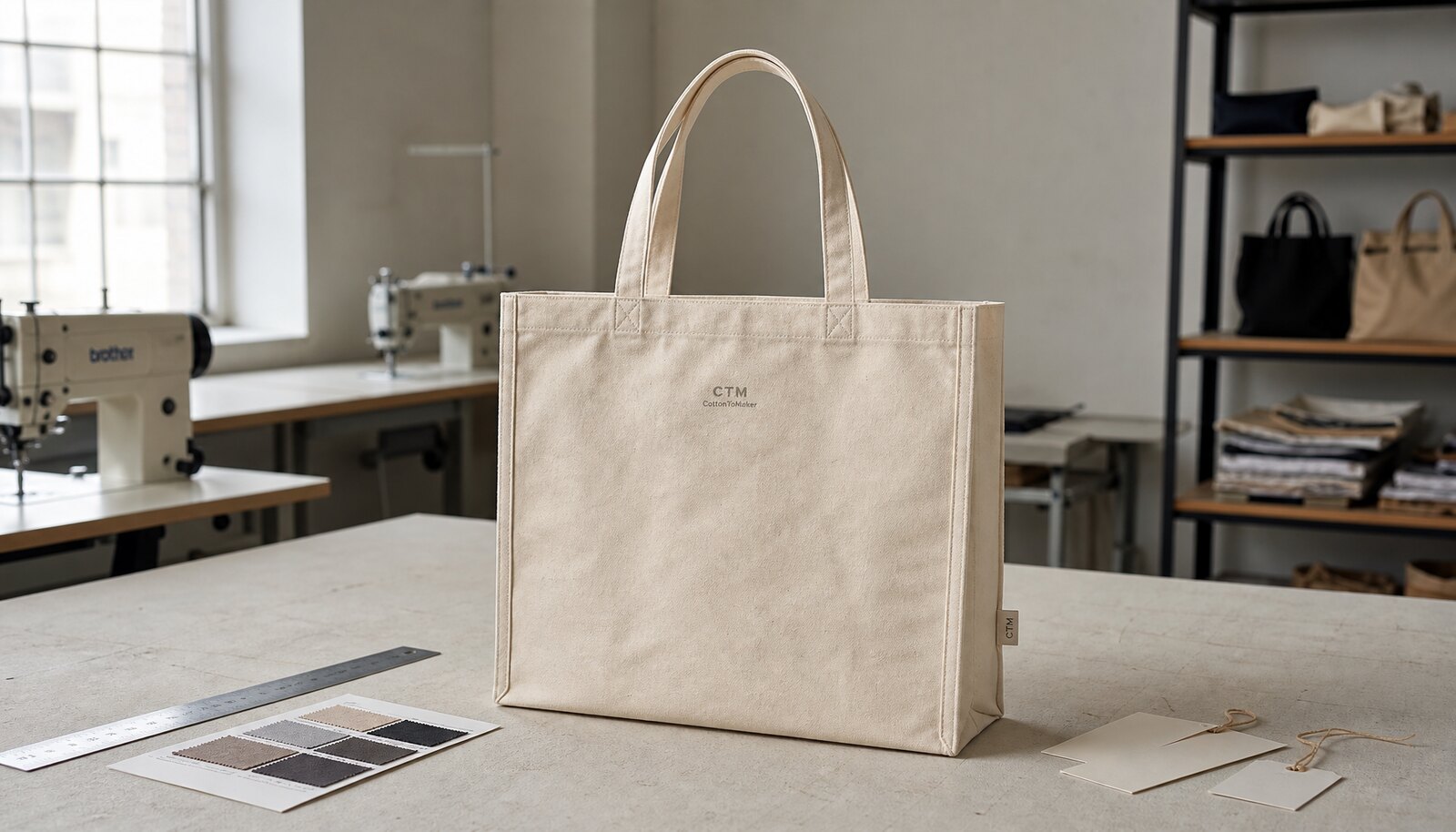
Why bookstore tote approval needs a real checklist
Canvas exhibition tote bags for bookstores sit in a tricky middle ground. They need to carry books, catalogs, event flyers, and mixed retail purchases, but they also have to look composed enough for a counter display, a shelf rack, or a book fair table. That means the approval sample cannot be treated like artwork proof alone. If the process stops at the mockup, the buyer may approve a bag that looks good on screen and then disappoints on fabric hand, seam quality, fold behavior, or load performance once it is sewn in bulk.
The commercial risk is higher than it first appears because the same tote can serve two buyer needs at once. One team may want a practical giveaway for an event, while another wants a retail item that feels worth paying for. Those goals often collide in the same spec: lighter canvas can improve cost and pack size, but heavier canvas usually looks and feels more retail-ready. A proper sample approval checklist gives procurement a way to balance those tradeoffs with evidence instead of assumptions.
The other reason to use a structured checklist is that tote quotations are easy to distort. A supplier can change canvas weight, move the print method, simplify the packing format, or outsource one step and still present a quote that looks comparable. The sample approval process is what exposes those differences. If the physical sample and the written spec are tied together, the buyer has a real baseline for reorder pricing, store rollout, and future seasonal variants.
- Treat the sample as the production reference, not as a display prop.
- Make one person accountable for artwork, construction, packing, and final sign-off.
- Use the checklist to compare like-for-like builds across suppliers.
- Keep the signed sample tied to the PO so the bulk order cannot drift quietly.
Start with the use case, not the artwork
Before asking for a sample, define how the tote will actually be used. A bookstore event giveaway may need a lower-cost build with a simpler finish, while a retail tote on the sales floor usually needs better structure, cleaner decoration, and more consistent packing. If the same design is meant to do both jobs, write that down and decide which use case is primary. The factory cannot optimize for everything at once, and the sample should show the compromise the buyer is willing to accept.
Load matters more than many RFQs acknowledge. A tote that carries a few paperbacks can survive on 10 oz / 340 gsm canvas, but a tote that regularly holds hardbacks, magazines, and promotional inserts is better served by 12 oz / 406 gsm or a comparable weight in a firm weave. If the bookstore wants a visibly substantial bag, weight alone is not enough; the weave density, bottom construction, and handle reinforcement also need to support the look and the carrying load. Ask the supplier to quote the same bag in two options only if the business decision genuinely needs that comparison.
The sample brief should include the real carry scenario. State whether the tote must hold one large hardcover, a stack of trade paperbacks, a bundle of catalogs, or a mixed retail basket. Then test the sample with those contents. This is the quickest way to find whether the gusset is deep enough, whether the handles sit comfortably on the shoulder or in the hand, and whether the bag still looks retail-ready after loading.
- Write the primary use case: giveaway, retail, staff bag, or hybrid.
- Define the realistic load, not just the maximum theoretical weight.
- Choose the fabric weight based on what the bag will actually carry.
- Do a load test with bookstore items before signing off on appearance.
Freeze the base construction before the first sample is cut
Artwork should not be the first decision in a tote project. The sample will be more useful if the base build is settled first: finished size, gusset depth, bottom shape, handle length, handle drop, seam allowance, and reinforcement points. Once those are fixed, the print position can be judged against a real body rather than a moving target. If the buyer keeps changing dimensions after the first sample, the supplier will often rework the sample but not the underlying quote logic, and that is where avoidable cost creep starts.
For bookstore totes, a practical default is a medium-firm natural canvas with a clean surface that holds shape but does not feel cardboard-stiff. Self-fabric handles are common because they keep the bag visually simple and easy to brand, but the handle drop needs to match how the bag will be carried. A hand-carry tote, a shoulder-friendly tote, and a display tote do not use the same handle geometry. If the buyer does not specify the intended carry style, the factory may default to its own standard length, which can be off by enough to change user comfort and shelf appeal.
Do not leave tolerances out of the sample brief. Without them, the supplier may consider a one-centimeter variance acceptable while the buyer considers it a fit problem for cartons or retail display. Give the factory explicit ranges for the dimensions that matter most, and be selective rather than vague. Tight tolerances on the opening width and handle drop may matter more than an equally tight tolerance on the overall body height, depending on the way the tote will be packed and displayed.
- Specify finished size, not only cut size.
- State gusset width and whether the bottom is flat, boxed, or stitched closed.
- Define handle length, handle drop, and reinforcement stitching.
- Add dimension tolerances before the sample is sewn.
- Choose the carry style first: hand-carry, shoulder carry, or display-only.
Choose the decoration method with the bulk process in mind
One-color screen print is often the safest baseline for bookstore exhibition totes because it is durable, repeatable, and relatively easy to compare from sample to bulk. It suits simple logos, event branding, and reorder-heavy programs where consistency matters more than decorative complexity. But the sample needs to show the actual production method, not a placeholder proof. A digital mockup can support internal artwork review, yet it cannot reveal ink deposit, mesh marks, cure quality, or edge clean-up on the fabric.
If the tote is positioned more like a retail product, stitched labels and woven side tags can add a cleaner, more permanent presentation. Embroidery can also work, but only when the canvas weight and logo size are appropriate for the stitch density. Too much embroidery on a light canvas can pucker the fabric, distort the opening, or create a stiff patch that looks out of proportion. If the buyer wants a premium feel, ask the supplier to show exactly where the extra labor sits and how it changes the bulk price.
A useful procurement rule is to keep the decoration method constant across the sample and the PO. If the sample uses a heat transfer but bulk will use screen print, or if the sample has a sewn label but bulk will use a printed mark, the sample is no longer a reliable approval reference. In that situation, the buyer is approving an idea rather than the finished build. The more important the retail presentation, the less acceptable that gap becomes.
- Use screen print for simple, repeatable artwork.
- Use woven or sewn labels when the bag must read more like a retail item.
- Use embroidery only when canvas weight and logo size support it.
- Never approve a decoration method that differs from the production method.
Inspect the sample like a production unit, not a photo prop
A tote sample should be measured, handled, and loaded the way the bulk order will be used. Start with dimensions, then check the gusset shape, seam straightness, handle symmetry, and print placement relative to the top edge and side seams. A bag can look acceptable in a front-facing photo and still fail on the line because the print sits too close to a seam or the handles are not centered. Put a ruler on the sample, not just a camera.
The bag should also be checked in a realistic sequence: unfolded, folded, packed, carried, and displayed. That sequence matters because bookstores often care about shelf presentation as much as the hand feel. If the tote is to be sold, the folded profile should look neat, the creases should not create visible pressure marks on the print, and the bag should stand or lie flat in a controlled way. If the tote is for event use, the buyer should care more about load performance and recovery after folding.
A strong sample review also includes the inside of the bag. Loose thread tails, uneven seam finishing, or exposed raw edges can be ignored in a casual photo but become obvious when a customer opens the tote or stores product inside. Ask the supplier for front, back, side, inside, and packed-state photos. More important, inspect the physical sample under good light. The sample should explain the build without a sales pitch.
- Measure height, width, gusset depth, and handle drop against the drawing.
- Load the tote with actual bookstore items, not just paper filler.
- Inspect front, back, side seam, inside seam, and packed state.
- Keep one signed golden sample and one reference sample with version control.
Turn quote comparison into a real cost comparison
A tote quote becomes misleading when it bundles too much into one line. Sample fee, setup cost, decoration cost, packing labor, and bulk unit price should be broken out so procurement can see what is recurring and what is one-time. If the supplier does not separate these items, the buyer cannot tell whether a low first-order quote will remain competitive at reorder volume. That matters for bookstore programs because the first order is often a launch quantity, then the bag is re-ordered for a seasonal event or a store network refill.
MOQ is often driven by setup economics rather than raw material usage. A small run has to absorb screen preparation, cutting, sewing changeover, and packing coordination. That is normal. The useful question is whether the MOQ is connected to a transparent price ladder. Ask for a pilot quantity and a target reorder quantity so the team can see how much the unit price changes once setup is already paid. If the price barely moves, ask why; if it drops sharply, confirm that the lower rate still uses the same fabric, print method, and packing route.
Compare supplier routes by control, not just by headline price. A direct factory with in-house sewing and decoration often offers better consistency, but only if it truly owns the steps it claims. A trading company may help with coordination, especially when the buyer is consolidating multiple products, but the paperwork must still show who is doing the actual work. For a bookstore tote, the risk is not just price variance; it is build variance. If the quote cannot map to the sample, the buyer is not comparing the same item.
- Request sample fee, setup cost, bulk price, and packing cost as separate lines.
- Ask for at least two quantity points: pilot and reorder.
- Confirm whether setup elements can be reused on future orders.
- Compare identical build specs before judging supplier price.
Make packing and shelf readiness part of the approval
Packing is not an afterthought for bookstore totes. The fold method, fold size, inner count, carton dimensions, carton marks, and retail label placement can change both the appearance and the landed cost. A tote that looks good unfolded may arrive with rub marks, compression creases, or label damage if the fold pattern and carton fill are wrong. That is why the sample should be reviewed in both open and packed states. If the factory only shows the unfolded tote, the buyer has not approved the item that will actually be received.
This is especially important when the tote is sold through a bookstore chain or distribution warehouse. Receiving teams want predictable carton weights and clean markings; merchandising teams want an unpacked tote that does not look crushed. Decide early whether the bag should be polybagged, belly-banded, or bulk packed. Each option has a cost, a labor step, and a visual consequence. Polybags protect well but add plastic and labor; belly bands can look more retail-friendly but offer less protection; bulk packing may reduce cost but increases the risk of transit marks.
Specify the shelf-facing or first-open experience. If the store buyer wants the logo visible immediately after unboxing, the bag should be folded to support that. If the priority is warehouse efficiency, the fold may need to follow carton optimization instead. Either way, make the packed sample part of the sign-off. A buyer should never approve a tote only to discover that the final fold hides the logo or distorts the body shape.
- Define fold method and which face must be visible when first unpacked.
- Set inner pack count, carton mark content, and carton size limits.
- Choose between polybag, belly band, or bulk pack before bulk starts.
- Approve both the open sample and packed sample photos.
Use a QC checklist with pass/fail language
Quality control is most useful when it is operational, not aspirational. For canvas exhibition tote bags, the buyer should define what passes, what fails, and what needs a correction note. For example, a missing stitch in a non-load-bearing area may be minor if the standard allows it, but a skipped stitch at the handle anchor is a clear fail because it affects strength. The same logic applies to print. A tiny speck in a low-visibility area may be cosmetic, but a shifted logo or bleeding edge on the front panel can be a rejection issue if the tote is meant for retail presentation.
Use three defect buckets so everyone speaks the same language. Critical defects are safety or functional failures such as open seams, broken handles, severe contamination, or a body dimension that makes the bag unusable for the intended load. Major defects are visible or performance-related issues that would likely trigger a customer complaint, such as obvious misregistration, uneven handle lengths, or a badly distorted fold. Minor defects are cosmetic issues that do not affect function, such as a small loose thread outside the visible face, if your standard allows them. The point is not to be lenient; it is to be explicit.
Add measurable thresholds where possible. Ask the supplier to confirm the acceptable range for dimensions, the load test result for the approved contents, and the acceptable print position relative to seams. If the tote is to be sold or displayed, define what 'clean appearance' means in practical terms: no visible stains, no odor, no severe wrinkling, and no obvious color contamination. When the standard is written this way, the sample review becomes faster and the supplier understands what must be corrected before bulk.
- Classify defects as critical, major, or minor before sample approval.
- Set pass/fail rules for load performance, seam quality, and print placement.
- Require the factory to use the same standards on the pilot lot.
- Reject any sample with open seams, handle failure, or severe contamination.
- Document any acceptable cosmetic variance in writing, not verbally.
Ask for the right evidence before you release the PO
The sample itself is important, but the evidence around the sample is what makes the approval useful later. Ask for a dimension sheet, a photo set, the approved artwork version, and a packing photo. If the supplier can provide a stitched seam close-up, a print strike-off, and a picture of the actual sample room or production line, that helps confirm the route. The goal is not to collect documents for their own sake; it is to make future reorder decisions easier and to reduce disputes if the next batch differs.
A simple evidence pack also helps when several teams need to sign off. Purchasing may focus on price and MOQ, while merchandising may focus on appearance and retail readiness. A clear packet that includes the signed sample photo, dimensions, and packing plan keeps those conversations aligned. If a supplier later proposes a change, the buyer can compare it against the evidence pack rather than relying on memory. That is especially useful when the order moves across seasons or between store groups.
Do not leave the approval trail informal. Save the date, version number, approver name, and the exact sample retained. If there is any deviation from the approved build, record it before production begins. This is the simplest way to prevent the common problem where the bulk tote arrives and no one remembers whether the handle was supposed to be 55 cm or 60 cm. Procurement teams do not need more paperwork; they need the right record once.
- Keep front, back, inside, and packed-state photos with version numbers.
- Store the signed sample and the spec sheet together as the approval record.
- Record any approved deviation before the PO is released.
- Use the evidence pack as the baseline for reorder negotiations.
Use the approval process to protect landed cost, not just unit price
The cheapest-looking tote can become expensive once the hidden work is visible. A lighter fabric may require extra complaints handling, a cheaper fold may increase repacking, and a lower-cost supplier may outsource part of the build, which can create quality variability that shows up only after shipment. For bookstores, landed cost should include more than ex-factory price: packing volume, carton count, freight exposure, and the risk of rework or rejection. A sample approval checklist helps expose those costs before the PO is issued.
This is also where procurement should avoid overfitting the spec. If the tote is a short-run event bag, it may not need premium finishing. But if it is intended for store sale, the buyer may justify a better weave, cleaner label application, or tighter packing control because the customer sees the bag as merchandise. The right answer depends on the business model, not on a generic tote rule. That is why the checklist should say what matters most: durability, shelf appearance, stacking efficiency, or reorder consistency.
When the sample is approved, capture the exact version that was signed off and make it the reference for the next round. Then the supplier can quote reorders without guessing what changed. That reduces friction on the next procurement cycle and keeps the buyer from re-litigating the same tote details every season. The goal is a better approval process now and a cleaner re-buy later.
- Compare landed cost, not just unit cost.
- Include packing volume and freight implications in the buying decision.
- Use the approved sample as the reference for the next reorder.
- Match the spec to the tote's role: event, retail, or hybrid.
Specification comparison for buyers
| Spec decision | Recommended option | When it fits | Buyer risk to check |
|---|---|---|---|
| Sourcing route | Direct factory with in-house sewing and decoration, or a tightly managed cut-and-sew partner with named subcontractors | Best when you need one party accountable for fabric, stitching, print, and packing consistency | Risk rises if the supplier cannot name where printing, finishing, or carton packing actually happens |
| Sample type | Physical pre-production sample plus a written spec sheet, with photos of front, back, inside, and packed state | Useful when multiple stakeholders must approve the same build and stores need a repeatable reference | Photo-only approval misses fabric handfeel, seam balance, and print cure defects |
| Fabric weight | 12 oz / 406 gsm natural canvas as a practical default; test 10 oz / 340 gsm only for light-duty events | Fits bookstore totes that carry books, magazines, and mixed retail purchases without sagging immediately | Too light can bow under hardbacks; too heavy can raise cost and change hand feel or fold profile |
| Weave and finish | Medium-firm plain weave with a clean, not overly brushed finish | Works when the tote must look retail-ready while still holding shape on a table or shelf | Over-soft fabric can slump; overly stiff fabric can crack print or create bulky folds |
| Print method | One-color screen print for repeatable bulk runs; stitched label or woven tag when the bag should read as a retail item | Best for simple logos, events, and reorders where consistency matters more than elaborate decoration | Digital artwork proofs can look cleaner than production if ink, mesh, or curing changes in bulk |
| Handle build | Self-fabric handles with reinforced cross-stitch or bar tack anchors | Works for retail use and heavier carry loads when the tote must feel clean but durable | Thin handles twist, stretch, or feel uneven if the anchor spacing is not controlled |
| Dimensions and tolerances | Finished size with explicit tolerance bands for height, width, and gusset depth | Needed when the tote must fit counter displays, shelf bins, or bookstore packing rules | A bag can be 'close enough' on paper but still fail carton fit or retail presentation |
| Packing route | Fixed fold method, defined inner count, carton mark, and whether each bag is polybagged, belly-banded, or bulk packed | Right for bookstore chains and distributors that need shelf-ready consistency and warehouse-friendly cartons | Loose packing can hide scuffs, print rub, and fold variation that only appears at receiving |
Buyer checklist before sampling
- Write the tote's actual use case first: event giveaway, retail sale, staff carry bag, or a hybrid of these.
- Freeze finished size, gusset width, handle drop, and load target before requesting samples.
- State the acceptable fabric weight, weave feel, and color family; say whether natural, bleached, or dyed canvas is acceptable.
- Approve artwork, print method, print size, and placement from the same revision number.
- Ask for one physical sample, one retained golden sample, and a simple dimension sheet signed by the supplier.
- Request packed-state photos that show fold direction, label position, carton marking, and inner pack count.
- Ask the supplier to break out sample fee, setup cost, bulk unit price, and packing cost separately.
- Record who has final approval authority and how many revision rounds are allowed before the quote or lead time is reopened.
- Test the sample with real bookstore contents such as hardbacks, catalogs, or a mixed retail purchase bundle.
- Reject any sample that needs a verbal explanation to match the written spec; the sample should explain itself.
Factory quote questions to send
- What exact canvas weight, weave, and finish are you quoting, and what tolerance range will you hold in bulk production?
- Is the print, embroidery, woven label, or seam reinforcement done in-house, and if not, who performs it?
- What does the sample fee include, and is any part of it creditable against production if we place the bulk order?
- What is the MOQ by size, color, print method, and carton configuration, and where are the price breaks?
- Can you quote a pilot quantity and a reorder quantity so we can see how setup cost spreads across volume?
- What are your standard lead times for first sample, revised sample, pre-production sample, and bulk shipment?
- What carton size, inner pack count, and gross weight are you planning, and will that change if we change fold format?
- What inspection standard do you use before shipment, and which defects are critical, major, and minor in your system?
- Can you show photos of a similar finished tote, the actual sewing area, the print setup, and the sample room?
- If we change handle length, gusset depth, or label position, which elements trigger a new sample and a new quote?
Quality-control points to confirm
- Fabric weight should match the approved range, not just the nominal spec; if the supplier changes GSM or oz, require re-approval before bulk.
- Measure finished height, width, gusset, and handle drop against the drawing. A practical buyer tolerance is usually tight enough that the bag still fits shelf displays and carton packing, but not so tight that normal sewing variation becomes a dispute; define that band in writing for each dimension.
- Accept no obvious stains, oil spots, odor, needle damage, or color contamination on visible panels, seams, and handles.
- Print edges should be clean with no major bleeding, double images, ghosting, or misregistration that is visible at normal viewing distance.
- Minor ink pinholes or tiny cosmetic specks may be acceptable only if written into the standard; otherwise treat them as defects and sample out the issue first.
- Seams should be straight and securely sewn, with no open seam ends, skipped stitches in load-bearing areas, or loose thread clusters that could snag in retail handling.
- Handle anchors should be symmetrical and reinforced with the approved stitch pattern; when loaded with books, the handles should not twist, torque, or pull the top edge out of shape.
- Bottom shape should remain stable under the approved load test; if the base sags or collapses beyond the accepted look, the sample should fail.
- Folded dimensions must match the retail or warehouse packing spec so the bag does not exceed carton limits or create scuffed print at transit.
- Use a sign-off threshold for load testing: the sample should carry the realistic bookstore load you defined without seam opening, handle stretch, or obvious distortion.