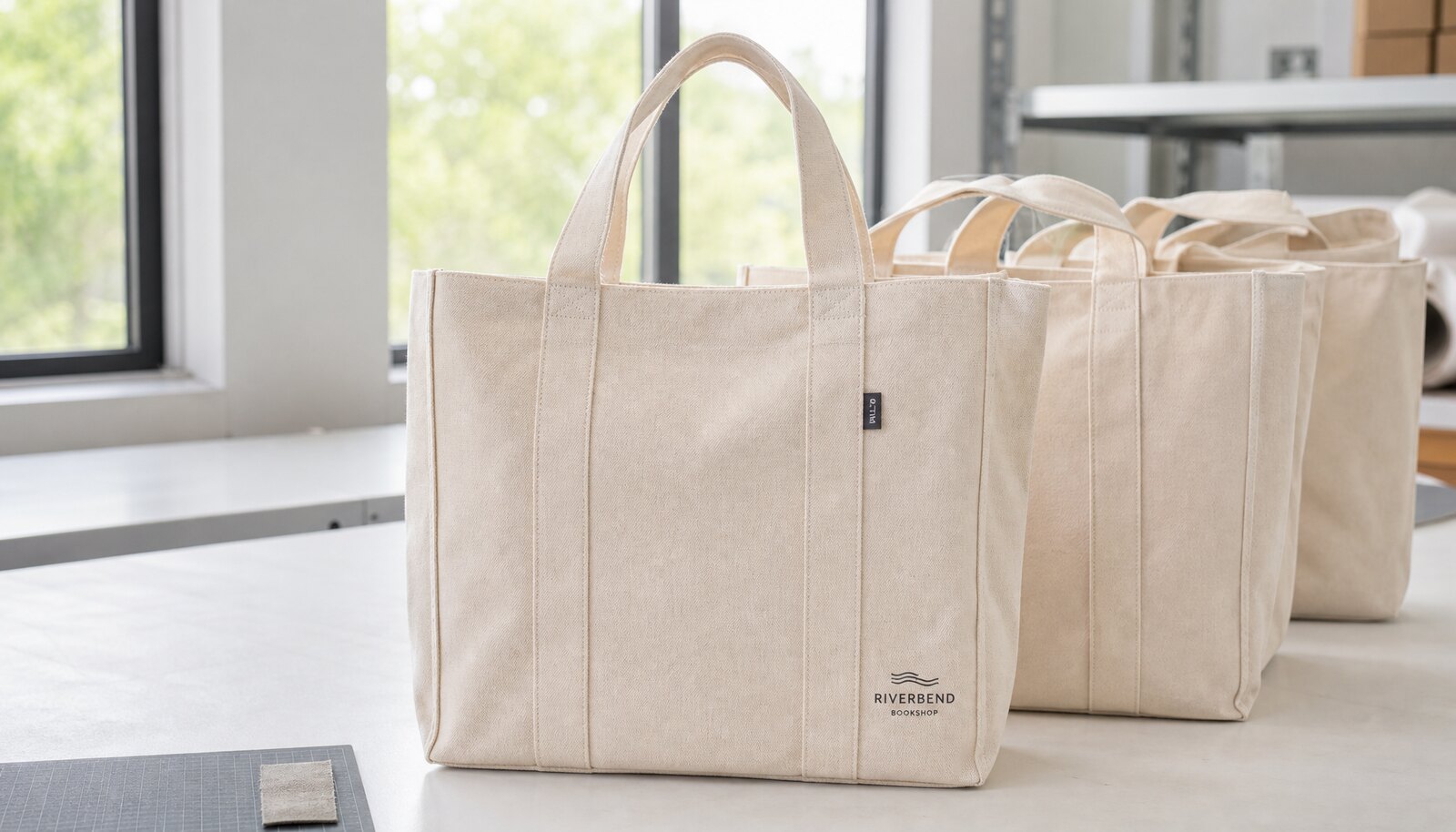
Why bookstore exhibition totes fail at inspection
For bookstores, an exhibition tote is not just a giveaway. It may hold hardcovers, catalogs, small impulse items, and still sit on a counter as a visible brand piece. That means the inspection standard needs to cover both carry performance and shelf presentation. A bag that looks acceptable in a sample photo can still fail when the canvas is too thin, the handles twist after sewing, or the print sits off-center by a few millimeters and looks careless in retail lighting.
Most buyer problems come from treating the tote as a simple low-cost item. The factory may quote based on fabric only, while the real risk sits in the details: fabric lot variation, print curing, reinforcement at handle joins, and carton packing accuracy. If you are buying for a bookstore chain, fair booth, or publisher event, the first task is to define what defect would create a customer complaint versus what is only a cosmetic variation.
- Treat the tote as a visible retail product, not only an event handout.
- Set inspection rules around shape, print, seams, and pack count before sampling starts.
- Use one written standard so procurement, merchandisers, and the supplier evaluate the same thing.
Start with the right canvas weight, weave, and finish
For most bookstore exhibition bags, 10 oz to 12 oz canvas, roughly 340 to 410 GSM, is the practical range. Below that, the bag can feel limp, sag under books, and show print bleed more easily. Above that, the bag becomes heavier to ship and more expensive to sew, and some factories slow down on top stitching and handle reinforcement when the material gets stiff. If the bag is meant to feel premium and carry heavy catalogs, 12 oz is usually the safer starting point.
The finish matters almost as much as the weight. Natural unbleached canvas gives the cleanest bookstore look and is often easier to align with eco or literary branding. But natural canvas can also have more slub, seed, or lint variation. If the brand is sensitive to print quality, ask whether the factory can grade the fabric by roll and keep all panels for one order from the same lot. A good supplier will tell you whether the fabric is preshrunk, heat-set, or only sewn and packed as received.
- Use 340 to 410 GSM as the normal buying range unless the bag will carry unusually heavy loads.
- Ask for finished fabric weight, not only greige yarn specs.
- Request roll consistency control if you care about print registration and color uniformity.
Choose the print method by artwork, not by habit
Screen printing is still the most practical method for most bookstore totes with one to three solid colors. It gives strong opacity, good brand visibility, and usually better unit economics than more complex methods. The cost driver is setup: each color, each side, and each screen adds cost. If the artwork has small text, gradients, or detailed illustration, screen print can still work, but the line thickness and halftone rules need to be built into the art before the quote is finalized.
Digital print or heat transfer can handle more detail, but they are not automatically better. Digital may solve artwork complexity yet raise concern on wash fastness or rub resistance if the ink system and curing are weak. Heat transfer can look sharp on day one and then show edge lift or stiffness differences after handling. For a bookstore buyer, the right question is not which method is modern; it is which method survives retail handling and still looks clean when the customer folds the bag into a backpack or stuffs it with books.
- Use screen print for bold logos and simple exhibition graphics.
- Use digital or transfer only when the artwork requires detail that screen print cannot hold.
- Demand proof of curing or fastness testing if the print is expected to see heavy use.
Compare sourcing routes before you compare price
Not every supplier quote means the same thing. Some sellers are direct factories with their own sewing and print lines. Others are traders who outsource the work. That difference changes quality control, sample speed, and who is responsible when a print shifts or a seam opens. For a custom bookstore tote, direct factory sourcing is usually the better route when you need repeatability, but a trading company can be useful if you need fast coordination across multiple trims or packaging requirements.
The cheapest quote is often the one that excludes the most. A low unit price can hide separate charges for screen setup, sample shipping, fabric upgrade, artwork cleanup, test reports, or export cartons. Before you evaluate a supplier, make them quote the same spec sheet. If the bag is going to be used at a book fair or retail counter, do not let the supplier substitute a lighter fabric or simplify the reinforcement just to hit a target price.
- Compare quoted GSM, print method, handle reinforcement, and packing on the same line item basis.
- Separate direct-factory pricing from trader pricing so you understand where QC responsibility sits.
- Watch for hidden setup charges that make a low quote expensive after sample approval.
Comparison table: sourcing options for bookstore exhibition totes
Use the table below when you need to decide which supplier route fits the order. The right answer depends on volume, artwork complexity, and how much control you need over inspection and repacks. A chain bookstore with a rolling calendar of events usually values repeatability more than the lowest initial quote. A one-time trade show order may prioritize speed and lower setup burden.
The sample record for canvas exhibition tote bags for bookstores quality inspection checklist should include front, back, side, seam, logo, label, inside, and packed-carton photos. For important programs, keep one signed physical sample and record the sample version in the approval file.
- Write decisions in measurable language, not only descriptive wording.
- Ask for sample photos plus one physical approval sample for important orders.
- Keep quotation, sample approval, and inspection notes tied to the same spec version.
Inspect the sample like it is the first production carton
A sample should do more than show the logo placement. It should confirm the way the bag will be built in mass production. Measure the finished body, gusset, and handle drop. Check whether the tote stands reasonably upright when empty, whether the handles twist, and whether the seam allowances are even. If the sample looks perfect but is built with hand-finished methods that the production line will not repeat, the sample is not useful for approval.
The best sample approval process includes a written sample sheet and one physical reference sample held by both sides. Mark the acceptance points: print placement window, stitch density, handle length, and any required lining or binding. If the bag is supposed to be used for heavy books, load test the sample with real product weight and inspect the handle stitches again after carrying. If the supplier cannot reproduce the sample on a small pilot lot, the quote is not yet production-ready.
- Measure the sample with a tape, not by eye.
- Test carry weight with actual books or comparable load.
- Seal one approved sample as the production reference before bulk sewing begins.
Write QC thresholds that can be measured at the factory
A useful quality plan avoids vague language like good, neat, or acceptable. Instead, define what can be measured. For example, the print should stay within the approved placement window; the bag width and height should not drift beyond the tolerance; and the handle attachment should show no missing stitch lines, open ends, or needle damage. If your supplier already uses internal AQL checks, ask them to map those checks to your specific tote risks rather than showing a generic report.
A bookstore tote usually has a small number of defects that matter more than the rest. Crooked logo placement, stain marks on natural canvas, and weak handle reinforcement are the usual customer-facing issues. Loose threads can be cleaned up at the factory if caught early, but seam opening or misaligned panels usually require rework or rejection. Decide in advance which defects are repairable, which are rework-only, and which are immediate rejection at final inspection.
- Define measurable tolerances for dimensions, print placement, and stitch quality.
- Separate cosmetic defects from structural failures.
- Use the same defect logic for pre-production approval and final shipment inspection.
Packing, carton count, and shipping efficiency
Packing affects both damage risk and landed cost. For bookstore exhibition totes, the normal approach is bulk packing in export cartons with a clear count per carton and an outer label for SKU and quantity. If the buyer needs individual retail presentation, then each bag may require a polybag, paper wrap, or belly band, but that adds labor, material, and carton volume. Do not accept packing as an afterthought; it changes freight charges and can affect the bag’s appearance when opened by store staff.
Carton dimensions matter because canvas totes are bulky even when light. A supplier may give you a reasonable unit price but overpack cartons so tightly that the fabric creases or the handles press sharply against the body. Ask for a carton loading plan and estimated gross weight. If the order ships by air or consolidated sea freight, the difference between efficient folding and careless stuffing can affect freight cost and carton damage.
- Lock carton pack count and carton label format before production starts.
- Request estimated carton size and gross weight for freight planning.
- Choose retail-ready individual packing only when the customer channel justifies it.
Lead time risk: where bookstore tote orders usually slip
The schedule often slips before sewing even starts. Artwork approval takes longer than expected because the print file needs cleanup, color matching, or line-thickness adjustment. Then the factory waits for fabric or trim confirmation, or the buyer changes the handle length after sample approval. If you want the order to stay on schedule, freeze the spec before the factory buys materials. A simple tote with one color print may still need two to three rounds of alignment if the artwork is not finalized early.
For a normal custom order, a practical lead time often includes sample development, material sourcing, bulk production, inspection, and packing. The actual calendar depends on whether the factory has fabric in stock and whether the print line is shared with other jobs. The risk rises when the supplier promises a very short timeline without showing where material stock sits or whether your order will be inserted behind larger programs. The quote should state the lead time after sample approval, not only the first sample date.
- Freeze artwork and bag dimensions before bulk material purchase.
- Ask whether fabric is stock goods or made to order.
- Separate sample lead time from bulk production lead time in the quote.
Use landed-cost thinking instead of unit-price thinking
A low unit price can disappear once you add setup, inspection, freight, and packing upgrades. To compare options fairly, build a landed-cost view that includes the true sewn bag price, printing setup, carton usage, shipping volume, and any extra handling for labels or inserts. This is especially important for bookstore programs because the bag may be sold at a modest retail price, and every hidden cost cuts margin or reduces room for promotional discounting.
The best comparison is not between one supplier’s quote and another’s headline price. It is between total cost to receive an acceptable bag and total cost to receive a bag that is ready for shelf or event use. If one supplier includes a sturdier 12 oz canvas and a cleaner print, while another quotes a lighter bag that fails inspection, the cheaper quote can become the more expensive outcome after rework or replacement.
- Add print setup, cartons, packing inserts, and freight volume into the comparison.
- Compare acceptable landed cost, not just factory gate price.
- Reserve a cost buffer for rework, spare cartons, or partial rejects.
Specification comparison for buyers
| Spec decision | Recommended option | When it fits | Buyer risk to check |
|---|---|---|---|
| Fabric weight | 10 oz to 12 oz canvas, usually 340 to 410 GSM | Bookstore giveaways, event retail, and reusable shopping bags that need a sturdier hand feel | Too light will sag and print may look cheap; too heavy raises cost and can increase sewing difficulty |
| Canvas finish | Natural unbleached or lightly bleached canvas with controlled slub | Brands that want an earthy bookstore look and lower dyeing complexity | Uneven yarn slub can affect print sharpness and panel matching if the factory does not control rolls |
| Print method | Screen print for 1 to 3 solid colors; heat transfer or digital for complex art | Simple logos, event titles, and seasonal bookstore graphics | Poor curing causes cracking; digital print may look good in sample but fade faster without wash/rub testing |
| Handle construction | Self-fabric handles with box-X reinforcement and bar-tack at stress points | Retail bags expected to carry books, catalogs, or hardcovers | Short handles or weak reinforcement lead to shoulder complaints and seam failure under load |
| Bag shape | Flat tote or moderate gusset of 4 to 5 inches | Books, journals, and folded collateral with some volume | Over-gusseting adds cost and material waste; no gusset reduces usable capacity and shelf appeal |
| Supplier route | Direct factory with sample room and in-house QC | Repeat orders, custom print, and controlled lead time | If the factory outsources printing or sewing, responsibility gaps appear when defects are found |
| MOQ strategy | 500 to 3,000 pcs per color/style for custom production | Private label, bookstore chains, and seasonal campaigns | MOQ below real production minimum often hides setup charges, waste allocation, or weaker QC attention |
| Packing method | Bulk packed in export carton with counted inner polybag or paper wrap if required | Wholesale supply and distribution to store networks | Loose counting creates quantity disputes; excessive individual packaging increases cost and plastic compliance risk |
| Inspection level | AQL-style inspection with pre-shipment review of print, seams, dimensions, and carton count | Any order where the bag will be sold or given in public-facing retail channels | Skipping measured inspection can hide crooked print, missing reinforcement, and carton shortages until after arrival |
Buyer checklist before sampling
- Confirm canvas GSM, weave density, and whether the fabric is pre-shrunk or only heat-set after sewing.
- Lock bag dimensions with tolerance, including body width, gusset depth, handle length, and finished opening.
- Specify print method, artwork file format, print placement, ink color standard, and curing expectation.
- Require seam reinforcement details: top stitch count, side seam construction, box-X or bar-tack at handles, and stitch SPI target if the factory uses it.
- Approve a pre-production sample against a written sample checklist, not just a photo.
- Define packing format, carton count, carton size limit, barcode or SKU label location, and inner pack requirement.
- Set acceptable inspection criteria for print alignment, stain level, loose thread, hole, skipped stitches, and dimensional tolerance.
- Collect factory quote data in the same format from every supplier: fabric, print, trim, packing, sampling, lead time, and incoterm.
Factory quote questions to send
- What canvas GSM do you recommend for bookstore exhibition totes, and is that weight from greige fabric or finished fabric?
- Is the canvas sourced from one mill lot per order, or can different lots be mixed within the same shipment?
- Which print method are you quoting, how many colors are included, and what is the setup charge per design or per side?
- What seam reinforcement is included at the handles and base, and is that already included in the unit price?
- What is your MOQ by color and by print version, and what cost changes if we reduce or split the order?
- Can you provide a pre-production sample, production sample, and sealed gold sample, and what is the sample lead time?
- What is the carton pack count, carton gross weight limit, and carton dimension estimate for freight planning?
- What inspection standard do you use before shipment, and can you share in-process and final QC photos or a report?
- What is the production lead time after sample approval, and what factors would extend it?
- What quotation items are excluded from the unit price, such as plates, artwork cleanup, tests, or export carton labels?
Quality-control points to confirm
- Fabric weight should match the agreed GSM within a practical tolerance and feel consistent across all cartons.
- Bag dimensions should stay within the agreed tolerance for width, height, gusset depth, and handle drop.
- Print should be centered within the placement window, with no major shade shift, blotching, pinholes, or curing tackiness.
- Handle attachment must withstand load handling without loose stitches, broken bar-tacks, or needle damage at the seam.
- Stitching should be straight enough for retail presentation, with no skipped stitches, open seams, or loose thread clusters.
- Fabric should be free from visible oil stains, heavy slub defects, yarn breaks, holes, and excessive lint at inspection light.
- Cartons should match the packed quantity, SKU label, and artwork version, with no mixed styles unless explicitly approved.