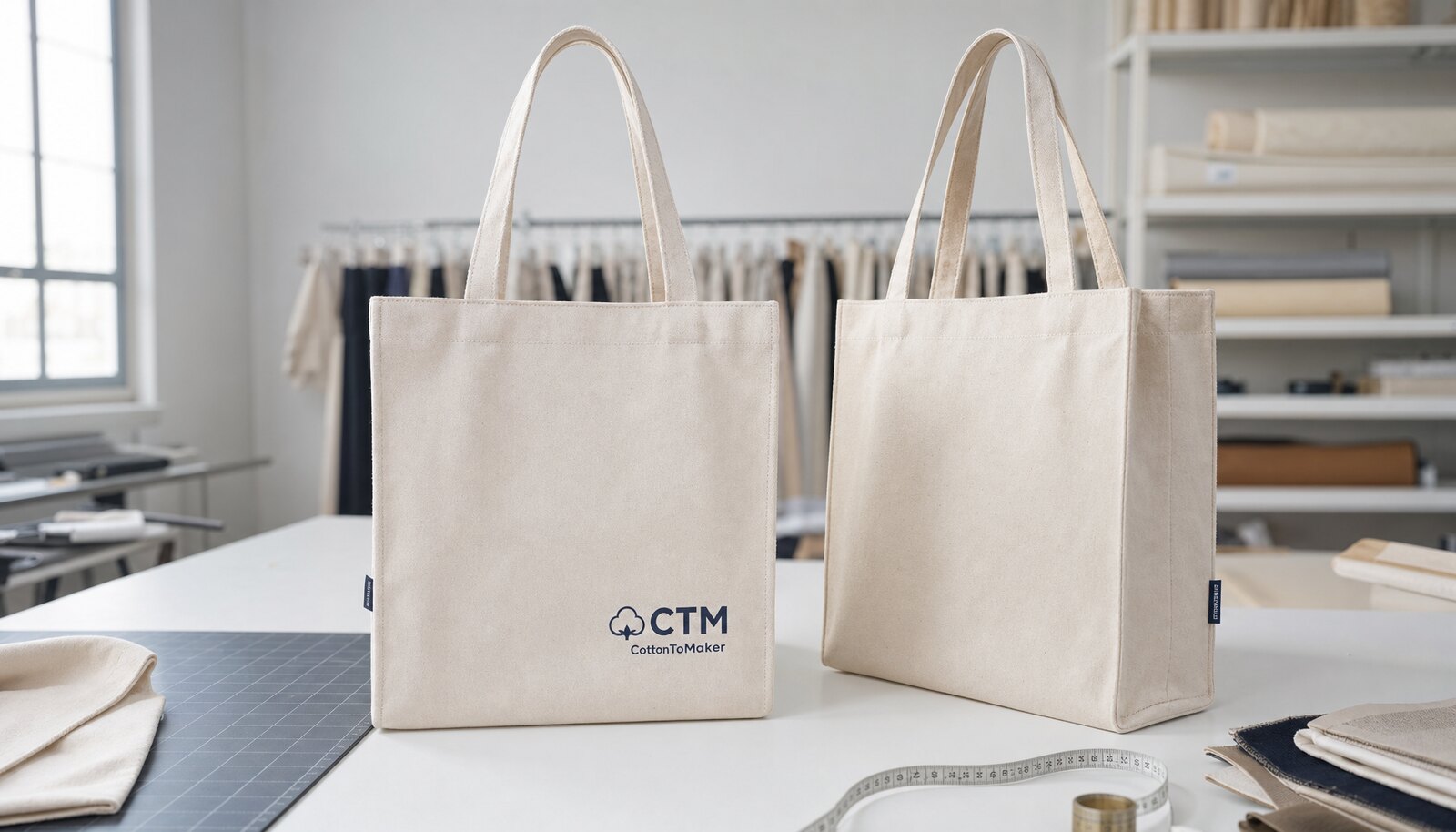
What bookstores need from an exhibition tote
For bookstores, the buying problem is not simply 'which tote looks best.' The bag has to work as a carry item, a brand carrier, and a retail product that feels worth keeping. Exhibition totes used for book launches, author events, membership gifts, and seasonal campaigns often carry hardcovers, paperbacks, bookmarks, and small gift items, so the structure needs more than a basic giveaway bag. If the canvas is too thin, the bag looks cheap and folds oddly on the shelf. If the print is too heavy, it can crack or feel plastic when the customer carries it every day.
Start with the use case before artwork. A bookstore tote that will sit beside a register and be sold as a branded item needs cleaner stitching, straighter print placement, and a more controlled hand feel than a one-off event tote. Most buyers do well with a natural canvas body, reinforced handles, a simple logo field, and a size that fits books without collapsing. A common retail-friendly starting point is 38 x 42 cm or 40 x 45 cm with an 8 to 10 cm gusset, but the right dimension depends on whether you want A4 books, hardcovers, or mixed retail carry.
- Treat the bag as a repeat retail item, not a disposable promo item, if it will be sold at the counter.
- Confirm whether the bookstore wants a neutral everyday look or a campaign graphic that only works for one season.
- Make the bag size match the product mix, especially if boxed gifts or hardcovers will be packed inside.
Start with the fabric weight and bag construction
Canvas weight drives both print quality and perceived value. For bookstore exhibition totes, 10 oz to 12 oz canvas, roughly 340 to 400 GSM, is the practical middle ground for most retail programs. At that weight, the bag has enough body to stand up during display, but the fabric still accepts screen print cleanly. If the bag is meant for heavier books or frequent reuse, go toward 12 oz or add reinforcement at the handle and bottom seam. If the order is purely for an event handout and the buyer wants a lower cost, 8 oz to 10 oz may be enough, but the bag will look softer and feel less premium.
Construction matters as much as cloth weight. Ask for a turned hem at the top, reinforced cross-stitch or box stitch at handle points, and a bottom seam that does not twist when the bag is loaded. If the design includes a gusset, confirm whether the gusset is folded from one panel or sewn in as a separate panel; that changes both cost and durability. A bookstore tote is judged quickly by how it hangs on a hook, so straight seams and balanced handles often matter more than a slightly lower unit price.
- 10 oz canvas is usually the floor for a retail tote that needs a clean shelf appearance.
- 12 oz canvas is the safer choice if the bag will carry multiple books or be reused often.
- Reinforced handles and a stable gusset reduce complaints more than a small change in print method.
Which print method fits the artwork and the order size
The best print method depends on three variables: artwork complexity, order volume, and how the buyer wants the bag to feel in hand. For a bookstore logo with one or two spot colors, direct screen print is usually the best commercial choice. It gives the sharpest edges, the lowest unit cost at volume, and the most predictable repeat order. For a campaign illustration with gradients, small type, or multiple colors, transfer methods can reduce setup time, but the buyer should accept a more layered feel on the canvas and a higher risk of edge lift over time.
The method also changes the sourcing workflow. A bag factory with in-house printing keeps accountability simpler because sewing, print, and packing stay in one place. If the print is outsourced, you may get faster artwork flexibility but more handoff risk. That matters on bookstore programs because the product is often tied to a date-sensitive event, a title launch, or a retail promotion with no room for rework. The cheapest method is not the best method if it misses the campaign date or prints the logo in the wrong position.
- Use screen print for simple logos, repeated bookstore branding, and reorder stability.
- Use transfer or DTF only when the artwork needs fine detail or the first order is small.
- Keep one method locked for repeat orders so the brand does not drift between seasons.
How the print methods compare in practice
A buyer should compare methods the way a factory compares them: by setup, color count, registration, and failure risk. Screen print wins on cost and durability when the artwork is stable. Water-based screen print gives a softer hand but needs stronger artwork contrast and better ink control. Heat transfer and DTF are useful when the buyer wants more detail or a small trial run, but they usually cost more per unit and may sit more on the surface of the fabric. For bookstore totes, that surface look is acceptable for a launch bag, but less ideal for a premium retail line that is meant to age well.
Do not let the factory quote only the print method name. Ask what exact inks, mesh count, transfer film, curing method, and placement tolerance they use. A good screen print quote on paper can still produce a poor bag if the factory uses too much ink, the artwork is too fine for the mesh, or the print area sits over a seam. The buyer should treat the print sample as the decision point, because the fabric weave and tote structure change the result more than many new buyers expect.
- Screen print: best for simple branding, repeat orders, and clean unit economics.
- Water-based screen print: best for a softer premium feel, but not every canvas color supports it well.
- DTF or heat transfer: best for short runs, full-color art, and trial campaigns.
MOQ logic and cost drivers that change the quote
MOQ should be treated as a function of setup, not a random factory number. Screen print needs screen making, alignment, curing, and sometimes color separation, so the supplier wants enough pieces to spread that setup cost. That is why a 1,000-piece screen-printed order often looks much more efficient than a 200-piece transfer run. If the buyer is testing the bookstore market or ordering for a single event, a small run can still make sense, but the unit cost will be higher and the quote should be compared as a test budget, not as a long-term price benchmark.
The biggest cost drivers are fabric weight, bag size, color count, artwork coverage, and packing standard. A large, full-bleed print across a 12 oz canvas tote will usually cost more than a small one-color logo on the front panel, even if both are the same bag size. Add lining, inner pockets, or a custom label, and the quote can move quickly. Buyers should ask the factory to separate material, sewing, print, packing, and freight so they can see where the money is going and where a spec change would actually lower cost.
- Higher canvas GSM increases both material cost and the chance that the bag feels premium enough for retail.
- More colors can raise setup cost faster than they raise material cost.
- Full-panel coverage usually pushes the quote up more than a simple logo field.
What to send in the RFQ so quotes are comparable
A useful RFQ for bookstore totes should remove guesswork. Send the exact finished size, fabric weight target, handle length, gusset depth, logo artwork in vector format, and the print placement drawing with measurements from the bag edge. If you want the supplier to compare screen print and transfer, say so explicitly and ask for a quote under each method. Without that, some factories quote the cheapest route they can make, not the best route for your artwork. If the bookshop is selling the tote at retail, also specify whether the bag needs a side label, hangtag, barcode sticker, or individual polybag.
The RFQ should also explain the commercial intent. A tote for a one-day author event is not the same as a tote sold all year in a chain bookstore. Tell the supplier whether the bag needs to survive repeated use, whether the print should feel soft or bold, and whether a reorder is likely. That changes how the factory selects ink, whether they keep screens or files for repeat production, and how they structure the price. If the supplier cannot answer those points clearly, the quote is not ready for comparison.
- Include one reference photo of the look you want, but also give measurable specs.
- State the first-order quantity and the expected reorder range separately.
- Ask for material, sewing, print, packing, and freight to be broken out where possible.
Sample approval and QC thresholds that prevent rework
The sample stage should prove more than the logo placement. For canvas exhibition totes, request a blank sewn sample first if the bag structure is new, then a printed strike-off or pre-production sample once the final artwork is set. Check the way the bag stands, how the handles balance, whether the gusset opens properly, and whether the print sits flat across the weave. A logo that looks fine in a digital proof can become fuzzy on real canvas if the mesh is too open or the transfer film is too rigid.
Set acceptance criteria before mass production starts. For example, define the approved print area, the acceptable shift from the centerline, the allowed color tolerance, and the minimum stitch quality at the handle attachments. The point is not to create a lab document; it is to stop a factory from deciding quality on its own terms. When the tote will be sold in a bookstore, small defects are visible at the counter and often become retail rejects even if they are technically within a loose factory standard.
- Approve a physical sample for both structure and print before bulk production.
- Use the same lighting to judge color every time, ideally daylight or a controlled white light.
- Keep one signed master sample with the confirmed artwork and one with the approved packing style.
Packing, barcodes, and shelf-ready presentation
Bookstore buyers often focus on the tote itself and leave packing as an afterthought. That creates trouble later. If the bag is sold at retail, the way it is folded, inserted, and labeled affects the shelf appearance and the labor at the receiving dock. A clean fold with a consistent crease is better than a random stuffed pack, and a barcode sticker or hangtag should be placed where store staff can scan it without opening the bag. If the tote is a giveaway, a simpler bulk pack can work, but the carton count still needs to be stable and easy to receive.
Ask the factory for carton dimensions, piece count per carton, net weight, gross weight, and whether cartons are double-walled for export. That information helps compare landed cost and warehouse handling. If the bags are going to a bookstore chain, carton labels should match the purchase order format used by the buyer's receiving team. A bag that prints well but arrives in the wrong pack configuration creates avoidable labor cost and sometimes delays store rollout.
- Agree on folding direction and piece count per inner pack before sample sign-off.
- Confirm whether the bag will ship flat, folded, polybagged, or loose in cartons.
- Make carton labels and SKU data part of the production spec, not an afterthought.
Lead time, capacity, and schedule risk
Lead time is where many tote programs slip. Screen print needs screen making, sample approval, fabric booking, sewing, printing, curing, packing, and export handling. If artwork changes late, the factory often has to restart one of those steps. A transfer order may seem faster, but only if the film supplier, printer, and bag factory are all aligned. Buyers should not assume the shortest quoted lead time is the safest one; they should ask what parts are in-house, what parts are subcontracted, and what would delay the order if the sample is not approved on the first pass.
For bookstore launches tied to event dates, the schedule should include buffer time for sample correction and freight disruption. If the tote is part of a seasonal campaign, build the order backward from the shelf date rather than from the factory promise. A practical schedule includes a sample window, a bulk production window, and a packing and dispatch buffer. If the supplier cannot identify where the critical path sits, the buyer is carrying all the schedule risk.
- Ask which steps are internal and which are outsourced.
- Build in one sample revision cycle if the artwork is not already proven on the chosen canvas.
- Do not lock the campaign date until you have a confirmed production slot.
Landed-cost comparison and the final sourcing decision
The best buying decision is not always the lowest ex-factory quote. A retail tote can look cheap on paper and expensive after print rework, packing changes, and freight. Compare landed cost by looking at the full chain: fabric and sewing, print setup, packing labor, carton volume, and transport. A direct screen print from the bag factory often gives the most stable landed cost on medium and larger orders. A transfer-based order can be better for a trial run, but if the bookstore plans to reorder the same design, the unit economics usually improve once screens and approvals are fixed.
Use the final decision to match the product to the channel. If the tote is a premium retail item, the buyer should bias toward better canvas weight, simpler artwork, and a print method that survives repeated handling. If the tote is a time-sensitive event bag, speed and artwork flexibility may matter more than the softest hand feel. The right answer is the one that meets the store's merchandising goal without creating a hidden production problem. That is why the buyer should compare methods as sourcing routes, not as decoration labels.
- Compare quotes on the same fabric weight, same bag size, and same packing standard.
- Treat setup fees as part of the landed cost, especially on lower MOQs.
- Choose the route that supports repeat orders if the bookstore program is expected to continue.
Specification comparison for buyers
| Spec decision | Recommended option | When it fits | Buyer risk to check |
|---|---|---|---|
| One-color bookstore logo on natural canvas | Direct screen print from the tote factory | Best for large logos, simple marks, and repeat orders at 500 pcs or more | Ink thickness can feel heavy if the print area is too large or the mesh is too coarse |
| Two to four spot colors with clear edges | Multi-screen spot-color printing | Works for event graphics, reading campaign art, and clean brand marks | Color registration and artwork trapping need approval on a real strike-off, not a digital mockup |
| Full-color illustration or gradient artwork | Heat transfer or DTF from a confirmed decorator | Useful for short runs, seasonal art, and bookstore illustration campaigns | Edge lift, plastic hand feel, and wash durability can be weaker than screen print |
| Soft premium hand feel on natural canvas | Water-based screen print | Fits boutique retail bags where buyers care about a softer finish | Opacity can drop on darker canvas and fine lines may fill in |
| Small detailed logo with tiny text | Woven label, patch, or a very small print panel | Best when the main logo is too detailed for canvas printing | Small text below about 6 pt often fails after sewing and washing |
| Short-run launch or trial order | Digital transfer through a factory with stable film supply | Useful for 100 to 300 pcs when the buyer wants to test demand first | Unit cost rises fast and the transfer supplier may sit outside the bag factory's quality control |
| Reorder for a chain bookstore program | Direct screen print with retained screens and approved master sample | Best when the same art repeats across seasons or stores | Screens, inks, and placement records must be stored or the reorder can drift |
| One supplier versus split sourcing | Bag factory with in-house printing when possible | Best when the buyer needs one point of accountability for sewing, print, and packing | Split sourcing adds handoff risk, longer lead time, and unclear blame if print or sewing fails |
Buyer checklist before sampling
- Confirm the bag size, gusset, handle length, and target book load before asking for a quote.
- State the fabric weight in oz or GSM, not just 'canvas', and note whether the bag must stand upright on a shelf.
- Send vector artwork, Pantone references, and the exact print area with placement measurements.
- Choose the print method based on artwork complexity, order size, and whether the bag is a retail item or an event giveaway.
- Ask for a printed strike-off or pre-production sample, not only a blank sample.
- Agree on acceptable print shift, color variation, loose threads, seam strength, and carton pack before production starts.
- Specify whether the bag needs a woven side label, barcode sticker, hangtag, or polybag for retail presentation.
- Clarify overrun or underrun tolerance, lead time after sample approval, and the shipping term used in the quote.
- Request carton dimensions and gross weight so you can compare landed cost and warehouse handling.
- Keep one signed master sample and one signed artwork sheet for reorder control.
Factory quote questions to send
- Is the printing done in-house at the bag factory, or is it subcontracted to another decorator?
- What is the MOQ for each print method, and how does the unit price change at 300, 500, 1,000, and 3,000 pcs?
- What fabric weight, yarn count, and finished bag size are included in the quote?
- How many colors can you print cleanly on this canvas without losing edge definition?
- Can you send photos of a blank sample, a printed sample, and the packaging standard you will use?
- What are your tolerances for print placement, print size, and seam alignment?
- What is the sample fee, and is it deductible from the bulk order after approval?
- What lead time do you need after sample sign-off, and what happens if the artwork or fabric is changed later?
Quality-control points to confirm
- Check fabric weight against the agreed spec in oz or GSM and reject obvious underweight cloth.
- Inspect seam strength at the handle attachments and bottom seam, especially if the bag will carry books.
- Verify print placement, size, and registration against the signed artwork sheet.
- Confirm that solid ink areas are even, with no pinholes, smudging, or bleeding into the weave.
- Review color against the approved strike-off under daylight or a controlled light source.
- Check loose threads, broken stitches, skipped stitches, and needle damage along the top hem and handles.
- Measure finished dimensions and gusset depth after packing, not only on a flat sample.
- Verify carton count, inner pack quantity, barcode or carton label accuracy, and moisture protection if the route is long.