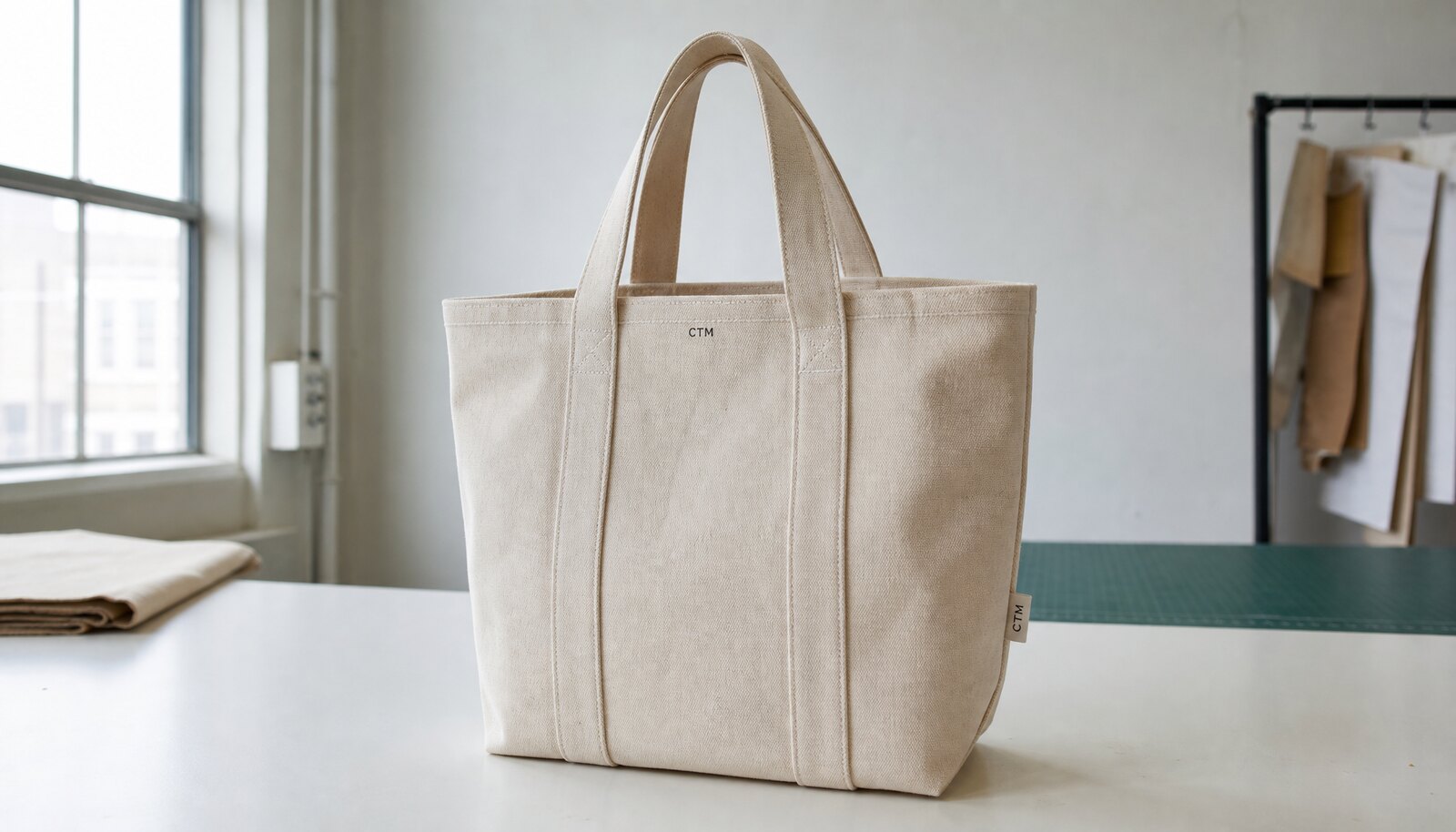
Why bookstore totes need a different material spec
Canvas exhibition tote bags for bookstores are not generic promotional totes. They are expected to do three things at once: carry books safely, look presentable on a checkout counter or display table, and support a margin structure that still works for resale, gifting, or event distribution. That combination makes material selection more important than in many other tote programs.
A bookstore tote usually sees a different type of wear than a supermarket bag or a trade-show handout. Hard book corners stress the base, stacks of paper goods push on the side seams, and customers often keep the bag for repeated use because the branding is tied to the store or event. If the canvas is too light, the tote can look limp; if it is too heavy, it raises cost and shipping weight and may fold poorly for retail display.
The main sourcing error is starting with decoration instead of construction. Buyers often ask for the logo first, then treat the bag as a blank commodity. In practice, fabric weight, weave tightness, seam allowance, handle type, and packing format all influence whether the tote is good enough for a bookstore assortment. A strong RFQ should describe the bag as a finished retail item, not as a print surface with handles.
- Treat the tote as a product line, not only a printing job.
- Balance shelf presentation, carrying strength, and freight cost together.
- Write the RFQ around end use: resale, event giveaway, or premium merch.
Start with the right canvas weight and weave density
For most bookstore programs, 12 oz canvas, roughly 340 gsm, is the practical starting point. It gives enough body for books and gift items while staying flexible enough to fold and store. If the tote is sold as a higher-value merchandise item, or if it regularly carries heavier hardcovers, 14 oz canvas, roughly 400 gsm, is often the safer choice. Lighter canvas can work for low-cost events, but it can start to look thin once printed and loaded.
Do not rely on nominal weight alone. Two fabrics can both be labeled 12 oz and still behave differently if one has tighter weave density, better yarn quality, or lower shrinkage after finishing. Ask the factory to state whether the canvas is pre-shrunk, enzyme-washed, mercerized, bleached, or left in a natural finish. These details affect size stability, print sharpness, and how the bag feels in hand.
For bookstore buyers, the most useful fabric question is not 'what is your canvas weight?' but 'what actual fabric lot are you quoting, and what tolerance do you hold?' If the supplier cannot define that clearly, the bulk order may drift from the approved sample. That is especially risky when the bag uses centered artwork or precise logo placement.
- Use 12 oz / about 340 gsm as a starting point for general retail.
- Move to 14 oz / about 400 gsm for heavier books or a more premium hand feel.
- Request measured gsm, not a vague weight claim.
- Ask whether the canvas is pre-shrunk or finished in a way that controls size change.
Select the body structure for display, load, and shelf appeal
A gusseted tote is usually the right choice for bookstore merchandising because it stands better on a table and holds books more naturally than a flat bag. A base gusset gives the tote a boxier silhouette, which helps the bag look finished when displayed full or partially full. Side gussets also reduce strain on the side seams by creating more internal volume for hardback spines and boxed sets.
If the tote will be used in a premium bookshop, museum store, or exhibition booth, a slightly deeper base and cleaner edge finishing can improve shelf presence. The bag does not need to feel bulky, but it should not collapse into a thin panel when placed upright. Buyers often underestimate how much retail presentation affects sell-through, especially for a tote that is sold next to books and gift items.
Construction choices should be tied to the product role. A flat tote may save a little money, but if the bag is intended to stand on a display table or be sold as a branded accessory, a structured gusset often earns back its cost in perceived value. Put differently: a better shape can be a merchandising tool, not just a sewing detail.
- Choose a gusseted body if shelf presentation matters.
- Ask for a flat base or box base when the bag should stand upright.
- Keep structure moderate if the tote must still fold flat for checkout or shipping.
Handle type and reinforcement decide how the bag feels in use
Handle construction affects both comfort and failure rate. Self-fabric handles are economical because they use the same canvas as the body, but they can feel narrow or stiff if the tote carries heavy books. Webbing handles, usually cotton or polyester, cost more but can distribute load more comfortably and often look cleaner on premium programs. The best choice depends on the expected carry weight and the brand position of the bookstore.
The buyer should not accept a handle description that stops at 'long handles' or 'short handles.' Ask for handle width, handle length, handle drop, and attachment method. Reinforcement matters as much as length. Bar-tacks, boxed stitching, or double-row stitching at the attachment points reduce stress failures. A tote that looks fine on day one can still fail early if the top seam and handle junction are underbuilt.
A useful way to think about handle specification is to connect it to real use. If customers will carry one paperback and a magazine, a simple self-fabric handle may be enough. If the bag will carry several hardcovers or a gift set, a wider webbing handle and stronger top reinforcement are worth the added cost. The quote should show that tradeoff clearly rather than hiding it in a lump sum.
- Ask for handle width, length, drop, and reinforcement method in writing.
- Use wider webbing handles for heavier loads or premium merch.
- Check that attachment points have bar-tacks or equivalent reinforcement.
Print method should match artwork complexity and reorder plans
For most bookstore totes, screen print is still the most practical decoration method. It gives good coverage on canvas, handles one- or two-color artwork well, and is usually easier to repeat on reorder runs than more complex decoration methods. It is especially suitable when the logo, slogan, or exhibition graphic uses bold typography and clear shapes. The key is to approve the strike-off, not just the artwork file.
Heat transfer can be useful when the artwork is detailed, the run is small, or the buyer wants more image complexity than screen print can comfortably handle. However, buyers should treat it as a process choice with a durability tradeoff, not as a default upgrade. For totes that will be used repeatedly, ask the supplier how the transfer behaves under rubbing, folding, and normal handling. If the print is part of the product’s retail value, that durability question matters.
Embroidery and woven labels work well when the brand wants a restrained, premium look. A small woven label at the side seam or a stitched mark near the top can support identity without increasing the size or cost of the decoration too much. The best decoration method is the one that fits both the artwork and the selling channel, not the one that sounds fancier in the quote.
- Use screen print for simple logos and repeatable retail orders.
- Use heat transfer only when the artwork or volume justifies the tradeoff.
- Consider woven labels or small embroidery for premium or understated branding.
- Specify one side or two side decoration, plus exact placement distances from seams and top edge.
A buyer-friendly RFQ should make the quote comparable
A good quote is one that can be compared without follow-up guesswork. For canvas exhibition tote bags for bookstores, the RFQ should define finished size, canvas weight, handle type, print method, artwork count, packing style, and approximate order quantity. If one factory assumes a 10 oz bag, another assumes 12 oz, and a third adds webbing handles by default, the quotes are not actually comparable.
The RFQ should also include a simple measurement diagram or annotated sketch. That drawing does not need to be fancy; it just needs to show body width, height, gusset depth, handle length, and logo placement. When the factory sees the same diagram, you reduce the risk of vague interpretation. This is one of the fastest ways to improve price accuracy and sample alignment.
Artwork files matter too. Send vector artwork when possible, note Pantone references if color match matters, and identify any fine text or thin lines that may not reproduce well on canvas. Ask the supplier to confirm whether the file needs to be simplified for screen printing. That saves time and makes the sample stage more meaningful.
A useful RFQ also asks for packed carton data. Unit price alone does not tell you enough. Carton count, carton size, gross weight, and packing method all influence freight. A tote that folds efficiently and packs densely can be cheaper landed even if its ex-factory price is slightly higher.
Finally, ask the factory to state what is included and what is not included. Common gaps include sample fees, label costs, carton marks, inner polybags, barcode stickers, and special packing requests. Clear inclusions are the easiest way to prevent quote surprises later.
- Attach a simple measurement diagram.
- Send vector artwork and note Pantone or visual color references.
- Ask for line-item pricing where possible.
- Request carton dimensions and unit count in the first quote round.
Use sourcing route logic instead of only chasing the lowest unit price
The sourcing route should match the buying problem. Factory direct is usually the strongest fit when the bookstore chain, distributor, or brand wants control over fabric selection, sewing quality, and reorder consistency. If you need stable private-label execution and plan to reorder, factory direct usually gives the clearest path to repeatability—provided the buyer can manage the spec and follow-up discipline.
Trading companies or sourcing agents can make sense when the buyer wants to reduce coordination work, combine several product categories, or source through a single commercial contact. The tradeoff is visibility. You may get a simple answer quickly, but less detail on which factory is making the bag, which fabric lot is being used, and how the production is being controlled. That is not a problem if the agent is strong and transparent, but the buyer should still ask for underlying fabric and process details.
Domestic decorators are a different tool. They are useful when speed matters more than landed cost, such as store openings, event deadlines, or small test programs. They can also help buyers validate artwork before committing to a larger import order. But they are rarely the right benchmark for a scaled tote program because blank bag selection, decoration cost, and freight structure differ sharply from factory-direct import sourcing.
The main procurement question is not 'which route is cheapest?' It is 'which route is the most reliable way to buy the same tote twice?' For bookstore merchandise, consistency across the first order and the reorder often matters more than winning the lowest first quote by a small amount.
- Use factory direct for repeatable private-label programs.
- Use a trading company when you need coordination more than raw factory transparency.
- Use domestic decoration for urgent or very small runs, not as the default pricing benchmark.
Compare supplier options on control, speed, and landed cost
Supplier comparison should go beyond unit price. For bookstore totes, the buyer needs to compare how each sourcing route handles fabric control, sample turnaround, print repeatability, carton efficiency, and reorder consistency. A supplier that communicates clearly and documents the spec may cost a little more on paper but save money by reducing error risk and freight surprises.
The table below expands the practical decision criteria buyers actually use. The goal is not to pick the 'best' route in the abstract. It is to match the route to the order size, timeline, artwork complexity, and internal procurement bandwidth. Use it to narrow your field before you request samples.
One useful discipline is to ask every supplier to quote the same finished size, same artwork file, same packing style, and same carton target. Then require at least one physical sample or a clearly identified strike-off. If a supplier cannot work from that level of detail, the quote is too soft to use in a serious comparison.
- Compare routes using the same exact spec version.
- Ask for sample photos plus physical approval where the order is important.
- Keep all RFQ and sample notes tied to one revision-controlled document.
Sampling should prove size, hand feel, and print before mass production
A sample is not just a display piece; it is a process check. For bookstore canvas totes, the sample should show whether the fabric has the right body, whether the print sits cleanly on the weave, and whether the bag carries weight without pulling the seam line out of shape. If those three things do not work together in the sample, they rarely improve in bulk production.
The sample path should usually start with a fabric swatch or mill standard, then a print strike-off if decoration is involved, and then a pre-production sample built from the intended bulk process. That sequence matters because it separates material approval from sewing approval. Buyers who skip one of those steps often end up discovering problems too late, such as logo distortion after stitching or a handle length that feels wrong once the tote is actually loaded.
Measure the sample in a disciplined way. Check dimensions after sewing and after any pressing that the factory will use before packing. Measure handle drop so shoulder carry is realistic. Confirm logo placement from the top edge and side seam, not only by eye. If the tote has a standing base, test whether it stands upright with the intended book weight. If the bag is meant to fold flat, confirm that the structure still packs efficiently.
This is also the right stage to verify labels and packaging. If the bag needs a care label, barcode sticker, or country-of-origin mark, sample it now. The cost of a misplaced label is tiny compared with the cost of relabeling an entire order.
- Approve fabric before approving sewing details.
- Test the sample with a realistic book load, not just by hand.
- Check label placement, barcode position, and retail presentation during sampling.
Packing, carton data, and freight can change the landed cost meaningfully
Packing is often treated as an afterthought, but it can change your freight cost and warehouse handling work. A tote packed efficiently with a clear folding method, size-sorted inner bundles, and well-marked cartons can ship more economically than a loosely packed product with decorative extras. If the tote includes individual polybags, belly bands, hang tags, or special inserts, these should be part of the quote from the start.
Carton data is especially important for import buyers. Two quotes can have similar unit prices and very different landed costs if one supplier packs the same number of totes in a smaller carton. Ask for packed dimensions, gross weight, and pieces per carton. If the factory can provide a carton loading plan, even better. That allows freight comparison before the PO is locked.
Lead time should also be broken into stages rather than quoted as one vague number. A realistic schedule may include fabric reservation, artwork approval, sample making, bulk production, packing, inspection, and shipping booking. The longest step is not always sewing. Custom canvas, custom color matching, or a complicated print job can slow the schedule more than the bag construction itself.
Buyers should be cautious with unsupported 'fast lead time' claims. What matters is whether the factory can explain exactly what work has to happen before shipment and whether any step is dependent on your approval. A short promised lead time is only useful if it is attached to a controlled process.
- Request carton dimensions, gross weight, and pieces per carton in the quote.
- Keep packaging simple unless retail presentation requires more.
- Build time buffers into the schedule for artwork and sample approval.
- Treat packed cube as part of the landed-cost calculation, not just unit cost.
Specification comparison for buyers
| Decision area | Supplier / spec option | Best fit for bookstore programs | Cost and risk considerations |
|---|---|---|---|
| Factory direct | Quote directly from the bag factory with fabric spec, construction details, and packed carton data fully itemized | Stable reorder programs, private-label bookstore chains, and buyers who need control over material, stitch, and print consistency | Lowest transparency risk if the factory is mature; usually better for repeat orders, but sample and communication discipline are essential. Price can rise if the spec is incomplete or if the factory must source special fabric, lining, or labels. |
| Trading company / sourcing agent | One contact manages multiple factories and coordinates spec, sampling, and shipment | Buyers who want lower internal workload, mixed product sourcing, or help consolidating several SKUs | Often easier to manage, but the buyer may see less detail on fabric origin, subcontracting, or process control. Unit price can include coordination margin, and reorder consistency depends on the underlying factory. |
| Domestic decorator / local bag printer | Local printer or decorator buys blank totes and applies logo decoration after the blank bag is sourced | Short lead-time events, small campaigns, or urgent store openings where freight time is the limiting factor | Good for speed and communication, but blank tote choice may be limited and landed cost per unit is often higher. Useful for small runs, not usually the best benchmark for import programs. |
| 10 oz / about 280 gsm canvas | Lighter woven cotton canvas with simpler construction | Giveaways, handout bags, or very low-budget event use where the tote carries only light items | Lower material cost, but the bag may sag, show print distortion, or feel too soft for hardcovers. Not ideal if the tote is sold as retail merchandise. |
| 12 oz / about 340 gsm canvas | Mid-weight canvas with acceptable body and durability | Most bookstore retail totes, author events, museum shops, and general merchandising programs | Usually the practical starting point for balance of feel, carry strength, and folding behavior. Ask suppliers for measured gsm tolerance and shrinkage control, not just a nominal weight. |
| 14 oz / about 400 gsm canvas | Heavier canvas with stronger structure and a more premium hand feel | Premium merch, heavier book loads, or brand programs where the tote is part of the perceived value | Higher sewing load, higher fabric cost, and more carton weight. Good for premium positioning, but freight and labor increase. |
| Self-fabric handles | Handles cut from the same canvas body material | Price-sensitive retail totes and simple branding programs | Clean and economical, but comfort depends on width and stitch quality. Narrow self-fabric handles can feel harsh if the bag is loaded with heavy books. |
| Webbing handles | Cotton or polyester webbing sewn onto the body | Heavier loads, better shoulder comfort, or a more finished retail appearance | Adds line-item cost and needs clear spec on width, color, and bar-tack reinforcement. Better for durability than very thin self-fabric handles. |
| Screen print | One- or two-color direct print on canvas | Most bookstore logos, event slogans, and repeat programs with stable art files | Usually the best balance of cost, readability, and durability for simple artwork. Needs a strike-off and ink cure control; misregistration or poor curing will show up in use. |
Buyer checklist before sampling
- Define the use case before you ask for prices: resale tote, membership gift, author-event giveaway, or co-branded exhibition bag. The load, print quality, and packing choice should follow that use case.
- State finished size in millimeters or centimeters, not only a general description like 'medium tote.' Include body width, height, gusset depth, handle length, and handle drop if shoulder carry matters.
- Lock the canvas weight in gsm or oz and define whether the fabric must be pre-shrunk, enzyme-washed, dyed, bleached, or left natural.
- Specify the artwork file format and art count: vector file preferred, Pantone references if needed, number of print colors, and whether the decoration is on one side or both.
- Ask for a measurement diagram before sampling so every factory quotes the same tote geometry. Include seam allowance, base depth, and handle attachment position.
- Define acceptance tolerances for size, color, print position, and stitching before the production sample is approved.
- Request carton dimensions, carton count, gross weight, and packed unit count so you can compare freight impact, not only unit price.
- Confirm labeling needs early: care label, country-of-origin mark, barcode sticker, and retail ticketing.
- Ask for sample stages in writing: fabric swatch, print strike-off, pre-production sample, and pre-shipment sample if the order is large enough to justify it.
Factory quote questions to send
- What is the exact fabric specification you are quoting: canvas weight in gsm or oz, yarn count if available, weave style, shrinkage allowance, and whether the material is pre-washed or pre-shrunk?
- Can you quote the bag on a line-item basis for fabric, cutting, sewing, printing, labels, packing, and cartons so we can compare suppliers on the same basis?
- Which decoration method are you pricing, and what is included in the base price: one-color screen print, multiple screens, embroidery, woven label, or heat transfer?
- What is the minimum order quantity per color, per artwork version, and per fabric finish? Please state whether the MOQ changes if we change the print count or handle type.
- What handle construction is included: self-fabric handles, cotton webbing, handle width, handle length, attachment method, and bar-tack count?
- What size tolerance and print placement tolerance do you guarantee after bulk sewing and final packing?
- Do you provide a pre-production sample made from bulk-material equivalent fabric, or only a reference sample?
- What are the packed carton dimensions, gross weight, and unit count per carton for this exact spec?
- What lead time applies after sample approval, and which steps can extend it: fabric sourcing, print strike-off, dye matching, or export booking?
- What QC standard do you use for seam strength, print alignment, loose thread trimming, and packing cleanliness?
Quality-control points to confirm
- Fabric verification: confirm that the bulk fabric matches the approved swatch for weight, weave density, hand feel, and color. If possible, measure gsm across at least three points per roll to catch variation rather than relying on a single average.
- Size check: measure finished body width, height, gusset depth, and handle length on a random sample. Set clear tolerances in the PO. For a retail tote, a common procurement approach is to hold critical dimensions tighter than decorative dimensions, especially if shelf presentation matters.
- Shrinkage and distortion test: if the bag is expected to be washed or steam pressed, test one sample for dimensional change and seam twist after a controlled wash or wetting cycle. Reject excessive shrinkage that changes logo position or makes the tote skew.
- Handle attachment strength: inspect bar-tacks, stitch density, and seam backstitching at the top edge. A practical acceptance check is to load the bag with a representative weight and observe for seam popping, stitch elongation, or handle tilt. Any early loosening at the attachment point is a production risk.
- Load behavior: load the tote with books that match the intended use case—paperbacks for light use, mixed hardcovers for retail use, or a heavier book set for gift programs. The bag should hang evenly, stand acceptably if that is part of the spec, and not twist at the seams.
- Print QC: inspect for registration, edge clarity, ink coverage, and curing consistency. On light canvas, watch for bleed-through or strike-through. On dark or dyed canvas, verify opacity and that the print does not wash out visually against the base fabric.
- Color control: compare print color against the approved Pantone or visual reference under consistent lighting. Document whether a delta tolerance is acceptable and whether batch-to-batch variation is allowed for reorders.
- Thread and seam finish: check for loose threads, skipped stitches, puckered seams, uneven seam allowance, or visible overlock failure. For retail merchandise, a few minor flaws may be acceptable; for premium bookstore branding, the threshold should be much tighter.
- Construction symmetry: the left and right panels should match, and the bag should not lean when set down if a standing base was specified. Misaligned gussets or skewed base seams are common reasons for downgrade.
- Surface cleanliness: look for oil marks, water marks, dust, lint, and fold creases that do not release. Canvas totes often ship folded, but stains and residue are not acceptable.