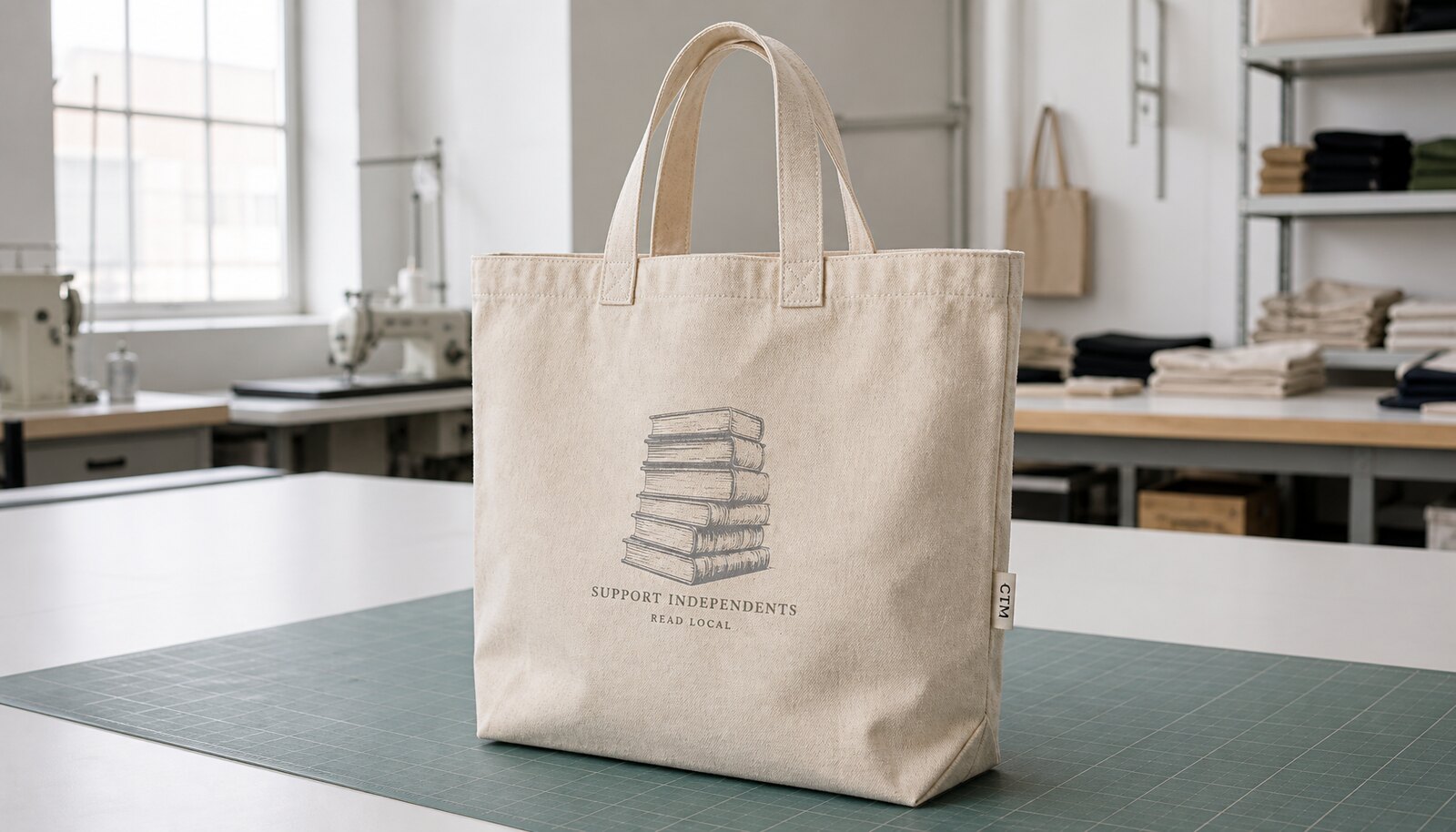
Start With the Event Use, Not the Bag
For bookstore events, the bag is usually a carrier for books, catalogs, postcards, membership forms, and a small giveaway set. That sounds simple, but the bag spec changes fast once you define the actual use. A tote handed out at a signing table for one afternoon does not need the same construction as a bag that will live in a customer's car and be reused all year. The best buying result comes from matching the build to the event, not from choosing a generic canvas tote and hoping it fits.
When buyers say canvas exhibition tote bags for bookstores event giveaway planning, the real question is whether the tote must create brand visibility, survive a heavier load, or simply control cost for a large attendance count. If the bag is meant to carry one hardback and a flyer pack, the spec can stay light. If it must carry two books, a catalog, and a product sample, the body, handles, and seams need more margin. Clarify the use case first and the rest of the spec becomes easier to price and compare.
- Define the giveaway life span: one event, one season, or retail reuse.
- Set the heaviest load item before you choose fabric weight.
- Include 5 to 10 percent overage for spoils, replacements, and no-shows.
Pick Fabric Weight and Build Before You Talk Print
Canvas weight is one of the first choices that affects both cost and perception. For lightweight bookstore giveaways, 8 oz canvas, roughly 270 gsm, can be enough if the bag only carries paper goods or a slim book. Around 10 oz, or about 340 gsm, is a common middle ground for standard event totes because it feels sturdier without pushing the price too far. Once you move to 12 oz, about 400 gsm, the tote starts to feel closer to a premium retail bag and handles heavier books more comfortably. At 14 oz and above, the bag becomes more durable but also more expensive, heavier to ship, and harder to fold neatly for large volume handout.
Construction matters as much as raw fabric weight. A flat tote with no gusset is cheaper, but a 10 to 12 cm gusset improves book fit and makes the tote more usable. Handle length and handle width should match the event format. Short handles work for hand carry, while longer shoulder-drop handles are better for visitors who will walk the show floor or leave with multiple items. Ask for double stitching, bar-tacks at stress points, and a clean seam allowance so the bag does not twist after the first load test.
- 8 oz to 10 oz fits light handouts and keeps freight efficient.
- 12 oz is the safer choice when the bag must hold books without sagging.
- Use gussets and bar-tacks when the tote must be reused beyond the event.
Choose the Print Method for the Artwork
Most bookstore giveaway totes are won or lost on print execution. Screen print is usually the best option for a simple logo because it is durable, repeatable, and cost-effective at higher volume. It also behaves well on natural canvas, where the texture helps the ink look solid. If the art has multiple colors or tight registration, the price and setup time rise quickly, so the buyer needs to know whether the logo can be simplified without hurting brand value. A clean one-color mark often looks stronger on canvas than a busy print that breaks up at the weave.
Heat transfer, digital transfer, or direct-to-fabric methods can help with small runs or more complex art, but they are not automatically the smarter choice. They can raise unit cost, especially if the artwork is full color, and some methods age poorly under folding and abrasion. Embroidery works for smaller logos on thicker canvas, while a woven label or sewn side label is better when the goal is brand presence without large print coverage. Before quoting, send vector art, specify the print area, and state whether a Pantone match is required or whether a close visual match is acceptable.
- Use screen print for simple logos and repeat orders.
- Use transfer methods only when color complexity or low volume justifies it.
- Keep fine lines, tiny text, and thin reversed type out of the first production run.
Build the Quote Around Real Cost Drivers
A useful quote is not a single bag price. It is a breakdown that shows what changes the price and what does not. Fabric weight, size, gusset, handle construction, print colors, label type, and packing format all move the number. If one supplier quotes a tote with no gusset, one-color print, and loose bulk packing while another includes an inner polybag and carton labels, the comparison is meaningless until the line items are normalized. Buyers who skip this step usually think they found a cheaper source when they actually found a thinner spec.
The fastest way to get comparable quotes is to send one data sheet with finished size, fabric GSM or oz, print area, print method, handle length, packaging rules, and destination terms. Add the event date and whether you need a sample before bulk. Ask the factory to show where the price steps change, because the jump from 500 to 1,000 units may be small or very large depending on setup and fabric consumption. Also separate sample fee, mold or screen fee, carton cost, and freight so the real landed cost is visible.
- Normalize size, print method, and packing before comparing unit prices.
- Ask for separate lines on sample fee, setup fee, carton cost, and freight basis.
- Request the price break at each quantity tier, not only the best-case quote.
Compare Sourcing Routes Before You Compare Unit Price
The table above is there for a reason: supplier type changes risk as much as price. A direct factory gives you the most control over fabric, seams, and print, but it expects a clearer spec and usually a more disciplined approval process. A trading company can reduce the coordination burden if you have several SKUs or need one contact for bags, inserts, and labels, yet you should still know who actually cuts, sews, and prints the order. Domestic decorators are useful when the event date is tight and the tote can be standard stock, but their blanks and freight cost can erase the speed advantage on larger runs.
For bookstore event giveaways, the right route depends on how much of the spec is fixed. If the design is simple and the deadline is short, a stock-body supplier with in-house print may be enough. If the event is part of a brand launch and the tote will be reused, a cut-and-sew factory with in-house print and packaging control usually gives the better long-term result. Do not let a low unit price hide a weak sourcing route. A quote that looks cheap can turn expensive when you add misprints, repacking, or reorders caused by a supplier who did not control the whole build.
- Use direct factory sourcing when the spec is custom and repeatable.
- Use a trading company when you need one point of control across several product types.
- Use domestic or stock-body routes only when speed matters more than custom construction.
Approve the Sample Like a Production Tool
A sample is useful only if it reflects the same fabric, print method, and construction that will be used in bulk. Photos are not enough. Ask for a pre-production sample that shows the final canvas weight, actual print placement, sewn label, and finishing details. Then measure it. Check the width, height, gusset, and handle drop against the approved drawing, because the bag can look correct but still shrink or stretch during sewing. If the tote will carry books, load it with the heaviest expected item and see how the handles sit and whether the seams distort.
The sample approval should also cover print behavior. Verify that the ink sits cleanly on the weave, that fine text remains readable, and that the logo is centered in the approved location. If the color matters, compare against a physical swatch or Pantone reference under daylight, not only on a screen. A good factory will keep the approved sample and use it as a production reference. A better factory will also tell you where the process can drift, such as natural fabric shade variation, handle length tolerance, or stitch pull on thick canvas. That is the information you need before bulk starts.
- Measure the sample in at least three points, not once.
- Test the bag under the actual event load before sign-off.
- Keep one signed sample as the bulk reference for QC and claims.
Specify Packing for Store Delivery and Event Distribution
Packing is where many tote orders become inconvenient for the buyer. If the bags are only bulk packed in cartons, the receiving team may need extra labor to sort them by store, campaign, or event day. That may be acceptable for one location, but it is a poor setup for a bookstore chain or a multi-city roadshow. Decide whether the order needs individual polybags, folded inserts, barcode labels, or pre-sorted master cartons. The more locations you have, the more valuable upstream kitting becomes.
Ask for carton data in the quote: piece count per carton, carton dimensions, gross weight, and label format. Those numbers affect freight cost, warehouse handling, and whether the cartons can be stacked safely. For canvas tote bags, a neat fold pattern matters because irregular folding increases carton volume and can make the shipment look sloppy on receipt. If the bag will be handed out with a bookmark, brochure, or voucher, define whether the insert is packed inside the bag or added as a separate item. That single decision can change the labor cost and the receiving process.
- Choose bulk pack only if your team can sort cartons easily on arrival.
- Use carton labels that show style, color, quantity, and store or campaign code.
- Confirm whether inserts are packed inside the tote or as a separate kit line.
Plan Backward From the Event Date
A tote order becomes risky when the schedule is built from the purchase order date instead of the event date. Work backward from the actual giveaway day and leave room for artwork finalization, sample approval, bulk production, inspection, booking, transit, customs, and local delivery. If the schedule only works with a perfect first sample, it is not a real schedule. Most delays happen in the first two stages, where buyers wait too long to lock the art or suppliers try to quote before the spec is stable.
For imported orders, build in a correction buffer. If the first sample shows that the handle is too short, the logo sits too low, or the fabric shade is off, you need time to revise without affecting the event. Seasonal peaks, port congestion, and holiday shutdowns can add friction even when the factory is performing well. The safest approach is to treat the quote lead time as the minimum, not the promise. Ask for milestone dates in writing so you can see when sample approval, sewing completion, and carton readiness should happen. That makes late movement visible before it becomes a missed launch.
- Build one full correction cycle into the project schedule.
- Treat supplier lead time as the minimum, not the delivery promise.
- Reserve extra time for peak-season freight and internal approval delays.
Compare Landed Cost, Not Ex-Factory Price
Two tote quotes can look far apart on paper and end up close after freight, duty, inland transport, repacking, and inspection are added. A lower factory price can disappear once you include the cost of denser carton packing, longer transit, or a higher defect rate. When the tote is for a bookstore campaign, the real question is not which supplier offered the lowest ex-works number. The real question is which one delivers the best usable bag at the lowest landed cost with the least internal labor.
That is why the quote should separate manufacturing price from logistics cost. Compare the fabric weight, print method, packing format, and destination terms side by side. If one supplier offers a lower unit cost but requires you to repack or label each tote at your warehouse, the apparent saving is often false. The better quote is the one that reduces surprise costs after the bags arrive. For high-volume event programs, even small differences in carton efficiency, sampling discipline, and defect rate can have a larger financial impact than a small unit-price gap.
- Compare landed cost per usable tote, not only factory unit price.
- Include freight, duty, inland delivery, inspection, and any repacking labor.
- Watch carton efficiency because poor packing can raise shipping cost fast.
Write the RFQ So Every Supplier Quotes the Same Bag
The cleanest RFQ is short, but it is not vague. Suppliers should get the same exact bag definition, the same artwork file, and the same packing rule set. If one supplier quotes a 10 oz bag with a short handle and another assumes 12 oz with a shoulder handle, the prices cannot be compared. Put the finished dimensions, target fabric weight, print method, label type, carton requirements, destination terms, and event date into one document. If you want a reusable tote, say so explicitly. If you want a low-cost one-day giveaway, say that too.
The best RFQs also tell the supplier how to respond. Ask for unit price at each quantity tier, sample fee, lead time, packing detail, and any assumption that could change the number. That makes it easier to compare responses without back-and-forth email chains. Add the buyer checklist and quote questions to the same packet so the factory understands that the order will be judged on measurable points, not on persuasion. When the supplier knows you will inspect the sample, verify carton counts, and compare landed cost, the quote tends to become more realistic and less padded.
- Send one spec sheet, one artwork file, and one packing instruction sheet.
- Force each supplier to quote the same incoterm and destination.
- Require quantity-tier pricing and stated assumptions in the first response.
Specification comparison for buyers
| Spec decision | Recommended option | When it fits | Buyer risk to check |
|---|---|---|---|
| Direct cut-and-sew factory | Best when you need custom size, exact handle length, and stable repeat production | You have a clear spec, a mid-sized order, and enough time for a proper sample round | Confirm they sew the bag themselves and are not only brokering the order |
| Trading company with factory network | Useful when you need multiple SKUs, mixed packing, or one contact for several items | You want fewer suppliers and can trade some margin for convenience | Get the real factory name, QC responsibility, and export documents in writing |
| Domestic printer on imported blanks | Fastest route for short-turn event giveaways with simple artwork | The event date is close and the bag shape can be standard | Check blank quality, print durability, and whether the final landed cost beats offshore custom |
| Factory with in-house screen printing | Better control for repeat logos, Pantone matching, and fewer handoffs | You expect reorder volume or need tight print placement | Verify print curing, ink coverage, and the actual color tolerance they will accept |
| Factory with outsourced printing | Can work when sewing cost is low and artwork is simple | You are comparing several factories and print is secondary to body construction | Watch for transport damage, inconsistent shade, and schedule slips between vendors |
| Supplier with stock canvas bodies | Good for standard exhibition totes with custom label, print, or pocket | You need speed and do not require a fully unique body pattern | Lock the stock fabric shade and weight before approving bulk |
| Supplier offering kitting and store labels | Best for bookstore chains, event booths, or multi-location delivery | You want totes sorted by store, region, or campaign pack | Confirm carton counts, label format, and who pays for assembly labor |
| High-MOQ export factory | Lowest unit cost when volume is high and spec is stable | You can commit to a larger run and want the best price break | Check whether their low quote assumes a minimum fabric width, color limit, or packing shortcut |
Buyer checklist before sampling
- Lock the event count, plus overage for replacements, before requesting quotes.
- Define the heaviest item the tote must carry, not just the average giveaway load.
- Specify finished size, gusset depth, handle length, and target fabric weight in GSM or oz.
- State the print method, number of colors, artwork area, and Pantone tolerance if color matters.
- Decide whether the bag needs a woven label, side label, pocket, zipper, or inner polybag.
- Ask for a pre-production sample made with the same fabric and print method as bulk.
- Set packaging rules for each carton, master carton labels, and any store-level kitting.
- Ask suppliers to quote on the same incoterm and destination so freight is comparable.
- Build schedule buffer for sample approval, one correction round, production, and transit.
Factory quote questions to send
- What is the exact fabric construction, weight, and width you will use for bulk production?
- What are the finished dimensions after sewing, including gusset and handle drop?
- Which print method is included in the quote, how many colors are allowed, and what is the print area?
- What is the MOQ at this exact spec, and what changes the price break?
- What does the sample fee cover, and can it be credited after bulk order placement?
- How many days do you need for sample production, bulk production, and shipment readiness?
- What packing method is included: bulk pack, individual polybag, folded insert, or store kitting?
- What carton size, pcs per carton, and gross weight should we plan for freight?
- What tolerance do you hold for size, stitch alignment, and print placement?
- Can you share recent production photos or inspection records for a similar canvas tote spec?
Quality-control points to confirm
- Measure fabric weight against the approved spec and allow only a narrow variance for bulk.
- Check finished dimensions at multiple points because sewing can pull the tote smaller than the cut size.
- Inspect handle stitching, bar-tacks, and seam strength at stress points by the handle base and gusset corners.
- Verify print position, registration, and ink coverage against the signed sample, not just the artwork file.
- Use a tape pull or rub check on the print to confirm curing and surface adhesion.
- Reject bags with broken stitches, loose threads, oil marks, stains, holes, or visible distortion.
- Confirm that the tote can hold the agreed event load without seam failure or handle stretch beyond tolerance.
- Audit carton labels, piece counts, and packing layout so the shipment can be distributed without repacking.
- Check odor, moisture, and dust level because a clean-looking tote can still fail retail handling if stored badly.