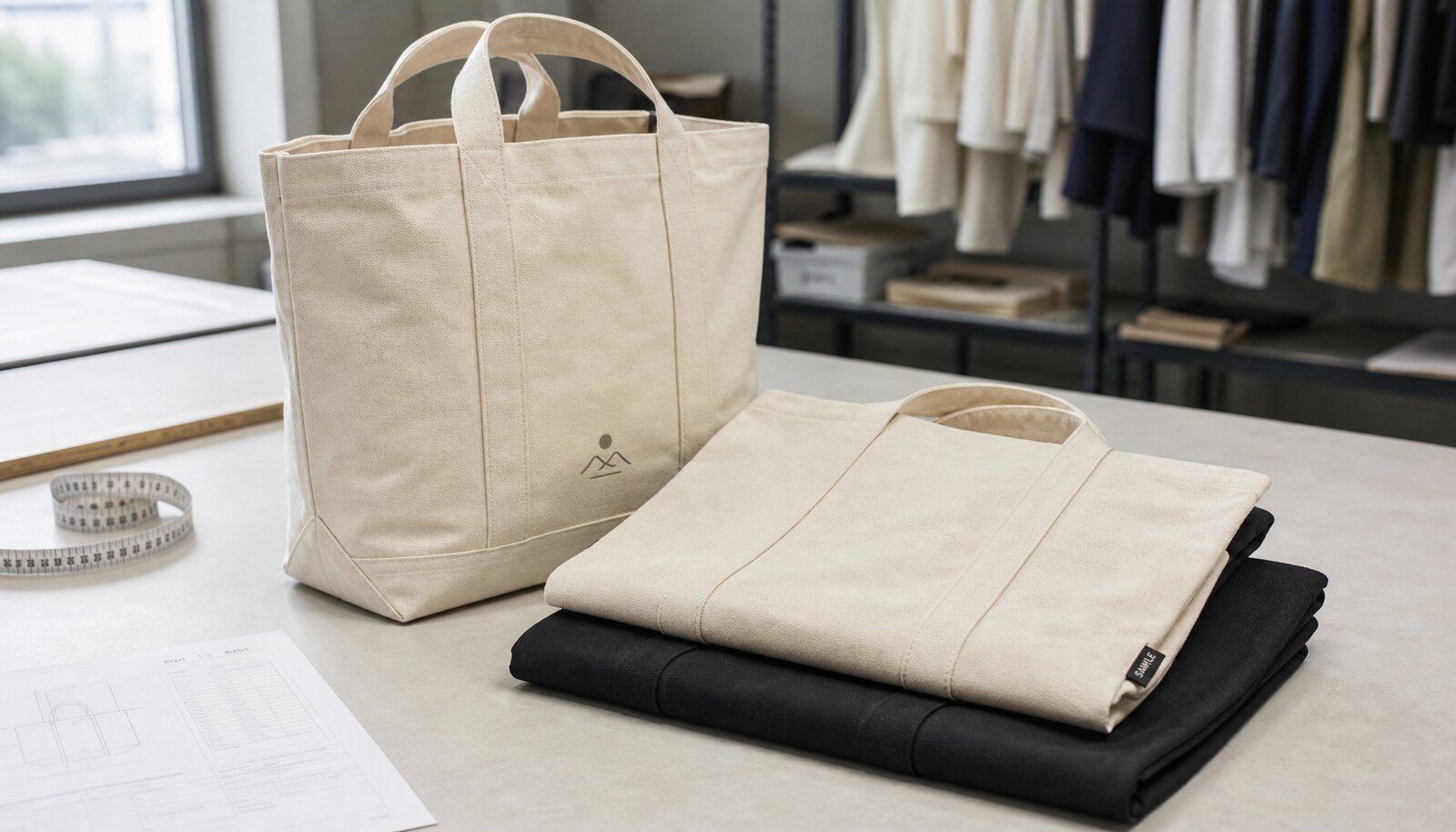
What apparel brands are actually buying when they order exhibition totes
For apparel brands, a canvas exhibition tote is rarely just a giveaway bag. It often has to carry folded garments, lookbooks, inserts, or sample packs, then still look good enough to be reused after the event. That means the buying decision is about more than logo placement or a cheap unit price. It is about how the bag performs when it is filled, handed over, and seen in public.
The common sourcing mistake is to spec the bag as a generic promo item. A launch kit tote, a trade show tote, and a retail add-on tote do not have the same load, presentation, or durability needs. If the brief does not say what the bag has to hold and how long it needs to last, the supplier fills in the gaps with assumptions. That is how a quote becomes unhelpful and a bulk order misses the mark.
- Define the use case first: event handout, retail purchase bag, garment carrier, internal sample bag, or packaging insert.
- State what the bag must carry in real use, not just what it looks like empty.
- Decide whether the bag is disposable, reusable, or premium enough to support brand perception after the event.
Choose the build before you compare quotes
Canvas weight is the first spec that changes both perception and price. For most apparel-brand exhibition use, 12oz to 14oz cotton canvas is the safest range because it holds shape, takes print cleanly, and feels intentional rather than flimsy. A 10oz bag can work for a low-cost campaign, but it should be a deliberate choice. If the bag will be filled with folded shirts or catalogs, too-light canvas can sag and make the print look cheap.
Construction matters just as much. A flat tote is easier to sew and usually cheaper to pack, but a gusseted tote gives you more volume and a better fit for apparel. Handle width, handle drop, and reinforcement stitching affect both comfort and failure rate. Decorative options such as lining, closures, or extra labels should only be added when they support the use case, not because they make the quote look more complete.
- 10oz is the lowest-cost option and is best reserved for short-life promotional use.
- 12oz is the middle ground for trade shows and brand activations.
- 14oz feels more premium and holds shape better, but it adds material and freight cost.
- Flat bodies reduce sewing time and cube, while gusseted bodies improve capacity and presentation.
- Handle reinforcement is usually more valuable than decorative extras when the bag needs real durability.
Bulk pricing plan: how to read the number on the quote
A useful bulk pricing plan starts with landed cost per accepted bag, not the factory's first number. The real cost usually includes ex-factory price, setup amortization, packing, origin charges, freight, duty or brokerage, warehouse handling, and an allowance for defects or rework. If a supplier cannot separate those items, the quote is too vague to compare cleanly.
Here is a simple planning model. At 2,000 pieces of a 12oz one-color tote, an illustrative quote might land around $2.43 per accepted bag if the ex-factory price is $1.72, setup amortization is $0.06, packing is $0.09, freight and clearance average $0.33, domestic charges or duty average $0.18, and QC allowance is $0.05. At 10,000 pieces of the same spec, the same model might land closer to $1.68 because setup spreads out, freight per unit falls, and the factory can run the line more efficiently. That gap is the part procurement cares about, not just the sticker price.
- A $120 print setup adds $0.12 per bag at 1,000 units, $0.024 at 5,000, and $0.012 at 10,000.
- Every added print color or print location raises setup cost and the chance of registration issues.
- Individual polybag packing can add more than the difference between two suppliers if it is not planned early.
- A cheaper ex-factory quote can still land higher if freight, packing, or duty are heavier.
Compare sourcing routes without leaning on folklore
The right sourcing route is the one that can repeat the same bag six months later without changing fabric, print behavior, or packing. A first order that looks cheap but cannot be re-run cleanly is not a real saving. The buyer should ask who actually cuts the cloth, who prints it, who stitches the handles, and who owns the packing standard. If the answer keeps moving between companies, the supply chain is harder to control than the quote suggests.
Country choice matters, but not in the simplified way buyers are often told. A factory route is usually better when the spec is stable and the buyer wants clearer control over quality and price breaks. A distributor or stock-program route is usually better when speed and MOQ matter more than exact construction control. Nearshore or domestic sources can win when transit time, communication, or replenishment risk matters more than raw unit cost. The right question is not which country is cheapest. It is which route gives you the lowest accepted cost for the calendar you actually have.
- Use direct factory sourcing when the spec is stable and you want the strongest price transparency.
- Use a distributor or converter when you need a low MOQ or a faster test run.
- Use a nearer source when shorter transit and easier replensihment outweigh the higher ex-factory price.
- Ask every supplier to state the actual fabric source, not just the selling location.
Comparison table: what the routes mean in cost and control
Use the comparison table as a sourcing tool, not as a country ranking. The quote band is only a planning range and will move with fabric weight, print setup, packing format, and freight. A route with a slightly higher factory number can still win if it gives you lower defects, better lead-time reliability, or lower destination cost.
The key comparison is apples-to-apples. If one supplier is quoting bulk carton pack, one-color print, and FOB origin while another is quoting individual polybags, two-color print, and delivered pricing, the numbers are not comparable. Rebuild the quotes on one spec, one incoterm, and one pack standard before you decide.
- Match the same finished size, same canvas weight, same print method, and same pack format across suppliers.
- Ask for origin charges, freight, and destination charges separately when possible.
- Convert every option to landed cost per accepted bag, not just ex-factory price.
- Treat MOQs and re-order stability as part of the cost, not just a commercial note.
Write an RFQ that gets comparable quotes instead of guesswork
A good RFQ reads like a spec, not a shopping list. It should name the finished size, canvas weight, weave, base color, handle drop, stitch type, artwork dimensions, print method, packing format, destination, and the volume bands you want quoted. If you need Pantone matching, say so. If a visual match is acceptable, say that too. The point is to remove supplier interpretation before the quote lands.
Do not bury commercial details inside the technical note. Ask for setup charges, sample charges, packing charges, label charges, and any optional adders separately. If you want a real bulk pricing plan, ask for pricing at 1,000, 3,000, 5,000, and 10,000 pieces, then ask where the breakpoints are. That tells you whether the factory is giving you a real scale discount or just a flat number that looks competitive.
- Include a reference image or a signed sample photo set with version control.
- Ask the supplier to list every exclusion, not only the included items.
- State whether the bag should arrive folded, bulk packed, barcoded, or retail ready.
- Ask for lead time by stage: sample, approval, production, packing, and shipment.
- Request the same quote in at least three volume bands so the price curve is visible.
Sample approval and change control before you release the PO
A sample is not approved because it looks acceptable on a desk. It should be checked under the same conditions the bag will face in use. Put real product inside it, fold it the way your warehouse or store will receive it, and inspect the handles, side seams, print position, and top edge while it is under load. A tote that looks fine empty can still fail when the body twists or the print creases.
Change control matters because small substitutions are easy to hide. If the factory changes canvas weight, ink type, handle tape, or print process after approval, the bulk order is no longer the same spec. Keep one master sample tied to the PO revision, artwork file, and carton spec. If anything changes, reapprove it. That prevents later arguments about whether the production run matches what was signed off.
- Check the sample filled, not only empty.
- Measure the finished bag after pressing and folding.
- Verify that the sample uses the same fabric weight and base color as the bulk plan.
- Archive the approved sample with the artwork version and PO number.
- Require reapproval if any material, print, or packing detail changes after sign-off.
QC that catches the failures buyers actually see
The common tote defects are visible, boring, and expensive. A logo that sits too low, one handle sewn higher than the other, weak topstitching, or a bag that comes in narrower than spec will be noticed immediately by store teams, event staff, or customers. For apparel brands, those details matter because the tote is often seen next to the clothing line or handed out in a public setting. Quality has to reflect that visibility.
A practical inspection plan does not need to be complicated. Use a simple critical, major, and minor defect framework so both the buyer and the factory know what fails the lot. Critical defects are wrong artwork or a functional failure. Major defects are size drift, bad print, or weak seams. Minor defects are cosmetic and do not affect use. If the order is large enough for third-party inspection, define the check points in writing before production starts.
- Measure size after pressing and folding, not only cut panels.
- Set a tolerance band for canvas weight and reject out-of-range material unless it was approved.
- Check handle symmetry, handle length, and reinforcement stitching at both ends.
- Inspect print placement, density, and edge sharpness against the master sample.
- Verify carton count, carton marks, SKU labels, and pack method before shipment release.
Packing, freight, and warehouse handling are part of the unit cost
Packing is one of the easiest places to lose money because it looks small on paper. Bulk carton packing is usually the lowest-cost option, but individual polybags, tissue inserts, barcode labels, and retail folds all add labor and cube. If the warehouse needs shelf-ready units or e-commerce-ready units, that is fine, but it should be priced on purpose instead of discovered at the end of production.
Freight math is equally easy to underestimate. A tote bag that is light but bulky can cost more to move than a denser product if the carton cube is poor. For ocean freight, standardized carton dimensions help you use container space better. For air freight, every extra insert, fold, or oversized carton has a cost. Always ask for carton dimensions and gross weight so you can estimate what the shipment will really cost before approval.
- Bulk carton pack is the default when cost efficiency matters most.
- Polybag packing should be reserved for retail-ready or hygiene-sensitive deliveries.
- Barcode labels and carton marks speed warehouse receiving and reduce miscounts.
- Confirm the carton spec before production so freight estimates are not based on guesswork.
- If the bags need to be stored or shipped flat, define the fold pattern in the PO.
How to make the next order cheaper and safer
The best savings usually come from repeatability, not from chasing a new supplier on every order. Keep the approved sample, quote, artwork file, carton spec, QC report, and PO revision in one record. That makes reorders faster and reduces the chance of a silent spec drift. It also gives you a clean benchmark when a supplier proposes a price change and claims the market moved.
Before you approve the order, ask one final question: what can be standardized without hurting the brand? Often the answer is to keep one canvas weight, one print method, one carton spec, and one packing standard across runs. If you can simplify by one color, one label, or one packing step, the landed cost can fall more than a supplier switch would. That is the practical version of a bulk pricing plan.
- Standardize one canvas weight where possible so reorders do not need new approvals.
- Keep one master artwork file and one print reference tied to the PO record.
- Use the same carton spec and fold method across replenishment orders.
- Ask suppliers to quote a second option only when the trade-off is clear and measurable.
- Reprice the order on landed cost, not on the headline factory number alone.
Specification comparison for buyers
| Sourcing route | Illustrative bulk quote band | Typical MOQ and lead-time shape | Main cost drivers | Best fit |
|---|---|---|---|---|
| Mainland China direct factory | About $0.80-$2.20 ex-factory for common custom builds; heavier canvas, extra print, or retail packing pushes higher | MOQs often start around 1,000-5,000 pcs per design, with better pricing once the spec is stable and the run reaches 5,000+ | Fabric grade, print setup, carton cube, and freight volatility | Repeatable bulk programs where the spec is locked and the buyer wants broad material and print options |
| India direct factory | About $0.90-$2.50 ex-factory for cotton-heavy builds, depending on weave, dye, and finishing | MOQs often sit around 1,000-5,000+ pcs, with lead time sensitive to dye lot control and finish approval | Shade control, shrinkage, and finishing consistency | Cotton-forward sourcing where the buyer can manage sample approval closely |
| Vietnam factory | About $1.00-$2.60 ex-factory for custom work, with specialty trim or canvas sourcing moving the number up | Custom runs often start in the low-thousands; lead time depends on whether cloth is in-house or sourced externally | Fabric sourcing outside the factory, trim availability, and packing complexity | Apparel brands already buying in the region or wanting a tighter garment-supply-chain fit |
| Turkey or nearby Mediterranean supplier | About $1.40-$3.40 ex-factory, with faster transit to Europe-facing programs often offsetting some cost | Smaller runs are often possible, but capacity can tighten during seasonal demand | Labor cost, duty, routing, and seasonal capacity pressure | Launches, replenishment, and programs where transit time matters more than the lowest ex-factory price |
| Domestic converter or stock-program distributor | About $2.00-$5.00+ all-in before rush fees, special decoration, or unusual packing | Often useful for 50-500 pcs or urgent replenishment, with short lead times if stock is on hand | Markup, limited control over the base bag, and the cost of modifications | Urgent campaigns, low-MOQ tests, or buyer programs that need local support |
| Material | 8-12 oz cotton canvas, 120-220 gsm cotton, recycled cotton, or blended fabric selected by use case and target price | Before price comparison | Different cloth weights, backing, or certification claims make quotes hard to compare | |
| Construction | bag size, gusset, handle drop, seam allowance, stitch density, reinforcement patch, and loading expectation | Before sampling | Weak stress points create returns and failed inspections | |
| Decoration | screen print, heat transfer, embroidery, woven label, or hangtag matched to fabric texture and brand durability needs | Before artwork approval | The wrong method can crack, bleed, pucker, or fail on the chosen fabric |
Buyer checklist before sampling
- Define the finished bag size, not just the flat panel size, and include tolerances for width, height, and gusset.
- Lock the canvas weight in ounces or GSM, and state the acceptable range so the factory cannot quietly downgrade the cloth.
- Specify the exact print method, number of colors, print placement, and whether Pantone matching is mandatory or only a visual match.
- State handle length, handle width, stitch type, reinforcement points, and the minimum load expectation for real use.
- Choose the packing method up front: bulk carton, individual polybag, barcode label, tissue insert, or retail-ready fold.
- Request quote breaks at at least three volume bands so setup cost and scale pricing are visible.
- Ask for a production sample, then a pre-shipment photo set or first-carton check before release.
- Tie the approved sample, artwork file, carton spec, and PO revision number together so reorders match the right version.
- Confirm the Incoterm, named port or delivery point, and every local charge that sits outside the unit price.
- Ask for carton dimensions and gross weight so you can estimate freight and warehouse cube before you approve the order.
Factory quote questions to send
- What exact bag specification are you pricing, including fabric weight, weave, construction style, handle type, and any lining or closure?
- What is included in the unit price and what is excluded, especially print setup, screens or plates, packing, labeling, and cartonization?
- What is the MOQ for the bag body, the artwork, the colorway, and the packing format, and do those minimums differ?
- Can you quote the same spec at 1,000, 3,000, and 5,000 pieces so I can see the real price break?
- How many sample rounds are included, what is the sample charge, and can any sample fee be credited back against production?
- What Incoterm are you quoting, which port or delivery point is named, and what local charges are outside the quote?
- What lead time do you need for sample approval, bulk production, packing, and export booking after the PO is released?
- What inspection standard do you use, and can you provide inline photos, final QC photos, or a pre-shipment report?
- How do you control fabric shade, print consistency, and repeat orders so the next purchase matches the approved master sample?
- If I move from one-color print to two-color print, or from bulk packing to polybag packing, what exactly changes in cost and lead time?
Quality-control points to confirm
- Measure finished size after pressing and folding, not only the cut panels, because sewing can change final dimensions.
- Check the canvas weight against the approved range, and reject material that falls outside the agreed tolerance unless it was reapproved.
- Inspect handle length, handle symmetry, and reinforcement stitching at both attachment points, since those are common failure areas.
- Review print placement, color density, and edge sharpness against the approved artwork and master sample under normal viewing distance.
- Treat skipped stitches, puckering, loose thread knots, and uneven topstitching as major defects when they appear at load-bearing seams.
- Pull-test the handles with a realistic fill weight if the bag is meant to carry folded garments, lookbooks, or event materials.
- Verify carton count, carton marking, barcode labels, and pack method so the warehouse receives the right SKU and quantity mix.
- Check that the fold pattern protects the print and that the packed bag opens cleanly without a hard crease across the logo.
- Use a simple defect classification in the PO or inspection plan: critical for wrong artwork or functional failure, major for off-spec size or bad print, minor for cosmetic issues.
- If the order includes recycled, organic, or other compliance claims, require documents before shipment rather than after arrival.