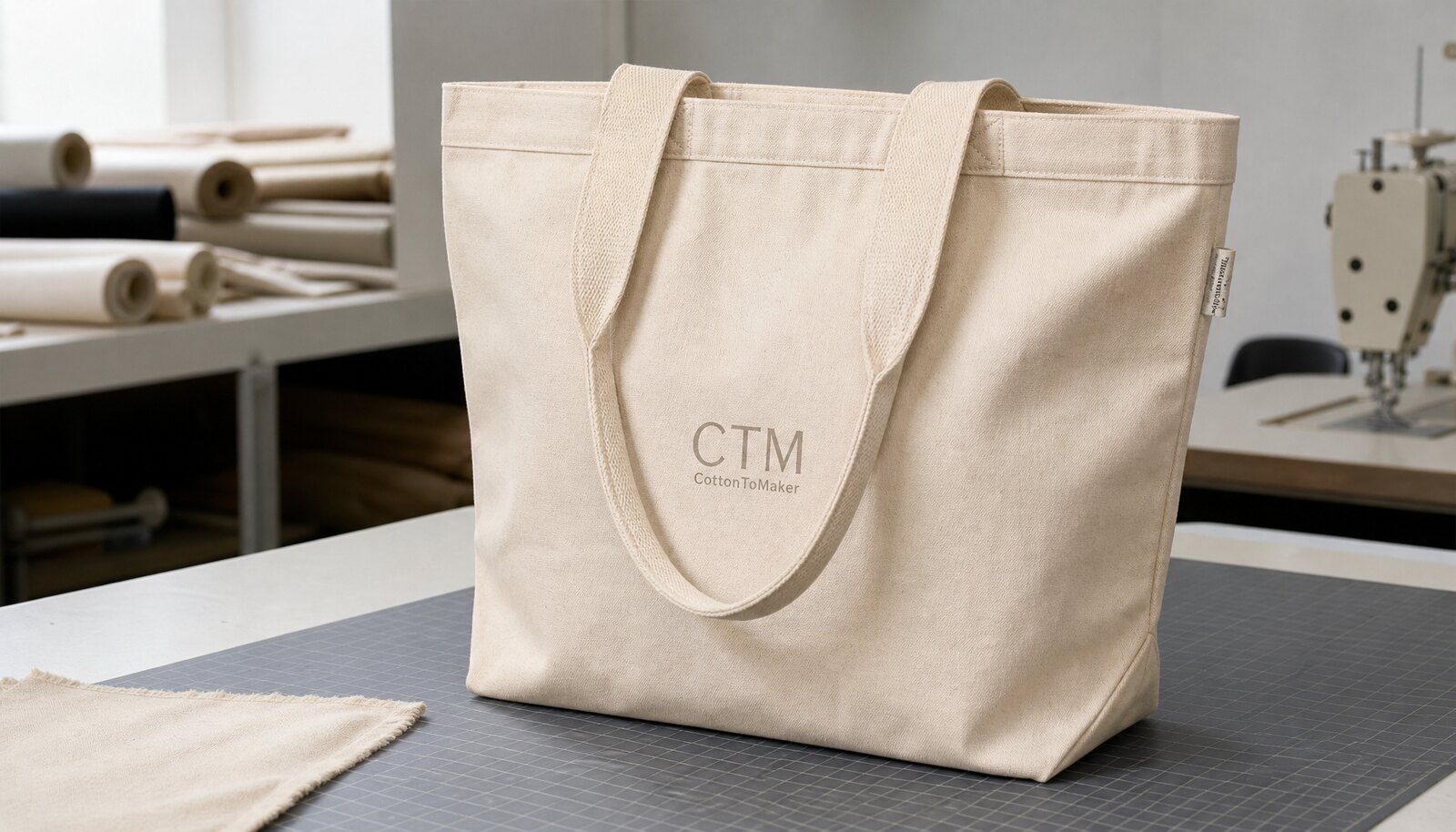
Why this tote is a different buy
For a cosmetic brand event, a canvas tote is doing more than carrying giveaways. It is part of the booth presentation, part of the product story, and often the last physical item a visitor takes home. That means the bag has to look clean on a table, survive multiple handoffs, and still present the logo well when the recipient uses it later. A generic promo tote often fails one of those jobs. The right buying question is not just "Can you sew a bag?" It is "Can you supply a bag that holds the samples, prints sharply, and arrives in a format the event team can deploy immediately?"
The cost mistake many buyers make is treating the tote as a simple afterthought and then discovering that the fill weight, print method, and packing method all affect the usable result. A bag that feels fine empty may sag once the kit is added. A print that looks fine on a PDF may fail when the logo sits on a textured natural canvas. For cosmetic brands, the giveaway tote often needs a more controlled spec than a standard trade show bag because the audience is judging it as a brand object, not just packaging.
- Treat the tote as part of the event experience, not only as packaging.
- Match the bag spec to the actual sample kit weight and how the bag will be handed out.
- Use the same approval standard for the tote that you would use for a retail accessory.
Start from the event use case
The fastest way to spec the wrong tote is to start with the logo and not the use case. A cosmetic brand event giveaway usually falls into one of three patterns: light handout bags for brochures and small samples, medium-duty bags for a sample kit and printed inserts, or premium presentation bags that need to feel closer to a retail purchase. Each use case pushes the size, gusset, handle drop, and fabric weight in a different direction. If the team expects the bag to hold boxed products or glass items, the construction needs to be set for that load, not for a flat brochure set.
For a buyer, the practical spec begins with what goes inside and how the visitor carries it. If the tote will be filled at the booth, a wider gusset and a more stable base matter more than a decorative finish. If the bag will be distributed pre-packed, folding consistency and carton efficiency matter more. A common event size is in the range of about 34 x 38 cm with an 8 to 10 cm gusset, but that is only a starting point. The right answer depends on the kit size, the shipping carton limit, and whether the bag needs to sit upright on the table before handout.
- Define the fill item list first: brochure, sample pouch, boxed cosmetic, or mixed kit.
- Set a carry target in practical terms, such as light handout or medium sample load.
- Choose bag shape around deployment: flat stack, pre-packed, or booth fill-on-demand.
Choose the fabric and build that fit the job
Canvas weight drives both the hand feel and the cost. For event giveaways, buyers usually look at 8 oz, 10 oz, and 12 oz canvas, which are roughly in the light-to-medium-and-heavy range depending on weave and finishing. An 8 oz bag can work for simple handouts and lower-load kits, but it can feel too soft if the brand wants a more premium presentation. A 10 oz bag is often the practical middle point for cosmetic events because it gives better structure without jumping too far in cost. A 12 oz bag is better when the kit is heavier, the bag must stand up better on its own, or the brand wants a denser, more retail-like feel.
The build details matter as much as the fabric. Handle width, handle attachment, seam allowance, bar tack placement, and side or bottom gusset style all affect whether the bag survives a busy event day. If the bag will hold glass or boxed items, reinforce the stress points and avoid assuming the fabric alone will solve the load issue. Natural undyed canvas is usually the most economical route and gives a clean, brand-neutral base for print. Bleached or dyed canvas can improve image presentation but can also increase cost variation, color control issues, and minimum order constraints.
- Use 8 oz for lighter handouts, 10 oz for most cosmetic event kits, and 12 oz when the bag must feel firmer or carry more weight.
- Specify whether the canvas is natural, bleached, dyed, or washed, because that changes tone and quote structure.
- Ask for reinforced handle stitching and clear seam details if the kit includes heavier boxed products.
Print method decides brand appearance
For cosmetic brands, the print is often the difference between a bag that feels premium and one that looks like a generic giveaway. Screen printing is usually the first option to evaluate because it handles simple logos well, gives solid coverage, and is easier to control on canvas than many buyers expect. One- or two-color logos are the most efficient. If the artwork uses gradients, thin type, or small details, the screen count and registration risk rise quickly. Water-based ink can give a softer hand feel, while plastisol can improve opacity on darker or more textured surfaces. The right choice depends on the logo, the target finish, and how much rub resistance the event team needs.
Heat transfer can help on smaller runs or when the artwork is too detailed for a clean screen print, but the buyer should treat it as a controlled exception rather than a default. It can crack or peel sooner if the print area is bent repeatedly or if the artwork is large and heavily handled. Embroidery or woven labels may work well for a premium side mark or a small brand signature, but they are usually not the best solution for a large event logo on canvas. The safe rule is simple: keep the logo area clean, avoid fine lines that disappear on weave texture, and approve the actual printed sample under the same lighting the event team will use.
- Use screen printing for simple logos and stable repeat orders.
- Reserve heat transfer for detailed artwork or very small runs, and validate rub resistance.
- Keep artwork bold enough to survive the texture of canvas and the distance of event viewing.
Compare supplier routes before you compare unit price
The same tote can come from very different sourcing routes, and each route changes risk. A direct factory is usually strongest on cost control, fabric control, and repeatability, but it demands a buyer who can manage specs and approval. A trading company or sourcing agent can simplify coordination, especially when the tote is only one item in a bigger event kit, but the buyer needs clarity on who actually owns production quality. A domestic decorator is useful when the event is close and the logo artwork is simple, though the bag blank may be outside your control. A blank wholesaler plus local printer can be a speed play, but only if the blank size, print area, and carton format all line up.
The right route depends on the decision pressure. If the order is small and the event date is fixed, speed and predictability may matter more than absolute unit cost. If the order is repeatable and the brand wants a long-term tote program, direct factory sourcing usually becomes more efficient after the first approved run. If the tote is part of a larger cosmetics event pack, an integrated promo supplier can reduce coordination load, but only if the tote spec is handled with enough discipline. Do not compare routes only on ex-works price. Compare their control over fabric, sample sign-off, packing discipline, and re-order consistency.
- Use a direct factory when the tote is a recurring item and you can lock the spec.
- Use a domestic decorator or blank-plus-print route when speed is the main constraint.
- Use a sourcing intermediary only when they can show clear production ownership and QC accountability.
What a usable quote should actually include
A quote for canvas exhibition totes is only useful if every supplier is pricing the same package. The bag body spec, fabric weight, print method, print size, handle length, packing format, and shipping term all need to be written in the same way. Otherwise one supplier quotes a light 8 oz blank with loose bulk packing, another quotes a reinforced 10 oz bag with individual folding, and the unit price comparison becomes meaningless. In practice, the most common hidden cost drivers are the canvas weight, the number of print colors, any special sewing reinforcement, and whether the event wants individual retail-style packing.
The quote should also reveal where the supplier is making money or taking shortcuts. If the bag is cheap but the sample fee, setup fee, or carton change fee is high, the final landed cost may not be favorable. If the quote only says "cotton tote" without GSM, weave type, and print area, you do not have a real offer. Ask for the specification to be written back in the supplier's own words so you can catch misunderstandings before production begins. For a cosmetic brand event, quote clarity is not paperwork. It is the cheapest way to avoid a late reprint or a bag that does not fit the kit.
- Require the supplier to restate the full spec in the quote, not just the product name.
- Compare setup fees, sample fees, packing charges, and carton charges as separate line items.
- Match every supplier on the same quantity, print method, and shipping term before judging price.
MOQ logic, samples, and approval discipline
MOQ for canvas totes is usually driven by fabric, print setup, and sewing efficiency, not by one universal rule. Natural canvas with one-color print generally gives the most flexible MOQ because the factory can use standard material and fewer production changes. If you add custom dyeing, lining, zipper tops, special piping, or multiple print locations, the MOQ usually rises because the factory has more setup and more scrap risk. For event giveaways, buyers sometimes split the order across too many colors or artwork versions and then wonder why each version has a high minimum. Consolidating the spec often saves more than negotiating the price down by a small amount.
Sample approval should be more controlled than a casual photo review. A blank sample tells you little about print registration or final handle feel. A pre-production sample is better because it shows the exact construction, artwork position, and packing method. Once approved, keep one sealed reference sample with the date, approved artwork, and agreed measurements attached. If the event order is large enough, make the factory keep the same sample on the line for first-article comparison. That one habit prevents a lot of disputes about whether the bulk run matched the approved version.
- Expect MOQ to rise when you add custom color, lining, extra pockets, or complex packing.
- Use a pre-production sample as the real approval point, not a generic blank bag photo.
- Keep one sealed gold sample so the bulk line has a physical reference.
Packing should support the event, not just shipping
Packing decisions affect cost, carton count, and how fast the event team can use the bags. For many giveaway programs, bulk packing is the right answer because the bags are opened and distributed immediately at the event. Folding the bag to a consistent finished size saves carton space and reduces freight cost. If the brand wants a more polished handout, individual polybags with inserts or a branded belly band may make sense, but those choices add labor and materials. The buyer should decide whether the package is for transit efficiency or for end-user presentation. Those are not the same goal.
Carton planning is part of the tote spec, not a separate afterthought. The supplier should confirm how many bags fit per inner pack and master carton, what the carton dimensions are, and whether the carton can survive export handling without crushing the bag shape. For distributor or retail buyer workflows, carton marks, SKU labels, and pack counts matter because the bags may go through a warehouse before they reach the event site. If the totes are going straight to a booth, simpler packing may be better as long as the cartons are clearly marked and easy to open.
- Choose bulk pack if speed and freight efficiency matter more than display presentation.
- Choose individual packing only when the brand wants a retail-style handoff or dust protection.
- Confirm carton counts, carton dimensions, and label format before production starts.
Lead time risk starts before production
For event giveaways, lead time is not just factory sewing time. It includes sample approval, art correction, material sourcing, production slot booking, packing, export handling, and transit. A supplier may quote a short bulk lead time, but that number is not useful if artwork approval is still open or if the canvas color has to be sourced after the order is placed. Buyers should plan backward from the event date and leave room for at least one approval loop. If the tote is tied to a launch or fair, a small delay in proof sign-off can erase the margin in the whole schedule.
The risk windows are predictable. New artwork with multiple colors usually takes longer than a repeat print file. Custom-dyed canvas takes longer than natural stock fabric. Special packing or inserted cards add time even if the sewing itself is unchanged. If the event has a hard deadline, the buyer should ask the factory to separate sample lead time from bulk lead time and then add freight time outside both numbers. That sounds basic, but it is where many rushed tote orders fail. A realistic schedule beats an optimistic one every time.
- Separate sample time, bulk production time, and transit time in the project calendar.
- Treat artwork approval and material confirmation as schedule-critical tasks.
- Assume custom fabric, special packing, and complex print all add real risk to the timeline.
Set QC limits before you release the order
Quality control for a canvas giveaway bag should focus on function and consistency, not on unrealistic luxury-bag perfection. The first checks are dimensional: does the bag match the approved size, does the gusset open correctly, and do the handles sit where they should? Then move to construction: are seams straight, are bar tacks secure, and is the handle attachment even on both sides? Print inspection should cover placement, ink opacity, edge definition, and any rubbing or cracking after light handling. If the logo is intended to photograph at the booth, the print must look clean under the same lighting used in the event space, not only in a factory photo.
A useful QC plan includes a simple load test and a simple handling test. The bag should be able to hold the agreed practical fill without seam failure, handle pull-out, or obvious distortion. The surface should stay free of oil marks, loose threads, and heavy lint. Carton inspection matters too because a bag can pass sewing QC and still fail at the distribution stage if cartons are crushed or counts are wrong. Buyers who set these standards in writing before mass production usually get fewer disputes later because both sides know what "acceptable" means.
- Check size, gusset, handles, seams, print placement, and carton count against the signed sample.
- Use a simple load and carry test that reflects the actual event contents.
- Write tolerances into the PO so the factory is not guessing what acceptable means.
Specification comparison for buyers
| Spec decision | Recommended option | When it fits | Buyer risk to check |
|---|---|---|---|
| Direct factory in a canvas bag hub | Best for repeat runs, controlled GSM, and custom sewing details | You have a stable spec, enough volume to justify setup, and time for sample approval | Confirm the factory is actually sewing the bag, not outsourcing the core build without telling you |
| Trading company or sourcing agent | Useful when you need one contact, mixed products, or multilingual coordination | You are buying totes together with other event items and want less internal coordination | Ask who owns QC, who approves samples, and where the real production line sits |
| Domestic decorator using imported blanks | Good for tight event deadlines and simple logo jobs | The bag shape is standard and the print area is small and flat | Check blank bag consistency, print durability, and whether inventory can disappear before your reorder |
| Blank bag wholesaler plus local printer | Practical for short runs with simple one-color artwork | You need fast turnaround and do not need custom sewing or custom dye lot control | The blank and the print shop must agree on dimensions or the logo placement can drift |
| Integrated promotional products supplier | Convenient when totes are one item in a broader giveaway kit | A brand event needs bags, inserts, and other items under one PO | Verify the tote is a core product, not a side item with weaker spec control |
| Nearshore factory | Strong option when transit time matters more than the lowest ex-works cost | Your event date is fixed and you want easier communication during approvals | Compare fabric availability, trim options, and whether the same finish can be repeated later |
| Small workshop or artisan supplier | Works for low MOQ, premium hand-finished looks, or local sourcing stories | The order is small and brand presentation matters more than full-scale efficiency | Expect more variation in seam consistency, measuring tolerance, and bulk repeatability |
| Reorder from the same approved factory | Safest route when a prior sample was already signed off | You need the same tote again and want to minimize risk on the next event | Do not assume the last run was identical; reconfirm fabric lot, print file, and pack method |
Buyer checklist before sampling
- Lock the use case first: handout tote, sample-kit carrier, or retail-style giveaway bag.
- Specify bag size, gusset depth, handle length, and target canvas weight in the RFQ.
- Choose one print method and one artwork version before you compare quotes.
- Decide whether the bags will be bulk packed, folded with inserts, or retail packed.
- Ask for a pre-production sample and keep a sealed reference sample after approval.
- Compare all quotes on the same Incoterm, carton count, and packing format.
- Set tolerance limits for size, print position, seam quality, and color variation.
- Build shipping and customs time into the event calendar, not just the factory lead time.
Factory quote questions to send
- What exact canvas weight is quoted, and is it measured before or after washing or finishing?
- Is the bag sewn from single-layer canvas, lined, or reinforced at the handle and side seams?
- Which print method is included, what is the print size, and how many colors are covered?
- What is the MOQ at this exact spec, and what changes would trigger a new setup charge?
- Is the sample a blank sample, a pre-production sample, or a color-reference sample, and what is the fee?
- How are the bags packed per inner polybag, master carton, or pallet, and what is the carton size?
- What dimensional tolerance do you hold for the bag body, handle length, and print placement?
- Which shipping term is quoted, and what is included in the price besides the sewn bag itself?
Quality-control points to confirm
- Canvas weight should match the approved target closely enough that the hand feel and body match the sealed sample.
- Bag dimensions should stay within an agreed tolerance for width, height, and gusset depth.
- Handle stitching and bar tacks should be even, secure, and able to hold the agreed practical load without distortion.
- Print registration should stay within the approved placement window and should not blur, crack, or show pinholes.
- Color tone on natural or bleached canvas should stay consistent across the run and not shift obviously from sample to bulk.
- Seams, corners, and base reinforcement should be clean, with no skipped stitches, loose threads, or broken needle marks.
- Finished bags should be free of odor, heavy lint, oil spots, and packing dust before carton closure.
- Carton count, carton marks, and outer packing should match the PO so event teams can receive and distribute without repacking.