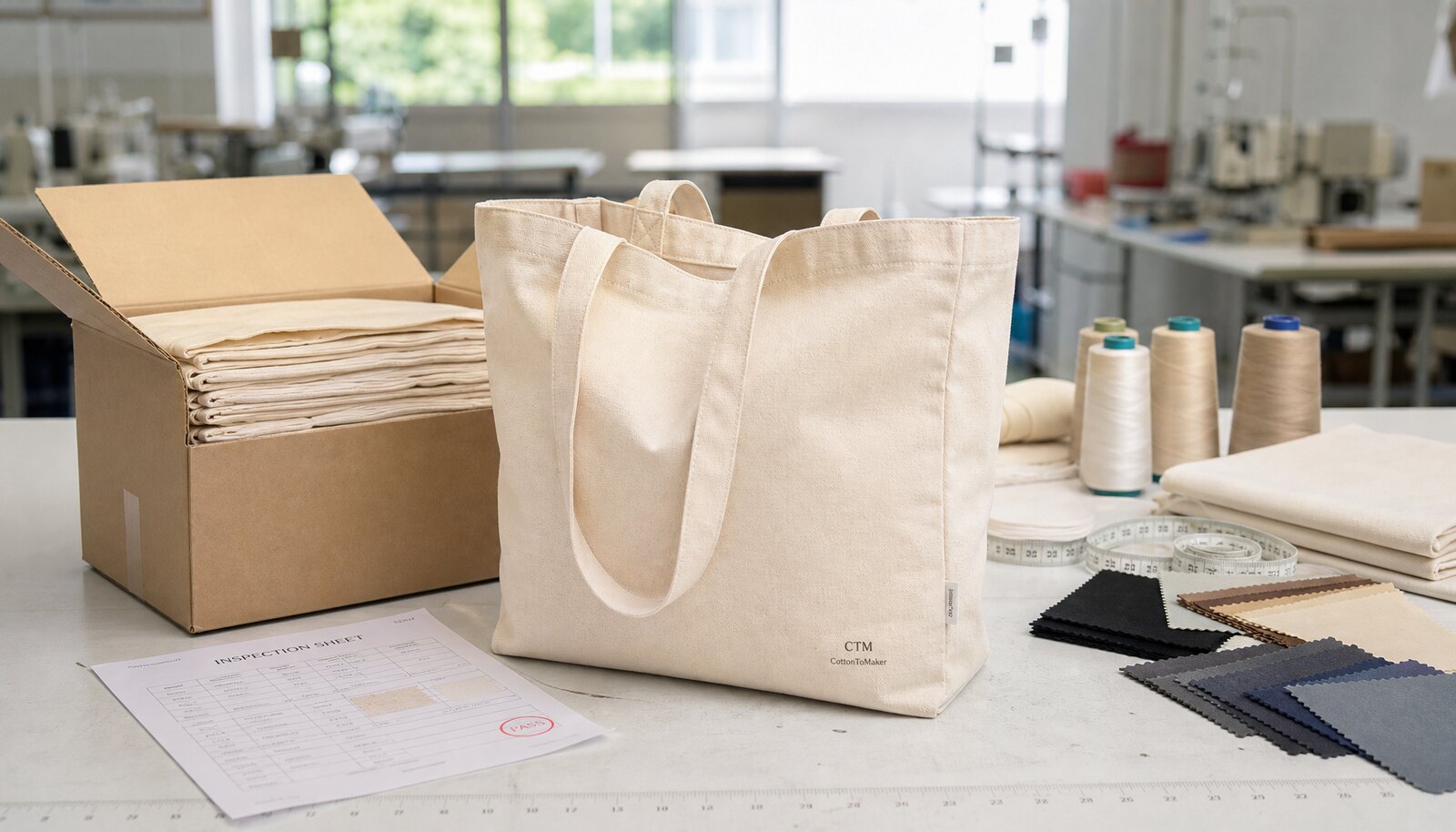
Why packaging specification matters as much as the tote itself
For canvas exhibition tote bags for corporate events, many buying teams start with logo approval and treat packing as a last-mile detail. That approach underprices the real commercial impact of the carton, the fold pattern, and the label system. Packaging determines freight density, warehouse handling time, carton damage risk, and how quickly staff can issue bags at a registration desk or booth. Two bags with the same print can land very differently if one is flat-packed in a clean master carton and the other is folded loosely with mixed labels and inconsistent carton count.
Procurement also has to decide how the bag is meant to travel through the supply chain. If it goes from the factory to a third-party warehouse and then to the event venue, you need cartons that survive multiple touches, clear case marking, and a pack count that a receiving team can scan or count quickly. If the tote is handed out directly from a staging area, the pack format should prioritize fast access and minimal unpacking waste. If the bag is intended to be kept and reused, the buyer may want presentation packing or an insert card that protects the print face and helps the bag feel premium at handout.
The key error is assuming a generic “canvas tote bag” quote already includes the right packing standard. It usually does not. One supplier may quote bulk flat pack, another may quote individual polybags with barcode labels, and a third may include presentation folding but a larger carton footprint. Those are not interchangeable offers. For a procurement buyer, the first step is to separate bag specification from packaging specification so pricing, lead time, and receiving risk can be evaluated cleanly.
Start with the event use case before you choose the bag spec
A tote for a conference registration desk is not the same buy as a tote for an executive summit, a trade show booth giveaway, or an internal sales kickoff kit. The use case defines the load profile, how much structure the bag needs, whether it should stand up on a table, and how visible the logo must remain after packing and transport. Before asking suppliers to quote, define what the bag must carry, how it will be distributed, and whether the bag will be reused after the event.
For standard exhibition use, the tote usually needs to hold a notebook, brochure pack, water bottle, and a few sample items without sagging or twisting at the handle. That points to a practical 10-12 oz canvas, reinforced handle attachment, and a pack method that keeps the bag flat enough for efficient carton fill. If the event is premium or the bag doubles as a brand accessory, then a heavier cloth, pre-shrunk fabric, and a more controlled folding pattern may be worth the cost because they improve presentation consistency.
Buyers should also distinguish staff-use bags from attendee giveaway bags. Staff bags often carry heavier, more uneven loads and need stronger handle reinforcement and seam control. Attendee giveaway bags may be lighter, but they are more visible and often photographed. If one bag style must serve both roles, spec to the heavier load case and then refine the packing format so the lighter handout use still looks clean at venue opening.
Choose fabric weight and construction using the actual load, not a generic range
For most corporate event programs, 10-12 oz canvas, roughly 340-410 GSM, is the most useful starting zone. It feels substantial enough for a branded handout, prints cleanly, and can carry typical exhibition contents without collapsing immediately. Lighter canvas can work for low-load giveaway programs, but buyers should expect more sag, more visible print show-through, and a greater chance of deformation around the handle points. Heavier canvas improves hand feel and can support a more premium positioning, but it increases fabric cost, cutting waste, and freight weight.
Fabric weight alone does not tell you whether the bag will perform. Ask the supplier what the cloth is made from, whether it is greige, pre-shrunk, or washed, and whether the weave is stable enough to hold a straight print line. A pre-shrunk or controlled-wash canvas is often easier to manage for branded programs because it reduces dimension drift after sewing and finishing. That matters when the print placement is tight, when the bag must fit a specific carton, and when a reorder has to match the first lot.
Construction should match the real fill weight. Open-top, self-fabric handle totes are cost-effective when built correctly, but handle attachment needs visible reinforcement at the stress points. For repeated carrying of catalogs or sample packs, specify bar-tack or X-box reinforcement where the handles meet the body and require the stitch pattern to be consistent across the entire lot. If the bag is meant to look premium, describe the visible stitch style and the inside seam finish separately. A neat front panel does not help if the handle seam fails or frays during event distribution.
- Best buyer question: what happens to the dimensions after washing, finishing, or heat exposure during print curing?
- Best supplier answer: a measurable shrinkage statement with test method, not a vague assurance that the cloth is ‘stable’.
- Best buyer control: approve both the finished size and the post-finish tolerance before mass cutting begins.
Pick the decoration method around artwork complexity, wear, and run size
Decoration choice should follow the art file, the quantity, and the way the bag will be handled after packing. For many exhibition orders, screen printing remains the best balance of cost, opacity, and durability. It works well on natural canvas, especially for simple logos, large solids, and one- to two-color branding. It also makes supplier comparison easier because setup costs are visible and repeatable across bids.
Heat transfer is useful when the order is smaller or the artwork includes fine type, gradients, or multi-color detail that would be difficult to register cleanly on canvas with a screen. The buyer should not approve it based on appearance alone. Ask for a fold and rub check on the approved sample because packed bags are compressed in cartons and will often be folded again at the venue. If the transfer lifts, cracks, or looks glossy in a way the brand does not want, the method is wrong even if the first sample looks sharp.
Embroidery or woven-label decoration can create a more premium look, but it is not automatically better for event totes. Embroidery can add thickness and may pucker lighter canvas. A woven label can look refined, but it changes the cost structure and may require a secondary sewing step. If you want a premium result, define the stitch density, backing, and acceptable puckering limit. Otherwise the supplier may deliver a visually acceptable sample that scales poorly in production or slows the line down.
Compare sourcing routes on control, not just unit price
Direct factory sourcing is the strongest route when you need custom dimensions, stable fabric control, and a defined packing format. It is also the most useful route when procurement wants to reduce hidden markup layers and work from one approval chain. The tradeoff is that the buyer has to write a cleaner RFQ, approve samples more carefully, and manage lead time with discipline.
A trader or sourcing agent can help when the buyer is running multiple event items, needs communication support, or wants a single point of contact across several factories. That service can reduce internal coordination load, but it only adds value if the buyer knows who actually makes the bag and who signs off quality. Ask for the real factory name, the production site location, and sample or inspection evidence from that site. If the agent cannot show that chain, the buyer is paying for convenience without getting meaningful control.
Stock or semi-custom suppliers fit tight deadlines and simple artwork. This route can work well if the buyer accepts limited choices on fabric, color, and packing format. Nearshore or regional production can also be attractive when transit time, urgent reorders, or communication speed matter more than the lowest ex-works price. In all cases, compare bids using the same bag specification, the same packing requirement, and the same Incoterms. A cheap quote on the wrong spec is not a better quote.
- Use direct factory sourcing when bag dimensions, print placement, and carton format are fixed and repeat business is likely.
- Use a trader when your team needs project coordination across multiple SKUs and can still verify the real factory.
- Use stock or semi-custom only if the event deadline matters more than full spec control.
A cleaner comparison table for bag spec, packaging spec, and supplier route
The table below separates three things buyers often mix together: the bag itself, the packaging standard, and the way the supplier is sourced. That matters because a quote can look favorable while quietly changing one of those three dimensions. A good comparison table helps the buyer normalize offers before price ranking starts.
If you receive supplier quotes in different formats, rebuild them into the same framework: bag specification, pack-out specification, carton logic, and supplier route. Once those fields are aligned, differences in cost, lead time, and quality risk become easier to see.
- Write decisions in measurable language, not only descriptive wording.
- Ask for sample photos plus one physical approval sample for important orders.
- Keep quotation, sample approval, and inspection notes tied to the same spec version.
Specify packaging like a receiving team will use it
Packaging specification is where many tote orders lose commercial clarity. A useful packing spec should tell the supplier how the bag is folded, how many bags are in an inner or master pack, whether each bag is polybagged, what labels are applied, and how the carton is marked. The buyer should also state whether the venue or warehouse has size, weight, or pallet constraints. Without that information, the supplier may optimize for factory convenience rather than receiving speed.
Flat packing is the simplest and usually the cheapest route. It reduces labor, keeps cartons efficient, and is often enough when the bags are handed out at a venue and do not need shelf presentation. But flat pack can create sharper fold lines on printed areas if the cloth is stiff or the print is sensitive. If presentation matters, the buyer may prefer a controlled fold, tissue or insert card, and individual polybagging. That raises unit cost and carton volume, but it can reduce surface scuffing and improve first impression.
Carton sizing is not just a shipping detail; it changes the whole receiving plan. Oversized cartons can be difficult to store or move through a venue dock, while cartons that are too small can force the bags into hard folds that leave deep marks on the logo panel. Ask the supplier to propose a carton size that respects the final fold pattern and then test whether the carton can be carried, stacked, and scanned in the real receiving environment. For high-volume events, include carton count per SKU, case marks, and palletization notes so the receiving team can reconcile shipments quickly.
- Flat pack: best for cost, cube efficiency, and fast unpacking at event sites.
- Individual polybag: best when print protection, hygiene, or presentation matters more than freight density.
- Presentation pack: best when the tote is part of a premium kit, but it adds labor and carton volume.
- Carton design: confirm dimensions after folding the final sample, not before.
Set carton logic, master pack rules, and venue receiving constraints
A procurement buyer should think in three layers: unit pack, inner pack, and master carton. The unit pack is the way the bag is presented, folded, or protected. The inner pack is useful when cartons will be opened in stages or distributed by team. The master carton is what travels through freight, warehouse receiving, and venue handling. If these three layers are not aligned, the order can arrive technically correct but operationally awkward.
Master pack logic should reflect the destination. If bags are going straight to the event floor, smaller cartons can speed hand carrying and reduce the chance of damage, even if cube efficiency is slightly worse. If they are going to a warehouse, a heavier master carton with clear destination marks and a clean packing list may be better. If the venue has a strict freight dock window or lift capacity limit, ask the factory to quote a carton size and weight that respects that constraint before the order is placed.
Barcode and ASN needs should be clarified early. If the buyer’s warehouse or 3PL scans cartons by SKU, then each carton needs a readable carton label and the packing list must match the carton count exactly. If the order is part of a larger event kit, ask whether the supplier can separate bag cartons by color, event zone, or destination team. Mixed cartons are convenient for the factory but often slow down receiving and distribution. The most common shipment failures in this category are not bag defects; they are wrong carton count, wrong label, unreadable case marks, and inconsistent inner pack quantity.
- Ask for carton dimensions, gross weight, and packed cube from the supplier before confirming freight.
- Require carton marks that match the purchase order language and SKU naming used by your warehouse or event team.
- If the venue has a receiving limit, state it in the RFQ as a hard constraint, not a note.
Build the RFQ so bids are comparable and reorders stay clean
A useful RFQ starts with a technical sheet. Include bag size, fabric weight, weave type if known, handle length and construction, print method, print area, and intended event use. Then add packing requirements, carton logic, labeling rules, delivery term, and the exact event date or inbound deadline. If the order is time-sensitive, do not hide the deadline in a cover email. Put it in the RFQ so the supplier can decide whether the schedule is realistic.
Separate recurring unit price from one-time setup costs. Screen setup, plate charges, sampling fees, label changes, and carton changes should be visible. If those charges are hidden inside a single unit quote, procurement cannot tell whether a reorder should be cheaper than the first run. Ask suppliers to quote both ex-works production price and delivered price under your preferred Incoterm. This makes it easier to compare factories, agents, and stock sellers on the same basis.
The RFQ should also define acceptable variation. If small shade variation is acceptable on natural canvas, say so. If the bags must be packed by destination team or color, state the pack rule. If the print sits close to a seam, specify the measurement reference. The more operational detail the RFQ includes, the less the factory has to guess and the fewer change orders the buyer will see later.
- Include: bag drawing, fabric target, decoration method, pack-out, carton spec, delivery term, and final date.
- Ask for separate pricing on unit cost, sample cost, setup cost, and packing cost.
- Require the supplier to confirm whether the price assumes a single fabric lot or multiple lots.
Use sample approval to lock the final product, packing, and carton fit
Sample approval should prove the actual order, not a generic version of it. A blank sample or an off-spec mockup does not show how the fabric will print, how the fold will sit in the carton, or whether the handles distort after sewing. Request a pre-production sample that uses the final cloth, final print method, final stitch style, and intended packing format. If the supplier cannot produce that, the quote should be treated as preliminary.
A strong approval sequence has three layers. First, approve the technical drawing and artwork placement. Second, approve the pre-production sample for the bag itself. Third, approve the pack-out sample, including the fold pattern, polybag if used, insert card, carton label, and carton count. This prevents the common failure where the tote is technically correct but the packaging creates receiving delays or leaves visible crease marks on the logo panel.
The sample should be checked using the same reference points that will be used in mass QC. Measure logo position from seams. Check whether the top edge is square, whether the handles hang evenly, and whether the bag folds neatly without forcing the print area into a sharp crease. If the event team will open cartons on site, test whether the pack format is fast to unpack and whether the presentation remains tidy when the first carton is opened.
- Never approve final production from a blank bag sample alone.
- Ask for a pack-out sample when carton appearance or presentation matters at handout.
- If the sample does not fit the carton cleanly, revise the fold or carton before bulk production.
Specification comparison for buyers
| Comparison axis | Option A | Option B | Option C | Procurement decision point |
|---|---|---|---|---|
| Bag specification | 10-12 oz / 340-410 GSM open-top canvas tote | 12-14 oz / 410-475 GSM reinforced premium tote | 8-10 oz / 270-340 GSM light promotional tote | Match weight to real fill load, hand feel, and whether the bag will be reused after the event |
| Construction | Self-fabric handles, open top, basic hem | Reinforced handles, gusset, bar-tack or X-box stitching | Lined body, zipper, pocket, or structured bottom | Specify only features that protect the use case; every added component raises cost, MOQs, and inspection risk |
| Decoration | 1-2 color screen print | Heat transfer or digital transfer | Embroidery or woven label | Choose the method that matches artwork complexity, abrasion exposure, and quantity |
| Packing format | Flat pack in master carton | Individual polybag plus master carton | Folded with insert card, barcode, and case labeling | Define presentation versus throughput; packaging format changes carton size, labor, and damage control |
| Carton logic | Standard export carton with case pack only | Carton plus inner packs for venue distribution | Retail-ready carton with barcode/SKU, destination mark, and ASN references | Use the carton structure that matches warehouse receiving, event site handout, or cross-dock delivery |
| Supplier route | Direct factory | Trader / sourcing agent | Stock or semi-custom source | Compare the same spec across routes; do not compare a stock tote to a custom spec quote |
| MOQ profile | Lowest only after setup is amortized | Moderate, with more flexibility on service | Fastest, but least spec control | Tie MOQ to the number of artwork colors, trim changes, and packing complexity |
Buyer checklist before sampling
- Final artwork in vector format, with the print area marked, seam reference points shown, and Pantone references or an agreed CMYK tolerance
- Bag drawing with finished size, gusset depth, handle length/drop, seam allowance, and allowed tolerance range
- Fabric target in oz or GSM, plus weave type, whether the cloth is pre-shrunk or washed, and any shade-control requirement
- Decoration method, print size, color count, surface finish target, and whether the priority is opacity, softness, or abrasion resistance
- Packing format: flat pack or individual polybag, insert card need, barcode or SKU label, inner pack count, and master carton mark
- Carton dimensions, case pack, palletization requirement, and whether cartons must fit venue, warehouse, or retail receiving rules
- Sample approval plan: blank proto, pre-production sample, and what must be signed off before bulk release
- Delivery term, shipment mode, destination, buffer time for rework, and who owns export documents and booking
- Inspection standard: AQL level or equivalent carton-open rule, defect severity definitions, and photo evidence requirements
- Reorder expectations: whether the supplier must hold the same fabric lot, print screen, carton spec, or label file for repeat runs
Factory quote questions to send
- What exact fabric weight, weave, and tolerance are included in your quote, and is the canvas pre-shrunk or washed?
- Is your quotation based on the same bag drawing we will approve for production, including handle length, gusset depth, and seam allowance?
- What is included in the pre-production sample: final fabric, final print method, final stitching, and final pack-out?
- Which charges are one-time setup costs, such as screen setup, plates, labels, hangtags, carton changes, or barcode printing?
- What is your MOQ for this exact bag size and decoration method, and how does the MOQ change if we add a zipper, lining, pocket, or rigid insert?
- Can you separate unit price from packing cost, and state whether the quote assumes flat pack, individual polybag, or venue-ready presentation packing?
- What lead time applies after sample approval, and which steps can extend it: fabric purchase, print approval, packaging approval, or export booking?
- What inspection documents can you provide before shipment: inline photos, final inspection report, carton count sheet, and packing list by carton?
- Which Incoterms are you quoting, and what freight, inland, or destination costs are included or excluded?
- If we reorder later, what will you keep on file: fabric lot, print screen, carton spec, label artwork, and approved sample reference?
Quality-control points to confirm
- Fabric weight should stay within the agreed tolerance band. Reject rolls with thin spots, loose slubs that affect print clarity, or visible shade variation that would be obvious on a flat-panel bag.
- Bag dimensions should be checked on a flattened, unstuffed bag against the approved drawing. Typical buyer tolerances are ±5 mm on critical width and height measurements and ±8 mm on handle drop, unless the program needs tighter control.
- Logo placement should be measured from seam references, not judged by eye. Use one reference method across all inspections and set a visible tolerance, such as ±3 mm on print centering from the approved reference point.
- Screen print should be checked for registration, edge sharpness, ink coverage, and rub resistance. Reject major off-registration, heavy pinholing, smearing, or print cracking after the agreed rub or fold test.
- Handle stitching should use reinforced bar-tack or X-box reinforcement at stress points. Reject skipped stitches, loose thread tails longer than the agreed limit, uneven stitch density, or handle asymmetry that affects carry comfort.
- If the order includes a zipper, snap, pocket, or rigid insert, test function on random samples from multiple cartons rather than only the first-off sample.
- Carton count should match the packing list, with no mixed colors or mixed sizes unless the PO explicitly allows it. Carton marks should show SKU, quantity, destination, and case pack clearly.
- Use a defined inspection method, such as AQL General Inspection Level II with a stated acceptance/rejection plan, or a written equivalent if the factory does not use AQL terminology.
- Carton drop or transit checks should be agreed before shipment if the bags are packed in finished presentation format. A practical benchmark is face, edge, and corner drops on a representative master carton after pack-out, with no product damage, broken handles, or severe creasing beyond agreed limits.
- Set packaging reject thresholds before production: unreadable labels, wrong case pack, damaged polybags, crushed corners, excessive folding marks on printed panels, or cartons that exceed warehouse receiving size or weight limits.