Start With The Giveaway Job, Not The Bag
Charity campaigns buy canvas exhibition tote bags for one reason: they need a low-friction item that can move through an event quickly and still make the sponsor or cause look organized. The bag is not the main product. It is the delivery vehicle for brochures, donation inserts, sample packs, registration kits, or a small retail bundle. That means the spec should start from what the attendee will actually carry, how the bag will be distributed, and how long it needs to survive after the event.
If the bag is only meant to leave the booth once, do not overbuild it. If the campaign expects donors to reuse the bag, then a slightly heavier canvas, stronger handle stitching, and a more durable print method are justified. The mistake most buyers make is comparing tote quotes on unit price alone and ignoring the real job. A bag that looks cheap at the event can undermine the campaign; a bag that is over-specified can burn budget without adding useful value.
- Use-case first: handout, donor reward, sponsor pack, or retail-style giveaway.
- Load requirement first: brochures only, or brochures plus bottle, notebook, and inserts.
- Lifetime expectation first: one-time event use or repeated consumer reuse.
Choose A Body Spec That Fits The Campaign
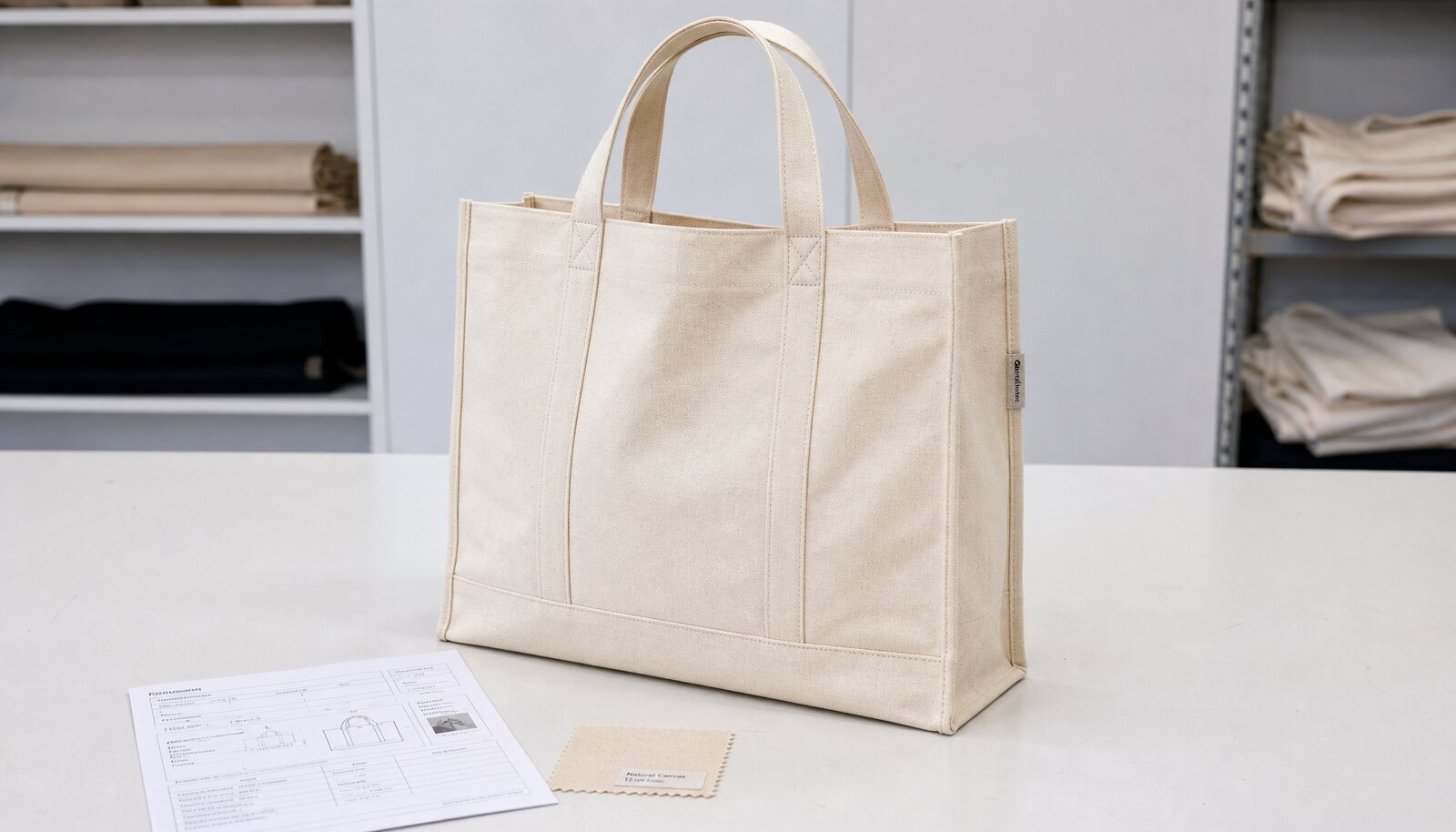
For most canvas exhibition tote bags used in charity campaigns, the practical starting point is 10-12 oz canvas, which is roughly 340-410 gsm. That range usually gives enough body to sit upright on a table, enough stiffness to print cleanly, and enough perceived quality to avoid the thin promotional feel that hurts event giveaways. A natural or lightly bleached finish also keeps the bag broad-appeal and helps the logo stand out without pushing the decoration cost too far.
Size matters as much as fabric weight. A common event format is around 38 x 42 cm or 40 x 45 cm with an 8-12 cm gusset and handles long enough for shoulder carry. If the campaign includes catalogs or a bottled drink, a gusset saves more trouble than a larger flat body. When the buyer expects repeated reuse or heavier fills, move up to 12-14 oz canvas and strengthen the top hem and handle anchors. The extra cost is usually easier to justify than handling complaints after the event.
- 10-12 oz canvas is the default zone for a balanced giveaway bag.
- 12-14 oz works better when the bag must be reused frequently or carry heavier inserts.
- A gusset is more useful than oversized dimensions when the bag must hold mixed event materials.
Print Method Drives Perceived Value And Risk
For campaign bags, one- or two-color screen print is still the most reliable choice. It is simple to inspect, predictable in production, and strong enough for large logo areas on natural canvas. If the artwork has gradients, fine shading, or photo-like detail, a transfer print may be possible, but it needs a proper wash and rub test because some transfer films look good on day one and then crack, peel, or lose edge definition after handling.
Avoid trying to push too much detail onto canvas. Small text, thin outlines, and delicate reverse knockouts often become messy once the ink enters the weave. The safest approach is to simplify the logo for the bag and keep sponsor names or campaign slogans large enough to read across a booth or hallway. For buyers, the real control point is not the print method name. It is whether the supplier can show an actual print strike, approved artwork proof, and a clean registration sample before the bulk order starts.
- Use screen print for bold logos, sponsor marks, and clean flat colors.
- Use transfer only when the artwork genuinely needs it and the performance is tested.
- Set a minimum text size and line thickness before approving the artwork.
Compare Sourcing Routes Before You Compare Price
A direct factory quote, a trading company quote, and a local decorator quote can all land on your desk with similar-looking unit prices, but they do not carry the same risk. A direct factory with sewing and printing under one roof usually gives the buyer better coordination on fabric, stitching, and print placement. A trading company can help if you are consolidating multiple SKUs or need one team to manage several suppliers, but the margin and communication layers need to be clear. A local decorator may be useful for domestic emergencies, but the bag body, print cost, and freight are often priced separately in a way that makes true comparison difficult.
For charity campaigns, the sourcing route should be matched to the consequence of delay. If the event is fixed and the artwork is already approved, direct factory sourcing usually gives the cleanest responsibility chain. If the order is small and time-sensitive, a closer supplier can protect the schedule, but only if the finish quality is already proven. The buyer should compare sample ownership, revision speed, defect handling, and freight control alongside the quoted price. A cheaper line item is not a cheaper order if it creates rework or missed distribution.
- Direct factory works best when one supplier controls sewing, print, and packing.
- Trading company sourcing is more useful when you need coordination across several product types.
- Local decoration can be a rescue route, but it is not automatically the lowest landed cost.
MOQ, Sampling, And The Order Of Freeze
MOQ is usually driven by fabric roll use, print setup, and cutting efficiency, not by the bag alone. Every added print color, handle variation, or alternate size increases the chance that the order needs a separate setup or a separate production batch. That is why buyers should freeze the fabric first, then the size, then the print position, and only then the packing format. If the event team keeps changing the artwork after quote stage, the real MOQ effectively rises because the factory loses efficiency on every adjustment.
Sampling should be treated as a production gate, not a design exercise. A sales sample is useful for early feel, but it should not be the final approval item. The pre-production sample is the one that matters because it reflects the real fabric lot, real ink behavior, real seam finish, and real handle construction. Keep one signed sample as the seal item and compare the bulk lot against it. If the campaign has multiple sponsors or a sensitive logo color, note the acceptable range in writing rather than relying on verbal agreement.
- Freeze fabric, size, print, and packing in that order.
- Treat the pre-production sample as the approval gate for bulk release.
- Track extra colors and print positions because they change both MOQ and lead time.
Packing Should Fit Distribution, Not Just Shipping
Many campaign bags are overpacked because the buyer thinks retail-style presentation will make the product look better. For charity giveaways, bulk carton packing is usually the smarter route. It lowers material waste, keeps freight weight under control, and makes on-site distribution faster. If the event team only needs the bags handed out from a table or stored in a back room, individual polybags rarely add enough value to justify the cost.
Packing details matter when the buyer is planning an event handoff. Carton counts should be easy to divide by the number of venue teams or distribution stations. The outer carton should show style, color, quantity, PO number, and carton sequence so the receiving team can stage inventory without opening every box. Handle flattening, carton compression, and moisture protection need to be balanced against freight efficiency. A carton that is too tight can crease the bag body; a carton that is too loose wastes space and raises shipping cost.
- Bulk pack for event distribution unless retail presentation is a real requirement.
- Use clear carton marks so venue teams can stage the bags quickly.
- Keep handles and bag bodies flat enough to save volume without crushing the product.
Lead Time Risk Comes From Decisions, Not Sewing Alone
A simple charity tote order can move quickly if the artwork is final, the fabric is standard, and the supplier does not need to source a special trim. In practical terms, a buyer may see a few days for quoting, several days for sample production, and a few weeks for bulk manufacturing on a straightforward order. The real delays usually come from unresolved artwork, late color approval, missing packing detail, or the need to remake a sample after someone spots a logo issue at the last minute.
The safest schedule plan is to work backward from the event date and add a buffer that covers one approval cycle plus a transport margin. That buffer matters more on charity campaigns because the bags often support a fixed distribution window. If the order is for a launch or donor event, missing the date can force the team to distribute a weaker substitute or lose sponsor visibility. Buyers should also remember that heavier canvas, special print methods, and high-season shipping all expand the schedule even when the factory is efficient.
- Hold a buffer for at least one artwork correction cycle.
- Expect longer timing if the order uses heavier fabric or more than one print color.
- Treat shipping delay as part of the production plan, not as an exception.
Read The Quote Like A Landed-Cost Worksheet
A useful quote should break out the main cost blocks instead of hiding everything in one bag price. For this type of order, ask for the fabric cost, cutting and sewing, print setup, print run, packaging, cartons, internal QC, and freight separately. That is the only way to compare a direct factory quote against a trading company quote or a local source on equal terms. If one supplier includes sample approval and another charges it separately, the unit price is not enough to make a decision.
For landed cost, the buyer should calculate the total delivered cost per usable bag, not the invoice cost per bag. Add sample charges, carton cost, freight, and a reasonable allowance for rejects or overage. If the order is going by sea, the carton dimensions matter almost as much as the bag spec because a bulky carton can erase a lower sewing price. If you need a clean comparison, ask every supplier to quote on the same Incoterm and the same packing format. Otherwise, you are comparing different cost bases, not different suppliers.
- Demand line items for fabric, sewing, print, packing, cartons, and freight.
- Compare suppliers using the same Incoterm and the same pack format.
- Include rejects, sample cost, and any setup fee in the landed-cost math.
The Mistakes That Create Rework And Complaints
The most common production mistakes are easy to prevent if the buyer writes the spec in measurable terms. Thin fabric chosen to save a small amount of money often makes the event bag feel disposable. Weak handle anchors cause the most visible failures. A print that looks fine in a PDF can become blurry or too light once it hits the weave. Buyers also lose time when they leave artwork approval vague and then discover that the factory interpreted spacing, logo size, or background color differently from the brand team.
Set acceptance criteria before the order starts. A practical example is finished size tolerance within plus or minus 1 cm, print placement within a small position window, no broken stitches, no loose threads longer than the agreed limit, and no visible oil stains or fabric holes. Add a simple load test that reflects how the bag will actually be used at the event. The point is not to create an academic inspection sheet. The point is to keep the supplier focused on the defects that would be visible to the people receiving the bags.
- Use measurable tolerances for size, print placement, and sewing quality.
- Require reinforced handle anchors and a simple load test on the approved sample.
- Treat artwork ambiguity as a production risk, not a design preference.
What To Put In The RFQ So Quotes Stay Comparable
A clean RFQ packet does most of the sourcing work before a salesperson even replies. Include the final tote size, fabric weight target, handle length, gusset depth, print file, print colors, quantity by style, packing requirement, ship-to location, and the target in-hands date. If you have a preferred quote structure, say so. For example, ask for sample cost, bulk unit price, packaging, cartons, and freight on separate lines. This avoids the common problem where one supplier gives you a product price and another gives you a delivered price, which makes comparison useless.
If the campaign has two audience groups or two distribution dates, show that clearly in the RFQ so the supplier can advise whether one production run is enough or whether you should split the order. Buyers save time when they give the factory one clear version of the spec instead of a loose brief and multiple follow-up emails. The better the RFQ, the more likely the quote will reflect what can actually be produced, packed, and delivered on time.
- Include final size, fabric weight, print file, quantity, packing, and deadline.
- Request one quote format across all suppliers so the totals can be compared cleanly.
- State whether split shipments, alternate fabrics, or alternate packing are acceptable.
Specification comparison for buyers
| Spec decision | Recommended option | When it fits | Buyer risk to check |
|---|---|---|---|
| Sourcing route | Direct factory with sewing and printing under one purchase order | Best when the artwork is fixed, the event date is firm, and you need one point of responsibility | Verify whether printing is truly in-house or quietly subcontracted, because that changes lead time and defect ownership |
| Fabric weight | 10-12 oz canvas, roughly 340-410 gsm, in natural or lightly bleached finish | Works for most charity giveaways where the bag must feel substantial without pushing the budget too far | Below 300 gsm can look weak; above 420 gsm raises cost and can slow printing and sewing |
| Print method | 1-2 color screen print for the main logo, with transfer only for complex artwork | Fits bold campaign logos, clear sponsor marks, and short production windows | Fine gradients, tiny text, and thin knockout lines may fail at production scale, so approve an actual print proof |
| Bag build | Self-fabric handles with reinforced top hem and cross stitching at the stress points | Good for literature packs, donation inserts, and normal event handouts | Weak handle anchors or a loose top hem will show failure early, especially when the bag is carried full |
| Gusset and size | About 38 x 42 cm or 40 x 45 cm with an 8-12 cm gusset | Useful when the giveaway needs to hold brochures, a notebook, and a small water bottle | Oversized bags increase freight and print area cost; undersized bags look cheap and do not carry well |
| Sampling route | Pre-production sample after artwork and spec are frozen | Needed when color match, handle length, and print placement matter to the buyer | Sales samples can hide real fabric shade, stitch density, or ink coverage differences |
| Packing route | Bulk packed by carton count, with clear outer labels and no retail polybag unless required | Best for direct event distribution and lower freight cost | Individual polybags add cost and waste unless the bags are going to retail or need moisture protection |
| Freight route | Sea freight for planned campaigns, air freight only for urgent top-up orders | Choose based on event date, carton count, and the real penalty of missing the launch | Flat-packed cartons reduce chargeable volume; overstuffed cartons can crush handles and create claims |
Buyer checklist before sampling
- Lock the event date, arrival window, and latest in-hands date before requesting pricing.
- Define tote size, fabric weight, handle length, and gusset in centimeters, not in vague terms.
- Send vector artwork and state the exact logo colors, preferred Pantone references, and minimum text size.
- Decide whether the bags should be bulk packed, inner packed, or individually polybagged.
- Ask for unit price, setup charges, sample cost, carton cost, and freight as separate lines.
- Request a pre-production sample and keep one sealed reference sample for bulk comparison.
- Confirm carton count, carton dimensions, gross weight target, and outer label format.
- Keep schedule buffer for artwork corrections, sample approval, and shipping delay.
Factory quote questions to send
- What fabric weight will you use, and what tolerance should we expect on the finished gsm?
- Is the print done in-house, and how many setup charges apply for each color or print position?
- What is the MOQ by fabric color, print color, and artwork version?
- Can you separate sample cost, bulk price, packing, and freight in the quote?
- What carton size, piece count per carton, and gross weight do you propose for this style?
- What approval sample will you provide before bulk sewing starts?
- What is the lead time from art approval to ex-factory completion?
- How do you handle defects found in bulk against the approved sample?
Quality-control points to confirm
- Fabric weight matches the approved swatch within the agreed tolerance range.
- Finished dimensions, gusset depth, and handle length stay within the spec sheet tolerance.
- Print placement, color density, and edge sharpness match the signed sample.
- Stitching is even, with reinforced handle anchors and no skipped stitches or loose thread runs.
- A practical load test does not open seams or stretch the handles beyond acceptable limits.
- No oil stains, holes, heavy odor, or visible fabric defects should appear on packed goods.
- Carton labels, pack count, and outer marks match the packing list and purchase order.
- The pre-shipment sample or top-of-bulk reference matches the production lot before release.