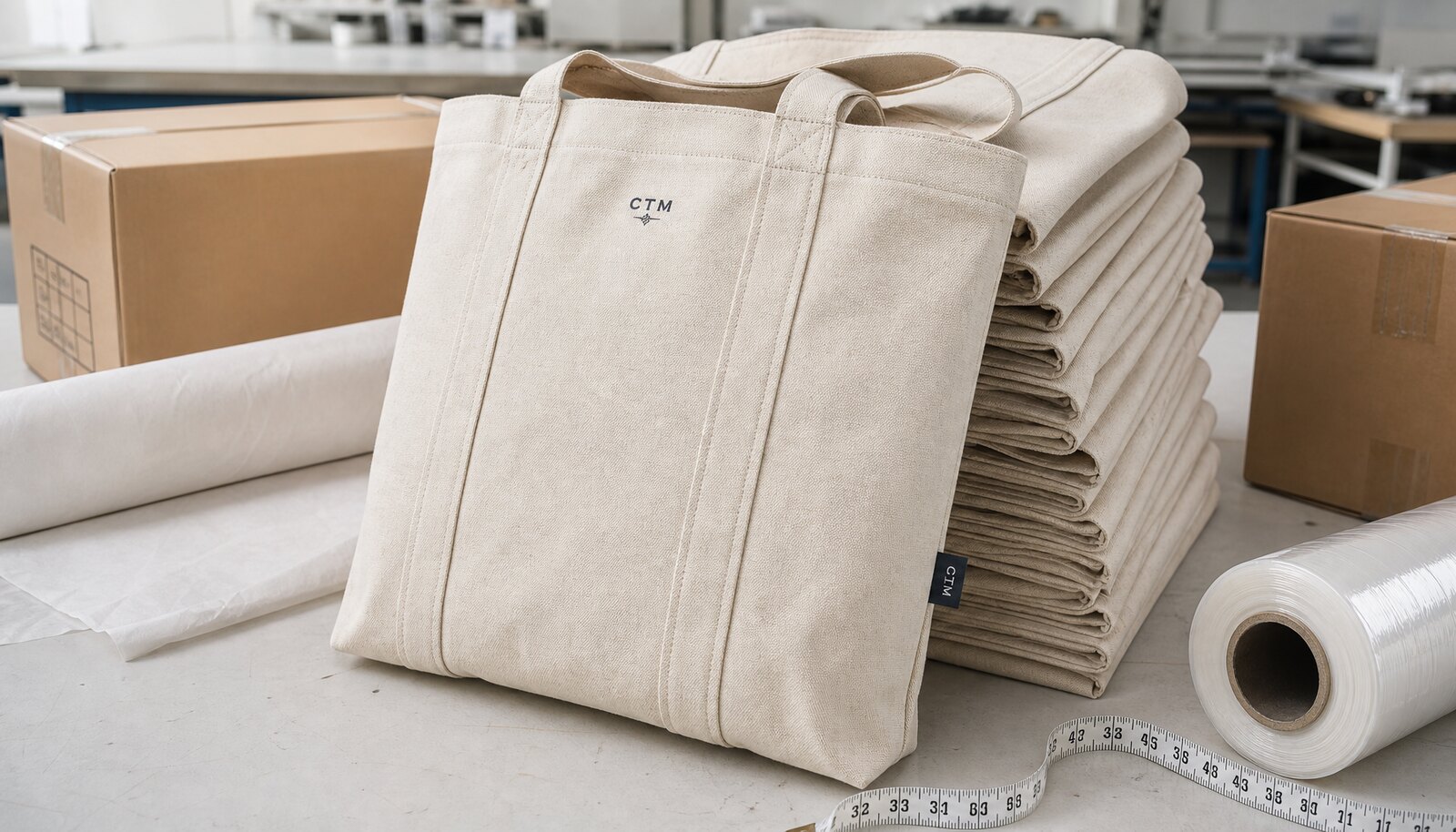
Start With the Shipment, Not the Tote
For apparel brands, the tote bag is only one part of the purchase. The real buying unit is the packed carton. If the bag is specified without the carton plan, the supplier can still produce something that looks right in a sample room and still fail in dispatch because the cartons are too heavy, too large, or too soft for the route.
That is why the first conversation should include the receiving limit, the shipping mode, the destination profile, and the carton count target. A tote that will ride in a retail launch box does not need the same pack-out as a tote that will move by sea in mixed freight, then be broken down into DC replenishment. Write those differences into the RFQ before the factory prices the bag. Then every quote is based on the same transport reality.
The fastest way to avoid a bad comparison is to define the order in operational terms: finished bag size, fold style, carton dimensions, carton gross weight, and whether the shipment is palletized. Once those five variables are fixed, suppliers can still compete on fabric quality, print quality, and lead time. Without them, the quote is only a rough estimate.
- Confirm your shipping mode first: courier, air freight, sea freight, or mixed domestic distribution.
- Set a maximum gross carton weight and a preferred carton size before asking for unit pricing.
- Treat the folded carton spec as part of the product, not as an afterthought.
Choose Canvas Weight Around the Real Load
Canvas weight should match how the tote will actually be used. A 10-12 oz canvas body, roughly 340-410 GSM, is the most practical range for most apparel event totes because it gives enough structure for print, folds cleanly, and does not create oversized cartons. That range also tends to feel close to retail merchandise rather than disposable promotion stock.
Lighter 8 oz canvas works when the bag is a handout or insert and freight cost matters more than body structure. It cuts weight, but it can wrinkle faster and show the dark side of the print on the front panel. Heavier 14 oz and above creates a more premium hand feel, but the fold grows fast and the carton count drops. If the bag is not meant to carry heavy product or resale value, extra weight is often a freight problem rather than a quality advantage.
When suppliers quote approximate weight bands, make them state the basis. Ask whether the GSM was measured before washing, after finishing, or from a supplier standard sheet. If the fabric is dyed or coated, the final hand feel can differ enough to alter pack thickness, so the procurement file should note the measurement basis alongside the number. That keeps two suppliers from appearing equivalent when they are not.
- 8 oz: use for low-cost campaigns and short-use programs, but check for print strike-through and limp body feel.
- 10-12 oz: use for most apparel brand launches and exhibition handouts because it balances structure and pack efficiency.
- 14 oz and above: use when the bag needs more body or resale appeal, then recalculate carton size and freight before you commit.
Lock Handles, Print, and Fold Before You Ask for Quotes
The bag spec has three carton-impacting variables that buyers often leave vague: handle build, print method, and fold style. Handle width and reinforcement determine how much bulk builds up in the fold. Print method determines whether the front panel needs tissue or polybag protection. Fold style determines whether the bag stacks flat or starts to form a thick, uneven carton.
For a standard apparel program, self-fabric handles or 25-30 mm cotton webbing are common because they fold predictably and handle moderate carry weight. A simple one- or two-color screen print is easier to repeat and inspect than a more complex decoration. If you need a patch, woven label, embroidery, or dense print coverage, ask the factory to show the added thickness in the folded sample. Otherwise the bag dimension may be right while the carton plan is wrong.
This is also where route differences matter. A tote that is moving by air or parcel should be optimized for lightness and uniform carton size. A tote that is going into sea freight can tolerate a little more outer reinforcement, but only if the carton board and pallet stack are matched to the transit duration. The spec should reflect the route, not just the artwork mockup.
- Write handle width, handle length, and handle stitch reinforcement into the spec sheet.
- Choose screen print for stable repeat runs unless the artwork forces a different method.
- Approve the fold orientation before bulk so every carton stacks the same way.
Do the Carton Math Before You Price the Freight
A useful sourcing quote should let you calculate freight from the carton outward. The basic math is simple. Carton volume in CBM is length x width x height in meters. Dimensional weight depends on the carrier rule, which varies by mode and lane, so always ask the forwarder or courier for the billing divisor used on your route. If the supplier cannot give you carton dimensions, you cannot reliably estimate freight.
Example one: a carton measuring 61 x 41 x 28 cm has a volume of 0.0701 CBM. At 30 cartons, that is about 2.10 CBM before pallet wrap and void allowances. If the same carton holds 36 pcs, then 1,000 pcs equals about 28 cartons, or about 1.96 CBM. The bag itself may look small, but the packed carton is what the carrier bills.
Example two: a heavier tote packed 24 pcs per carton at 61 x 46 x 30 cm creates about 0.0843 CBM per carton. For 1,000 pcs, that is about 42 cartons and roughly 3.54 CBM. If the shipment is booked by volume or on a tight warehouse receiving window, that difference can be the deciding cost factor even if the unit bag price is lower. Buyers should compare quotes on cartons per 1,000 pcs and CBM per 1,000 pcs, not bag price alone.
If you are booking pallets, add the pallet footprint and stack pattern. A standard 120 x 100 cm pallet can often carry six to eight cartons per layer depending on carton orientation. If the carton footprint wastes space, you may lose a layer or two per pallet, which increases handling and can trigger a higher freight class. That is why tote sourcing should include a pallet drawing when the order is large enough to justify it.
- Compare quotes using cartons per 1,000 pcs, CBM per 1,000 pcs, and gross weight per carton.
- Ask for gross weight at more than one pack count so you can test the manual lift limit.
- Use the folded carton size to estimate freight, warehouse fit, and pallet height before approval.
Use Route-Specific Packing Scenarios to Compare Suppliers
A comparison table is only useful if it reflects the route. A quote that works for domestic delivery may fail on ocean freight because the board grade is too light, or it may fail on parcel delivery because the carton is too bulky for the carrier's dimensional-weight rule. Buyers should read carton plans through the lens of the actual lane.
For long-haul sea freight, the key risks are stack compression, moisture, and carton edge wear. That usually points toward stronger board, careful pallet wrap, and consistent layer counts. For air freight, the key risk is billed volume, so reducing carton height or improving fold efficiency often matters more than using heavier board. For domestic distribution, the priorities are manual lift weight and easy receiving, which makes carton count and label clarity more important than maximum cube efficiency.
The right supplier answer should not be a single number. It should be a set of route-specific recommendations that explains why one carton profile is better for a given lane. If the supplier cannot explain that difference, they are probably quoting from habit rather than from the shipment plan.
- Ask suppliers to recommend a carton profile for sea, air, and domestic routes if your program may change lanes.
- Use stronger board when the pallet will be stacked high or transshipped multiple times.
- Prioritize lower dimensional weight when the shipment will move by parcel or air.
Read Supplier Quotes Like a Procurement Buyer
A quote is only useful if it states what is included. Some suppliers quote the bag only. Others include print, folding, inner packing, carton printing, pallet wrap, and export marks. Those are not comparable offers. If the quote does not spell out the pack-out, the lowest number is often missing labor or packing material that appears later as an add-on.
The cleanest way to compare suppliers is to force the same assumptions: same canvas GSM, same print method, same fold, same pack count, same carton spec, same pallet requirement, and same destination terms. Then ask the factory to show carton dimensions, gross weight, cartons per 1,000 pcs, and the intended pallet layers. If the numbers do not line up, you are not comparing the same product. That is a commercial risk, not a minor technical difference.
Procurement teams should also request the basis for any approximate claim. If a supplier says a bag weighs 180 g or a carton holds 36 pcs, ask whether that is a target, a sample measurement, or a production tolerance band. A number without its basis is not helpful for freight planning, especially when you are comparing multiple factories or bidding a re-order across seasons.
- Ask whether the price is based on finished bag only, packed bag, or packed-and-cartoned bag.
- Confirm if the supplier included artwork setup, sample charges, carton marks, and pallet wrap in the unit price.
- Do not compare two quotes until the pack count and carton size are identical.
RFQ Questions That Expose Hidden Cost
A good RFQ makes the supplier do the engineering work upfront. The fastest way to uncover hidden cost is to ask for the carton plan before you accept the bag price. If the factory can answer clearly, you can compare suppliers on the same basis. If they cannot, the quote is not ready for procurement.
Use questions that force measurable answers. Ask for the finished size after final pressing, the expected cut allowance, the carton dimensions at 20, 30, and 40 pcs, and the gross weight at each pack count. Ask whether tissue or polybag changes the carton size. Ask for the carton board grade and whether the outer marks are printed or applied as labels. Those details reveal whether the factory has packed this type of order before or is guessing.
A useful RFQ also asks about pallet logic, not only carton logic. If the shipment will be palletized, ask how many cartons fit per layer, how many layers they recommend, and whether they expect any top board, corner board, or stretch wrap. That lets you compare the real receiving unit, which is the pallet, not the carton sitting on the factory floor.
- What is the finished size after sewing and after fold?
- What carton size do you recommend at 20, 30, and 40 pcs per carton?
- What gross weight will each carton reach at those counts?
- What pack materials are included: tissue, polybag, insert card, or none?
- What carton board grade do you recommend for our route?
- How many layers do you recommend per pallet, and what is the loaded pallet height?
Sample Approval Without Guesswork
The first approved sample should prove more than the look of the bag. It should prove the tote can be folded, packed, and shipped the way the PO requires. A flat presentation sample can hide problems that show up once the bag is folded under pressure for a few days. That is why the buyer should inspect the sample in its packed state, not only on a table.
Check the bag after folding it to the agreed orientation and leaving it under light compression. Confirm the print is still centered, the handles sit flat, and the front panel does not show permanent crease lines across the logo area. If the bag uses a woven label, patch, or heavy print coverage, make sure the added thickness does not force the carton to bulge. A good sample is one that can become a repeatable packing instruction, not just a photo approval.
If the order is large enough, ask for a pre-production carton sample and a loaded pallet photo before bulk shipment. That is a simple way to catch an easy-to-miss mismatch between carton count, stack height, and pallet wrap. A few minutes spent on a packed sample can prevent a full container from being rejected at receiving.
- Inspect the sample after folding and short-term compression, not only when it is freshly pressed.
- Compare the sample against the agreed carton count and carton dimensions before giving final approval.
- Ask for one packed-carton photo that shows the exact bag orientation, interleaf method, and outer mark layout.
QC Checks at Bag, Carton, and Pallet Level
Quality control should happen in three layers. First, inspect the bag construction: fabric weight, seam alignment, handle reinforcement, and print placement. Second, inspect the packed carton: count, folding consistency, and carton strength. Third, inspect the dispatch lot: labels, pallet height, and carton condition after stacking. If the buyer only checks the finished bag, the order can still fail in transport.
The most useful tolerances are the ones tied to transport risk. A practical commercial rule is +/-0.5 cm on finished width and height for standard canvas totes, and +/-0.3 cm on handle drop if the handle length affects the fold. For print, define your own acceptable drift before production starts; multi-color art should not be allowed to wander enough to look misregistered at normal viewing distance. On the carton side, reject any box that arrives crushed, swollen, or split at the corners, even if the bags inside look fine.
For palletized shipments, the QC file should name the stack pattern, loaded height, and compression assumption. A carton that survives on a factory floor can still fail after a week on a warm dock if the pallet is too tall or the top layer is uneven. If the supplier cannot maintain a consistent layer count, reduce the layer count or upgrade the board grade before you release the lot.
- Reject any carton with split tape, crushed corners, or exposed corrugation.
- Reject any bag with skipped stitches, loose seam ends, or handle anchor defects.
- Hold any lot where the print rubs onto a white cloth under light hand pressure.
- Check cartons from the top, middle, and bottom of the shipment instead of approving one good carton only.
- If cartons exceed a manual lift limit, require palletization or reduce the pack count.
Lead Time and Booking Windows
For a straightforward canvas tote with standard print and a simple carton spec, a practical planning window is often 20-35 days after sample approval. Add more time if the fabric needs dye matching, the print is multi-stage, or the carton is printed with SKU-specific marks. First orders move slower than reorders because the factory is still confirming the fold method, the carton count, and the pack sequence.
The schedule risk is usually not sewing capacity. It is late change control. A small change in handle length or print size can change the fold, which changes the carton height, which changes the pallet plan and the freight booking. Freeze the carton dimensions before production starts, and do not treat carton approval as something that can happen after the bulk bag is already sewn. The carton spec should be locked at the same time as the artwork and finished size.
For apparel brands with seasonal launches, it is worth building a simple cut-off calendar. The order should have a freeze date for artwork, a freeze date for carton spec, and a final booking date for freight. That keeps the tote from drifting into an unplanned packaging project at the end of a merchandising sprint.
- Plan extra days for print setup, color approval, and first-time carton proofing.
- Freeze the fold and carton dimensions before bulk sewing starts.
- Ask the factory for the critical path if your delivery date is fixed, not just the end date.
Specification comparison for buyers
| Option | Example carton profile | Board grade / palletization | Operational tradeoff | Freight implication |
|---|---|---|---|---|
| 8 oz canvas giveaway tote | 50-60 pcs per carton; about 61 x 41 x 23 cm; gross weight about 11-14 kg | Usually 3-ply or light 5-ply if stacking is modest; palletize if cartons ride long distance or top-load is high | Lowest fabric cost and smallest bag bulk, but the body is limp and print show-through is more likely | Good carton density, but weak boxes can crush under stack weight and extra void space wastes CBM |
| 10-12 oz standard event tote | 30-40 pcs per carton; about 61 x 41 x 28 cm; gross weight about 14-18 kg | Commonly 5-ply export carton; 10 layers on a 120 x 100 cm pallet is usually too high unless carton compression is tested | Best balance of hand feel, print stability, and fold size for most apparel programs | Usually the easiest profile to move through receiving, warehousing, and mixed-freight booking |
| 14 oz premium retail tote | 20-28 pcs per carton; about 61 x 46 x 30 cm; gross weight about 16-22 kg | Prefer 5-ply or 7-ply if cartons are double-stacked or exported with long transit time; pallet layers often need to be reduced | More structure and a more retail-like hand feel, but bulk rises quickly after folding | Higher dimensional weight and more cartons per 1,000 pcs if the fold is not controlled |
| Flat fold with tissue interleaf | Pack labor rises slightly; carton height may increase by 0.5-1.5 cm depending on the fold stack | 5-ply is usually enough if the carton count stays moderate; pallet layers can often remain unchanged | Reduces rub marks on fresh print and helps the tote keep a cleaner face in transit | Small increase in pack time and packing material, but lower damage risk |
| Flat fold with polybag | Adds one more packing step and usually a modest increase in carton dimensions | 5-ply is common, but if polybagged cartons are heavy or travel by sea, buyers should test corner crush and compression | Better surface protection, but it can trap heat, add waste, and slow pack-out | Carton size often grows a little, and labor cost becomes visible in the quote |
| One SKU per carton with clear marks | No mixed lots; carton labels match SKU, color, and count exactly | Any board grade can work, but route-specific labeling is easier to control when pallets are built by SKU and PO line | Simplifies receiving and claims handling, but requires tighter packing discipline | Lower receiving risk and faster warehouse put-away, with fewer relabeling issues |
Buyer checklist before sampling
- Lock finished bag size, cut-size allowance, canvas GSM, handle width, handle length, print method, and fold direction before requesting carton pricing.
- Ask each supplier to state the pack count per carton, the target gross weight per carton, and the carton board grade instead of quoting bag price only.
- Set a manual lift limit for the receiving team and write it into the RFQ so cartons do not arrive too heavy to handle safely.
- Ask for carton math on a sample basis: carton dimensions, gross weight, cartons per 1,000 pcs, CBM per 1,000 pcs, and pallet layers per pallet.
- Send one folding photo reference or a simple folding sketch so every factory packs the tote the same way.
- Decide in advance whether the order needs tissue, a polybag, or no inner packing, then keep that rule consistent across quotes.
- Request a sample carton plan with carton dimensions, gross weight, carton count per 1,000 pcs, and the pallet stack pattern if palletization is required.
- Write reject conditions for print rub, loose stitches, carton crush, mixed SKUs, and out-of-tolerance carton dimensions before sample approval.
Factory quote questions to send
- What is the finished size after sewing, after pressing, and after final fold, and what cut-size allowance are you using?
- How many pieces fit in one export carton at this bag weight, and what carton dimensions does that create?
- What is the gross weight per carton at 20, 30, and 40 pcs, and can you keep cartons under our receiving limit?
- Please show the carton math for this order: carton CBM, cartons per 1,000 pcs, and estimated pallet layers if we build on pallets.
- Does your quoted price include print setup, artwork proofing, folding, inner packing, carton marks, and pallet wrap if we need it?
- What is the MOQ by color, by print version, and by carton configuration?
- What carton board spec do you recommend for this route, and is it 3-ply, 5-ply, or 7-ply?
- What tolerances do you allow for bag width, bag height, handle drop, print placement, and carton outer dimensions?
- How long do you need for sample approval, carton proofing, and pallet sample confirmation?
- Can you provide photos of the folded bag inside the carton and a loaded carton stack so we can verify pack orientation and compression before bulk production?
Quality-control points to confirm
- Fabric GSM should match the agreed spec within the supplier tolerance, commonly within about +/-5% unless the contract states a tighter band. If the supplier is using a blended canvas or dyed fabric, ask for the test method they use so the number is comparable across mills.
- Finished width and height should be within +/-0.5 cm of the approved sample; handle drop should be within +/-0.3 cm if the bag uses a standard retail-style drop. For large printed logos, verify that the measured print placement still centers correctly after the bag is folded.
- Reject any bag with skipped stitches, open seams, loose thread bundles at the handle anchor, incomplete box-stitch reinforcement, or uneven binding that changes the fold thickness.
- Print should sit in the approved position and remain readable after normal folding; set a written rejection point if multi-color art drifts beyond the tolerance you approved with the artwork team.
- Perform a simple rub check on the printed face; if color transfers visibly to a white cloth under light hand pressure, hold the lot for review and check whether curing or ink density is the cause.
- Cartons should arrive square, dry, and fully taped, with no crushed corners, split flaps, or exposed corrugation on the edges. If the route is humid or transshipped, ask whether the supplier uses moisture-resistant tape or outer wrap.
- Carton count must match the packing list exactly, with no mixed lots unless the PO explicitly allows them. If mixed assortments are unavoidable, define how they will be labeled and palletized.
- Keep carton gross weight under the receiving limit you set in the RFQ, commonly 15-18 kg for manual handling. If the bag is heavy or the pack count is high, reduce the count or require palletized handling.
- Check one packed carton from the top, middle, and bottom of the lot so you do not approve a single perfect carton and miss a packing drift across the run.
- For courier or domestic parcel moves, request a packed-carton drop test sample; for sea freight, focus more on stack compression, corner crush resistance, and pallet layer stability.