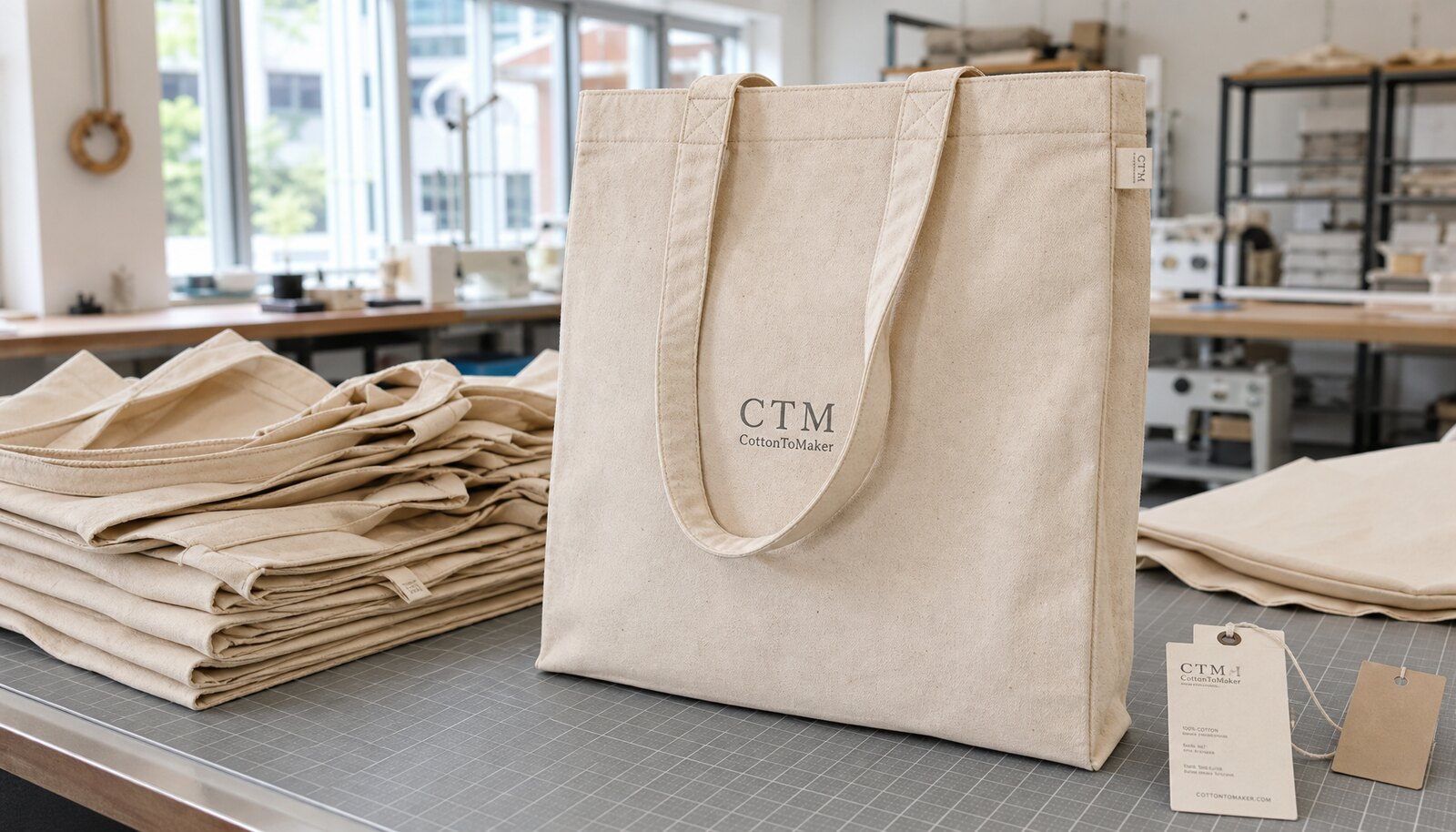
1. Start With the Packaging Problem, Not the Bag Price
For boutique programs, the packaging spec is usually where the order goes wrong. Buyers focus on the tote itself, then discover the real issue at receiving: the fold is inconsistent, the label is missing, the carton count is off, or the bag cannot go straight into shelf stock. If the tote is meant to support an exhibition, a pop-up, or a boutique gift campaign, the pack format is part of the product. You are not buying a blank canvas bag; you are buying a retail-ready unit that must survive handling, look clean out of the carton, and present the brand correctly.
That is why the best RFQ starts with how the bag will be sold, stored, and handed out. A boutique tote often needs more than a single unit price. It needs a defined fold, a defined insert, a defined label location, and a clear outer carton spec so every supplier quotes the same thing. If those points are left open, one quote may look cheaper because it excludes polybags, another may hide a different handle construction, and a third may silently change the print method. The result is not comparison. It is confusion.
- Define the end use first: shelf display, counter giveaway, event handout, or gift-with-purchase.
- Treat retail packing as part of the item spec, not as an optional add-on.
- Use one approved sample as the reference for both the bag and the pack-out.
2. Choose Fabric Weight for Print Quality and Bag Behavior
For this category, fabric weight drives more than cost. It changes how the bag hangs, how the print sits, how much it wrinkles, and whether the tote feels like a boutique product or a low-grade giveaway. A common working range is 8 oz to 12 oz cotton canvas, which is roughly 272 to 407 GSM. Lighter cloth can work for flat promotional handouts, but it often sags once the bag carries a catalog, bottle, or boxed purchase. Heavier canvas gives a more structured feel, but it also changes sewing time, needle wear, and shipping weight.
The practical buying question is not just what weight the supplier can sew. It is whether the fabric is stable enough for the print method and the pack format you want. Pre-shrunk or pre-washed cloth reduces later distortion, especially if the bag will be folded into a precise retail format. Natural greige canvas may show more slubs and shade variation, which some boutique buyers like, but that needs to be approved against a bulk shade band. If your logo has fine lines, you should care as much about weave density and surface finish as about nominal GSM.
- 8 oz to 10 oz works for lighter gifting and exhibition handouts when cost and pack volume matter.
- 10 oz to 12 oz is a safer range for boutique retail programs that need better drape and print clarity.
- Ask for fabric shrinkage data, not only GSM, because the finished size can move after washing or pressing.
3. Lock the Print Method Before You Compare Quotes
Print method is one of the biggest hidden cost drivers in canvas tote sourcing. Screen printing is usually the baseline for simple logos and solid spot colors. It can give a strong, opaque impression on canvas, but it needs proper artwork separation and setup. Heat transfer can support more complex artwork or smaller runs, though the hand feel and durability need to be checked against your brand standard. Embroidery looks premium, but it adds time, needle cost, and fabric stress, so it is not always the right option for a flat exhibition tote.
A buyer should specify print area, placement tolerance, and the acceptable color variation before any sample is made. If the logo must sit centered to the seam, the factory needs that exact reference, not a vague request for 'around the middle.' If the bag has a side label, the print and label should not interfere with each other in the final folded pack. For boutiques, subtle problems matter: a logo that skews five millimeters may be rejected even if the bag itself is well made. Ask the factory to supply a pre-production proof on actual fabric, not only a digital mockup.
- Use screen print for simple boutique logos, repeat orders, and better unit economics.
- Use transfer or specialty methods when the artwork is detailed or the order size does not justify full screen setup.
- Require a printed strike-off or pre-production sample on the same fabric lot whenever possible.
4. Compare Supplier Routes Before You Commit to One Quote
Not every supplier is solving the same problem. A direct factory may give you better control over fabric, sewing, and pack-out, but only if they genuinely manage all of it. A trading company can simplify communication and bundle several steps into one invoice, though the actual factory may change between orders. A domestic converter can be useful if you need speed, small lots, or market-specific packaging, yet the unit cost usually reflects that convenience. The right route depends on whether your priority is price, control, speed, or lower ordering friction.
For boutique tote bags, the quote must show who owns each step. If the printing is subcontracted and the packing is subcontracted again, you need to know where the process gaps are. That matters when the buyer asks for a slightly different fold size, a new barcode format, or a better carton spec. A supplier with in-house sewing and packing can usually make those adjustments faster. A supplier that only sources finished bags may keep the commercial conversation easy, but the quality risk shifts to their unseen partners.
- Use one supplier route when you need tight control over packaging and brand consistency.
- Use a trading route only if they disclose the actual factory and keep the same line stable across reorders.
- Compare quotes on the same basis: product, print, pack-out, carton, and freight terms.
5. Write the Pack-Out Spec Like a Warehouse Will Receive It
The pack-out spec should tell the factory exactly how the tote leaves the line and how it lands in your warehouse. That includes fold direction, folded dimensions, tissue paper if used, belly band placement, barcode label position, polybag type, and the number of units per master carton. If your retail team wants the bag ready for hanging or shelf display, state that early. A clean pack-out saves labor downstream and prevents the common mistake where the bag itself is correct but the opening plan fails at the distribution center.
Keep the spec practical. The factory needs enough detail to quote and pack without guessing, but not a page of decorative language. Specify if the bag must be folded to a standard retail size, if the handle should remain exposed or hidden, and whether the tote should be compressed or kept loosely folded to avoid creasing the print. If you need barcodes, make sure they are assigned in the same SKU format used by your retail system. A label that scans poorly in receiving creates cost that is far greater than the label itself.
- State the folded size in millimeters or inches, not only as 'small fold' or 'retail fold.'
- Define whether the pack is a single bag in a polybag or a bulk pack without inner packaging.
- Include carton marks, SKU codes, and pallet rules if the bag is going into chain retail.
6. Use MOQ Logic to Protect Quote Comparability
MOQ is rarely just a minimum quantity. It is usually a combination of fabric consumption, printing setup, sewing efficiency, and packing labor. A factory may accept a lower total order if the artwork is simple and the fabric is standard, but the same factory may push the MOQ higher if the order has multiple colors, special labels, or retail insert cards. The key is to understand what causes the step-up. If the factory gives you one MOQ for the bag and another for the pack-out, those are two different cost structures and should be quoted separately.
For buyers managing boutique assortments, the smartest approach is to protect the core spec and let only one or two variables change at a time. Keep the bag size fixed, keep the logo placement fixed, and vary the body color or label only if the factory can maintain the same line setup. That gives you real comparison data. If you change the fabric, the print, the fold, and the carton at the same time, the quote becomes impossible to interpret. You may think one source is cheaper, when in fact it is simply quoting a different product.
- Ask which cost items are fixed setup charges and which are unit-based.
- Separate MOQ by bag body, print method, and packaging accessories.
- If you need multiple colors, ask whether the MOQ applies per color or per total design.
7. Sample Approval Should Test Both the Bag and the Pack
A sample that only checks the bag body is not enough. The sample approval should include the final fold, final print method, final label, and final carton format. Otherwise, the factory may approve a nice loose sample and then compress it into a pack that wrinkles the logo or shifts the label position. For exhibition and boutique use, the product can look acceptable in flat form and still fail in retail presentation. The sample stage is where you catch those problems cheaply.
A useful sample process has two checkpoints. First is the salesman sample or development sample, which proves that the size and branding direction are right. Second is the pre-production sample, made with the actual bulk fabric, print plates, and pack-out method. On that sample, measure the body size, handle length, stitching alignment, and folded presentation. If the tote is meant to sit beside premium stationery, cosmetics, or books, the sample should also show how it photographs after unpacking. If the pack leaves hard crease marks or uneven edges, fix it before bulk starts.
- Check size, print registration, handle reinforcement, label placement, and folding result on the same sample.
- Approve only when the sample uses the same fabric lot or an approved equivalent.
- Keep one sealed approval sample from each order for later dispute resolution.
8. Set QC Thresholds That Match Retail Reality
A buyer-friendly quality standard should focus on defects that customers and store teams will actually notice. Loose threads, off-center logos, twisted handles, dirty fabric, and inconsistent folds are the first problems to reject. On the technical side, you also want control over stitching density, seam strength, color shade, and packing count. If the order is for boutiques, the visual standard is usually tighter than for standard promotion. That does not mean over-engineering the inspection. It means drawing a clean line between acceptable variation and real reject conditions.
The factory should know which defects are critical, major, and minor before production starts. Critical issues might include wrong artwork, wrong SKU label, or broken handle stitching. Major issues might include visible print misalignment, staining, or inaccurate folded size. Minor issues could include slight natural canvas shade variation within an agreed band. When the standard is written this way, the factory can inspect more intelligently, and the buyer has a better basis for disputes. If the order is large enough, request a pre-shipment inspection against an AQL plan and include pack-out verification, not just bag appearance.
- Treat label errors, wrong print color, and handle failure as critical defects.
- Set size and fold tolerances before bulk so the warehouse team does not invent its own standard later.
- Require carton count checks and a random scan test of barcode labels if the bags are retail-coded.
9. Compare Landed Cost, Not Just Unit Cost
When buyers compare tote quotes, the cheapest unit price often hides a more expensive total landed cost. A lower factory price can be offset by oversized cartons, extra inner packing, higher freight volume, or more receiving labor because the pack-out is awkward. The right comparison includes the bag, printing, labels, inner packs, master carton dimensions, carton gross weight, freight basis, and any local handling charges. If the supplier quotes FOB only, you still need to estimate the effect of carton math and destination duties before deciding.
This matters especially for exhibition tote bags for boutiques, where the packaging spec is not decorative. A tighter fold can reduce freight volume, but it may also require more labor. A heavier canvas can improve perceived quality, but it may cut carton quantity per shipment. One supplier may look more expensive per piece and still land lower because the cartons are more efficient and the packing is cleaner. Ask for a quote line that includes carton size, units per carton, and the estimated loading quantity so the comparison is based on transport reality, not just sewing cost.
- Compare FOB, CIF, and DDP only after the spec is frozen.
- Use carton dimensions and gross weight to estimate freight efficiency.
- Include receiving labor and repacking risk when the order is retail-ready.
Specification comparison for buyers
| Spec decision | Recommended option | When it fits | Buyer risk to check |
|---|---|---|---|
| Primary sourcing route | Direct factory with in-house sewing and packing, or a factory-managed packing partner | Best when you need the bag, print, and retail pack-out controlled under one quote | Check whether carton making, polybagging, and barcode labeling are included or priced separately |
| Artwork control | Factory with in-house screen printing or transfer printing and a signed pre-production proof | Best when logo placement, color consistency, and boutique branding are non-negotiable | Ask who owns final artwork review if the print shop is subcontracted |
| Retail-ready packing | Supplier that can add tissue, belly band, hangtag, insert card, and barcode sticker | Boutique launches, gift programs, and shelf-ready display orders | Confirm the exact pack-out sequence and whether overages are allowed for damaged packs |
| MOQ structure | Factory that allows color splits but keeps one artwork setup charge per design | Seasonal assortments with several colorways but one logo | Watch hidden setup charges for each color, size, or print position |
| Fabric route | 8 oz to 12 oz pre-shrunk cotton canvas from a sewing factory with stable fabric sourcing | Most boutique exhibition tote programs where hand feel and print quality matter | Check shrinkage, weave consistency, and whether the fabric is greige or bleached before printing |
| Compliance route | Supplier with lot coding, needle control, and retention samples for each order | Retail channels that require traceability and consistent replenishment | Request written QC records rather than only a verbal assurance |
| Lead-time route | Integrated factory with cutting, printing, sewing, and packing in one site | Tight exhibition dates or launch windows with limited time for transfers | Verify whether peak-season capacity is already booked before you approve the sample |
| Landed-cost route | Supplier able to quote FOB, CIF, and DDP on the same spec sheet | Buyers comparing offshore and nearshore options across different destinations | Do not compare unit price alone if carton size, inner pack, or freight basis changes |
| Sampling route | Salesman sample, then pre-production sample made from the final fabric and print method | Any order where boutique branding and packaging are part of the selling point | Make sure the sample uses the same handle length, print plate, and pack format as bulk |
Buyer checklist before sampling
- Confirm bag size, gusset depth, handle length, and whether the bag must stand upright in retail display.
- Lock fabric weight in oz and GSM, plus whether the cloth is pre-shrunk, bleached, dyed, or natural.
- Specify print method, print area, one-sided or two-sided branding, and the acceptable color tolerance.
- Define the retail pack format: folded size, tissue, insert card, belly band, hangtag, polybag, and barcode label.
- State carton count, master carton dimensions, gross weight target, and pallet requirements if needed.
- Request sample photos of actual pack-out, not only a flat bag image.
- Ask for the quote to separate bag cost, print setup, packing materials, carton cost, and freight basis.
- Set a clear approval point for pre-production sample, then bulk production only after written sign-off.
Factory quote questions to send
- What exact fabric weight, weave count, and shrinkage allowance are you quoting?
- Is the price based on direct printing, heat transfer, embroidery, or woven label application?
- Does the quote include inner packing, tissue, belly band, hangtag, barcode label, and master carton?
- What are your MOQ and price break points by color, print area, and pack format?
- Can you provide carton dimensions, gross weight, and loading quantity for each carton size?
- What is your standard sample lead time, and will the bulk sample use the same line and materials?
- Which parts of the order are subcontracted, if any, and who is responsible for final inspection?
- What is the expected bulk lead time after sample approval and deposit, and what could extend it?
Quality-control points to confirm
- Fabric weight should stay within the agreed tolerance, usually a small band around the target GSM rather than a loose estimate.
- Finished dimensions should be checked after pressing and folding, not only on cut panels.
- Print registration should stay within the agreed tolerance, especially on centered logos and multi-color artwork.
- Handle stitching should be even, secure, and reinforced at the stress points where buyers usually see failure first.
- Seam allowance and thread trimming should be consistent so the bag looks retail-ready out of the carton.
- Pack count should match the carton spec exactly, with no mixed fold directions unless approved in writing.
- Barcode or SKU labels should scan correctly and match the buyer's item master.
- Carton compression and corner protection should hold up to transit, stacking, and warehouse handling.