Why the pouch matters in a launch kit
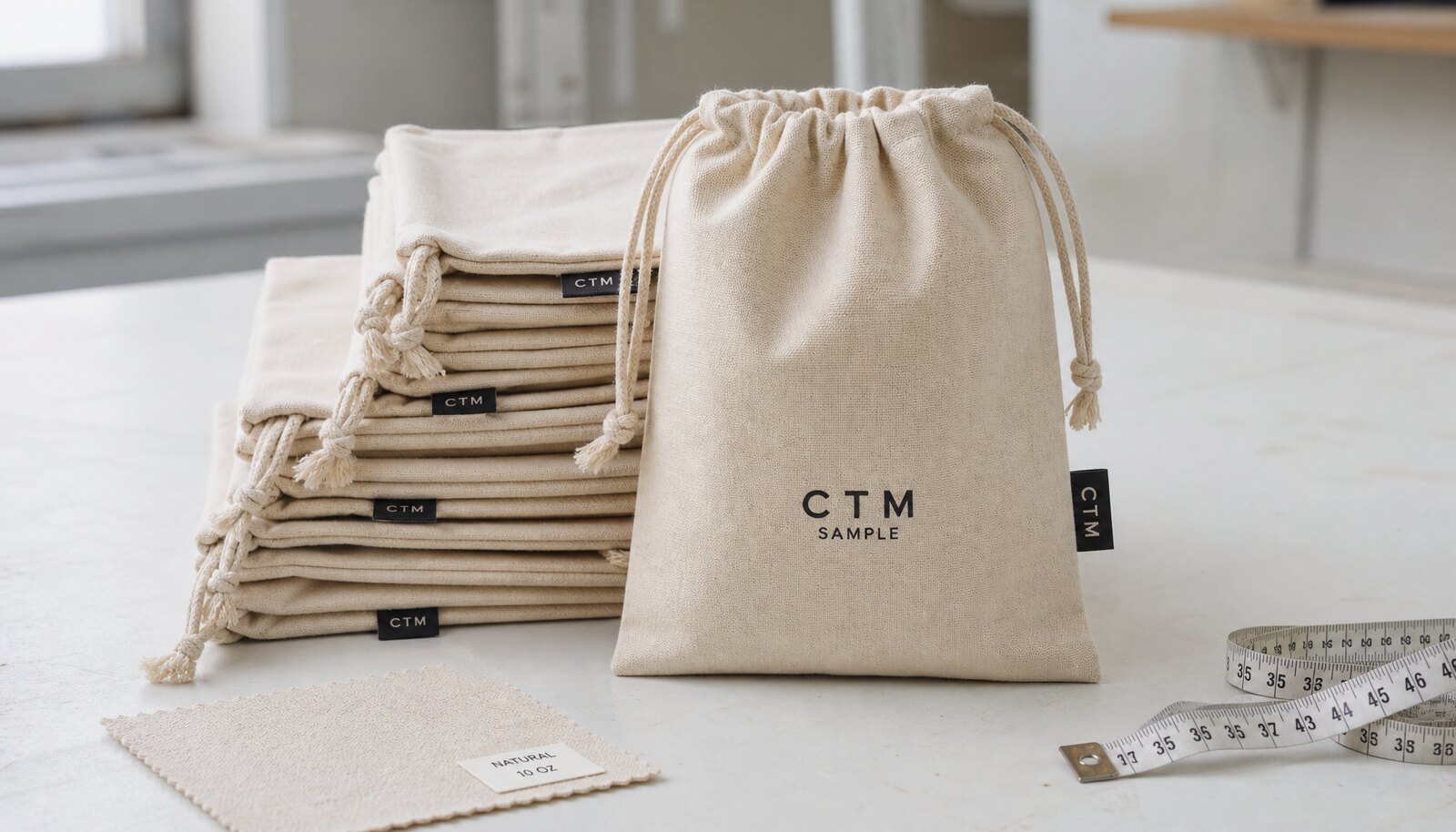
Canvas drawstring pouches for brand launches are rarely just packaging. They sit in PR boxes, retail inserts, influencer kits, event handouts, and premium gift sets, which means they are part of the first physical impression the buyer gets from the brand. That makes the pouch a visible product component, not a generic textile item to be bought on price alone. If the sample feels right but the bulk lot arrives with a different hand, a shifted logo, or a weak closure, the launch absorbs that inconsistency immediately.
Procurement teams usually get better results when they treat the pouch like any other controlled launch item. The brief should state the use case, the product it will hold, the pack-out method, the launch date, and the acceptable tolerance on size, color, print, and finish. That is what gives suppliers a real target. Without it, quotes drift toward vague descriptions, and the risk shows up later as rework, delayed kitting, or a pouch that looks acceptable in isolation but wrong inside the finished kit.
The goal is not to over-engineer a simple bag. It is to define enough detail that the first sample and the bulk shipment are judged against the same standard. Once that is in place, you can compare suppliers on cost, capacity, and process control instead of trying to infer quality from a marketing line item.
- Treat the pouch as a visible launch asset, not filler packaging.
- Tie the brief to one actual use case instead of a generic size chart.
- Write the spec so the sample and bulk lot can be judged against the same reference.
Define fit before you talk fabric
Size decisions should start with what the pouch has to hold, not with a convenient catalog dimension. A pouch for a fragrance sample, a jewelry insert, and a skincare bundle will need different opening widths, body depth, and closure behavior. If the pouch is too tight, the item will not sit flat and the kit looks forced. If it is too loose, the presentation looks underfilled and the pouch feels less deliberate than the rest of the launch.
For procurement, the useful number is the finished internal fit, not the cut fabric size. Measure the pouch after seams and the drawcord channel are complete, then test it with the actual product or a close dimensional proxy. That matters because canvas behaves differently once it is sewn and packed. A pouch that is a few millimeters short can stop a bottle, card, or accessory from sitting cleanly. A pouch that is too tall can waste material and shift the visual balance of the kit.
A practical way to reduce guesswork is to define one standard fit test for every variant. Put the product in the pouch, close it, and confirm three things: the item fits without forcing the seam, the opening closes cleanly, and the final pack-out looks intentional when viewed from the outside. That gives the supplier a functional target instead of a decorative one.
- Map each pouch size to one actual product or kit configuration.
- Check the pouch empty, partially filled, and fully packed before approving the dimension.
- Use finished internal dimensions, not cut size, when you compare samples.
The build choices that change look and yield
Fabric weight is one of the first decisions that changes how the pouch feels in hand and how well it holds up under launch handling. For many brand programs, 10-12 oz canvas is the practical starting point because it gives enough body for a premium feel without becoming hard to sew or expensive to decorate. Lighter cloth can reduce cost, but it tends to wrinkle, fold flat, and look casual under retail lighting. Heavier cloth can feel more deliberate and reusable, but it raises material cost and sewing resistance, and it may be more structure than a simple insert needs.
Construction details matter just as much as fabric weight. Ask whether the canvas is pre-scoured or pre-shrunk, because untreated fabric can move after approval and change the final size or print position. Ask for seam allowance, bartack location, and cord channel depth in writing. If the pouch is meant to feel more refined, the inside finish matters too. Loose trimming, uneven edge cleanup, or a sloppy drawcord exit will show up in the hand long before the buyer reads the logo.
The best spec is not the strongest-sounding spec. It is the one the factory can repeat. If the pouch needs to be carried, stuffed, or reused, define that load case early. If it only needs to hold a light launch insert, do not overbuy fabric weight just to make the quote look premium. Matching the build to the actual use keeps both cost and rework under control.
- 8 oz canvas can work for light-duty inserts, but it is usually less structured.
- 10-12 oz canvas is the most useful middle ground for brand launches.
- Heavier cloth can improve perceived quality, but it increases sewing difficulty and unit cost.
Compare sourcing routes on one set of criteria
The right comparison is not between suppliers in the abstract. It is between sourcing routes that offer different levels of control, speed, and visibility. Stock blank pouches are useful when speed matters more than exact construction. Factory-direct custom production gives you the most control over fabric, sewing, and print repeatability. Trading-company bundles can simplify launch logistics when the pouch is only one item in a larger kit, but they often add another layer between the buyer and the actual factory. Domestic decoration partners are fast for short runs or market tests, but they usually cost more per unit.
What matters is whether the route fits the launch risk. If the pouch is a visible part of the reveal moment, you want traceability and repeatability. If it sits deep inside a kit and the priority is speed, a stock route may be enough. What should not happen is buying a stock pouch while expecting factory-custom control, or buying a custom pouch while accepting no visibility into who made it. That mismatch is where most procurement frustration starts.
Use the comparison table as a decision tool, not a catalog. It should let buyers compare the same criteria side by side: spec profile, launch fit, approximate lead time, and the checks needed before a PO is placed. If a vendor cannot explain the route clearly, the quote is not ready to compare.
- Use stock pouches when speed is the top requirement and branding is limited.
- Use factory-direct custom production when the pouch is part of the brand experience.
- Use bundled sourcing only when the supplier can show chain-of-custody and QC responsibility.
Artwork that survives canvas
Canvas is not a smooth substrate, so artwork that looks sharp on screen can fail on cloth if the linework is too fine or the contrast is too low. Screen printing is still the most reliable default for simple logos and one- or two-color artwork because it gives stable repeatability and clean coverage on coarse weave. It is also easier to scale later if the launch performs well and the pouch becomes a reorder item. Heat transfer can work for short runs or more detailed art, but it needs a real rub check and a fold test because adhesion problems often show up after packing, not during sampling.
Woven labels and sewn side labels are good options when the brand wants a more understated finish. They avoid some of the color-matching issues that come with ink on fabric, but they add another sewing step and another placement point to control. Embroidery can work on heavier canvas, yet it is not a free upgrade. Small text can distort, and light pouches can pucker around dense stitches. If the artwork has fine detail, ask the supplier for the minimum text height and line thickness it can hold without softening the logo.
A practical procurement rule is to make the factory prove the artwork on the chosen fabric. Do not accept a generic yes. Ask for a sample at the final print size, not a scaled mockup. If the mark uses small type, ask for a magnified production proof or accept that the design may need to be simplified before bulk order.
- Screen print is usually the safest starting point for simple launch logos.
- Heat transfer should be tested for rub resistance and fold marks before approval.
- Woven labels can look premium, but they still need placement control and sample sign-off.
Prove the supplier is real
For procurement buyers, supplier qualification matters as much as the pouch spec. A good quote is easy to write; a factory that actually makes the pouch and can repeat the spec is harder to find. Start by confirming the legal company name, production address, and which steps happen in-house. If cutting, sewing, printing, and packing are split across different sites, the buyer needs to know that before the first sample is approved. Otherwise the approved sample and the bulk shipment may come from different processes.
Ask for evidence, not just claims. Useful documents include a business license, factory photos with dated production context, a recent audit report if available, and a basic quality system summary. If the supplier sells into regulated markets, ask for material declarations and any market-specific compliance files that apply to the destination country. Textile claims should be supported by paperwork, not by copy in a quote. If the pouch is going to a market with restricted substances or children's product rules, the seller should already know what documents are needed.
A short live review helps more than a polished brochure. Walk through the production line by video if an on-site visit is not possible. Ask where the fabric is stored, how cut panels are tracked, where print is done, and how final inspection is recorded. If the supplier cannot answer those questions cleanly, the risk is not the pouch itself. The risk is that no one can prove who made it or what changed between sample and shipment.
- Confirm the real production address and who performs each manufacturing step.
- Request business, audit, and compliance documents that match the target market.
- Use a live line review or site evidence to verify that the factory is actually making the pouch.
Write the RFQ so quotes are comparable
A useful RFQ is specific enough that suppliers cannot respond with a generic number and a generic promise. Include the finished size, fabric weight, weave or hand expectation, closure style, artwork method, print placement, packing format, and the launch timeline. Then ask for the same quote in two formats: bulk packed and retail-ready packed. That lets procurement see the real labor and material delta instead of guessing where the price moved. If the supplier cannot price both formats cleanly, the comparison will not be reliable.
The RFQ should also force the factory to show what is included. Ask whether the price covers fabric waste, print screens or plates, carton marks, barcode labels, and any extra handling tied to mixed sizes or mixed print versions. If the answer is buried in a paragraph, ask for a line-item breakdown. The best quotations are boring in the right way: same spec language, same unit basis, same packing assumption, and same lead-time trigger from sample sign-off rather than from inquiry date.
A final check is to ask for the supplier's change-control rule. If the buyer changes artwork, fabric, or packing after the sample is approved, does the factory issue a new lead time, new sample, or new fee? That question is useful because launch work changes often, and the quote should make those consequences visible before the order is placed.
- Price the pouch in both bulk-packed and retail-ready formats.
- Ask for a line-item view of pouch, print, packing, and carton cost.
- Make the supplier state what changes trigger a new fee, sample, or lead time.
Lock the sample and change control
Sample approval should be treated as a controlled reference, not a loose conversation. The sample needs to confirm the fabric lot, size, seam finish, cord behavior, print placement, and packed appearance. Photos are useful, but they do not replace a physical sample that can be measured and handled. The important point is to approve the version the factory will actually run, not a lookalike made from different cloth or a different finishing path.
For launch work, request a pre-production sample when the order is custom or the branding is sensitive. That sample should use the actual fabric, cord, and print method intended for bulk production. Keep one sealed approval sample and note the date, version, and any special tolerances on the label. If the factory later changes the lot or substitutes a cord diameter, you need a fixed reference that makes the deviation visible.
Change control is where many orders go soft. If the artwork changes after approval, if the pouch size shifts, or if packing becomes retail-ready instead of bulk, the buyer should expect a new sign-off. That is not bureaucracy. It is how launch programs avoid disputes when the bulk order arrives looking different from the sample that was originally approved.
- Approve a physical sample from the same process intended for bulk.
- Keep one sealed reference sample with dated approval notes.
- Treat changes in fabric, cord, artwork, or packing as formal revisions, not informal tweaks.
QC thresholds to write into the PO
Quality control should focus on defects the end user will actually notice. For canvas drawstring pouches, that means size drift, seam failure, print problems, cord issues, stains, odor, and wrong pack-out. A launch buyer does not need a decorative inspection list; the PO needs a standard that can be applied quickly on the factory floor and again at receiving. The simplest way to do that is to define major, minor, and critical defects before production starts.
A practical baseline for many buyer programs is AQL 2.5 for major defects and 4.0 for minor defects, with critical defects at zero tolerance. Use that as a starting point, then tighten it if the pouch is retail-facing or if the launch cannot absorb rework. In the PO, define what counts as each defect class. A wrong artwork version, a missing cord, an open seam, a major stain, or a strong odor should be treated as critical or major. Loose threads, small trim marks, or very slight label skew can usually sit in the minor bucket if they do not affect use or presentation.
The inspection checklist should also include measurable checks. Confirm finished dimensions against the approved spec. Check seam density and reinforcement at the cord channel. Use a simple rub test on the print. Pull-test the closure point. Verify carton counts, labels, and size version against the packing list. When the supplier knows those checks will be used, the bulk lot tends to stay closer to the sample.
- Use AQL 2.5 for major defects and 4.0 for minor defects as a common starting point.
- Define critical, major, and minor defects in the PO before production starts.
- Check size, seam quality, print durability, cord strength, and carton accuracy on the same inspection sheet.
Packing, carton data, and closeout
Packing is a real cost driver, not a footnote. Bulk packing is the lowest-cost route and makes sense when the warehouse or kitting partner will do the final assembly. Individual polybags, hangtags, barcode labels, and retail inserts add labor and materials, but they may be necessary if the pouch is sold on shelf or shipped directly to customers. That means packing should be set during quoting, not after the order is already in motion. If it changes late, the unit economics often change with it.
Carton data matters for the same reason. A loosely packed pouch can wrinkle and look tired on arrival. A pouch packed too tightly can hold a crease or compress the print. Agree the carton quantity, carton dimensions, master carton marks, and lot coding before bulk starts. If the order moves across borders or into a warehouse with strict receiving rules, match the carton markings to the PO and packing list exactly. A lot of receiving problems begin with unclear outer-pack labeling rather than with the pouch itself.
Closeout should be procedural. Before shipment release, confirm the final count, compare the packed version to the approval sample, and save carton photos or inspection records if the supplier provides them. That creates a traceable file for reorders, claims, or future launch variants. A good pouch order is one that can be repeated without rediscovery.
- Choose bulk packing unless the pouch must arrive retail-ready.
- Set carton count, carton size, and carton marks before production begins.
- Keep shipment photos and inspection records so the spec can be repeated on the next order.
Specification comparison for buyers
| Sourcing route | Typical spec profile | Best launch use | Indicative MOQ / lead time | Procurement checks |
|---|---|---|---|---|
| Stock blank wholesaler | 8-10 oz natural canvas, standard sizes, blank or single-color branding | Fast PR kits, internal samples, filler items, or short test runs | Usually the lowest MOQ; ship from inventory in about 1-2 weeks if no decoration is needed | Confirm stock age, shade lot, exact size, and whether branding is done before or after import |
| Factory-direct custom | 10-12 oz pre-scoured canvas, sewn drawcord, one- or two-color print, defined packing spec | Mainstream launches that need repeatability, tighter brand control, and reorder consistency | Medium MOQ; sample plus bulk cycle is often about 25-45 days after approval | Verify who cuts, sews, prints, and inspects; request sample traceability and a named factory address |
| Trading company or bundled order | Pouch sourced alongside other launch items, sometimes from more than one factory | Multi-item launch kits where consolidation matters more than single-factory visibility | Flexible MOQ, but total lead time follows the slowest item in the bundle | Ask for chain-of-custody, subcontracting disclosure, and proof of who owns final QC |
| Domestic decoration partner | Blank imported or locally sourced pouch with domestic print, label, or kitting | Urgent regional launches, market tests, or retail-ready short runs | Low to medium MOQ; fastest delivery after decoration, but usually highest unit cost | Check print durability, fabric origin, and whether the finished pouch matches the future bulk spec |
| Material | 6-10 oz cotton canvas, 210D polyester, rPET, or blended cotton with shrinkage and colorfastness expectations set before sampling | Before price comparison | Different cloth weights, backing, or certification claims make quotes hard to compare | |
| Construction | cord diameter, eyelet or reinforced channel, bottom corner reinforcement, seam allowance, bar-tack position, and load target | Before sampling | Weak stress points create returns and failed inspections | |
| Decoration | screen print, transfer, embroidery, woven label, or drawstring tag tested against folding and abrasion | Before artwork approval | The wrong method can crack, bleed, pucker, or fail on the chosen fabric | |
| MOQ | Base MOQ plus change drivers | During quote review | Custom colors, trims, and packing can change minimums |
Buyer checklist before sampling
- Final finished size, opening width, and usable internal dimensions after seams and the cord channel are complete
- Fabric weight in GSM or oz, plus whether the canvas is pre-scoured, pre-shrunk, bleached, dyed, or left natural
- Weave, hand feel, and whether the pouch should read soft, rustic, structured, or premium in the final kit
- Construction details: seam allowance, stitch density, bartack placement, cord material, cord diameter, and closure style
- Artwork details: print method, file format, Pantone or color reference, logo placement, and minimum line and text size
- Supplier identity: legal company name, factory address, what is made in-house, and what is subcontracted
- Compliance documents needed for the target market, such as material declarations, dye declarations, or market-specific regulatory files
- Packing format by unit and carton, including polybag, hangtag, barcode label, and master carton markings
- MOQ by size, color, and print version, plus the price impact of mixed SKUs or mixed pack formats
- Approved sample standard for stitching, print alignment, odor, fabric shade, cord feel, and carton presentation
Factory quote questions to send
- What is the exact fabric composition and weight, and is that measurement before or after any finishing or washing process?
- Is the canvas pre-scoured or pre-shrunk, and what size tolerance should we expect after cutting, sewing, and packing?
- Which factory or workshop will actually cut, sew, print, and pack the pouch, and can you share the production address?
- What is the exact finished size and cut size, and can you show how much internal usable space remains after the seam allowance is added?
- Which stitch density do you build to on this canvas, and what reinforcement do you use at the cord channel and load points?
- What pull-test force do you use for the cord attachment, and what happens if the seam or channel fails that test?
- Which print method are you quoting, what is the placement tolerance, and what dry or wet rub result should we expect?
- What is the cost delta between one-color and two-color print, and between bulk packing and retail-ready packing?
- What is your MOQ by size, color, and print version, and what extra charges apply if we mix SKUs in one shipment?
- Can you quote the pouch both as bulk packed and as retail-ready packed so we can compare landed cost apples to apples?
Quality-control points to confirm
- Set the inspection plan before production starts. A common starting point for customer-facing launch orders is AQL 2.5 for major defects and 4.0 for minor defects, with critical defects at zero tolerance.
- Measure finished dimensions against the approved spec, including body height, opening width, and usable depth after seams are set. For many launch pouches, a tolerance of plus or minus 0.5 cm on smaller sizes and plus or minus 1 cm on larger sizes is a workable starting point if the packed fit still looks right.
- Check seam density and stitch quality. For canvas pouches, a practical target is often 6-8 stitches per inch on body seams, with no skipped stitches, no seam opening, and no loose thread tails longer than 5 mm.
- Inspect the cord channel and drawcord anchor. The closure should open and close cleanly, with no twisting, tearing, or channel collapse. Use a static pull test appropriate to the use case; many buyers start around 10 kgf / 22 lbf for standard launch pouches and increase the target for heavier kits.
- Rub-test the print before the carton is closed. A simple control is 10 dry rubs with a white cotton cloth under consistent hand pressure, with no visible transfer, cracking, or peeling. If the pouch will see wet handling, add a wet-rub check as well.
- Classify defects clearly. Treat wrong artwork version, missing cord, open seam, major stain, strong odor, or broken functionality as critical or major defects. Treat light thread trim issues or small label skew that does not affect use as minor defects.
- Check lot consistency. Natural canvas will vary, but the approved sample should still anchor the acceptable shade range, print placement, cord thickness, and overall finish.
- Verify packing accuracy. Count by size, print version, and carton label before shipment release, and confirm carton marks match the PO and packing list.