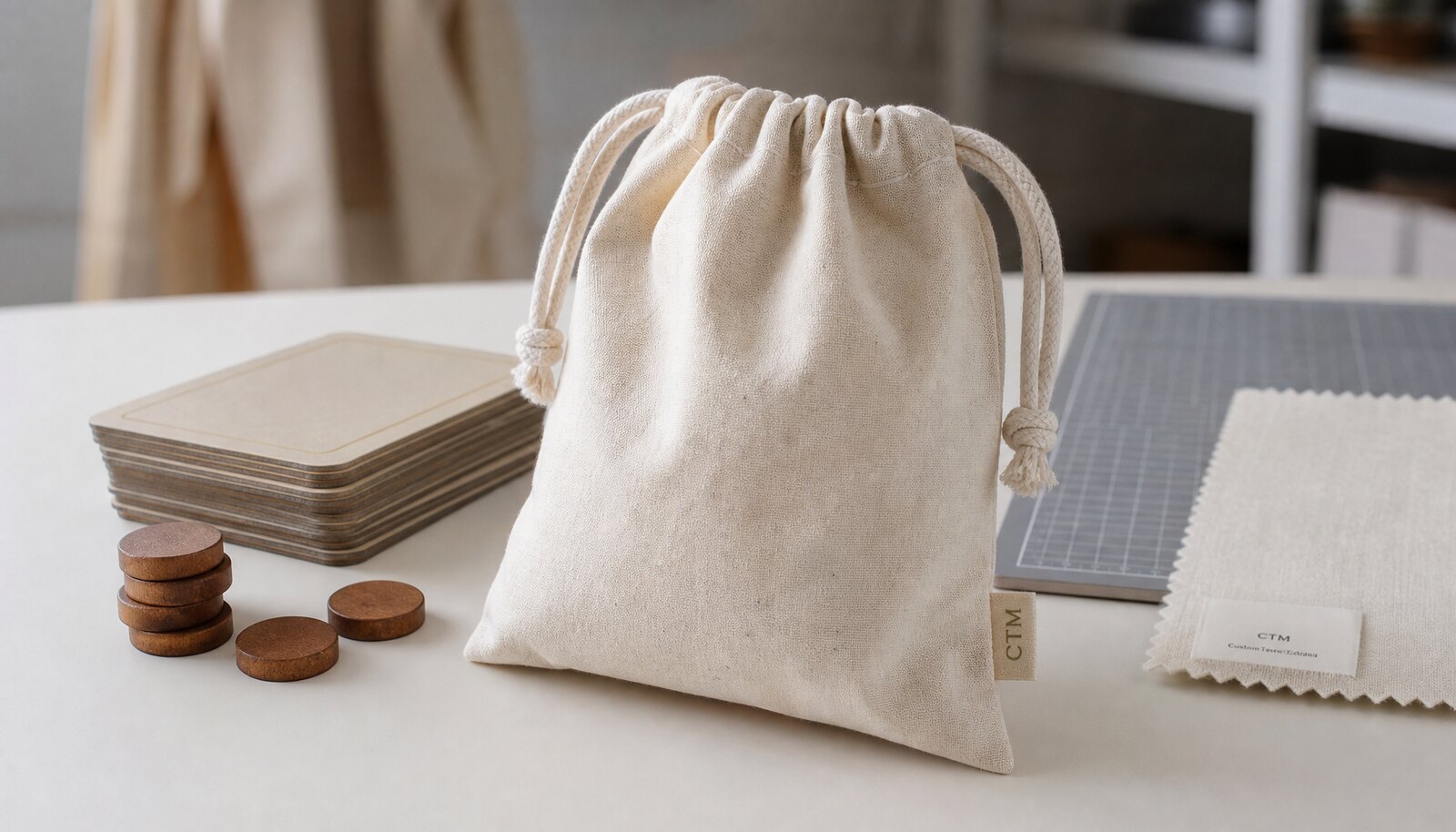
Why this pouch deserves hard specs
Canvas drawstring pouches for board game publishers are easy to under-spec because the item looks simple. In practice, the pouch affects fit, component protection, retail presentation, warehouse handling, and reorder consistency. A sample that looks fine in a photo can still fail in bulk if the opening is too tight for sleeved cards, the cord channel twists under load, the print sits too close to a seam, or the fabric shrinks enough that the approved size no longer fits the actual contents.
The right approach is to treat the pouch as part of the product, not as a promotional accessory. The spec should describe what must fit inside, how much clearance is needed, which cosmetic issues are acceptable, and which functional failures are not. That gives procurement a defensible standard and gives the factory a quote they can actually build against. If you compare vendors without that baseline, you are not comparing like-for-like offers.
For board game work, the practical failure mode is rarely dramatic. It is usually a small mismatch that becomes expensive later: a pouch that snags on cards, a print that drifts between reorders, a cord that loosens after repeated use, or a carton pack that forces repacking at the 3PL. The inspection checklist should be written to catch those issues before shipment.
- Treat the pouch as a functional game component, not a throw-in item.
- Define what it must hold, how it will be used, and which defects stop shipment.
- Use one approved sample and one written spec so every supplier quotes the same build.
Write the size spec around contents, not dimensions
The biggest mistake in pouch sourcing is quoting only an external size. Buyers need the internal usable size, the opening width, the seam allowance, and the folded thickness that will sit inside the game box. A pouch that measures correctly on the outside can still be unusable if the top hem steals opening space or the seam allowance crowds the cavity. If the pouch is meant to hold sleeved cards, test the actual sleeved deck, not the bare card dimensions.
A useful buyer rule is to build the spec from the contents outward. For card decks, tokens, and dice, require enough opening clearance that the contents slide in without forcing the seam apart. For mixed sets or miniatures, test the worst-case object, not the average one. If the pouch is packed inside a board game box, also check the folded thickness against the insert and lid height so the box still closes cleanly. Leaving 2-3 mm of headroom in the box pack-out is a practical starting point.
Put the acceptance criteria in writing. A reasonable baseline for many canvas pouches is a finished size tolerance of +/-3 mm on smaller pouches and +/-5 mm on larger ones, with a separate tolerance for opening width. Ask the factory to state its cutting allowance and its expected shrinkage or finishing drift. For cotton canvas, a buyer-controlled target of no more than 3 percent dimensional change after the agreed finishing or conditioning process is a reasonable benchmark if the material will be sensitive to moisture or heat. The key is to tie the number to the supplier's actual process, not to a generic claim.
- Specify finished internal size, opening width, and seam allowance.
- Test the actual cards, tokens, dice, or minis that will go into the pouch.
- Set a dimensional tolerance and a shrinkage limit before sampling starts.
- Check folded thickness against the game box or insert if the pouch ships inside the product.
Control fabric weight, shrinkage, and hand feel
For most board game publisher programs, 200-240 GSM natural cotton canvas is a practical range because it gives enough structure without turning the pouch into a bulky accessory. The lower end can work when the pouch is light-duty and cost-sensitive. The upper end makes sense when the pouch needs to feel premium, stand up in retail handling, or better protect heavier components. If the bag is printed, the weave and surface texture matter because they influence how sharp the artwork looks and how much ink the fabric absorbs.
Ask the supplier to identify the exact fabric lot used for the pre-production sample and to hold that lot or a controlled equivalent for bulk. If the order is dyed, keep all pouches from the same shade band and do not mix shade bands within the same carton. If the order is natural canvas, set acceptable limits for slubs, flecks, and yarn irregularity so the factory knows what is normal and what counts as contamination or poor finishing.
Shrinkage and hand feel should be part of the approval, not an afterthought. Even when the pouch will not be washed by the end user, heat, pressure, and humidity during production can change the finished dimensions. If washability matters for your product line, ask for a one-cycle shrink test on the production fabric and write the acceptable change into the spec. If it does not matter, still ask the factory to confirm its cutting allowance and to hold the approved finished dimensions within the agreed tolerance under normal warehouse conditions.
- Use a GSM range instead of a vague fabric description.
- Approve the actual bulk swatch or dye lot, not a generic catalog sample.
- Require one shade band per order and no mixed shades in the same carton.
- Set a clear shrinkage or cutting allowance tied to the factory's own process.
Stitching and cord construction need numeric acceptance criteria
The closure is where many pouches fail first, so the sewing spec should be explicit. Ask how the channel is built, what seam allowance is used, and where bartacks sit relative to the opening. For most canvas drawstring pouches, a top hem of 12-15 mm and side seams of 6-8 mm are sensible starting points, provided the construction still leaves enough internal volume. The stitch density should be consistent across the run; 3.5-4.5 stitches/cm is a practical target for a sewing line that needs both strength and repeatability.
Do not stop at visual approval. Ask the factory for a cord pull test or an equivalent repeated-pull check on bulk units. A practical buyer target for typical board game pouches is no seam opening, no cord escape, and no channel distortion after a static pull around 5 kgf. If the pouch will hold heavy metal tokens, dice, or miniatures, raise that target and make the requirement part of the quote so the supplier prices the stronger construction from the start. The important point is to define the test method and the pass-fail outcome before the order is placed.
Also inspect the cord itself. A 3-5 mm cotton cord is common for this kind of pouch, but the right choice depends on the opening size and the finished look. The cord ends should be cleanly cut or knotted so they do not fray early. Long loose threads, uneven cord lengths, or a twisted channel are not cosmetic trivia if they predict weak process control. If the pouch is meant for repeated player use, a weak closure becomes a return risk.
- Require a top hem, side seam width, and stitch density in the spec.
- Ask for a pull test with a defined load or at least a repeat-pull pass-fail rule.
- Reject cord escape, channel distortion, bartack failure, or seam opening.
- Match cord diameter to the opening size and the expected component weight.
Print and branding on canvas is a separate quality problem
Natural canvas is forgiving as a design surface and unforgiving in execution. The weave can make a logo feel premium, but it also exposes weak artwork prep, blurry screens, and poor ink cure. For simple branding, 1-2 color screen print is usually the most predictable route. If the design needs fine type, small icons, or a more retail-ready look, a woven label or sew-on patch may perform better than direct print. The right answer depends on the artwork, not on habit.
Set placement tolerance against a fixed reference point, such as the top hem or the side seam. A practical buyer standard is +/-3 mm for a small front logo and +/-5 mm for a larger centered graphic, unless your design has a tighter visible edge. Keep a safe zone of at least 10 mm away from the seam and the cord channel so the print does not sit in a high-wear area. If the art is too close to the top, the pouch may look clean in inspection and still wear badly in use.
Ask the supplier how the ink is cured and what rub or fold test they use before shipment. A reasonable buyer check is to ask for the test method and the pass result in the inspection record, with no visible transfer after a defined dry-rub cycle. On natural canvas, strike-through on the reverse side may be acceptable for some designs and unacceptable for others, so define that explicitly. If the pouch is part of a premium edition, avoid fine text that will collapse into the weave unless the print method is proven on the actual fabric.
- Approve artwork on the real canvas, not only on a digital proof.
- Use placement tolerances and a 10 mm safe zone away from stress points.
- Choose a woven label or patch if the design needs fine detail or repeat durability.
- Ask for a rub or fold test result tied to the actual print method.
Quote structure, MOQ, and landed-cost tradeoffs
The cheapest quoted unit price is often the least useful number in the buyer's spreadsheet. Ask for a line-item quote that separates fabric, cutting, sewing, print setup, label work, inner packing, cartonization, QC, and export handling. That makes supplier comparison possible and prevents one vendor from looking cheaper only because they omitted a setup fee or packed the goods differently. Use the same incoterm across all quotes so you can compare the real landed cost.
MOQ deserves the same discipline. A useful quoting pattern is to ask for three break points, such as 500, 1,000, and 3,000 pieces per SKU, or whichever breaks the factory will actually honor. If the 3,000-piece tier drops the unit price by only a few cents but creates 2,000 extra units of inventory, the savings may not justify the storage and obsolescence risk. On the other hand, if a common body with a different woven label lets you reuse the same fabric and sewing setup across multiple editions, the higher MOQ may be easier to absorb because the tooling and setup are shared.
Compare suppliers on the full cost structure, not the sticker price. EXW can look attractive but shifts pickup, export handling, and consolidation to your side. FOB may be simpler if the factory manages export documentation well. Delivered pricing can be convenient, but only if you know what freight, duty, and destination handling are included. For board game publishers, the cleanest comparison is often a landed-cost model that lists the base unit, setup, packing, freight, duty, and receiving cost separately. That shows where the money actually goes.
- Request fabric, sewing, print setup, packing, QC, freight, and duty as separate lines.
- Ask for at least three MOQ break points so you can compare inventory risk against unit savings.
- Use the same incoterm across all suppliers before you compare.
- If several editions share one pouch body, consider a common SKU with versioned labels instead of separate pouch builds.
Sampling and supplier proof should mirror the bulk run
A sample is useful only if it is made from the same materials and process that will be used in production. If the sample uses substitute fabric, a different cord, or a manual print method that the bulk line cannot repeat, it can hide the real risk. For most board game publisher programs, the right sequence is initial prototype, revision if needed, then a pre-production sample from bulk materials. If the factory offers a top sample after production starts, that can confirm line consistency, but it does not replace the pre-production approval.
The sample approval record should be more than a stamp that says approved. Record the exact dimensions, fabric weight, cord type, label type, artwork revision, and packing method. Include one fit test line that names the actual contents inserted into the pouch and whether the pouch closed cleanly. If the pouch needs to fit sleeved cards, miniatures, or a mixed component set, state that in the sample record so the factory cannot later claim that the approval was for a lighter load.
Supplier proof should focus on who actually controls the work. Ask for the legal entity, factory address, operating scope, and the name of the QC owner who signs off release. If the seller is a trading company, ask for the actual factory name and proof of the relationship. Keep one sealed or signed reference sample on both sides, linked to the PO or artwork revision. Any change in fabric lot, cord diameter, label supplier, or print screen should trigger a formal change request and, if the visual or functional result could move, a new sample approval.
- Use bulk materials for the pre-production sample whenever possible.
- Record dimensions, materials, artwork revision, and packing method on the approval sheet.
- Treat substitutions as change requests, not informal adjustments.
- Keep one signed reference sample at the buyer side and one at the factory.
Inspection should use defect classes, not vague quality language
A useful inspection plan starts with a sampling method and ends with a clear disposition. For many textile accessory buys, General Inspection Level II with an AQL target of 2.5 for major defects and 4.0 for minor defects is a workable baseline, unless your brand standard is tighter. If the pouch will go into a premium collector edition, tighten the major-defect threshold and make sure the supplier knows the standard before production begins. The point is not the number by itself. The point is to define defects so the factory and the inspector are judging the same thing.
Major defects should include anything that affects function, fit, or product identity: size outside tolerance, seam opening over 2 mm, cord pull-out, broken bartack, missing or badly misplaced print, mixed SKUs, contamination, or cartons labeled incorrectly. Minor defects should cover presentation issues that do not stop use but still matter to retail buyers: a few short loose threads, slight puckering, a small color drift within the approved range, or light print haze. If you want a hard rule, use it. For example, a loose thread under 10 mm can be minor, but a thread over 20 mm or a visible seam run should be major.
The inspection record should also check the pouch against the approved sample in good light and verify actual fit with the intended contents. If the inspection passes size and construction but the bag does not fit the sleeved deck, the lot is still a failure. End the report with one of three outcomes: pass, conditional pass with documented rework, or fail. If rework is allowed, write exactly what must be fixed and who will re-inspect it before release.
- Use a formal sampling plan and define major and minor defects in advance.
- Treat size drift, cord failure, print misplacement, and mixed cartons as major defects.
- Inspect the actual game contents inside the pouch, not just the empty pouch.
- Close the report with pass, conditional pass, or fail plus any reinspection rule.
Packing, carton labels, and reorder control protect the launch
Packing mistakes can erase the value of a good sewing run. Define the inner count, carton count, carton marks, barcode format, and palletization before mass production starts. If the pouches ship standalone, the factory should know whether they go loose, individually bagged, or grouped by SKU. If they are inserted into the game box, the pack plan should name the exact sequence so the pouch does not arrive folded differently from the approved sample or interfere with the insert.
Do not add packaging steps unless they solve a real warehouse problem. Polybags can protect against dirt and mixing, but they also add labor and can trap moisture around natural canvas. If your 3PL scans cartons by barcode or lot code, make sure the carton mark text matches the receiving SOP. If the order has multiple colors or editions, require SKU segregation at every stage: cutting, sewing, packing, carton marking, and pallet wrap. Mixed cartons are one of the most expensive errors to correct after shipment.
For reorder control, keep the versioned spec, the signed sample, the print file, and a shade swatch together. That file set becomes the reference for later runs when the factory changes line staff or books a new fabric lot. If you manage multiple board game titles, use a revision number on the pouch spec so the supplier cannot quietly substitute an older print or a different cord. Reorders are where process discipline either pays off or disappears.
- Define inner count, carton count, carton marks, and barcode needs before production starts.
- Use polybags only when they solve a packing or contamination problem.
- Require SKU segregation from cutting through pallet wrap when multiple versions are ordered.
- Keep the revisioned spec, signed sample, artwork file, and shade swatch together for reorders.
Specification comparison for buyers
| Spec decision | Recommended option | When it fits | Buyer risk to check |
|---|---|---|---|
| Sourcing route | Direct cut-and-sew factory with print control | Recurring title runs with custom sizes, labels, and repeat orders | Confirm the seller owns the sewing line or can name the actual factory and QC owner |
| Fabric weight | 200-240 GSM natural cotton canvas | Retail-facing component pouches that need structure and abrasion resistance | Too-light cloth frays and looks cheap; too-heavy cloth raises cost and box bulk |
| Stitch and seam build | 3.5-4.5 stitches/cm with 6-8 mm seam allowance and bartacks | Pouches opened repeatedly during gameplay or fulfillment | Weak channels and skipped stitches allow cord pull-out or seam split |
| Print method | 1-2 color screen print or sewn woven label | Simple logos, title marks, or edition branding | Check cure, edge sharpness, rub resistance, and placement tolerance on the actual canvas |
| MOQ and price breaks | Quote 500, 1,000, and 3,000 pcs per SKU | Buyers comparing one-off editions against repeat SKUs | Low MOQ often carries a setup premium; higher MOQ can create avoidable inventory risk |
| Landed cost structure | Separate fabric, sewing, print setup, packing, QC, freight, and duty | When comparing suppliers on the same incoterm | A low unit price can hide expensive extras or export handling |
| Sampling route | Pre-production sample from bulk materials plus top sample | Custom art, mixed sizes, or multiple editions | A sample made from substitute fabric or cord can hide real production drift |
| QC route | Factory in-line check plus third-party AQL inspection | Launches, reorder programs, or multi-SKU shipments | Vague defect definitions make acceptance arguments and delays more likely |
Buyer checklist before sampling
- Confirm the actual contents the pouch must hold, not just the outside dimension.
- Specify finished internal size, opening width, seam allowance, and the clearance needed for sleeved cards, tokens, dice, or minis.
- Set finished size tolerances in the spec, not only in the sample approval note.
- State fabric weight in GSM, weave type, and whether the canvas must be natural, bleached, or dyed.
- Require a shrinkage limit or cutting allowance that the factory can prove against the bulk material.
- Define stitch density, seam width, bartack placement, and cord diameter before quoting.
- Specify print method, number of colors, placement reference, and Pantone target if color matching matters.
- Request a pre-production sample from bulk fabric, bulk cord, and the final label or print method.
- Lock packing format, inner count, carton count, carton mark text, and barcode needs before mass production.
- Ask for a line-item quote with fabric, sewing, print setup, packing, QC, freight, and duty separated.
Factory quote questions to send
- What is the exact fabric weight, weave, and shrinkage allowance included in the quote?
- Is the quote based on direct factory production, or will any cutting, printing, or packing be subcontracted?
- What are the MOQ and price breaks at 500, 1,000, and 3,000 pieces per SKU?
- How much of the unit price is fabric, sewing, print setup, label work, packing, and cartonization?
- What is the setup charge per artwork, per side, and per color?
- What sample stages are included, and what is the charge for a revised sample or pre-production sample?
- What packing format is included per carton, and are inner bags, labels, or carton marks extra?
- What inspection standard do you use before shipment, and can the buyer add third-party inspection?
- What lead time is tied to artwork approval, material booking, production, inspection, and ship date?
- Can you confirm the legal entity, the actual maker, and the QC owner behind the order?
Quality-control points to confirm
- Measure finished length, width, and opening against the approved spec and test the actual game components inside the pouch.
- Use a daylight or D65 light source to compare fabric color, print tone, and label color against the signed sample.
- Check seam allowance consistency; a practical buyer target is 6-8 mm on side seams and 12-15 mm on the top hem unless the design requires otherwise.
- Inspect stitch density and continuity; a practical target is 3.5-4.5 stitches/cm with no skipped run that weakens the seam.
- Pull the cord repeatedly and verify no cord escape, no channel twist, and no seam opening after at least 10 firm pulls.
- Set a practical pull-strength baseline of 5 kgf for typical board-game pouches, then raise it if the pouch carries heavier contents.
- Check print placement against a fixed reference point; use +/-3 mm for small logos and +/-5 mm for larger graphics as a starting point.
- Reject any print shift that crowds the seam or cord channel by less than the agreed safe zone, typically 10 mm.
- Count loose threads and set a limit; one or two short loose ends can be minor, but long loose threads over 20 mm or visible seam damage should be treated as major.
- Verify carton counts, SKU segregation, and carton marks before pallets leave the factory, with zero mixed-SKU cartons accepted.