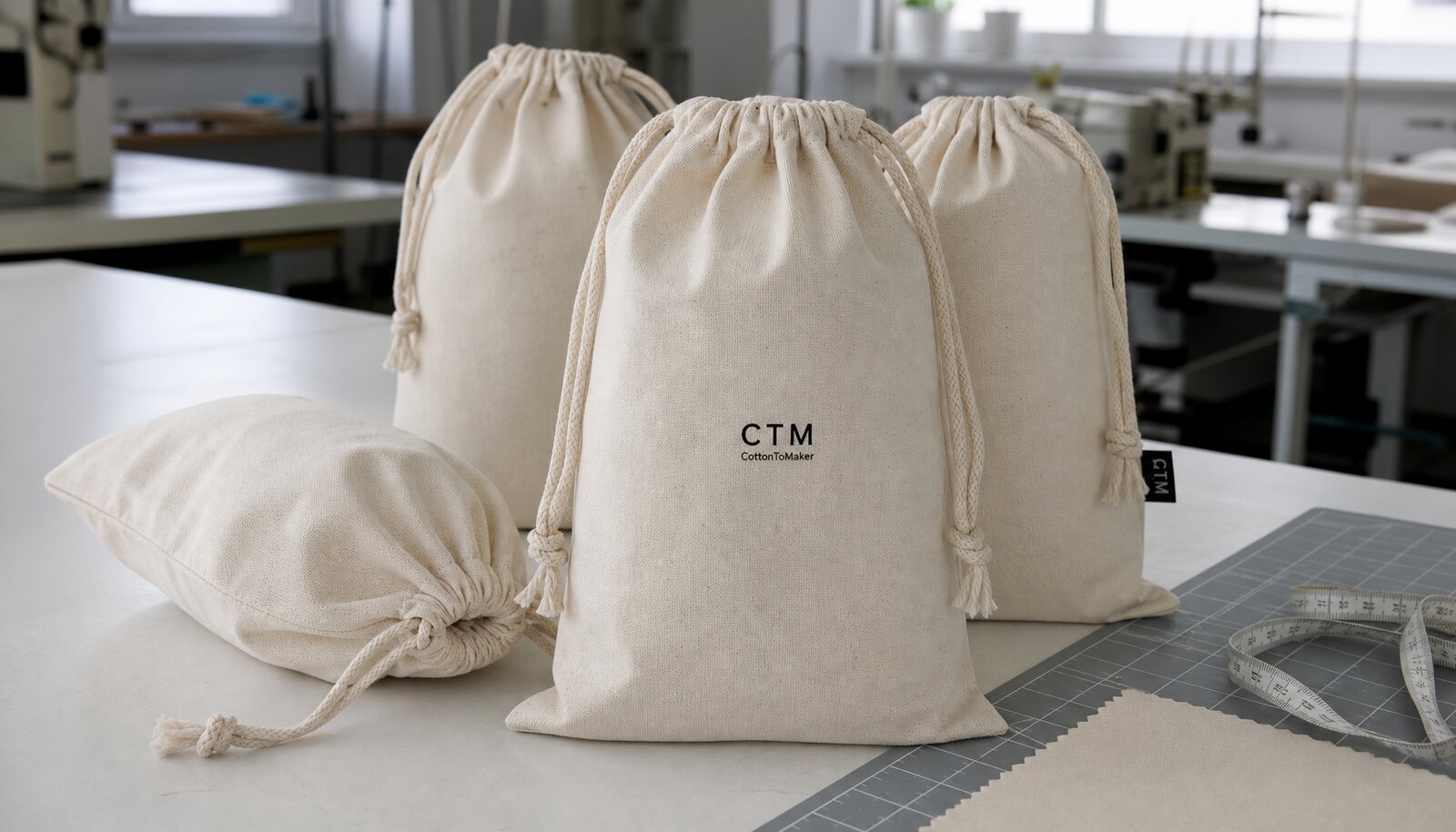
What Buyers Need the Pouch To Do
Canvas drawstring pouches look simple, but the buying problem is usually not the pouch itself. It is the mismatch between how the bag is expected to function and how the supplier interprets the brief. A pouch for jewelry, supplements, or small apparel has different needs from a pouch used as retail packaging or a branded gift insert. If you do not define the end use, the factory will often quote a generic pouch that looks acceptable in a sample photo and fails once you load it, print it, or ship it in volume.
The first decision is whether the pouch is doing product protection, presentation, or both. Protection pushes you toward heavier canvas, tighter stitch control, and a more stable closure. Presentation pushes you toward cleaner print, more consistent color, and better packing. If your RFQ does not state the primary use, you will compare quotes that are not actually the same product, which makes unit price meaningless.
- Use a presentation-first spec for retail gifting and brand kits.
- Use a protection-first spec for hardware, cosmetics, or travel accessories.
- If the pouch is reused often, weight and closure durability matter more than the lowest print cost.
Choose the Right Canvas Weight
For canvas drawstring pouches, fabric weight is the fastest way to control both feel and quote. A light 8 oz / 240 gsm canvas can work for promotional inserts and lightweight accessories, but it will drape more loosely and can show seams or dark product outlines. A midweight 10 oz / 340 gsm canvas is the common starting point for retail buyers because it gives enough body for a neat shape without making the pouch too stiff. A heavier 12 oz / 400 gsm canvas gives a more premium handfeel and better protection, but it raises material cost and can make the pouch harder to close if the opening is too small.
Fabric finish matters as much as weight. Unbleached natural canvas gives a warmer, more organic look and usually hides small handling marks better than bright white. Bleached canvas is better when you need clean print contrast or a more premium cosmetic presentation. Dyed canvas is fine for brand color matching, but the dye process introduces extra lead time and a higher chance of shade variation between dye lots. If you expect repeat replenishment, keep the construction simple and reserve dyeing for SKUs that truly need it.
- 8 oz / 240 gsm: good for low-cost promo or light accessory pouches.
- 10 oz / 340 gsm: the safest default for most branded retail programs.
- 12 oz / 400 gsm: better for premium presentation and heavier contents.
- Unbleached canvas: lower visual risk for small batch runs.
- Dyed canvas: only use when the color is part of the product promise.
Branding That Survives Handling
Most buyers overcomplicate artwork and under-specify print behavior. For canvas drawstring pouches, a simple one- or two-color screen print is usually the best commercial choice. It stays readable, works on natural fabric, and has lower setup risk than full-color processes. If your logo has fine text or gradients, the print can still be done, but you should expect a different pricing structure and a higher chance of approval delays. Embroidery looks strong on premium pouches, but it increases labor, can pucker light canvas, and may interfere with stacking when the pouch is packed in volume.
If the pouch is meant to support a retail brand, the logo should be sized for use, not for a website hero image. Small logos often disappear once the pouch is folded or tied. Large logos can distort on a soft panel if the fabric is too light. A good factory quote should specify print size in centimeters, print position from the top edge, ink color count, and whether the print is on one side or both sides. That detail prevents the common problem where everyone agrees on the logo, but not on the physical print area.
- Screen print is usually the best balance of cost, clarity, and repeatability.
- Embroidery suits premium pouches but needs stronger fabric and more handling time.
- Woven labels work well when the pouch needs a subtle brand mark instead of a large logo.
- Do not approve artwork without a measured print area and placement reference.
Closure, Cord, and Shape Details
The closure system determines whether the pouch feels well made or merely assembled. A clean drawcord channel, a consistent hem, and properly tied ends matter more than buyers expect. Cotton cord gives the most natural look and is often the right match for canvas, but soft cord can wear quickly if the pouch is opened and closed many times a day. Polyester-blend cord is more abrasion resistant and can slide more easily, which is useful for higher-use packaging or internal distribution. The tradeoff is that it can look less natural if you are aiming for a fully cotton presentation.
Shape control is the other hidden issue. A pouch that looks fine flat on the table can collapse once filled if the base panel is not sized correctly. If the product has corners, bottles, or sharp edges, the pouch needs a little extra room at the gusset or base seam. For retail buyers, this is where samples matter most. Bring the actual filled product, not just the pouch spec, to the sample review. A pouch should close smoothly when filled to normal use capacity, not only when it is empty.
- Cotton cord: best visual match for natural canvas and gift packaging.
- Polyester-blend cord: better slide and abrasion resistance for repeated use.
- Ask for cord diameter and finished length, not just cord color.
- Test the pouch with the real product weight before bulk approval.
Compare Supplier Routes Before Price
The lowest quote is not always the safest route. For canvas drawstring pouches, direct factories usually give the best cost control when you already know the spec and plan to reorder. Trading companies can help when your order mixes multiple SKUs or when you need one contact to coordinate different trims and packing formats. Local converters can be useful for urgent replenishment or short lead times, but their material options are often narrower and the fabric price can be higher than an export factory quote. The point is not which route is best in general. It is which route matches the maturity of your spec and the timeline of your launch.
If you compare suppliers, compare the evidence behind the quote. Ask where the canvas is sourced, where the printing happens, who handles packing, and which stage they control internally. A supplier that owns the cutting, sewing, and print process usually has fewer handoff errors than one that outsources each step. Also look at how they respond to detail. A serious factory will answer with weights, dimensions, tolerances, and packing counts. A weak quote often gives a neat unit price and little else, which makes it impossible to compare real landed cost.
- Direct factory: best for repeat business and tighter cost control.
- Trading company: useful for multi-item orders and coordinated sourcing.
- Local converter: practical for fast replenishment and smaller domestic runs.
- Compare process control, not only the quoted unit price.
Why MOQ Changes the Quote
MOQ logic on canvas drawstring pouches is driven by fabric handling, print setup, and packing labor. If you use stock natural canvas and one simple logo color, MOQ can stay relatively low because the factory can cut and print in a standard workflow. Once you add custom dyed fabric, multiple print colors, woven labels, or custom packaging, the factory has to spread setup and material risk across fewer units. That is why one supplier may look competitive at 1,000 pieces and another only becomes efficient at 5,000 or more.
Buyers sometimes push for a low MOQ by trimming features, then lose the saving through higher defect risk or poor packing. A smarter approach is to separate what is truly launch-critical from what can wait for the second order. For example, you can launch with standard canvas, one-color screen print, and bulk packing, then move to branded labels or custom inner packaging after sell-through is proven. That keeps the first order commercially sane and gives the factory a spec that is actually manufacturable at the requested quantity.
- Lower MOQ is usually possible when fabric and print are standard.
- Custom dye, custom labels, and retail-ready packing raise the MOQ floor.
- Ask the factory to quote breakpoints at 500, 1,000, 3,000, and 5,000 pieces if your program may scale.
What a Clean Sample Approval Looks Like
A sample is not approved because it looks nice in a photo. It is approved when the dimensions, print, handfeel, and closure all match the commercial use. Measure the pouch flat and filled. Open and close it several times. Check whether the drawcord slides without binding and whether the hem stays even after tension. If the pouch has a printed logo, inspect it under normal light and from arm's length, since that is how a customer or retail buyer will actually see it. If the print is too close to a seam or cord channel, the pouch can appear crooked even when the factory says it is within tolerance.
The best approval process is a simple document trail. You want the approved sample photo, the signed spec sheet, the artwork file version, and any notes about packing or labeling all in one place. That prevents later disputes when bulk production starts. If you change one element after approval, such as print placement or cord color, treat it as a new revision and get a revised sample or written acceptance. Small changes are where many pouch programs lose time because everyone assumes the change is minor until the first bulk carton is opened.
- Approve on measured dimensions, not only visual fit.
- Open and close the pouch repeatedly before sign-off.
- Keep one signed reference sample for production and one for receiving inspection.
- Treat artwork, packing, and trim changes as formal revisions.
Packing and Cartons Decide Shelf Reality
Packing is often ignored until the first shipment lands damaged, wrinkled, or counted wrong. For canvas drawstring pouches, bulk packing is usually the most efficient option when the pouch is going into a distribution center, kit line, or repacking process. Retail polybags are only worth the added cost if the pouch must hang, display cleanly, or protect a printed surface from rubbing in transit. If the customer will remove and discard outer packaging anyway, you are paying for presentation that never reaches the shelf.
Carton logic should be written into the quote. Ask for pieces per inner, inners per carton, carton dimensions, gross weight, and whether the factory uses moisture protection or carton inserts. These details affect freight cost as much as the bag itself. A pouch that is technically inexpensive can still become expensive if the packing format inflates carton volume or causes rework at receiving. The right packing spec keeps your count clean, your cartons stackable, and your import documents easier to reconcile.
- Bulk pack is usually best for B2B distribution and kitting.
- Retail polybag only makes sense when display or abrasion protection matters.
- Include carton dimensions and gross weight in the quote request.
- Use clear outer labels so receiving teams can identify size and SKU without opening cartons.
Lead Time and Landed Cost Discipline
Lead time on canvas drawstring pouches is not just sewing time. It includes fabric sourcing, possible dye work, print setup, sample approval, bulk cutting, sewing, packing, and export loading. If the supplier gives you one simple lead time without separating those steps, you cannot see where the schedule risk sits. A stock-fabric, one-color print order can move quickly once the sample is approved. A dyed, custom-labeled, retail-packed program can take materially longer because every added feature creates another approval gate.
For landed cost, do not stop at the ex-works price. Add carton volume, freight mode, import duty, local handling, and any repacking cost before you compare suppliers. A slightly higher unit price can still win if the pouch packs more efficiently or reduces damage. The most useful RFQ format is a line-item quote that separates base pouch, print, label, packing, and cartonization. That makes it obvious which supplier is efficient and which supplier is simply moving cost into a less visible line.
- Separate sample approval time from bulk production time.
- Ask for lead time by process step when you have custom fabric or labels.
- Compare landed cost, not only ex-works unit price.
- Request a line-item quote so hidden packaging cost cannot be buried.
Turn the RFQ Into a Decision Tool
A good RFQ for canvas drawstring pouches should let you compare suppliers without decoding their assumptions. Include the pouch use case, fabric weight, dimensions, print method, cord type, packing format, target quantity, and approval date. Then ask each supplier to quote the same structure. If one supplier refuses to break out the cost or keeps changing the spec during the quote stage, that is already useful information. It means the factory may not be ready for disciplined production control.
The buying decision should be based on repeatability, not only on sample appeal. The best supplier is the one that can reproduce the approved pouch at the agreed price, packing format, and schedule. If you want a short, reusable RFQ template, keep it simple: product use, material, artwork, closure, packing, quantity, and ship date. That is enough for a factory to quote accurately and enough for your team to compare offers without guessing.
- State the end use, not just the product name.
- Keep the RFQ on one spec version so quotes stay comparable.
- Require the supplier to note assumptions and exclusions.
- Use the first order to validate production discipline, not only price.
Specification comparison for buyers
| Spec decision | Recommended option | When it fits | Buyer risk to check |
|---|---|---|---|
| Fabric weight | 8 oz / 240 gsm for light use, 10 oz / 340 gsm for retail, 12 oz / 400 gsm for premium hold | Gift sets, cosmetics, small apparel, and brand packaging where drape and structure both matter | Thin canvas can look cheap and print can show through; heavy canvas can reduce capacity and raise freight cost |
| Sourcing route | Direct factory for repeat programs, trading company for mixed SKUs, local converter for urgent replenishment | When you need a balance of price, speed, and documentation control | Trading quotes can hide conversion steps; confirm where fabric, printing, and packing actually happen |
| Print method | 1-2 color screen print for most programs, woven label or embroidery for premium branding | When the logo is simple and the pouch is handled often | Complex artwork needs more setup and can miss registration; ask for print size, ink coverage, and cure method |
| Cord type | Cotton cord or cotton-blend cord for natural look, polyester core cord if higher abrasion resistance is needed | Retail sets, wellness kits, and reusable promo packaging | Soft cord can fray or knot poorly; confirm diameter, end finish, and pull strength |
| Top finish | Single drawcord channel with turned hem and bartacks at stress points | Standard pouches where unit price must stay controlled | Weak hem construction lets the opening distort; inspect channel width and reinforcement at the side seams |
| Size strategy | Use one base size family with 1-2 step variations instead of fully custom dimensions for every SKU | Brands with multiple pack counts or product bundles | Too many sizes increase MOQ, pattern changes, and carton complexity; lock the smallest functional size first |
| MOQ logic | Lower MOQ with stock canvas and one-color print; higher MOQ for dyed fabric, custom label, or specialty cord | When you are testing demand or launching a new SKU | Low MOQ often increases piece price; compare quote structure, not only unit price |
| Packing format | Bulk packed by size with clear inner labels and carton marks, retail polybag only if shelf presentation requires it | Distribution, kitting, and export cartons where repacking is expected | Mixed packing can cause counting errors; ask for pieces per inner, gross/net carton weight, and barcode location |
Buyer checklist before sampling
- Define the end use: retail gift bag, jewelry pouch, apparel accessory, kit component, or shipping insert.
- Fix the fabric target in gsm or oz, including whether the canvas should be unbleached, bleached, or dyed.
- Set the print method, artwork size, ink color count, and whether a side label or hang tag is part of the SKU.
- Confirm pouch dimensions with filled product inside, not just flat size on paper.
- State the cord material, cord diameter, and whether knots, aglets, or heat-cut ends are acceptable.
- Choose the packing format and carton spec before asking for quotes.
- Request sample photos or a pre-production sample after print and before bulk cutting.
- Require tolerance limits for size, stitching, and print placement in the PO.
- Ask the factory to separate fabric, print, labor, packing, and export carton costs.
- Lock the lead time assumption to sample approval date, not to RFQ issue date.
Factory quote questions to send
- What fabric weight, weave count, and finish are you quoting for the pouch body?
- Is the price based on stock canvas, custom dyed canvas, or a pre-approved greige fabric?
- What is included in the print cost: screen setup, ink, curing, and one or two sides?
- What is the MOQ for the base pouch, for printed pouch, and for custom label or hang tag?
- How are cord type, cord length, and end finishing counted in the unit price?
- What packing is included: bulk pack, inner polybag, size label, carton mark, or barcode sticker?
- What sample stage will you provide before bulk production, and what is the approval deadline?
- Which issues would trigger a re-quote after approval: artwork change, fabric change, size change, or packing change?
Quality-control points to confirm
- Measure the finished pouch against the approved spec, with a practical tolerance of about +/- 0.5 cm on small sizes and tighter control on branded retail packs.
- Inspect seam strength at the side seams, base corners, and drawcord channel, since those points fail first when the pouch is overfilled.
- Review print placement, registration, and ink opacity under normal room light; a logo that looks centered on the screen can still sit visibly off on the pouch.
- Pull-test the cord, knot, and channel to make sure the closure slides smoothly without cutting into the fabric.
- Check for loose threads, skipped stitches, oil marks, and fabric slubs on the outer face and inside seams.
- Verify carton count, inner pack count, and SKU labeling before shipment, especially when multiple sizes are in the same order.
- Approve one sealed pre-production sample for color, handfeel, and packaging before the main run starts.
- Record the accepted artwork file, sample photo, and signed spec sheet so the bulk batch has one clear reference.