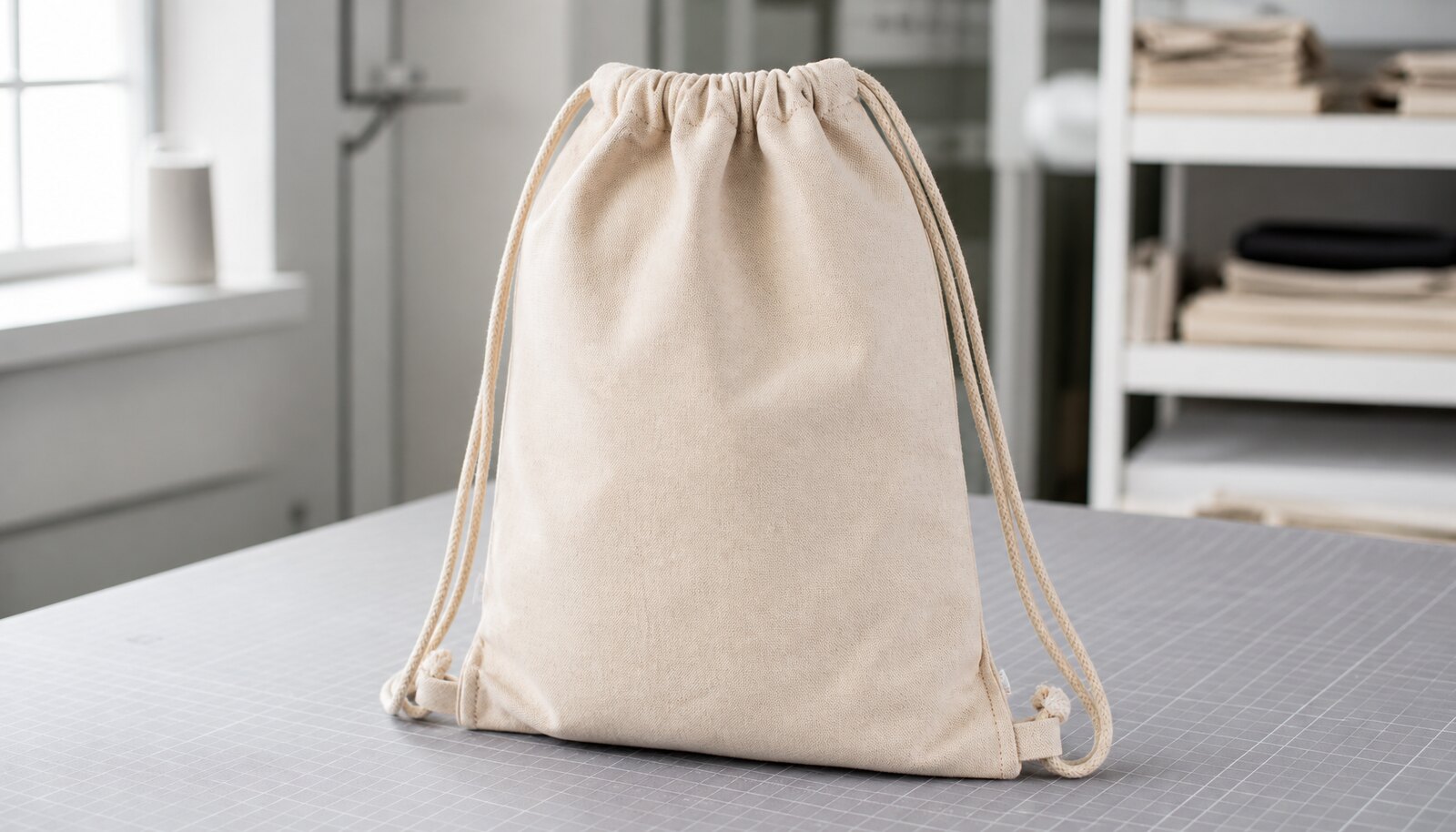
Why hotel buyers specify this bag differently
Canvas drawstring backpacks for hotels are usually bought for one of three jobs: guest welcome kits, amenity packaging, or a light retail item in a gift shop. Those uses sound similar, but they do not share the same spec. A welcome kit can tolerate a simpler build if it only carries slippers, a brochure, and small toiletries. A retail bag needs cleaner finishing, a better logo application, and a more consistent hand feel because the guest is buying the appearance as much as the function.
The first mistake is to treat this as a generic promotional bag. Hotel buyers need a bag that packs flat, looks clean at check-in, and does not fail in the guest room. That means the spec has to cover not only size and logo, but also canvas weight, cord quality, seam strength, and carton packing. If those items are left open, supplier quotes become impossible to compare.
- Use the intended contents to define the size, not the other way around.
- Decide early whether the bag is a disposable amenity pack or a reusable retail-grade item.
- Treat logo placement and packing as part of the product spec, not as afterthoughts.
Choose the canvas weight before you compare quotes
For hotel programs, the most common starting point is 8 oz canvas, because it gives enough body for a neat shape without pushing the price too high. If the bag is only carrying soft amenities, 8 oz is usually practical. If the buyer wants a more structured bag, a better drape, or a higher perceived value, 10 oz or 12 oz canvas is a more defensible choice. Once you move heavier, the bag begins to feel more like a retail accessory and less like a giveaway.
Do not accept a quote that says only “canvas” without finishing the fabric conversation. Ask whether the supplier is quoting finished fabric weight or raw cloth weight, whether the bag is pre-shrunk, and whether the canvas is natural, bleached, or dyed. Natural canvas can vary more in tone, which is acceptable if you define the shade window upfront. Bleached canvas prints cleaner, but it can cost more and show handling marks sooner.
- 8 oz: common for amenity packs and light guest use.
- 10 oz: better for premium hotels and repeated use.
- 12 oz: useful when the bag must feel sturdy and retail-ready.
- Lined construction adds cost and body, but it also improves logo appearance and interior finish.
Logo method affects both quote and guest perception
The logo decision should match the hotel's brand position. One-color screen print is usually the most efficient option when the artwork is simple and the order is repeatable. It gives a clean result if the mesh count, ink deposit, and placement are controlled. For a more refined look, a woven side label or small woven patch may be better because it resists wear and does not rely on a large ink area. Embroidery is possible on some styles, but it increases labor and can distort lighter canvas if the placement is too dense.
Buyers often underestimate how much print placement affects approval. A logo that looks fine on a flat art proof can shift visually once the bag is sewn and the cord channel pulls the top edge into shape. The factory should show a strike-off or pre-production sample on the actual bag body, not just on loose fabric. If the artwork has fine text, thin lines, or small icons, ask the supplier to state the minimum readable line width before you approve.
- Screen print works best for bold logos and repeat orders.
- Woven labels suit premium presentation and better wash resistance.
- Embroidery should be used only when the fabric weight and placement can support it without puckering.
- Approve the logo on the finished bag, not only on a paper proof.
Compare supplier routes before you lock the PO
The supplier route matters as much as the spec. A direct factory gives the best control over sewing, fabric sourcing, and packing, especially if you want a custom size or a recurring hotel program. A trading company can be useful when the order combines multiple bag types or when the buyer needs flexible consolidation, but the technical communication can be slower and the margin is less visible. A local decorator is only attractive if speed matters more than unit cost and the branding is simple.
The right route depends on how much process control you need. Hotels and distributors with repeat demand usually benefit from a direct factory because they can lock the same fabric and same seam spec for reorders. Buyers with low MOQ requirements may accept a trading route, but they should insist on source traceability and a clear statement of who actually sews the product. Without that, you may compare quotes that are technically not the same product.
- Direct factory: best for repeatability, custom build, and cost control.
- Trading company: better for mixed-category buying and easier coordination, but verify margins and source factory identity.
- Local decorator: fast but often limited on fabric choice and bulk economics.
- Stock importer: acceptable for urgent needs, but not ideal if you need a precise hotel spec.
What really drives MOQ and unit price
MOQ is rarely driven by the bag body alone. It is usually set by fabric dye lots, print setup, label weaving, cutting efficiency, and carton planning. A plain natural canvas bag with one-color print may have a manageable MOQ because the supplier can use standard cloth and a simple screen setup. Once you change the size, add a custom woven label, or ask for a specific dyed canvas, the MOQ can rise because the factory must commit to more material and more setup time.
For quote comparison, separate the cost into fabric, sewing, logo, packing, and extras. This exposes where one supplier is hiding cost or leaving items out. A very low unit price can look attractive until you discover that polybags, shipping cartons, print setup, or sample charges are excluded. If the bag is for a hotel program, a slightly higher unit cost may still win if the packing is cleaner and the approval cycle is shorter.
- MOQ often rises with custom color, woven label, and specialty packing.
- Ask whether the quote assumes standard stock canvas or reserved loom/dye production.
- Compare total landed cost, not just ex-factory unit price.
- Set a re-order target early so the factory can plan material efficiently.
Use a sample process that catches production mistakes early
A useful sample is not just a visual reference. It should tell you how the bag behaves when sewn, packed, and handled. Start with a pre-production sample that matches the final fabric weight, cord, logo method, and packaging. Check whether the bag opens and closes smoothly, whether the top channel sits flat, and whether the logo lands where the guest will actually see it. If the bag is meant to hold a folded towel set or amenities, pack a real contents sample and see whether the dimensions still work after stitching tolerances are applied.
The approved sample should be treated as a control piece. Keep one signed sample with the PO and one with the factory. That sounds basic, but it is where many orders go wrong: the buyer remembers the art proof, while the factory is sewing to a different physical reference. If the supplier says a feature is “close enough,” that is usually the point to write the requirement into the order confirmation.
- Review size, stitch quality, cord action, logo placement, and packing fit.
- Use real contents in the sample test, not an empty bag.
- Keep a sealed approved sample tied to the order record.
- Reject samples with weak cord channels or visible logo distortion.
Set QC thresholds that match hotel use
Hotel buyers need practical acceptance criteria, not cosmetic preferences. A bag can look good on a table and still fail in service if the seams are loose, the cord frays, or the print cracks after handling. Set a clear tolerance for finished size, stitching, and print position. For natural canvas, define what shade variation is acceptable and what is not. Minor fiber slubs are normal; oil stains, dirt marks, and broken seams are not. If the bag is going into guest rooms, a clean exterior and a tidy interior matter more than a brochure-perfect appearance.
Inspection should focus on the points that fail under normal use. Look at cord ends, side seams, bottom corners, label attachment, and logo alignment. If the bag has a drawstring closure, the opening should cinch evenly without twisting the body. Carton sampling should confirm that the folded bags keep their shape and that packing does not crush the print. If the supplier cannot describe its defect criteria, the buyer should write one before production starts.
- Set size tolerance and logo position tolerance in writing.
- Define what counts as a major defect: open seam, print flaw, stain, missing label, or wrong packing.
- Check both bulk appearance and functional closure.
- Use an AQL or defect list that the factory can actually apply.
Packing choices can change freight cost and presentation
Packing is a commercial decision, not only a warehouse detail. Folded bulk packing lowers carton volume and freight cost, which matters on large hotel programs. It also makes receiving easier when the buyer is stocking a central warehouse. But if the bags are meant for guest presentation or retail display, they may need individual polybags, a barcode sticker, or a simple insert card. That raises labor and material cost, so the quote needs to show it clearly.
Make the supplier specify carton quantity, carton dimensions, and whether desiccants or moisture barriers are included. Canvas absorbs warehouse odor and humidity more than many buyers expect. On a sea shipment, a carton that looks fine at the factory can arrive with creases or odor if the packing was too loose. If the hotel chain wants to distribute bags across multiple properties, carton marks should be consistent and readable so receiving teams can sort them fast.
- Bulk pack saves freight but can reduce presentation quality.
- Individual polybagging improves cleanliness and retail readiness.
- Carton size affects cube, not just weight, so compare shipping terms carefully.
- Confirm carton marks, barcode format, and quantity per carton before production.
Lead time risk is usually in setup, not sewing
For canvas drawstring backpacks for hotels, the sewing time is often not the slowest part. The real delay comes from artwork approval, fabric reservation, woven label production, and sample sign-off. If the factory needs to dye canvas, weave a label, or adjust the cord spec, the schedule can move quickly from normal to tight. Buyers who need a seasonal hotel rollout should work backward from the in-room date, not the purchase order date, and leave room for one sample revision if the artwork is not finalized.
The fastest programs are the ones with frozen specs. When the buyer changes the size after sample approval, it does not just affect the bag. It can change carton count, print placement, packing density, and even freight class. For that reason, the order confirmation should list the exact version approved, including fabric weight, logo method, packing method, and carton count. That reduces the chance of a last-minute argument over whether a revised sample counts as a new order.
- Artwork and label setup can take longer than sewing.
- Plan for at least one revision cycle if the spec is not fully locked.
- Freeze size, fabric, logo method, and packing before bulk starts.
- Build schedule buffer if the order needs dyed canvas or custom labeling.
How to compare quotes without missing hidden cost
A usable quote comparison starts with matching the same spec across all suppliers. If one factory quotes 8 oz canvas with bulk packing and another quotes 10 oz canvas with individual polybags, the lower unit price is meaningless. Ask each supplier to break out the same cost buckets: fabric, sewing, print, label, packing, sampling, and any tooling or setup charge. That lets procurement see where the cost is coming from and whether a cheaper quote is actually missing a component that another supplier included.
For hotel buyers, landed cost should include freight handling and any import side charges that affect the true budget. A supplier with a lower factory price but oversized cartons can end up costing more in freight. Likewise, a better packing spec can reduce damage and rework, which matters if the bags are going to multiple hotel properties. A quote that is slightly higher but cleaner in structure is often easier to approve internally because it reduces risk in receiving and deployment.
- Compare like for like: same fabric weight, same print, same packing, same incoterm.
- Separate one-time setup charges from recurring unit price.
- Check carton size and packing density before judging freight cost.
- Use landed cost, not only ex-factory price, for the final decision.
Specification comparison for buyers
| Spec decision | Recommended option | When it fits | Buyer risk to check |
|---|---|---|---|
| Source directly from a factory | Best for custom size, logo, and packing control | Hotel groups, distributors, and brands ordering repeat programs | Minimum order, sampling lead time, and whether the factory owns the sewing line or outsources stitching |
| Buy through a trading company | Use for mixed programs or when you need multiple bag types in one shipment | Smaller buyers or one-off promotional runs | Hidden margin, slower technical answers, and weaker control over fabric and QC details |
| Buy from a stock decorator | Choose if you need a fast local turnaround with simple branding | Short deadlines and low-volume pilot orders | Higher unit cost, limited fabric choice, and print durability that may not match hotel use |
| Use a standard 8 oz canvas | Good balance for guest amenity use and gift shop resale | Most hotel welcome kits and light retail programs | Too thin for heavy items; confirm whether 8 oz means finished fabric weight and whether it is bleached or natural |
| Move to 10-12 oz canvas | Use when the bag needs more structure and a premium feel | Upscale hotels, longer reuse cycles, and heavier contents | Higher cost, longer drying/finishing time, and larger carton weight |
| One-color screen print | Most efficient for hotel logos and simple branding | Large repeat orders with a clean, legible mark | Fine lines can fill in if the mesh count or ink deposit is wrong; review strike-off placement and size |
| Woven side label or woven patch | Best for understated branding and better wash resistance than surface print | Premium amenities and resale-ready programs | Label size, thread color, and attachment method must be approved early or it slips the schedule |
| Folded bulk packing | Lowest freight cost and simplest warehouse handling | Large hotel rollouts and distributor stock | Creasing, contamination, and label scuffing if the bags are not polybagged or separated correctly |
| Individual polybag plus carton divider | Use when bags must arrive retail-presentable or gift-ready | Boutique hotels and airport retail programs | More labor and material cost; make sure ventilation, barcode placement, and carton counts are specified |
Buyer checklist before sampling
- Confirm finished size, fabric weight in GSM or oz, drawcord type, and whether the bag is lined or unlined.
- Lock the logo method, print size, Pantone target, and placement before sample approval.
- State whether the bag will carry guest amenities, retail goods, or laundry items, because load expectation changes the seam and cord spec.
- Request factory photos of stitching, binding, cord channel, and carton packing from a real production run, not a showroom sample.
- Ask for a pre-production sample or sealed approved sample and keep the reference with your PO.
- Define acceptable shade variation for natural canvas and whether minor slubs or fiber specks are acceptable.
- Specify inner pack, outer carton count, carton mark format, and moisture protection for ocean freight.
- Compare quotes on the same basis: fabric weight, print method, packing, sample cost, tooling, and incoterm.
Factory quote questions to send
- What is the finished bag size, fabric weight, and exact canvas construction included in your quote?
- Is the quoted price based on raw natural canvas, bleached canvas, or dyed canvas, and does that include pre-shrinking?
- What is the drawcord material, diameter, and cord length, and is cord locking included or excluded?
- Which logo method is included in the price, what is the maximum print size, and how many colors are priced?
- What is the MOQ for the quoted spec, and does MOQ change if we switch from print to woven label or change the size?
- What sample charges apply, how long will the first sample take, and is the sample cost refundable against order volume?
- What is the bulk lead time after sample approval, and how does it change during peak season or before holidays?
- How are bags packed in cartons, what is the carton quantity, and do you use individual polybags or bulk inserts?
- Which quality checks are done in-line and at final inspection, and can you share your AQL or defect criteria?
- Does the quote include freight-ready export cartons, testing, and any labeling required by our market?
Quality-control points to confirm
- Finished size tolerance should be tight enough that the bag still fits the intended hotel contents; set an approval range, not a vague match-to-sample note.
- Stitching must be even, with no skipped stitches, loose thread tails, or open seams at the side and bottom gusset if used.
- Cord channels should run cleanly without twisting, snagging, or rough cut edges that abrade the cord in use.
- Print registration, color density, and placement should be checked on the first-off sample and again on random bulk cartons.
- Natural canvas shade variation is normal, but the buyer should define what is acceptable and reject bags with obvious oil spots, heavy slubs, or contamination.
- Cartons should pass drop and compression handling without bursting, and the carton marks must match PO, style, and quantity.
- Any woven label, side label, or care label should be centered, secure, and legible, with no frayed edges or crooked sewing.
- If the bag is intended for repeated guest use, pull-test the drawcord and inspect for seam distortion after loading with the agreed test weight.