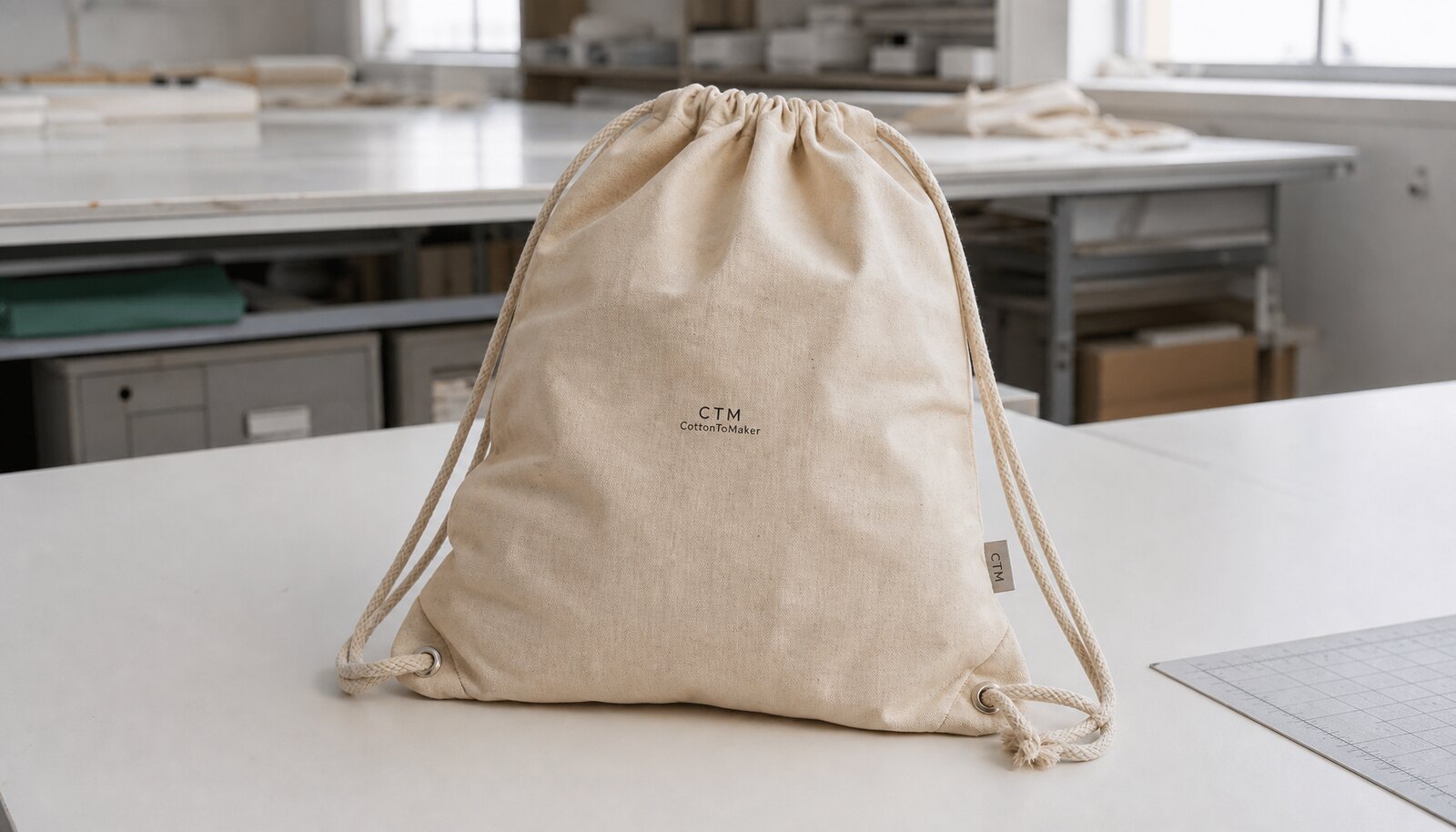
1. Why placement matters more on gym drawstring bags than on most promo items
Gym franchises use drawstring backpacks differently from one-off giveaways. The bag gets filled with shoes, towels, a bottle, and maybe a welcome pack, then it is cinched closed and carried in a crowded, high-use setting. That means the logo is judged in motion, not on a perfectly flat mockup. A design that looks centered in art review can end up too low, partially hidden by the top tunnel, or distorted once the bag is closed and loaded.
For procurement, the important shift is this: the logo is not just artwork, it is a manufactured location. The final placement depends on sewn seam allowance, the cord channel, fabric shrinkage after washing or softening, and the way the filled bag tension pulls the front panel. If those variables are not locked before the PO, the supplier can still produce a technically correct bag that does not meet the brand standard in use.
- The visible logo field is smaller than the flat front panel pattern.
- A centered mark can drift once the bag is filled and the top is cinched.
- Small woven labels help, but the front print still carries the main brand read.
2. Start with the use case, because the load changes the spec
The right canvas, cord, and decoration choice depends on what the franchise expects the bag to carry. A light welcome kit is a different job from a bag that will hold shoes and a towel every day. If the bag is also meant for retail resale, the buyer needs a more structured body, cleaner print edges, and stronger control on repeat decoration. If it is strictly for new-member onboarding, cost per piece may matter more than finish detail.
For this category, 10-12 oz canvas, roughly 340-410 GSM, is usually the practical range. Lower weights work for light promo use and make the bag easier to fold flat for distribution. Higher weights give better structure, less collapse around the logo, and a cleaner retail feel. If a supplier suggests a lighter body, ask them to justify it with the actual use case, not just price. If they suggest a heavier body, check whether the carton weight and sewing cost still make sense for your receiving and distribution plan.
- 10 oz canvas is usually enough for light kits and large rollout counts.
- 12 oz canvas is a better fit for daily gym use, retail programs, and heavier contents.
- If the canvas is washed or softened, confirm shrinkage direction and whether print registration was adjusted after treatment.
3. Lock the print window from the sewn pattern, not from the mockup
The print-safe zone should be measured on the finished pattern after seam allowance and the top channel are accounted for. Ask for a line drawing or production template that shows the top seam, side seam, centerline, and cord tunnel, then mark the usable print window on that template. Do not approve location from a flat art file alone. On a drawstring bag, a logo can be perfectly centered on the panel pattern and still sit too low once the bag is sewn and gathered.
For gym franchise orders, the most reliable placement is usually in the upper front panel, slightly above the visual center of the body. That keeps the mark visible when the bag is half full and reduces the chance that the bottom edge disappears into a fold. Keep enough distance from side seams so the logo does not wrap or distort. If the bag includes a pocket, hanging loop, label, or contrast trim, draw those elements into the placement file too. The goal is a repeatable production location, not a nice-looking one-off proof.
- Approve placement on a measured template with seam allowance called out.
- Check the logo position with the bag filled to expected use weight.
- Keep a print-safe margin from the top tunnel and side seams so the mark does not collapse into the gathered area.
4. Choose the decoration method by volume, artwork, and re-order risk
Screen print is usually the best fit for simple franchise logos because it scales well once the screen is set and the artwork is stable. It handles bold shapes, one- or two-color logos, and repeat replenishment cleanly. The catch is setup discipline. If the factory cannot hold the cure temperature, ink load, and placement register, the quote may be low but the real cost rises fast because misprints require sorting or remaking.
Heat transfer is useful when the order is smaller, the artwork is more detailed, or the brand expects a quick launch with likely revisions. The setup burden is lower, but the risk moves to adhesion and edge wear. Canvas is rougher than a smooth synthetic bag, so transfer performance must be checked on the exact body fabric, not just on a similar sample. Embroidery gives a premium look and strong wear resistance, but on lighter canvas it can pucker, and small text can lose legibility. For most gym franchise programs, embroidery works better as a secondary mark or a small accent than as the primary logo.
- Use screen print for repeat orders and simple flat-color logos.
- Use heat transfer for pilot runs, complex art, or short lead-time launches.
- Use embroidery only if the stitch count, logo size, and fabric weight can support it cleanly.
5. Compare suppliers on process ownership, not just the lowest unit price
A useful quote compares the same bag body, the same decoration method, the same pack format, and the same delivery point. If one supplier is quoting a finished bag while another is quoting only the shell, the unit price is meaningless. The same is true for process ownership. Factory-direct production with in-house printing and packing usually gives the buyer better control over placement, color, and carton labeling because fewer handoffs are involved. A trading company can still work, but only when they can show how they control the actual factory output and not just the communication layer.
The most important sourcing question is not whether the quote is cheap. It is whether the supplier can produce the same bag, with the same logo in the same place, across every store allocation without reinterpreting the spec. If they cannot show who prints, who checks, and who packs, you do not have a complete procurement proposal. You have a price sheet.
- Compare setup ownership, not only the final unit price.
- Ask whether the same team that prints the bag also releases the final carton pack.
- Treat multi-logo rollouts as separate setups even if the base bag body is identical.
6. Use a supplier vetting checklist before you request pricing
Many sourcing problems start before the quote. Suppliers often say they can screen print, embroider, or pack by store code, but the buyer never checks whether that capability is actually in-house, recently used, or controlled to a measurable standard. For this category, supplier vetting should cover three things: process traceability, audit readiness, and proof of similar production. Ask for a factory profile that shows where cutting, printing, sewing, inspection, and packing happen. If the supplier claims a print method, ask for recent photos or videos of that line with canvas in production, not just sample room images.
Audit checks do not need to be complicated. Confirm the company name on business and export documents, the address of the production site, the ownership or management of the decoration line, and whether the factory can trace raw canvas, cord, ink, and packing materials back to the PO lot. If a supplier cannot explain lot traceability or cannot separate a finished sample from a random showroom piece, that is a warning sign. For a franchise rollout, traceability matters because a print defect or carton mix-up can affect many stores at once.
- Ask for photos or videos of the actual print, inspection, and packing areas.
- Confirm who owns each step: cutting, decoration, sewing, inspection, and carton release.
- Request traceability details for canvas lot, ink lot, and packing lot before award.
7. Sample approval should test the real bag, not just the art file
A flat proof cannot tell you whether the logo will land correctly on a sewn bag. Before bulk approval, require a pre-production sample made from the final canvas, final cord, final decoration method, and final packing style. If the supplier uses a different body fabric or a different print setup on the sample, the approval is weak and should be treated as provisional. The sample should match the bulk order in every visible area that affects the buyer decision: material, placement, color, label, and pack format.
The review should also simulate use. Put the expected load into the bag, close it, and inspect the logo while the front panel is under tension. This is where many placement errors show up. A logo that reads well on an empty sample can drift low once shoes and a towel pull the body downward. If the order has several franchise logos, label each sample by artwork code and bag size so the production team cannot mix them up later. If there is any doubt, request a second sample with a tighter placement reference before releasing the order.
- Approve the sample in the filled or weighted condition that matches actual gym use.
- Keep one physical reference sample and one dimensioned photo set with the PO file.
- Do not freeze bulk production until the sample matches the print window, color reference, and packing method.
8. Write the RFQ so every supplier is quoting the same thing
The fastest way to compare suppliers is to make the RFQ specific enough that they cannot improvise the spec. Include finished size, fabric weight, color, print window, decoration method, logo version, packaging format, carton plan, and delivery destination. If the supplier is allowed to interpret those points freely, the quotes will not be comparable. One may hide packing labor. Another may assume a lighter fabric. A third may switch decoration methods to force the unit price down.
For a franchise rollout, the RFQ should also state whether each location gets the same bag with different artwork or whether the base bag changes by region. That matters because each logo version can create a separate setup, and setup count often drives the real MOQ more than the final bag count. A quote that looks competitive for one artwork can become expensive if the order is split across several logos, several pack formats, or several warehouse destinations. The RFQ should force those assumptions into the open before negotiation starts.
- Send one measured spec sheet, one artwork file, one approved color reference, and one packing brief.
- Require the supplier to state every setup fee separately.
- Ask them to confirm whether MOQ is driven by bag body, decoration setup, or carton allocation plan.
9. Sample approval, PO terms, and QC should line up before production starts
By the time the PO is issued, the buyer should have the exact placement, fabric weight, print method, carton count, acceptance criteria, and dispute path locked. That matters because the program is not just about branding. It is also a distribution exercise. The bags need to move cleanly through a warehouse, a franchise hub, or direct-to-store shipments without extra sorting or relabeling. If the PO leaves the details vague, the supplier will fill in the blanks with their standard assumptions, and those assumptions may not match the buyer's standard.
The cleanest programs are the ones where the supplier can reorder the same spec without asking for clarification. That only happens when the approval process is strong enough to become a production standard. If the first order is loose, every reorder turns into a new negotiation. If the first order is precise, the buyer gets a repeatable program with fewer surprises.
- Lock the artwork code, placement file, and approved sample before bulk start.
- Confirm bag, print, and packing standards in one PO record.
- Keep the same spec version for reorders unless the brand team approves a change.
10. Packing and carton planning should be designed for receiving, not just shipment
Franchise orders often look simple on paper and messy in the warehouse. A bag that ships flat can still create receiving issues if cartons are mixed across stores, artwork versions, or regions. Write the pack format before production starts. For flat canvas drawstring backpacks, flat packing is usually the most efficient approach. A practical carton range is often 25-50 pieces per carton, but heavier 12 oz canvas or larger body sizes may need 20-40 pieces per carton to keep the gross weight within handling limits. If your distribution center has a manual lift cap, use that as the hard limit rather than letting the factory choose the carton count for convenience.
Carton labels should do more than identify the PO. They should show franchise code, artwork code, size, carton number, and destination if the order is split across stores. If the order goes to retail, add the required polybag or hangtag standard to the quote so the supplier does not make packaging decisions on its own. Mixed-artwork cartons are a common cause of receiving delay because they force the warehouse team to sort bags that should have been separated upstream.
- Use flat pack unless the retail presentation requires an individual retail-ready pack.
- Set a carton count that keeps gross weight within your handling limit.
- Keep each artwork version physically separated and clearly labeled.
Specification comparison for buyers
| Option | Typical unit economics | Setup count and sample cost | Lead time / MOQ behavior | Best fit |
|---|---|---|---|---|
| 10-12 oz natural canvas with 1-color screen print | Lowest landed cost at repeat volume; best when one simple logo is used across many stores | 1 screen per color; sample usually needs one print setup and a small approval fee or sample charge | Fast once art is approved; typical MOQ is often 300-1,000 pcs per artwork because the screen setup is the main fixed cost | Welcome kits, member giveaways, and replenishment orders where durability and price matter more than premium handfeel |
| 12 oz dyed canvas with 1-color or 2-color screen print | Moderate cost because dye, print, and color control add steps | 1-2 screens per artwork; sample often costs more if a matching dyed body must be made first | Lead time can stretch if dye lot matching is required; MOQs often rise to 500-2,000 pcs per colorway or artwork because small dye runs are inefficient | Retail merch and premium franchise packs that need a more finished shelf appearance |
| Canvas with heat transfer | Low setup cost for short runs, but higher per-piece decoration cost at scale | No screen, but each artwork still needs a film or transfer setup; sample cost is usually low, yet test pieces are essential | Good for pilots and artwork changes; typical MOQ can be 50-300 pcs, but the per-unit price stays higher than screen print | Pilot launches, multi-color logos, and programs where design may still change after the first run |
| Canvas with embroidery | Highest decoration cost and slowest machine time; strong perceived value but expensive for large fills | Digitizing plus stitch sample required; sample is usually more expensive because thread density and placement need approval | Lead time is longer due to machine time and sampling; typical MOQ is often 100-500 pcs per logo, depending on stitch count | Premium retail items, executive gifts, or small marks where the logo does not need to cover much area |
| Factory-direct with in-house cutting, printing, sewing, and packing | Usually the best landed cost on reorder programs because handoffs are reduced | One sample process with fewer intermediaries; easier to hold a single line accountable for placement and packing | Most predictable for reorders and multi-store rollouts; MOQ depends on setup count, but the factory can usually explain the real bottleneck clearly | Franchise programs that need consistency, traceability, and fewer surprises during production |
| Trading company or split-sourcing model | Can look cheaper on paper, but freight, relabeling, and coordination often erase the gap | Sample approval may require more back-and-forth because the printing, sewing, and packing may sit with different vendors | Often slower because responsibility passes through more hands; MOQ can be less transparent when each party adds its own minimum | Smaller one-off buys or markets where local communication matters more than direct process control |
Buyer checklist before sampling
- Confirm the finished bag size, usable print window, and reference points from the top seam, side seam, centerline, and cord channel.
- Lock the canvas weight in GSM or oz and note whether the body is natural, dyed, washed, or softened before printing.
- Approve the logo size in millimeters and define a hard print-safe margin so the artwork does not creep into the seam allowance or top tunnel.
- Specify the decoration method by artwork version, not just by preference, so the factory knows which setup applies to each franchise logo.
- Define color control with Pantone, a physical master sample, or both, rather than relying on a screen-only file.
- State the use case up front: welcome kit, shoe bag, towel carrier, retail merch, or membership giveaway, because load weight changes fabric and cord requirements.
- Request a pre-production sample using the final canvas, cord, label, print method, and packing style that will ship in bulk.
- Write the carton plan before production starts, including carton count, store allocation, artwork code, and whether cartons are mixed or single-artwork only.
- Ask for a separate quote line for blank bag cost, decoration setup, decoration run cost, packaging, and inland freight if it is included.
- Require the supplier to state the rub or wash method they will use if the bags are expected to be reused often or sold at retail.
Factory quote questions to send
- What is the exact canvas weight in GSM or oz, and what tolerance do you allow batch to batch?
- Is the logo printed in-house, and which print method do you recommend for this placement and artwork size?
- Can you show the measured print window after seam allowance and the cord channel are removed from the usable area?
- What placement tolerance will you accept on the finished sewn bag for screen print, heat transfer, and embroidery?
- What is the MOQ by color, by print setup, and by logo version if we use the same bag body for several franchise locations?
- How many days do you need for sample making, sample revision, and bulk production after approval, and what changes reset the schedule?
- What packaging format is quoted: flat pack, single polybag, set pack, or carton labeling by store code?
- What carton count, carton dimension, and target gross weight are you using for this order?
- Which QC checkpoints do you include for print alignment, stitch strength, cord length, and carton count accuracy?
- Can you quote separate pricing for natural canvas, dyed canvas, washing or softening, and any label or hangtag work?
Quality-control points to confirm
- Single-color screen print lands within plus or minus 3 mm of the approved placement template on the finished bag.
- Multi-color screen print keeps color registration within plus or minus 1.5 mm between colors, with no obvious trapping or blur at normal viewing distance.
- Heat transfer stays within plus or minus 2 mm of the approved location and shows no edge lift, wrinkling, or corner peel on the sealed sample.
- Embroidery sits within plus or minus 3 mm of the approved mark position and does not cause visible puckering around the logo area.
- Canvas weight matches the approved specification within the agreed tolerance, usually 5 percent unless the PO states a tighter limit.
- Bag body dimensions and opening width stay within the agreed sewing tolerance so the print sits in the same visual zone across the lot.
- Cord lengths are equal within 1 cm, the tunnel runs cleanly, and the top channel does not twist or pinch after closing and reopening.
- Dry rub performance meets the buyer-agreed method, such as ISO 105-X12 or AATCC 8, with the minimum grade written into the PO.
- If wash resistance matters, the supplier follows the buyer-agreed wash method, such as AATCC 61 or an internal cycle definition, with no cracking, peeling, or major color loss after the agreed number of cycles.
- Carton count, carton label, and artwork code match the packing list, with no mixed logo versions in cartons that are meant to be single-artwork only.