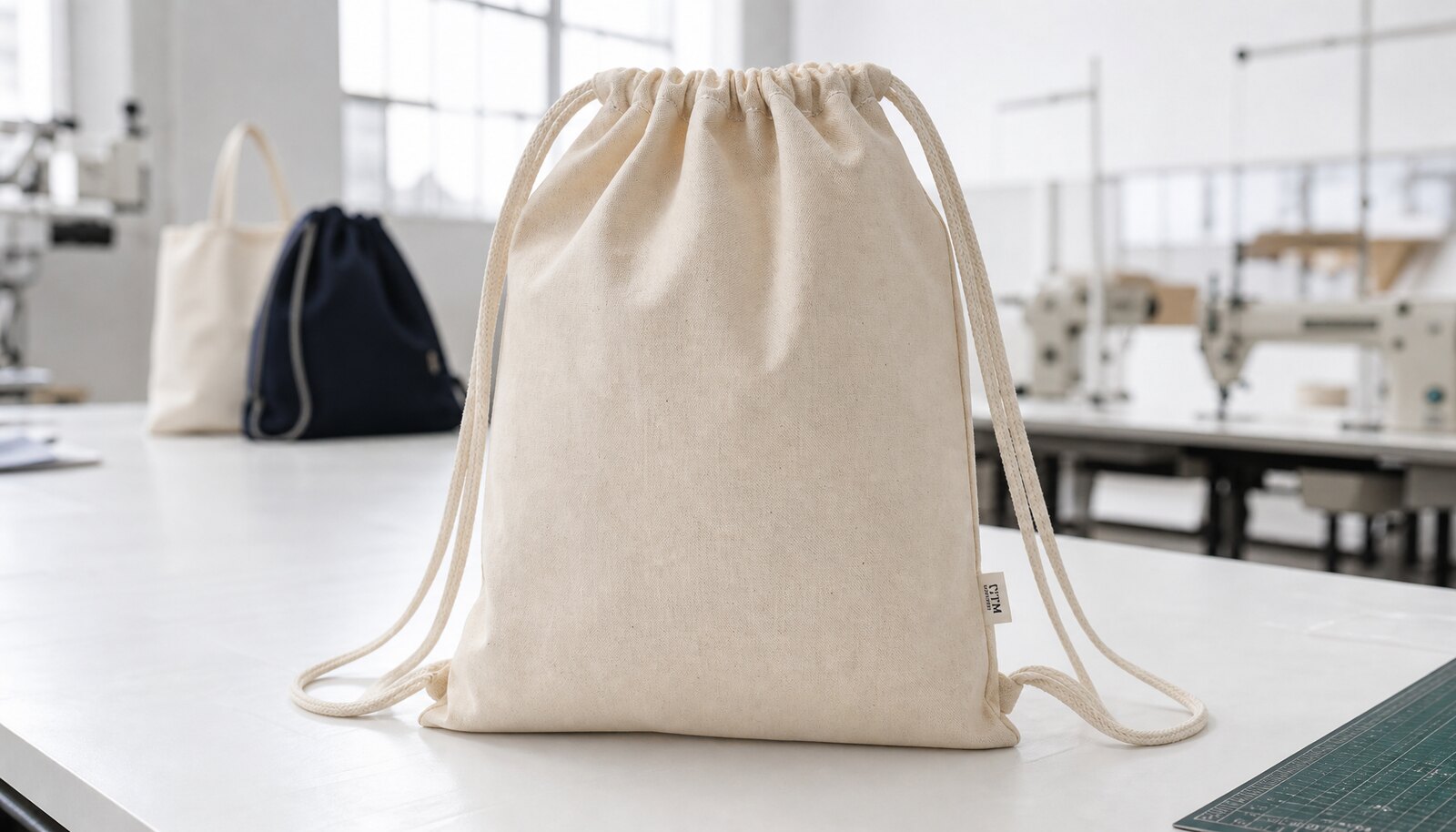
Why canvas drawstring backpacks work for corporate gifts
Canvas drawstring backpacks sit in a useful middle ground for corporate gifting. They feel more substantial than nonwoven bags, cost less than structured backpacks, and pack flat enough for events, onboarding kits, and retail promotions. For buyers, the main value is simple: you can print a brand mark on a usable item without paying for hard-shell construction, zippers, or complex linings.
The same simplicity creates sourcing mistakes. Buyers often treat all canvas bags as interchangeable, but a corporate gift bag has a different standard from a trade-show giveaway. You need enough fabric body to hold shape, a clean print surface, and a drawcord system that does not fail when the bag is loaded with notebooks, bottles, or sample packs. If the bag is meant to reflect a premium brand, the fabric weight and finishing details matter as much as the logo.
- Best use cases: employee welcome kits, client gifts, event packs, retail promo bundles.
- Avoid overbuilding: do not add lining or unnecessary pockets unless the gift set needs them.
- Treat the bag as a brand carrier: print quality and stitching are visible quality signals.
Start with the spec that controls perception: fabric weight, size, and finish
For canvas drawstring backpacks for corporate gifts, the first spec decision is fabric weight. A typical buyer range is 10 oz to 12 oz cotton canvas, which is heavy enough to feel commercial and stable, but still practical for mass packing. If the gift contents are light, 10 oz can keep the landed cost under control. If the bag needs to hold a metal bottle, hardback notebook, or a coordinated gift set, 12 oz is usually the safer choice because it resists sagging and looks more premium when filled.
Size matters just as much as fabric. A common corporate-gift size sits around 34 x 42 cm or similar, but the right measurement depends on what goes inside and how the bag will close. Too narrow and the drawcord struggles with thicker items. Too shallow and the top opening looks strained. A good supplier will quote finished size, cut size, seam allowance, and expected finished weight, not just a marketing name like 'large canvas backpack.'
- 10 oz canvas: lower cost, lighter handfeel, suitable for short-term event gifts.
- 12 oz canvas: better drape and perceived value, preferred for executive or onboarding kits.
- Request the fabric in GSM or oz and confirm whether it is bio-washed, enzyme-washed, or raw natural canvas.
- If the bag must look polished, ask for a tighter weave and lower slub variation on visible panels.
Print method drives the real cost more than the bag body
The print method can change the unit price more than buyers expect. For corporate gifts, screen print is usually the most economical choice when the artwork is one or two solid colors and the logo area is large enough to hold clean edges. It is also the easiest method for repeated replenishment because the setup is stable once the screen is made. The tradeoff is detail: fine lines, small text, and gradients can get muddy on textured canvas.
If the brand mark is small, highly detailed, or intended to feel more premium, embroidery or woven labels are better options. Embroidery can raise labor cost and may slightly distort light canvas if the backing is not managed well. Heat transfer can work for multicolor art, but buyers should be careful about wash resistance and surface feel. For corporate gifts that may be kept and reused, a crisp one-color screen print on a good canvas usually gives the best balance of cost and appearance.
- Screen print: best for bold logos, repeat orders, and controlled cost.
- Embroidery: better for premium gifts, smaller logos, and a more tactile brand signal.
- Heat transfer: useful for multicolor branding, but verify adhesion and folding tolerance.
- Woven side label: good secondary branding detail, especially if the print area is limited.
Compare sourcing routes before you compare unit price
A clean quote comparison starts with the right sourcing route. Direct factory quotes usually give the best control over fabric, print, stitching, and packing because the same plant handles the bag body and the branding process. That matters when you need consistent dimensions across a corporate rollout, since miscommunication between a bag supplier and a print subcontractor can cause shifts in print placement or lead time.
Trading companies and sourcing agents can still be useful when you need small mixed orders, complex destination handling, or access to multiple bag types in one purchase order. The buyer should not assume the lower quote is the better route. Often the real question is whether the supplier can prove where the printing happens, who does final inspection, and how many times the product changes hands before it ships.
- Direct factory: strongest control on spec, QC, and repeatability.
- Trading route: flexible for mixed bundles, but requires tighter document control.
- Retail buyers should compare landed cost, not just ex-factory price.
- Ask who owns the sample approval process if production is split across sites.
Decision table: how to choose the right supplier option
The table below compares common sourcing routes and specification choices that affect quote accuracy. Use it to separate a real factory quote from a low-detail sales quote. For this product, the cheapest line item is not always the cheapest landed result, especially once printing, packing, and carton volume are added.
When buyers skip this comparison, they often approve a unit price that looks good on paper but arrives with weak stitching, inconsistent fabric shade, or packing that cannot survive export transit. The goal is to compare what is actually being delivered, not just what is being promised.
- Write decisions in measurable language, not only descriptive wording.
- Ask for sample photos plus one physical approval sample for important orders.
- Keep quotation, sample approval, and inspection notes tied to the same spec version.
MOQ logic: why the order quantity changes the whole quote
MOQ is not just a factory preference; it is a cost structure issue. For custom canvas drawstring backpacks, the supplier pays for fabric cutting, screen setup, print registration, thread matching, and packing setup. If your order is too small, those fixed costs get spread across too few units and the unit price rises sharply. That is why many factories quote a much cleaner price band at 500 or 1,000 pieces than at 100 or 200 pieces.
For corporate gifts, a practical MOQ often sits in the 500-1,000 piece range per color and per artwork version. If the factory offers 300 pieces, verify whether it is using stock fabric, a standard cord color, and a single-location print. Once you start asking for custom labels, custom cartons, or multiple logo locations, the low MOQ advantage usually disappears. Buyers should plan MOQ around the full production setup, not just the bag shell.
- Lower MOQ usually means fewer custom options and higher unit cost.
- Multiple logos or office locations can multiply setup charges.
- Combining SKUs can reduce freight cost, but only if carton labeling stays clear.
Sample approval: what a real pre-production sample must prove
A sample is not approved because it looks acceptable in a photo. It is approved when it proves the factory can repeat the same result in bulk. For canvas drawstring backpacks for corporate gifts, the pre-production sample should show the exact fabric weight, drawcord type, print size, logo placement, and stitching construction that will be used in production. If the sample is made with a different fabric lot or a temporary cord, it is not a true approval sample.
The most useful sample checks are tactile and dimensional. Pull the cord several times to see whether the channel collapses evenly. Load the bag with the intended gift kit and see whether the bag stays balanced when carried. Measure the finished size after the sample is ironed flat, not only straight off the table. If the logo edges blur, the stitching wanders near the top channel, or the bag mouth twists when closed, the sample is not ready for mass production.
- Require a blank sample first if the fabric or size is new.
- Then approve a printed pre-production sample with the exact logo and placement.
- Record accepted measurements and a photo set before production starts.
- For premium gifts, include a simple load test with the actual intended contents.
Packing details affect damage rate and receiving speed
Packing is often treated as an afterthought, but it changes both damage risk and warehouse labor. For bulk corporate gift orders, the usual approach is 50 to 100 pieces per polybag and then carton packing with clear quantity marks. This keeps the carton count manageable and reduces unnecessary retail packaging costs. If the client wants a retail-ready presentation, individual polybags or printed sleeves may be needed, but those should be priced separately because labor and carton volume rise quickly.
Ask the supplier to state carton dimensions and gross weight in the quote. This helps you estimate freight, confirm warehouse handling, and compare suppliers on a true landed basis. A quote that omits packing structure is incomplete, because the same number of bags can ship very differently depending on folding method, bag thickness, and carton fill. For corporate gifts, neat packing also matters because buyers often open cartons for internal distribution before the bags ever reach the end user.
- Bulk pack for distributor and B2B gift programs.
- Individual packaging only if the gift needs shelf presentation or direct retail sale.
- Carton marks should include SKU, color, quantity, and PO number.
- If the bags are folded inside out or compressed too tightly, the canvas can crease permanently.
Schedule risk: where lead times slip and how to protect the launch date
A realistic lead time for standard custom canvas drawstring backpacks is often 30 to 45 days after sample approval, but that assumes the fabric is available and the artwork is final. The most common delays are not sewing delays. They are caused by late artwork changes, shade matching on fabric, print plate approval, and repeated sample revisions. If your corporate gift date is fixed, do not treat the mass production timeline as a single block; split it into sample approval, material booking, production, and packing.
Schedule risk rises when multiple stakeholders need sign-off. Marketing may want a brighter logo, procurement may need a lower price, and operations may want simpler packing. If those decisions are not made before the PO, the factory will pause. A practical way to avoid delay is to freeze the fabric weight, print method, and packing style before asking for final prices. Once those are locked, the supplier can book materials and give a meaningful delivery date.
- Allow extra time if you need custom labels, special inks, or a new fabric color.
- Build a buffer for artwork revision and sample courier transit.
- Do not promise an event date to stakeholders until sample approval is signed off.
Landed-cost comparison: the quote number is only part of the story
When comparing quotes for canvas drawstring backpacks for corporate gifts, use a landed-cost lens. The product price is only one part of the total. Freight, carton volume, packing labor, label cost, and potential inspection charges can change the final per-unit spend. Two suppliers may be within a few cents on the bag itself, but one may include a sturdier fabric and a cleaner print while the other charges less upfront and adds cost through packing or rework.
For importers and distributors, the right comparison also depends on replenishment behavior. A slightly higher-cost direct factory order can be cheaper over time if the supplier holds your approved spec, avoids print drift, and can repeat the same result on the next PO. For retail buyers, consistency across restocks matters more than chasing the lowest quote on a single shipment.
- Compare EXW, FOB, or CIF only when the packing spec is identical.
- Include freight impact from carton size and total volume.
- Use the approved sample as the benchmark for landed-cost comparison, not the photo.
Specification comparison for buyers
| Spec decision | Recommended option | When it fits | Buyer risk to check |
|---|---|---|---|
| Fabric route | 12 oz canvas for premium gifts; 10 oz canvas for price-sensitive bulk | Choose 12 oz when the bag carries notebooks, bottles, or premium kits; choose 10 oz when unit cost must stay tight | Too-light fabric can wrinkle, show print distortion, and feel cheap; too-heavy fabric increases freight and may reduce drawcord closure smoothness |
| Supplier route | Direct factory with print and packing in-house | Best when you need controlled branding, lower defect risk, and repeat replenishment | Many trading quotes hide subcontracted printing or packing, which can shift lead time and make shade control harder |
| Print method | Screen print for 1-2 solid-color logos; heat transfer or embroidery for smaller premium runs | Screen print works best for bold brand marks; embroidery suits executive gifts or smaller logo areas | Small text can fill in on screen print; embroidery adds cost and can pucker light canvas if the backing is not controlled |
| MOQ strategy | 500-1,000 pcs per color/logo for custom corporate gifting; 300 pcs only if using stock fabric and simple print | Use lower MOQ for pilot campaigns, event gifts, or multiple regional offices | Very low MOQ often means higher unit cost, weaker color control, or limited customization on cord, label, and packing |
| Closure style | Single drawcord with reinforced top channel; add double drawcord only if product needs better opening balance | Best for standard corporate kits and easy packing | Weak top channel stitching causes tearing when bags are loaded with hard-edged gifts |
| Liner or pocket | No lining unless the gift set includes small items; add one internal pocket only for premium kits | Fit for utility gifts, onboarding kits, or conference packs with accessories | Extra construction increases cost and sewing variation; pockets often reduce speed and raise rejection risk |
| Packing method | Bulk packed 50-100 pcs per polybag/carton with size label and carton marks; individual polybag only if retail-ready | Use bulk packing for distributor or B2B gift programs | Individual packaging raises labor and carton volume; unclear carton counts create receiving disputes |
| Supplier evidence | Request pre-production sample, stitched measurement sheet, and photo of print setup | Best for first-time orders or new artwork | Without evidence, buyers may approve a sample that cannot be repeated at bulk scale |
| Lead time approach | 30-45 days after sample approval for standard custom orders | Fits normal corporate gift schedules with one artwork version | Shorter timelines can compress QC and packing, especially when custom labels or special inks are involved |
Buyer checklist before sampling
- Fabric target is stated in oz or GSM, not just 'canvas' or 'cotton canvas'.
- Logo artwork is supplied in vector format with one-color and full-color versions if needed.
- Bag size, cord length, seam allowance, and finished weight are written into the RFQ.
- Packing requirement is defined: bulk pack, individual polybag, carton count, and carton mark format.
- Sample approval criteria include fabric handfeel, print clarity, stitch density, and drawcord pull test.
- QC standard covers dimensions, print placement, seam strength, odor, and carton drop tolerance.
- Lead time is split into sample time, material booking time, and mass production time.
- Quote compares at least two sourcing routes: direct factory and trading/intermediary supply.
- Incoterm, destination port, and freight assumptions are clear before price comparison.
- You have a backup spec if the first-choice fabric or ink cannot pass sample approval.
Factory quote questions to send
- What canvas weight do you quote: 10 oz, 12 oz, or another GSM/oz standard, and is that fabric greige, dyed, or finished?
- Is the printed logo screen print, heat transfer, embroidery, or woven label, and what is the setup charge for each method?
- What is your MOQ per color and per artwork version, and what happens if we combine multiple SKUs in one carton plan?
- Can you share finished size, seam allowance, drawcord diameter, and top channel construction in the spec sheet?
- What is included in your sample process: digital mockup, blank pre-production sample, and printed pre-production sample?
- How do you pack the goods for shipment, and can you provide the carton dimension, carton weight, and carton count per order?
- What QC checks do you run before shipment for stitch strength, logo placement, and cord pull resistance?
- What lead time should we use for plain sample, printed sample, and mass production after sample approval?
- Are labels, woven side tags, hangtags, or care labels included in the quote or charged separately?
- What freight terms are you quoting, and is the unit price based on EXW, FOB, or CIF?
Quality-control points to confirm
- Finished size tolerance should stay within ±0.5 cm for small bags and ±1.0 cm for larger formats.
- Logo placement should stay centered or within the approved position tolerance; artwork shift should not be visible at arm's length.
- Stitching at the top channel and cord tunnel should be even, with no skipped stitches, broken threads, or loose ends.
- Drawcord pull should open and close smoothly without tearing the channel or twisting the mouth of the bag.
- Fabric surface should be free of oil marks, dye spots, and severe slubs unless those are part of the approved natural canvas character.
- Print should not crack, bleed, or mis-register after normal folding and light rub handling.
- Cartons should match the declared quantity and include the correct SKU, color, and PO mark.
- Sample and bulk fabric shade should remain consistent within the approved tolerance; visible shade difference across panels is a rejection trigger for corporate gifts.
- If a woven label or side tag is included, it should be straight, cleanly sewn, and not interfere with the drawcord path.