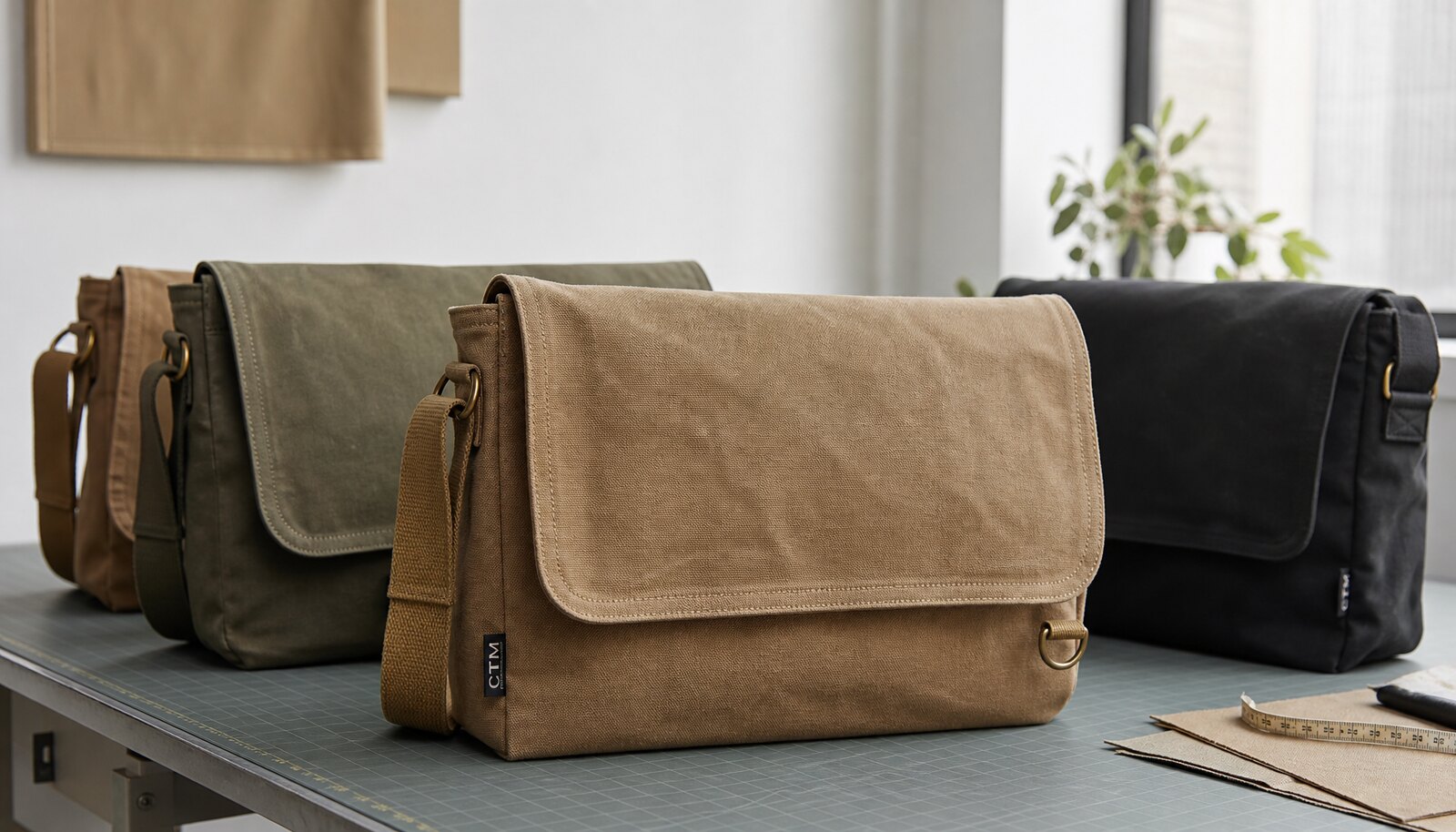
1) Start with the campaign job-to-be-done, not the bag style
When buyers search for canvas crossbody messenger bags for nonprofit campaigns, the first mistake is to think in product terms before use-case terms. A volunteer kit bag, a donor gift, and a conference handout item may all look like the same messenger bag at first glance, but they do not belong to the same RFQ. Each use case changes the acceptable fabric weight, closure strength, print method, and how much packaging value the buyer should pay for.
Nonprofit campaigns are especially sensitive to perceived value. The bag has to feel more durable than a cheap promotional tote, but it still has to fit a budget that can be audited internally. That balance is why this guide focuses on the procurement details that move the quote: construction, print, packing, and landed cost. If those parts are not written into the RFQ, suppliers will fill in the blanks in different ways, and the quotes will not be comparable.
A useful RFQ starts with a short commercial brief. Name the campaign, the distribution channel, the expected user, and the required delivery date. Then state whether the bag is for one-time event distribution or repeated use over months. The difference matters because it drives the acceptable level of reinforcement, the need for a lining, and whether a premium strap or closure makes business sense.
This is also where you should set the buyer’s success criteria. For example, the order may need to stay within a target landed cost, fit a standard carton cube, survive repeated carry use during a multi-day event, or present cleanly as a donor gift. When those priorities are written down up front, the supplier can suggest reasonable trade-offs instead of simply quoting whatever is easiest to make.
A non-templated RFQ is usually shorter in marketing language and deeper in operational detail. It should say what the campaign bag must do, what it must not do, and what is negotiable. That alone often removes a full round of quote clarification.
- List the campaign use case and channel before asking for pricing.
- State whether the bag must look giftable, durable, or purely functional.
- Define the delivery date and whether the order is a one-time event or a repeat program.
- Note any must-not-change items such as logo size, color, or strap comfort.
2) Choose fabric weight using performance and freight, not habit
Canvas weight is one of the most important decisions in the order, yet it is often specified too loosely. Saying 'heavy canvas' is not enough for a factory, and it is not enough for a buyer comparing two quotations. The right question is not simply how thick the cloth feels, but how it behaves after sewing, printing, folding, and shipping.
For many campaign messenger bags, a 12 oz to 14 oz canvas range is a sensible procurement target because it balances structure and cost. That said, the range should be treated as a starting point, not a rule. A smaller giveaway bag can perform well at 10 oz if the contents are light and the buyer values lower freight cost. A bag carrying books, bottles, or tablets may justify 14 oz or a reinforced canvas specification. The key is to link the fabric to the intended load, not to a generic quality label.
If you compare quotes from multiple suppliers, confirm whether the weight is stated in ounces, GSM, or both. Then ask for finishing details: natural, bleached, dyed, pre-shrunk, or washed. Two canvases with the same stated weight can shrink differently and sew differently. That is why procurement teams should not rely on a headline number alone. Ask for a swatch or sample bag, and check the hand-feel, the drape, and whether the print sits cleanly on the surface.
A useful RFQ also states what is not acceptable. For example, you may want to prohibit a switch from full canvas to a lighter duck cloth, or prevent a supplier from adjusting the weave to reduce cost without consent. If the order is important enough to have a sample approval step, it is important enough to control material substitution in writing.
- Specify fabric weight in oz and GSM, plus finish and shrinkage expectation.
- Tie the weight choice to load type: light giveaway, field-use bag, or premium donor gift.
- Ask for a swatch or fully built sample to compare drape, printability, and structure.
- Prohibit material substitution unless the buyer signs off in writing.
3) Build the messenger bag around wearability and load points
Crossbody messenger bags fail buyers most often at the strap, not the body. That is why the RFQ needs to address wearability with the same precision used for print placement. A strap that is too narrow, too short, or lightly sewn can make an otherwise decent bag feel cheap the moment it is loaded. For a nonprofit campaign, that experience matters because the bag is often worn in public and associated with the brand.
A practical starting point for many campaign orders is a webbing strap around 1.5 inches wide, but procurement teams should treat that as a baseline rather than a slogan. Narrower webbing may be acceptable for very light contents, while heavier kits or repeated field use may warrant wider webbing and stronger reinforcement. Ask the supplier to specify the full adjustment range so the bag works for different body sizes and wearing styles. If the bag will be worn over thick outerwear, the strap adjustment needs to account for that too.
The bag body should be described in terms of contents, not only dimensions. If the bag must hold a notebook, documents, brochures, and a water bottle, then gusset depth, flap overlap, and internal structure become important. A bag that looks fine when empty may be impractical when loaded if the flap strains or the opening narrows too much. That is why the RFQ should state the intended load and any must-fit item dimensions.
Also define the reinforcement standard. Strap end bartacks, side seam reinforcement, and flap attachment points should be written into the order. A factory can usually quote multiple build levels if the buyer asks directly. This makes the commercial comparison more honest: you are not comparing a lightly sewn giveaway bag against a reinforced campaign bag and calling them equivalent.
One useful tactic is to ask for a simple construction drawing with labeled panels, seam locations, pocket placement, and reinforcement points. That drawing becomes the reference for sampling, production, and inspection. It removes a lot of ambiguity when different people in sourcing, marketing, and logistics each review the same order.
- Set strap width, length range, and hardware type in the RFQ.
- Define the expected load so the factory can recommend gusset depth and reinforcement.
- Require bartacks or equivalent reinforcement at stress points.
- Ask for a dimensioned construction sketch before production starts.
4) Choose print method by artwork complexity, not by supplier habit
Nonprofit campaign artwork is often simple, but simple does not mean automatic. A logo can still fail if the print method is wrong for the fabric, if the placement is too close to a seam, or if the artwork file is not prepared correctly. The RFQ should say exactly what the artwork is, how large it must be, where it should sit, and what file format is being supplied. That lets the supplier quote the real work rather than guessing.
For larger quantities and straightforward logos, screen print is often the strongest procurement choice. It can be cost-effective, gives good opacity on canvas, and tends to suit flat campaign branding. However, if the artwork has gradients, very small type, or multiple colors that must be matched precisely, the buyer may need to consider heat transfer or another method. The right decision depends on the artwork, quantity, and expected durability. Buyers should be cautious of suppliers who recommend a more complex method simply because they can produce it, or a cheaper method simply because it is easier for them.
The artwork file requirements should be written into the RFQ. Ask for vector artwork when possible, note the PMS or equivalent color references if color matching matters, and specify whether the print should be one side only, both sides, or on the flap. If a print is close to a seam or fold, request a pre-production printed sample and a folded-state check. A flat proof alone is not enough to confirm how the bag will look in use.
For procurement teams, print quality should be treated as a measurable acceptance item. Ask for coverage expectations, edge clarity, placement tolerances, and proof approval before bulk production. If the supplier uses an alternative print process, request a sample that shows the same fabric, same logo size, and same placement. Otherwise the quote may be cheap because the print method is not actually comparable.
- Attach vector artwork when possible and state exact print size and placement.
- Ask for the print method recommended for the quantity and artwork complexity.
- Require a printed sample if the artwork sits near seams, folds, or closures.
- Clarify whether the quote includes setup, screens, plates, or artwork prep.
5) Write the quotation request so unit price can be compared fairly
Many RFQs fail at the comparison stage, not the pricing stage. Suppliers may answer the same bag request with different assumptions: one includes a lining, another omits it; one quotes a magnetic snap, another quotes hook-and-loop; one packs individually, another packs in bulk. A buyer looking only at the headline unit price can easily choose the wrong offer.
The RFQ should separate recurring and one-time costs. That means asking for unit price, sample charge, artwork setup, plate charge if relevant, label cost, carton cost, and any packaging surcharge. It also means asking for tiered pricing so the team can see where the price breaks sit at 500, 1,000, and 3,000 pieces. Nonprofit campaigns often scale unevenly, so the buyer needs to know whether the cost curve makes sense for a possible reorder or chapter expansion.
This is where factory-direct and trading-company sourcing should be evaluated carefully. Factory-direct quotes usually give clearer visibility on raw material and line control, which makes material substitution easier to police. Trading companies can simplify communication and coordinate multiple products, but buyers should verify whether the quoted price includes extra markups, whether the factory name is disclosed, and whether the sample actually comes from the same source. If the middleman does not control the factory spec tightly, the final quote may be easier to obtain but harder to trust.
A good quote request asks the supplier to state what is included and excluded. That simple requirement improves transparency dramatically. For example, if the supplier wants to change the lining, label, or closure to hit the target price, the quote should say so. Otherwise the buyer may compare two apparently similar numbers that are built on different product definitions. The cheapest line item often becomes the most expensive order once revisions and re-approvals are added.
Finally, ask for a repeat-order price sheet if the campaign is expected to continue. Many nonprofit programs reissue the same bag or a lightly updated version. If the factory can hold tooling, color, or print setups, the second order may be materially easier to buy.
- Ask for unit price plus all one-time charges separately.
- Request tiered pricing at 500, 1,000, and 3,000 pieces.
- Confirm whether the quote is factory-direct or through a trading company.
- Require an inclusion/exclusion list so spec drift is visible.
- Ask for a repeat-order price view if the bag may be reordered later.
6) Compare landed cost, not just the ex-factory number
In this product category, the shipped cost can swing more than buyers expect because messenger bags are bulkier than flat promotional items. A quote that looks cheaper on the factory floor may lose its advantage once you add carton size, packing method, freight mode, and any duties or import fees relevant to your lane. That is why landed-cost comparison is a procurement discipline, not a finance afterthought.
The buyer should build a simple worksheet that compares each supplier on the same assumptions. Use the same fabric weight, same print method, same packing format, and same quantity tier. Then add sample cost, carton dimensions, gross weight, freight mode, and any expected customs cost. If a supplier gives a price without carton dimensions, the quote is incomplete for real purchasing purposes because you cannot estimate freight properly.
Packaging decisions can have a large effect on the total. Bulk packing is usually the most efficient route for nonprofit campaigns because it reduces cube. But if the order will be handed out as donor gifts or retailed later, individual polybags or inner boxes may be required. Those upgrades are not inherently bad, but they must be visible in the quote. The same is true for a woven label, brand hangtag, or insert card. If the supplier includes a branded side label in one quote and excludes it in another, the unit price comparison is distorted.
For buyers managing budget approvals, the best landed-cost comparison is not a complicated spreadsheet with hidden formulas. It is a clean side-by-side view: spec, included features, packing method, unit price, sample charge, estimated freight, and any risk notes. That format is easier to review with marketing, finance, and logistics teams in the same meeting.
If the order is large enough to matter, ask the supplier whether the material is locked to a named mill or whether equivalent substitutions are allowed. Material substitution can erode value even when the quote price stays the same. A slightly lighter canvas, cheaper webbing, or lower-grade hardware can all change the real economics of the order without changing the number on the invoice.
- Compare suppliers on the same spec and packing basis.
- Ask for carton dimensions and gross weight so freight can be estimated.
- Include sample, packaging, freight, and customs assumptions in the comparison.
- Request written confirmation on whether material substitution is allowed.
- Use one worksheet for procurement, marketing, and finance review.
7) Put sample approval into measurable terms
A sample is only useful if the buyer knows what it is supposed to prove. For a canvas crossbody messenger bag, the sample should confirm not just appearance but build quality, print placement, comfort, and closure behavior. If the supplier sends only a fabric swatch, or only a print strike-off, that is not enough to approve a bag with moving parts, load points, and multiple panels.
The most useful sample is usually a fully built pre-production sample or a confirmation sample made with the actual production materials. The buyer should measure it against the approved spec sheet: bag width, height, gusset depth, strap width, strap range, pocket size, and print location. Check the sample in both flat and folded states. A bag that looks correct on the table may look wrong when worn across the body or when the flap is closed over a real load.
Sample review should be documented. If there is a change request, write it down in a correction note and have the supplier acknowledge it. Do not rely on email language like 'looks fine except for the strap.' That kind of note gets lost between sampling and production. The corrected sample or signed approval photo set should become part of the production record.
If the campaign has strict branding requirements, ask for a printed approval photo from the factory showing the actual sample measured against a ruler or reference board. That can help when the physical sample has to be returned or when multiple internal stakeholders need to review it. But remember that photos do not replace the physical sample, especially for strap comfort, closure alignment, and seam finish.
A disciplined sample stage often saves more money than a small price discount. It prevents large-scale rework, missed artwork placement, and packaging mistakes that are expensive to correct after production starts.
- Approve a fully built sample whenever possible.
- Measure dimensions and compare them to the spec sheet.
- Test strap comfort and closure behavior in both open and closed states.
- Document every correction and get supplier acknowledgment before bulk production.
8) QC needs hard acceptance criteria, not general promises
Quality control is where the RFQ becomes enforceable. Generic statements such as 'good workmanship' do not help much when a factory is producing thousands of campaign bags. Buyers need enough detail to know what the inspector is checking, what counts as acceptable variation, and what should trigger a reject or rework instruction.
For stitching, use concrete expectations. A buyer can specify even seam allowance, no skipped stitches, no loose thread tails, and bartack reinforcement at the strap ends and flap stress points. If your team has a target stitch density, state it. Many buyers use an inch-based measure such as 7–9 stitches per inch for general sewn canvas work, but the right number should be agreed against the approved sample and the factory’s construction standard. The important part is that it is written down, not guessed at the end of the order.
For strap strength, the acceptance standard should be more than a hand pull. Ask for documented pull testing or at minimum a clearly described repeated manual pull check on production samples, with rejection if there is seam distortion, thread breakage, or hardware pull-out. If you want a specific tensile threshold, write it into the PO or tech pack rather than assuming the supplier understands it. If the factory cannot test to a buyer-defined threshold, at least require a controlled in-house method and photo evidence.
Print QC also needs precision. The print should match the approved placement drawing, with color opacity appropriate to the chosen method and no obvious edge blur. If the print will be folded, use a folded-state check, because the image can break visually across a seam or crease. If the artwork contains small type, inspect legibility from the normal viewing distance, not only at close range.
Packing inspection should not be an afterthought. The cartons should match the approved quantity, outer marks should match the PO, and the count should reconcile before shipping. A buyer should reject cartons with crushed corners, unclear marks, or counts that do not match the packing list. If the order is going to multiple charities or chapters, carton labeling accuracy is as important as the product itself because a warehouse error can delay distribution even when the bag quality is fine.
In short, QC should be written as a list of pass/fail checkpoints with tolerances, not a list of hopes. That is the only way the supplier can be held to a standard that procurement, operations, and the campaign team all understand.
- State acceptable stitch quality, seam finish, and reinforcement details.
- Require documented strap pull testing or an equivalent controlled check.
- Set print acceptance criteria for placement, opacity, and folded-state appearance.
- Inspect carton count, carton condition, and outer marks before shipment release.
- Treat any material substitution as a controlled deviation requiring approval.
9) Ask for the packaging and artwork details that make distribution easier
Campaign buyers often focus on the bag itself and forget the distribution layer. Yet for nonprofit programs, packaging and artwork handling can be just as important as the product spec. If the bags will be sent to a warehouse, handed to volunteers, or distributed at multiple events, the packaging format affects speed, damage risk, and internal labor. A seller who can quote the bag but not the packing plan is only solving half the problem.
The RFQ should say whether the bags need to be bulk packed, individually polybagged, inner-box packed, or prepared for retail presentation. Each option changes cost and cube. Bulk packing is usually the most efficient for standard campaign distribution. Individual packing makes sense if the bags are being resold, donated through a retail-like channel, or handled by different sites that need cleaner presentation. If the campaign team wants a branded insert card, hangtag, or QR code card, say so early so the supplier can include it in the quote.
Artwork files also need to be specified in procurement language. Ask for vector files where possible, and confirm the approved color standard if color accuracy matters. State the exact print size and print position in the RFQ, and ask the supplier to flag any artwork issues before production. If the design is close to a seam, closure, or edge, request a pre-production print proof on the actual bag or on an equivalent production panel. Flat digital approvals are often not enough for canvas products.
Packaging is also where you can optimize channel fit. A bag intended for a donor mailing may need to be folded more tightly than one going to a conference table. A bag intended for retail resale might need a cleaner insert or a hangtag. A bag going to a warehouse for later distribution might need a carton sequence label and master barcode. These are not cosmetic details; they are operational details that should appear in the RFQ if the buyer wants a quote that reflects reality.
When suppliers quote packaging correctly, the rest of the order usually becomes easier to control. The same is true for artwork files: the earlier the supplier sees the real file, the fewer surprises there are during sampling.
- State bulk pack, individual polybag, inner box, or retail-ready format.
- Specify whether inserts, hangtags, or QR cards are required.
- Provide vector artwork and exact print size, position, and color reference.
- Ask for carton sequence labeling if the order will be split across sites.
- Request pre-production proof for artwork near seams or closures.
10) Use a quote comparison worksheet so the buying decision is easy to defend
The best RFQ guide is one that creates a clean decision record. Procurement teams, finance staff, and campaign managers often need different views of the same quote. If the supplier responses are scattered across emails and PDFs, the final award decision becomes hard to explain. A simple comparison worksheet solves that problem.
For this product category, the worksheet should include at least six columns: supplier name, factory-direct or trading route, fabric spec, print method, packing format, lead time, and total landed cost estimate. Then add notes for sample quality, QC transparency, and whether material substitution is allowed. This makes it easier to compare suppliers who may have similar unit prices but very different risk profiles.
A good worksheet also highlights quote gaps. If one supplier did not state carton dimensions, that should not be ignored. If another did not confirm whether the price includes a woven label or individual packing, the missing line should be visible. Buyers should avoid filling in those gaps with assumptions. When assumptions are needed, they should be written as assumptions and validated before award.
The decision should not be based only on lowest price. For nonprofit campaigns, the better supplier is often the one that gives the clearest spec confirmation, the most reliable sample control, and the most transparent packing and QC information. Those traits reduce the chance of delayed events, rework, or complaints from recipients. In other words, the commercial winner is not always the cheapest line item; it is the offer with the lowest execution risk for the campaign.
A final practical note: send the same RFQ version to every supplier and keep the revision number in the file name. That sounds basic, but it is one of the easiest ways to prevent quote drift. If one supplier is quoting a different spec version, the comparison sheet becomes unreliable immediately. A disciplined version control habit is one of the simplest procurement controls you can add.
If you are managing a national campaign or repeated nonprofit program, the quote worksheet becomes even more valuable because it creates a record for reorders. The next time you buy the same bag, you already know which supplier was transparent, which one needed extra follow-up, and which quotation was easiest to convert into a purchase order.
- Use one RFQ version for every supplier.
- Track supplier route, spec, lead time, and landed cost in one worksheet.
- Mark any missing quote detail as a gap, not an assumption.
- Keep sample approval notes tied to the same revision number.
- Use the worksheet as a reorder record, not only a one-time comparison tool.
Specification comparison for buyers
| Spec decision | Option A | Option B | Buyer decision notes |
|---|---|---|---|
| Fabric weight | 10–12 oz canvas | 12–14 oz canvas | 10–12 oz is usually lighter and cheaper, but it can feel less structured for messenger styling. 12–14 oz is the more common procurement target when the bag must look durable, hold shape, and print cleanly. Ask suppliers to state oz and GSM, plus shrinkage allowance, because the same weight label can behave differently by mill and finish. |
| Strap build | 1.0–1.25 inch webbing, light hardware | 1.5 inch webbing, reinforced bartacks | A narrower strap may work for a very light giveaway, but it is less comfortable when the bag carries brochures, a bottle, or a tablet. A 1.5-inch webbing strap is a practical procurement baseline for most nonprofit campaign bags, especially if volunteers will wear the bag for long periods. Confirm the full adjustability range, not only strap width. |
| Print method | 1-color screen print | Heat transfer or DTG | Screen print is usually the most efficient choice for simple logos, sponsor marks, and campaign slogans. Heat transfer or DTG can suit short runs or detailed artwork, but the buyer should test edge lift, cracking, and placement consistency. Ask whether the quote includes screens, plates, transfers, or artwork setup. |
| Closure | Hook-and-loop flap | Magnetic snap or metal buckle | Hook-and-loop is cost-efficient and quick, but it can wear down and sound noisy. Magnetic snaps look cleaner and are easier to open one-handed, but they must align correctly and be strong enough not to pop open when the bag is partially filled. Metal buckles can feel more premium but add weight and cost. |
| Lining and pockets | Unlined or simple pocketless interior | Light lining with one inner pocket | An unlined bag is easier to price and often more economical for campaign use. A light lining and one inner pocket improve usability for donors or volunteers who need a cleaner interior. If the supplier changes the lining during quoting, check whether it also changes print bleed risk, structure, or carton bulk. |
| Packing method | Bulk packed in master cartons | Individually polybagged or inner-box packed | Bulk packing usually improves freight efficiency for nonprofit campaigns. Individual packing is better for retail resale, cleanliness, or distribution through multiple sites, but it increases cube and cost. Buyers should confirm inner pack counts, carton dimensions, and outer marks before comparing freight-sensitive quotes. |
| Supplier route | Factory-direct | Trading company or sourcing agent | Factory-direct sourcing usually gives better visibility on material substitution, line control, and QC records. A trading company may be easier to communicate with, but the buyer should verify which factory is actually making the bags, what spec version they have quoted, and whether samples come from the same production line. |
| Landed-cost drivers | Unit price only | Unit price + sample + packing + freight + risk | The lowest unit price rarely wins if the bag is quoted with bigger cartons, extra packing, or hidden setup charges. For messenger bags, shape and carton cube matter more than many buyers expect. Always compare on a landed-cost basis using the same fabric, print method, and packing assumptions. |
| Order-fit scenario | Small charity event or pilot order | National campaign or repeat-program order | Small pilot orders can tolerate a little more per-unit cost if they reduce risk. Larger campaigns should push for stable fabric sourcing, repeatable print control, and a price break at 500, 1,000, and 3,000 pieces. Ask for tiered pricing so the buying team can plan reorders without restarting the sourcing exercise. |
Buyer checklist before sampling
- Define the campaign use case before you request pricing: donor gift, volunteer kit, event handout, fundraising merch, or sponsor giveaway. The use case determines fabric weight, pocket count, strap comfort, and whether the bag must look premium or simply functional.
- Write the RFQ around measurable specs, not adjectives. Replace words like 'heavy duty' or 'nice quality' with fabric weight, strap width, closure type, print method, and packing requirement.
- Ask suppliers to quote in both oz and GSM when possible, and include weave density, shrinkage allowance, and whether the canvas is natural, bleached, dyed, or pre-shrunk.
- State the full strap requirement: webbing width, usable length range, buckle or slider type, bartack locations, and any comfort or load-bearing expectation.
- Specify the print position with a dimensioned placement drawing. Include artwork file type, one-color or multi-color status, and whether the print should sit on the flap, front panel, or body panel.
- Require a pre-production sample or fully built confirmation sample. A blank fabric swatch or print strike-off is not enough to approve a messenger bag order.
- Ask for sample timing, sample charge, and what exactly the sample includes: fabric, hardware, labels, lining, print, and packing.
- Request packing details in writing: bulk or individual pack, units per carton, carton dimensions, gross weight, outer marks, and whether cartons need to be drop-tested or palletized.
- Ask every supplier to state what is included in the price and what is excluded: setup, artwork prep, label attachment, special hardware, polybags, and freight.
- Compare quotations on the same version of the spec sheet. If one supplier changes lining, strap, or closure, the quote is not directly comparable.
Factory quote questions to send
- Please confirm the exact canvas spec you are quoting: fabric weight in oz and GSM, weave density, fiber content, finish, and expected shrinkage after production or washing.
- Which closure option are you pricing, and what is included in that price: hook-and-loop, magnetic snap, buckle, or other hardware?
- What is the exact strap specification: webbing width, webbing material, adjustability range, slider type, reinforcement points, and bartack count at each stress area?
- What print method do you recommend for this artwork, what is the setup charge, and are screens, plates, or transfer tools charged separately?
- Can you quote the same bag with and without lining, inner pocket, woven side label, and individual polybag so we can compare landed cost properly?
- What is your MOQ per color and per artwork version, and what are the unit prices at 500, 1,000, 3,000, and 5,000 pieces?
- What sample will you provide first: material swatch, blank prototype, printed strike-off, or pre-production sample, and how many days will each stage take?
- How will you pack the bags, how many units per carton, and what carton dimensions and gross weight should we use for freight planning?
- Which QC checks do you run in-line and before shipment for stitch quality, strap strength, print registration, closure function, and carton count?
- Will you approve material substitution only with written buyer consent, and can you share mill or material traceability if a fabric change is proposed?
Quality-control points to confirm
- Fabric identification must match the approved swatch or approved sample; no substitute canvas weight, finish, or shade without written buyer approval.
- Measured bag dimensions should stay within a practical tolerance of about ±0.5 in / ±1.0 cm for width and height unless the buyer specifies tighter limits; gusset depth and strap length should also be checked against the approved sample.
- Strap width, strap length range, and hardware placement must match the spec sheet; any shortening, narrower webbing, or different slider type should be treated as a nonconformance.
- Stitching should show even seam allowance, no skipped stitches, no loose threads at stress points, and reinforced bartacks at strap ends and flap attachment areas.
- A simple production audit should verify stitch density consistency, ideally with a defined target such as 7–9 stitches per inch or the buyer’s chosen standard; use the approved sample as the reference if the factory has a different standard.
- Strap pull testing should be documented. For ordinary campaign bags, require the factory to prove the strap attachment can withstand repeated manual pull testing and, if available, a defined tensile test target agreed in advance; reject bags with seam distortion, thread breakage, or hardware pull-out.
- Print quality should be checked for registration, opacity, edge sharpness, and placement. Reject prints that are misaligned, light in coverage, cracked at first bend, smeared, or visibly off-center relative to the approved artwork.
- If the bag includes a logo on the flap or near a seam, inspect fold behavior so the print does not break up when the flap is closed. Ask for a folded-state visual check, not only a flat-panel approval.
- Closure function should be tested repeatedly on random samples from the line: snaps must align, hook-and-loop must fasten cleanly, and magnetic closures must not shift or leave the flap crooked.
- Hardware, if used, should be checked for plating consistency, burrs, sharp edges, corrosion risk, and missing components. Reject pieces with dents, rust, or rough finishing that could snag fabric or injury the user.